
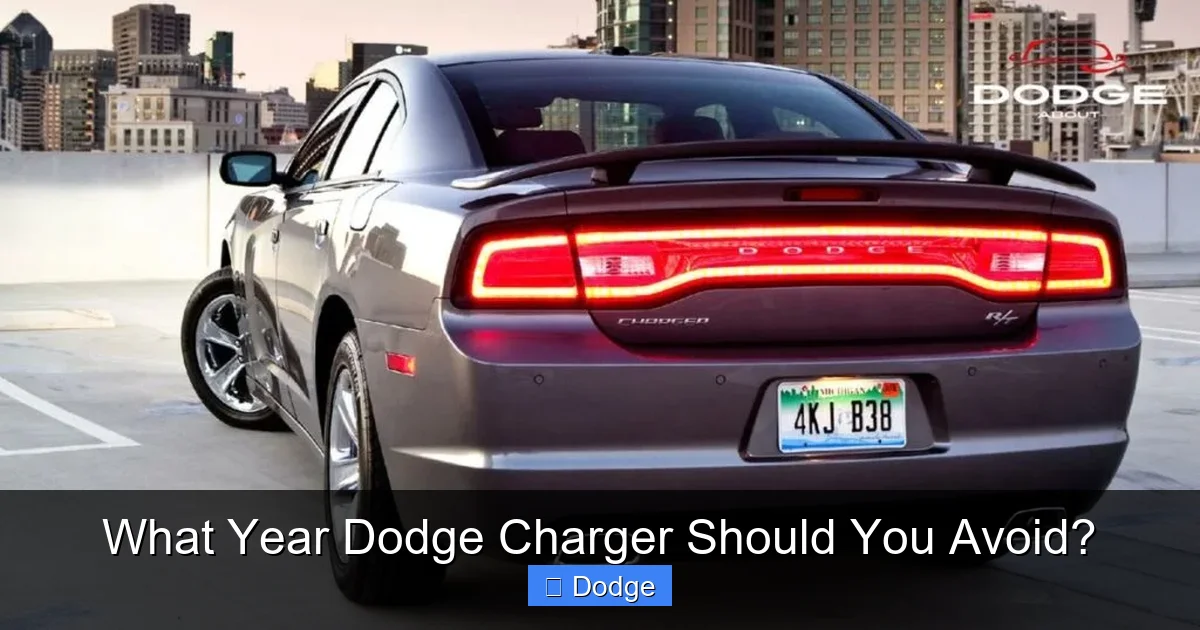
What Year Dodge Charger Should You Avoid?

Contents
- 1 Key Takeaways
- 2 📑 Table of Contents
- 3 Introduction: The Allure and the Pitfalls of the Dodge Charger
- 4 The 2011–2014 Dodge Charger: A Troubled Generation
- 5 The 2012 Dodge Charger: The Year to Avoid
- 6 The 2015–2016 Dodge Charger: Progress with Lingering Issues
- 7 The 2006–2010 Dodge Charger: Aging but Affordable
- 8 How to Avoid Buying a Lemon: Tips for Shoppers
- 9 Conclusion: Choose Wisely, Drive Confidently
- 10 Frequently Asked Questions

Car Cleaning Brush Set

Jumper Cables

Jack Stands

Car Back Support Cushion
Not all Dodge Chargers are created equal—some model years come with serious reliability concerns. While the Charger is a powerful and stylish sedan, certain years are plagued by transmission failures, engine troubles, and electrical glitches that can turn your dream car into a money pit.
Key Takeaways
- 2011–2014 Dodge Charger: Proceed with caution. These models are known for transmission issues, especially in V6 and V8 variants, with many owners reporting jerky shifting and premature failure.
- 2012 Dodge Charger: The worst of the bunch. This year stands out for frequent transmission problems, electrical faults, and poor fuel economy compared to competitors.
- 2015–2016 Models: Improved but not perfect. While reliability improved, some 2015–2016 Chargers still suffered from infotainment system crashes and minor electrical gremlins.
- Supercharged Hellcat Models (2015–2023): High performance, high maintenance. The 6.2L supercharged V8 is thrilling but demands premium fuel, frequent servicing, and can be costly to repair if issues arise.
- 2006–2010 Charger: Outdated tech and aging components. Early second-gen models lack modern safety features and suffer from worn suspension and interior wear over time.
- Always get a pre-purchase inspection. Even in “good” years, a thorough inspection by a trusted mechanic can save you from hidden problems.
- Check service history and recall status. Many Charger issues can be mitigated if previous owners followed maintenance schedules and addressed recalls promptly.
📑 Table of Contents
- Introduction: The Allure and the Pitfalls of the Dodge Charger
- The 2011–2014 Dodge Charger: A Troubled Generation
- The 2012 Dodge Charger: The Year to Avoid
- The 2015–2016 Dodge Charger: Progress with Lingering Issues
- The 2006–2010 Dodge Charger: Aging but Affordable
- How to Avoid Buying a Lemon: Tips for Shoppers
- Conclusion: Choose Wisely, Drive Confidently
Introduction: The Allure and the Pitfalls of the Dodge Charger
The Dodge Charger has long been a favorite among American muscle enthusiasts and daily drivers alike. With its bold styling, powerful engine options, and surprisingly spacious interior, it strikes a rare balance between performance and practicality. Whether you’re drawn to the rumble of a Hemi V8 or the efficiency of a V6, the Charger offers something for nearly every driver. But beneath that aggressive grille and sleek profile lies a truth that every buyer should know: not every model year is created equal.
While Dodge has made significant strides in reliability and technology over the past two decades, certain years of the Charger have developed reputations for mechanical headaches, costly repairs, and frustrating downtime. From transmission failures to electrical gremlins, some model years are best avoided—especially if you’re shopping used. This guide dives deep into the years you should think twice about, the common problems to watch for, and how to make a smart, informed decision when buying a Dodge Charger. Whether you’re a first-time buyer or a seasoned gearhead, knowing what to avoid can save you thousands and keep you on the road instead of in the shop.
The 2011–2014 Dodge Charger: A Troubled Generation
The 2011–2014 Dodge Charger represents a pivotal era in the car’s evolution. This was the first full redesign of the second-generation Charger, introducing a more modern look, improved interior materials, and updated technology. On paper, it was a big step forward. In practice, however, many owners found themselves dealing with persistent mechanical issues—especially when it came to the transmission.

Visual guide about What Year Dodge Charger Should You Avoid?
Image source: dashboardwarning.com
Transmission Troubles: The Achilles’ Heel
The most widespread complaint among 2011–2014 Charger owners centers on the 5-speed automatic transmission (used in V6 and non-Hemi V8 models). Many drivers reported harsh shifting, delayed engagement, and even complete transmission failure—sometimes as early as 60,000 miles. The problem was so common that it led to multiple class-action lawsuits and a Technical Service Bulletin (TSB) from Chrysler acknowledging the issue.
For example, a 2013 Charger R/T owner in Ohio reported that his transmission began slipping during highway acceleration. After a $2,800 repair at a dealership, the problem returned within 18 months. “I loved the car,” he said, “but the transmission issues made it feel like a ticking time bomb.” This isn’t an isolated case. Online forums like ChargerForums.com and Reddit’s r/Dodge are filled with similar stories, especially from owners of 2012 and 2013 models.
Electrical and Infotainment Glitches
Beyond the transmission, the 2011–2014 Chargers also suffered from electrical quirks. The Uconnect infotainment system, while advanced for its time, was prone to freezing, rebooting randomly, or losing Bluetooth connectivity. Some owners reported that the system would shut down entirely while driving, disabling navigation, climate control, and even the rearview camera.
Additionally, issues with the key fob, door locks, and interior lighting were frequently reported. One 2014 Charger SXT owner in Texas noted that her car’s interior lights would flicker at night, and the keyless entry system would fail to recognize the fob unless it was held directly against the door handle. “It’s annoying more than dangerous,” she said, “but it makes you wonder what else might go wrong.”
Engine Reliability: Mixed Results
The engine options in this generation—ranging from the 3.6L Pentastar V6 to the 5.7L and 6.4L Hemi V8s—were generally reliable, but not without flaws. The V6 was praised for its smoothness and fuel efficiency, but some owners reported oil consumption issues and premature timing chain wear. The Hemi engines, while powerful, were known to suffer from lifter tick and valve train noise, especially if oil changes were delayed.
One notable issue was the “Hemi tick,” a ticking noise that some owners mistook for a serious engine problem. While often harmless, it could indicate worn lifters or poor oil circulation—especially in vehicles with high mileage or inconsistent maintenance. Regular oil changes with the correct viscosity (5W-20 or 5W-30, depending on the model) were critical to preventing these issues.
The 2012 Dodge Charger: The Year to Avoid
If there’s one model year that stands out as particularly problematic, it’s the 2012 Dodge Charger. While the 2011 and 2013 models had their share of issues, the 2012 model seems to have combined the worst of both worlds: early transmission flaws, electrical bugs, and a lack of meaningful updates from the previous year.

Visual guide about What Year Dodge Charger Should You Avoid?
Image source: dashboardwarning.com
Transmission Failures at an Alarming Rate
The 2012 Charger is infamous for its transmission problems. The 5-speed automatic, already under scrutiny in 2011, continued to plague owners in 2012 with no significant improvements. Reports of slipping, harsh shifts, and complete failure were widespread. In fact, the National Highway Traffic Safety Administration (NHTSA) received over 200 complaints related to transmission issues in 2012 Chargers—more than any other year in the generation.
One owner in Florida reported that his 2012 Charger R/T lost all forward gears while driving on the interstate. The vehicle had to be towed, and the transmission was eventually replaced under warranty—but only after a three-week wait for parts. “I was lucky it happened close to a dealership,” he said. “If it had happened in the middle of nowhere, I’d have been stranded.”
Poor Fuel Economy and Drivability
Another downside of the 2012 Charger was its fuel economy. The V6 model averaged around 18 mpg city and 27 mpg highway—decent for a full-size sedan, but underwhelming compared to rivals like the Ford Taurus or Toyota Avalon. The V8 models fared even worse, with the 5.7L Hemi averaging just 15 mpg city and 23 mpg highway. For a car marketed as a daily driver, these numbers were a letdown for many buyers.
Additionally, the ride quality was often criticized as stiff and harsh, especially on rough roads. The suspension tuning prioritized sportiness over comfort, which made long commutes less enjoyable. Owners noted that the car felt “busy” over bumps, with excessive road noise and a lack of refinement compared to competitors.
Limited Safety Features
The 2012 Charger also lagged behind in safety technology. While it earned a 5-star overall safety rating from the NHTSA, it lacked advanced driver-assistance features like blind-spot monitoring, lane departure warning, or adaptive cruise control—features that were becoming standard in other sedans by 2012. This made the Charger feel outdated, especially for buyers prioritizing safety.
The 2015–2016 Dodge Charger: Progress with Lingering Issues
The 2015 model year marked a major refresh for the Charger, including a redesigned front end, updated interior, and the introduction of the 8-speed automatic transmission. These changes addressed many of the previous generation’s shortcomings, but they didn’t eliminate all problems.

Visual guide about What Year Dodge Charger Should You Avoid?
Image source: dashboardwarning.com
Improved Transmission, But Not Perfect
The switch to the 8-speed ZF transmission was a game-changer. It delivered smoother shifts, better fuel economy, and improved reliability. However, some early 2015 models still experienced issues, particularly with the transmission control module (TCM). Owners reported erratic shifting, delayed downshifts, and occasional limp mode activation.
For example, a 2015 Charger Scat Pack owner in California said his car would sometimes refuse to shift out of first gear during cold starts. “It felt like the transmission was confused,” he recalled. “The dealer updated the software, and it helped—but it shouldn’t have been an issue in the first place.”
Infotainment System Woes
The updated Uconnect system in 2015–2016 Chargers was faster and more responsive, but it wasn’t immune to bugs. Some users experienced random reboots, frozen screens, or loss of audio. The navigation system, in particular, was criticized for being slow to load and prone to incorrect routing.
One workaround was to perform a hard reset by disconnecting the battery for 10 minutes, but this was only a temporary fix. Dodge eventually released software updates to address these issues, but owners had to visit a dealership to have them installed—often at no cost, but still an inconvenience.
Supercharged Hellcat Models: High Risk, High Reward
The 2015 introduction of the Charger SRT Hellcat brought a 707-horsepower supercharged V8 to the lineup. It was—and remains—one of the most powerful production sedans ever made. But with great power comes great responsibility (and cost).
Hellcat owners need to be prepared for higher maintenance costs. The engine requires premium fuel, frequent oil changes (every 3,000–5,000 miles), and careful monitoring of supercharger belt tension. Overheating can be an issue during track use, and the car’s immense power makes it easy to overstress components if driven aggressively.
Additionally, the Hellcat’s warranty doesn’t cover damage from “abuse” or “racing,” so pushing the car too hard can void coverage. One owner in Nevada reported a blown supercharger after repeated high-speed runs on a closed course. “The dealer said it was ‘driver-induced damage,’” he said. “I paid $8,000 out of pocket.”
The 2006–2010 Dodge Charger: Aging but Affordable
The first generation of the modern Charger (2006–2010) offers a budget-friendly entry point into the Charger family. These models are widely available under $10,000, making them attractive to first-time buyers or those looking for a project car. But they come with their own set of challenges.
Outdated Technology and Safety
The 2006–2010 Chargers lack many of the features we take for granted today. No Bluetooth, no touchscreen, no backup camera—just basic audio systems and analog controls. Safety features are also limited, with no electronic stability control on base models and minimal airbag coverage.
While these cars are simple and easy to work on, they don’t offer the same level of comfort or protection as newer models. For families or safety-conscious drivers, this can be a dealbreaker.
Wear and Tear on High-Mileage Examples
Many 2006–2010 Chargers on the market today have over 100,000 miles. At that age, components like suspension bushings, struts, and engine mounts are likely worn. Interior materials—especially the dashboard and door panels—can crack or fade from sun exposure.
One common issue is the failure of the 5-speed automatic transmission, similar to the later models. However, because these cars are older, replacement parts can be harder to find, and repair costs may exceed the car’s value.
How to Avoid Buying a Lemon: Tips for Shoppers
Even in problematic years, a well-maintained Charger can be a reliable and enjoyable car. The key is knowing what to look for and where to look.
Get a Pre-Purchase Inspection
Never buy a used Charger without a thorough inspection by a qualified mechanic—preferably one familiar with Dodge vehicles. They can check for transmission fluid condition, engine compression, suspension wear, and electrical system functionality.
Check the Vehicle History Report
Use services like Carfax or AutoCheck to review the car’s history. Look for signs of flood damage, salvage titles, or repeated transmission repairs. A clean report doesn’t guarantee reliability, but a red flag should give you pause.
Verify Recall and TSB Status
Visit the NHTSA website and enter the VIN to see if the car has any open recalls. Also, ask the seller if any Technical Service Bulletins (TSBs) have been addressed. Many Charger issues can be resolved with software updates or part replacements—if they’ve been done.
Test Drive Thoroughly
During the test drive, pay attention to how the transmission shifts—especially from a stop and during highway passing. Listen for unusual noises from the engine or suspension. Test all electronics, including the infotainment system, climate control, and lighting.
Conclusion: Choose Wisely, Drive Confidently
The Dodge Charger is a fantastic car with a lot to offer—power, style, and American muscle heritage. But like any vehicle, it’s not without its flaws. The 2012 model year, in particular, should be avoided due to widespread transmission and electrical problems. The 2011–2014 generation as a whole requires careful scrutiny, while even the improved 2015–2016 models have their quirks.
That doesn’t mean you should write off the Charger entirely. With proper research, a solid pre-purchase inspection, and attention to maintenance, you can find a reliable example that delivers years of driving enjoyment. Just remember: the best Charger isn’t necessarily the newest or most powerful—it’s the one that’s been cared for and fits your needs. So do your homework, ask the right questions, and drive away with confidence.
Frequently Asked Questions
What year Dodge Charger has the most problems?
The 2012 Dodge Charger is widely considered the worst model year due to frequent transmission failures, electrical issues, and poor fuel economy. It has the highest number of owner complaints and NHTSA reports in its generation.
Are 2011–2014 Dodge Chargers reliable?
These Chargers are generally less reliable than later models, primarily due to transmission problems in the 5-speed automatic. However, well-maintained examples with documented service history can still be solid buys.
Is the Dodge Charger Hellcat worth the maintenance costs?
The Hellcat offers incredible performance, but it requires premium fuel, frequent oil changes, and careful driving to avoid costly repairs. It’s best suited for enthusiasts who can afford the upkeep.
Can I drive a 2012 Charger long-term?
It’s possible, but risky. Many 2012 Chargers have needed transmission replacements by 80,000–100,000 miles. If you do buy one, ensure the transmission has been serviced and consider an extended warranty.
What should I check when buying a used Dodge Charger?
Focus on transmission condition, service history, recall status, and a full pre-purchase inspection. Test all electronics and drive the car in various conditions to assess performance.
Are newer Chargers (2017–2023) more reliable?
Yes, significantly. The 2017 refresh brought improved build quality, better infotainment, and more reliable transmissions. These models are generally safer and more dependable than earlier years.


