What Type of Oil Does a Volkswagen Passat Take?

Contents
- 1 Key Takeaways
- 2 📑 Table of Contents
- 3 Why Your Volkswagen Passat’s Oil Choice Is Critically Important
- 4 Decoding the Mysterious Code: What Do Those Numbers and Letters Mean?
- 5 The Holy Grail: Volkswagen’s Official Oil Specifications
- 6 Matching Oil to Your Specific Passat Engine
- 7 Oil Capacity, Change Intervals, and the Service Reminder
- 8 What Happens If You Use the Wrong Oil? (Spoiler: It’s Bad)
- 9 Practical Tips for the DIY Passat Owner
- 10 Frequently Asked Questions

Liquid Car Polish

Jumper Cables

Digital Tire Pressure Gauge

Car Trash Can
Using the correct oil in your Volkswagen Passat is non-negotiable for its turbocharged engine’s health. Volkswagen mandates specific oil approvals like VW 502 00, 504 00, or 507 00, which far exceed standard industry ratings. Always verify your engine type and model year in the owner’s manual or oil cap, as requirements differ between gasoline TSI and diesel TDI engines. Choosing the wrong oil can lead to sludge, turbocharger failure, and voided warranties.
Key Takeaways
- VW Specifications Trump Generic Labels: Look for VW 502 00 (older gas), 504 00 (newer gas), or 507 00 (diesel) on the oil bottle, not just 5W-30 or 5W-40.
- Engine Type is Everything: A Passat with a 2.0L TSI (gasoline) engine has different oil needs than a 2.0L TDI (diesel) engine from the same era.
- Synthetic Oil is Required: All modern Passats require full synthetic oil to meet VW’s strict standards for longevity and performance.
- Capacity Varies by Engine: Oil capacity ranges from approximately 4.8 quarts (1.8T) to 6.0 quarts (some V6 models), so always check your specific engine.
- Change Intervals are Long, But Not Infinite: With VW 504 00/507 00 oil, intervals can extend to 10,000 miles, but severe driving conditions shorten this significantly.
- Wrong Oil Risks Are Severe: Using non-spec oil can cause premature wear, oil consumption, turbocharger destruction, and catalytic converter damage.
- Your Best Sources are the Manual and Cap: The owner’s manual and the oil cap itself are the most reliable references for your Passat’s exact requirements.
📑 Table of Contents
- Why Your Volkswagen Passat’s Oil Choice Is Critically Important
- Decoding the Mysterious Code: What Do Those Numbers and Letters Mean?
- The Holy Grail: Volkswagen’s Official Oil Specifications
- Matching Oil to Your Specific Passat Engine
- Oil Capacity, Change Intervals, and the Service Reminder
- What Happens If You Use the Wrong Oil? (Spoiler: It’s Bad)
- Practical Tips for the DIY Passat Owner
Why Your Volkswagen Passat’s Oil Choice Is Critically Important
Let’s be real for a second. When you pop the hood of your Volkswagen Passat, you’re not looking at a simple, old-school engine. You’re looking at a masterpiece of German engineering—a turbocharged, direct-injected, tightly-toleranced powerplant designed for efficiency and performance. This isn’t the kind of engine that thrives on “good enough” maintenance. It’s a precision instrument, and oil is its lifeblood. Using the wrong type of oil isn’t just a minor oversight; it’s a direct path to expensive problems like sludge buildup, turbocharger failure, and premature engine wear. For Passat owners, understanding the specific oil requirement is one of the most important pieces of maintenance knowledge you can have. This guide will cut through the confusion and give you exactly what you need to know, from decoding the labels on the bottle to the exact specs your specific model year and engine demand.
The German Engineering Mindset: Precision Requires Precision
Volkswagen, like other German automakers such as BMW and Audi, designs its engines with very specific operational parameters. The clearances between moving parts are incredibly tight. The turbochargers spin at speeds exceeding 200,000 RPM. The fuel injection system operates at immense pressure. All of this generates intense heat and stress. Generic “one-size-fits-all” motor oils simply cannot handle these conditions over the long term. Volkswagen therefore establishes its own rigorous oil specifications—essentially a checklist of performance tests an oil must pass to earn the VW badge on the bottle. These tests evaluate an oil’s ability to combat LSPI (Low-Speed Pre-Ignition) in turbocharged gas engines, control soot in diesel engines, prevent turbocharger coking, and maintain viscosity over extreme temperature swings. Your Passat’s engine was built with these specific oils in mind.
Decoding the Mysterious Code: What Do Those Numbers and Letters Mean?
Before we dive into Volkswagen’s specific codes, let’s quickly demystify the oil label itself. Walk into any auto parts store, and you’ll see bottles covered in a confusing alphabet soup: 5W-30, API SP, ACEA C3, and more. Understanding these basics is your first defense against buying the wrong product.

Visual guide about What Type of Oil Does a Volkswagen Passat Take?
Image source: blogger.googleusercontent.com
Viscosity: The 5W-30 Puzzle
The numbers like 5W-30 describe the oil’s viscosity, or thickness. The “W” stands for winter. The number before the W (5) indicates how easily the oil flows at cold temperatures. A lower number means better cold-start flow (so 0W is better for extreme cold than 5W). The number after the W (30) indicates the oil’s thickness at your engine’s normal operating temperature (around 100°C/212°F). For Passats, you’ll commonly see 5W-30, 5W-40, and occasionally 0W-20 or 0W-40 for newer models. Crucially, the correct viscosity is dictated by the VW specification, not the other way around. A VW 502 00 oil will almost always be 5W-40, while a VW 504 00 oil can be 5W-30 or 0W-20. You must follow the VW spec first.
API & ACEA: The Industry Benchmarks
API (American Petroleum Institute) and ACEA (European Automobile Manufacturers Association) set baseline standards for oil performance. You’ll see codes like API SP (for gas engines) or API CK-4 (for diesel). ACEA has categories like A3/B4 (for high-performance gas/diesel) and C3 (for catalysts and particulate filters). These are the floor, not the ceiling. A VW 502 00 oil will meet and exceed API SP and ACEA A3/B4 requirements. Seeing these on a bottle is good, but it’s not sufficient. The VW specification is the final, mandatory stamp of approval for your Passat.
The Holy Grail: Volkswagen’s Official Oil Specifications
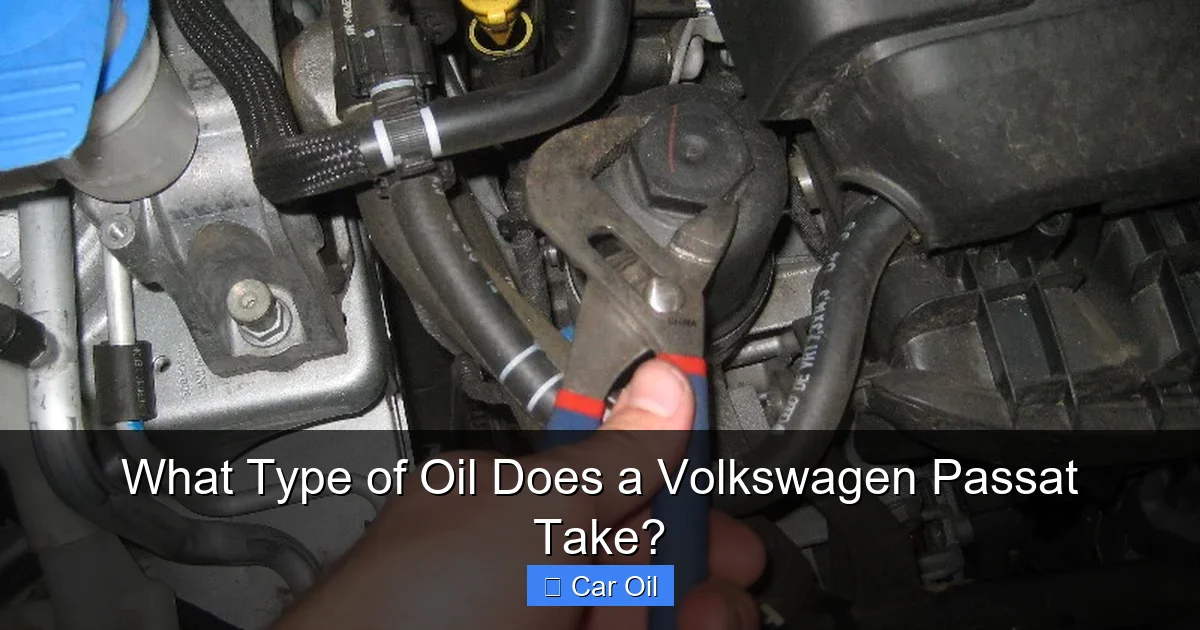
This is the most critical section. Forget everything else for a moment. For your Passat, the single most important thing to look for on the oil bottle is one of the following Volkswagen approvals. These are not suggestions; they are requirements. Using an oil without the correct VW specification is the number one mistake people make.
Visual guide about What Type of Oil Does a Volkswagen Passat Take?
Image source: paulstravelpictures.com
VW 502 00: The Standard for Older Gasoline TSI Engines
This specification is for older gasoline (TSI) engines, typically pre-2014/2015 models. It calls for a 5W-40 or 5W-50 viscosity. Oils meeting 502 00 are formulated to handle the high temperatures and stresses of turbocharged direct injection (TDI) gas engines. They provide excellent protection against wear, oxidation, and deposits. If your Passat is from the 2006-2013 era with a 2.0T or 1.8T engine, 502 00 is almost certainly your spec. Brands like Castrol EDGE Professional (with VW 502 00), Mobil 1 ESP, and Liqui Moly Top Tec 4200 carry this approval.
VW 504 00 / 507 00: The Long-Life Standard for Newer Engines
Volkswagen introduced these for extended drain intervals and compatibility with newer emissions systems.
- VW 504 00: For gasoline engines with extended service intervals (often 10,000 miles/1 year). It is typically a 5W-30 or 0W-20 viscosity. It includes special additive packages to keep engines cleaner over longer periods and protect sensitive components like camshafts and timing chains.
- VW 507 00: For diesel engines (TDI) with extended service intervals. It is almost always a 5W-30 viscosity. This spec is critical for diesel particulate filter (DPF) longevity, as it controls ash-forming sulfated ash content. Using a non-507 oil in a modern TDI Passat will quickly clog the DPF.
For Passats from roughly 2015 onward, you will need either 504 00 (gas) or 507 00 (diesel). They are not interchangeable. Your owner’s manual or oil cap will specify which one. Many newer models (2018+) may also list VW 508 00/509 00 for even lower viscosity (0W-20) oils.
What About Older Specs Like 501 01 or 502 01?
You might see references to older specs like VW 501 01 (for non-turbo gas engines) or 502 01 (an older version of 502 00). For any turbocharged Passat, these are obsolete. While an oil meeting 502 00 will also meet 501 01, you should always default to the highest spec listed for your engine in your manual. For a 2012 Passat 2.0T, that’s 502 00. For a 2020 Passat 2.0T, that’s 504 00.
Matching Oil to Your Specific Passat Engine
Now, let’s get practical. Your Passat’s engine code is the final key. Here is a general guide, but your owner’s manual is the ultimate authority.
Visual guide about What Type of Oil Does a Volkswagen Passat Take?
Image source: paulstravelpictures.com
Common Gasoline (TSI) Engines & Their Oil
- 2.0L TSI (Code: CCTA, CAEB, etc.): The most common engine. Pre-2015 models typically require VW 502 00 (5W-40). Post-2015 models (especially with the EA888 Gen 3 engine) require VW 504 00 (5W-30). Some late-model (2018+) may specify 0W-20 with VW 508 00/509 00.
- 1.8L TSI (Code: BZB, CDAA, etc.): Found in 2013-2017 models. Requires VW 502 00 (5W-40) or sometimes 504 00 in later years.
- 3.6L VR6 (Code: BLV, etc.): The non-turbo V6 option in some older models. It typically uses VW 502 00 (5W-40) or sometimes a standard 5W-30 meeting API SN.
Common Diesel (TDI) Engines & Their Oil
- 2.0L TDI (Codes: CBEA, CKRA, etc.): The workhorse diesel. From 2009-2014, it often required VW 507 00 (5W-30). Later models (2015+) with DPF absolutely require VW 507 00. Using a 502 00 oil here is a guaranteed path to a clogged DPF and massive repair bills.
- 1.6L TDI & 1.9L TDI: Older, pre-2009 diesel engines. These may use VW 505 00 or 507 00. Always confirm.
How to Find Your Exact Requirement (The 60-Second Method)
Don’t want to dig through the manual? Here’s what to do:
- Open your driver’s side door and check the door jamb sticker. Sometimes it lists oil viscosity.
- Look at the oil cap under the hood. It often states the viscosity (e.g., “5W-40”) and sometimes the VW spec.
- Find your engine code (on a sticker in the engine bay or in your manual). Search online for “[Your Year] Passat [Engine Code] oil specification.”
- When in doubt, call your Volkswagen dealer’s service department with your VIN. They can look it up instantly.
Oil Capacity, Change Intervals, and the Service Reminder
Knowing what oil to put in is only half the battle. You also need to know how much and how often.
How Much Oil Does a Passat Take?
Capacity varies by engine. Here are common figures:
- 2.0L TSI (gas): Approximately 5.6 quarts (5.3 liters) with filter change.
- 1.8L TSI: Approximately 4.8 quarts (4.5 liters).
- 2.0L TDI (diesel): Approximately 5.7 quarts (5.4 liters).
- 3.6L VR6: Approximately 6.0 quarts (5.7 liters).
Always use the dipstick to verify level. After draining and replacing the filter, add about 90% of the estimated capacity, then check the dipstick and top off as needed. Overfilling is as bad as underfilling.
Change Intervals: The 10,000-Mile Myth
If your Passat uses VW 504 00 or 507 00 oil, Volkswagen states a theoretical 10,000-mile or 1-year interval. This is a maximum under ideal “normal” driving conditions. “Severe” driving—which includes short trips (under 10 miles), extreme temperatures, dusty conditions, heavy traffic, or towing—requires more frequent changes, often every 5,000-7,500 miles. The car’s service reminder (based on engine running time and conditions) is a good guide, but many mechanics recommend a 7,500-mile interval as a safe middle ground for most drivers. Never exceed one year, even with low mileage.
Resetting the Service Reminder
After an oil change, you must reset the “Oil Change” or “Inspection” light. The procedure varies by model year. For many 2012-2018 models: Turn ignition on (do not start). Press and hold the “Menu” or “00” button on the steering wheel stalk until the display shows a reset confirmation. For others, it may be via the MFI (Multi-Function Indicator) menu. Your owner’s manual has the exact steps for your Passat.
What Happens If You Use the Wrong Oil? (Spoiler: It’s Bad)
This bears repeating: using oil without the correct VW specification is a gamble with your engine’s health. Here are the real-world consequences:
For Turbocharged Gas (TSI) Engines: LSPI and Sludge
Low-Speed Pre-Ignition (LSPI) is a destructive phenomenon where the air/fuel mixture ignites prematurely under boost, causing violent cylinder pressure spikes that can crack pistons and rods. Oils not formulated to prevent LSPI (a key part of VW 502 00/504 00) can contribute to this. Additionally, oils with poor deposit control lead to sludge and varnish in the intake valves (a problem with direct injection) and on the turbocharger’s shaft, eventually causing bearing failure. We’ve seen turbochargers on 100,000-mile Passats look like they have 300,000 miles because of poor oil choices.
For Diesel (TDI) Engines: The DPF Will Perish
The Diesel Particulate Filter (DPF) is a ceramic filter that traps soot. It periodically burns off the soot in a “regeneration” cycle. Oils with high SAPS (Sulfated Ash, Phosphorus, Sulfur)—common in oils not meeting VW 507 00—produce ash that cannot be burned off. This ash accumulates in the DPF, eventually clogging it completely. The solution is a DPF replacement, which costs $2,000-$4,000. There is no workaround. If you have a TDI Passat, 507 00 oil is not optional.
Warranty and Resale Value
Volkswagen can—and will—deny warranty claims for engine damage if they trace it back to the use of non-approved oil. Keeping your oil change receipts with the VW spec number listed is crucial proof of proper maintenance. Furthermore, a vehicle with a documented history of using the correct, specified oil has significantly higher resale value than one with ambiguous or incorrect maintenance records.
Practical Tips for the DIY Passat Owner
Changing your own oil is a great way to save money and ensure quality. Here’s how to do it right.
Buying the Right Oil: What to Look For on the Shelf
You’ll see brands like Castrol, Mobil 1, Pennzoil, Valvoline, and Liqui Moly. Here’s the checklist:
- Find the VW Spec: Scan the bottle for the circular “VW” logo with the number (502 00, 504 00, 507 00). It’s often on the back label or the cap.
- Confirm Viscosity: Ensure it matches your manual (5W-40, 5W-30, etc.).
- Look for “German Car” or “European Vehicle” Formulations: These are more likely to have the required specs.
- Buy from Reputable Sources: Avoid discount brands with no clear specifications. Amazon, Walmart, and major auto parts stores are generally safe for major brands.
Example Search: “Castrol EDGE Professional LongLife III 5W-30” (this is a 504 00 oil). Or “Liqui Moly Top Tec 4200 5W-40” (502 00).
The Oil Filter: Don’t Skimp
Use a high-quality filter that meets or exceeds VW’s standards. Brands like Mann, Mahle, Bosch, and OEM (Genuine Volkswagen) are excellent. A cheap filter can allow contaminants into your new, clean oil, defeating the purpose. For Passats, the filter is typically a cartridge-style (screws onto a housing under the car) or a traditional spin-on, depending on the model. Know which one you have before you buy.
A Step-by-Step Mental Checklist
- Warm Up Engine: Run the car for 5-10 minutes to warm the oil for better drainage.
- Lift Safely: Use jack stands on solid frame rails. Never rely on the jack alone.
- Drain Plug: Use the correct socket (often 16mm or 18mm). Replace the crush washer.
- Remove Old Filter: Have a drain pan ready. Clean the filter mounting surface.
- Install New Filter: Lubricate the rubber gasket with a dab of new oil. Hand-tighten, then a quarter-turn with the wrench (check filter instructions).
- Reinstall Drain Plug: Torque to spec (usually 22-30 ft-lbs, check manual).
- Fill with New Oil: Pour in 90% of capacity, wait a minute, check dipstick, top off.
- Check for Leaks: Start engine, let idle, check around drain plug and filter.
- Reset Service Reminder.
- Dispose of Old Oil/Filter Properly.
Frequently Asked Questions
Can I use 5W-30 oil in a Passat that calls for 5W-40?
No. The viscosity requirement is tied to the VW specification. A VW 502 00 oil is always 5W-40. Using a 5W-30 that lacks the necessary additive package for 502 00 will not provide adequate wear protection for your turbocharged engine, especially under high load or temperature. Always use the exact viscosity and spec called for.
What’s the difference between VW 502 00 and VW 504 00 oil?
VW 502 00 is for older gasoline engines and is typically 5W-40. VW 504 00 is for newer gasoline engines with extended service intervals and is typically 5W-30 or 0W-20. 504 00 has enhanced detergent and anti-wear chemistry for longer drain intervals and better protection of components like timing chains. They are not interchangeable.
Is full synthetic oil really required for a Passat?
Absolutely. All oils that carry a VW specification (502 00, 504 00, 507 00) are full synthetic. Conventional or synthetic blend oils cannot meet the extreme performance tests required by Volkswagen. Using anything less than full synthetic will lead to premature wear and potential engine damage.
Can I use a high-mileage oil in my Passat?
Yes, but only if it also carries the correct VW specification for your engine (e.g., “High Mileage VW 504 00 5W-30”). High-mileage oils have seal conditioners and anti-wear additives beneficial for engines with over 75,000 miles. Never use a high-mileage oil that lacks the mandatory VW spec.
I accidentally put in oil without the VW spec. What should I do?
Change it immediately. Drain the oil and replace it with the correct, specified oil as soon as possible. Do not wait for your next scheduled change. The longer the wrong oil circulates, the greater the risk of damage. Keep the receipt as documentation of the corrective action.
Where can I find the exact oil specification for my Passat if I lost the manual?
First, check the oil cap under the hood—it often lists viscosity. Second, look for a sticker in the driver’s door jamb. Third, search online using your exact model year, trim, and engine code (e.g., “2017 Passat 2.0T SEL oil”). The most reliable method is to call a Volkswagen dealer with your Vehicle Identification Number (VIN); they can look up the original specification.