What Transmission Fluid Does a 2009 Toyota Camry Take?

Contents
- 1 Key Takeaways
- 2 📑 Table of Contents
- 3 Why the Right Transmission Fluid is Everything for Your 2009 Camry
- 4 Decoding the 2009 Camry’s Transmission: What’s Under the Hood?
- 5 The Golden Fluid: A Deep Dive on Toyota WS Transmission Fluid
- 6 How to Check Your Transmission Fluid Level: The Right Way
- 7 Adding or Changing Your Transmission Fluid: A Careful Process
- 8 Warning Signs: When Your Fluid is in Trouble
- 9 Maintenance Schedule and Long-Term Thinking
- 10 Conclusion: Your 2009 Camry’s Transmission Depends on This
- 11 Frequently Asked Questions


A 2009 Toyota Camry with the standard 2AZ-FE 4-cylinder engine and 5-speed automatic transmission requires Toyota Genuine WS (World Standard) transmission fluid. The specific capacity for a drain and refill is approximately 3.5 quarts (3.3 liters). It is critical to use the correct WS fluid and follow the proper procedure to check the level, as overfilling or using the wrong fluid can cause serious transmission damage. Always consult your owner’s manual for the definitive specification for your specific VIN.
Key Takeaways
- Fluid Type: The 2009 Camry’s 5-speed automatic transmission (A960E) requires Toyota Genuine WS (World Standard) fluid. Using the correct WS specification is non-negotiable for performance and longevity.
- Capacity: A standard drain and refill service requires about 3.5 quarts (3.3 liters) of new WS fluid. A full flush may require 9-10 quarts but is generally not recommended by Toyota.
- Check Procedure: The transmission fluid must be checked with the engine running, warmed up, and in Park. The dipstick is located near the back of the engine bay, and the level is checked by removing it, wiping it, reinserting fully, and then reading.
- Never Overfill: Overfilling the transmission is a common and serious error. It causes aeration, foaming, erratic shifting, and can lead to complete transmission failure due to lack of proper lubrication and hydraulic pressure.
- Avoid “Universal” Fluids: Do not use Dexron/Mercon or other “universal” ATF in a WS-spec transmission. These fluids have different friction properties and will damage the transmission’s clutch packs over time.
- VIN Matters: While the vast majority of 2009 Camrys use WS fluid, the very rare V6 model (2GR-FE) with the 6-speed automatic uses a different Toyota fluid (Type T-IV). Always verify using your VIN or owner’s manual.
- Service Interval: Toyota’s original maintenance schedule for the 2009 Camry does not specify a routine transmission fluid change under “normal” driving. Severe service (towing, extreme temps, city driving) suggests checking every 30,000 miles and changing around 60,000-100,000 miles.
📑 Table of Contents
- Why the Right Transmission Fluid is Everything for Your 2009 Camry
- Decoding the 2009 Camry’s Transmission: What’s Under the Hood?
- The Golden Fluid: A Deep Dive on Toyota WS Transmission Fluid
- How to Check Your Transmission Fluid Level: The Right Way
- Adding or Changing Your Transmission Fluid: A Careful Process
- Warning Signs: When Your Fluid is in Trouble
- Maintenance Schedule and Long-Term Thinking
- Conclusion: Your 2009 Camry’s Transmission Depends on This
Why the Right Transmission Fluid is Everything for Your 2009 Camry
Let’s talk about the lifeblood of your car’s automatic gearbox. Your 2009 Toyota Camry is known for its reliability, and a huge part of that story is the health of its transmission. But here’s the thing nobody tells you until it’s too late: the fluid inside isn’t just a generic liquid. It’s a highly engineered, precisely formulated hydraulic fluid that does three critical jobs. It lubricates all those tiny, high-stress metal parts whirring around inside. It creates the hydraulic pressure that tells the clutch packs when to engage and shift gears. And it acts as a coolant, carrying heat away from the friction points.
Using the wrong fluid, or even the right fluid that’s old and dirty, sabotages all three of those jobs. You’ll get rough shifts, delayed engagement, slipping gears, and eventually, a repair bill that can easily surpass the car’s value. So, knowing exactly what goes into your specific 2009 Camry isn’t just car care trivia—it’s essential financial and mechanical self-defense. We’re going to break it down, piece by piece, so you never have to guess again.
Decoding the 2009 Camry’s Transmission: What’s Under the Hood?
Before we can talk fluid, we have to talk transmission. The 2009 model year Camry came with two primary engine and transmission pairings. Understanding which one you have is the first step to getting the right fluid.
Visual guide about What Transmission Fluid Does a 2009 Toyota Camry Take?
Image source: i.ytimg.com
The Vast Majority: 4-Cylinder with 5-Speed Automatic
If your Camry has the 2.5-liter 4-cylinder engine (code: 2AZ-FE), it is almost certainly paired with the A960E 5-speed automatic transmission. This is the workhorse combination for this model year. This transmission requires Toyota WS (World Standard) fluid. This is a specific, modern formulation designed for Toyota’s electronically controlled transmissions of this era. It’s not the same as the older Dexron fluid your grandfather’s Buick used. WS fluid is backward-compatible with some older Toyota specs but is not forward-compatible with newer ones. Its unique friction characteristics are tuned for the clutch materials in your Camry’s transmission.
The Exception: V6 with 6-Speed Automatic
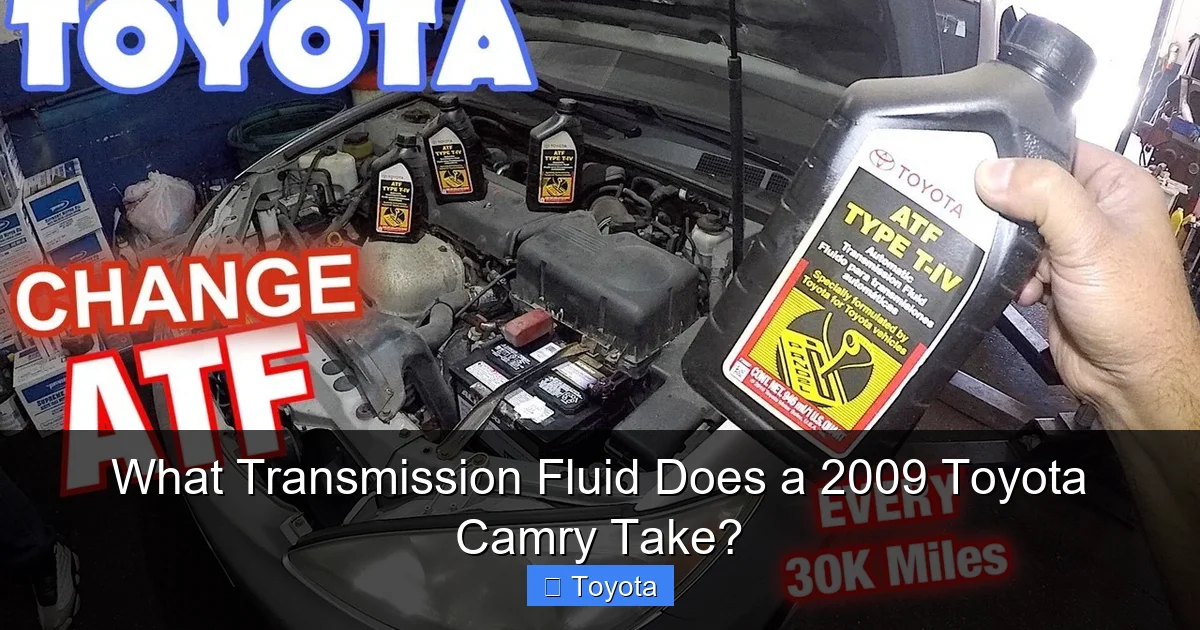
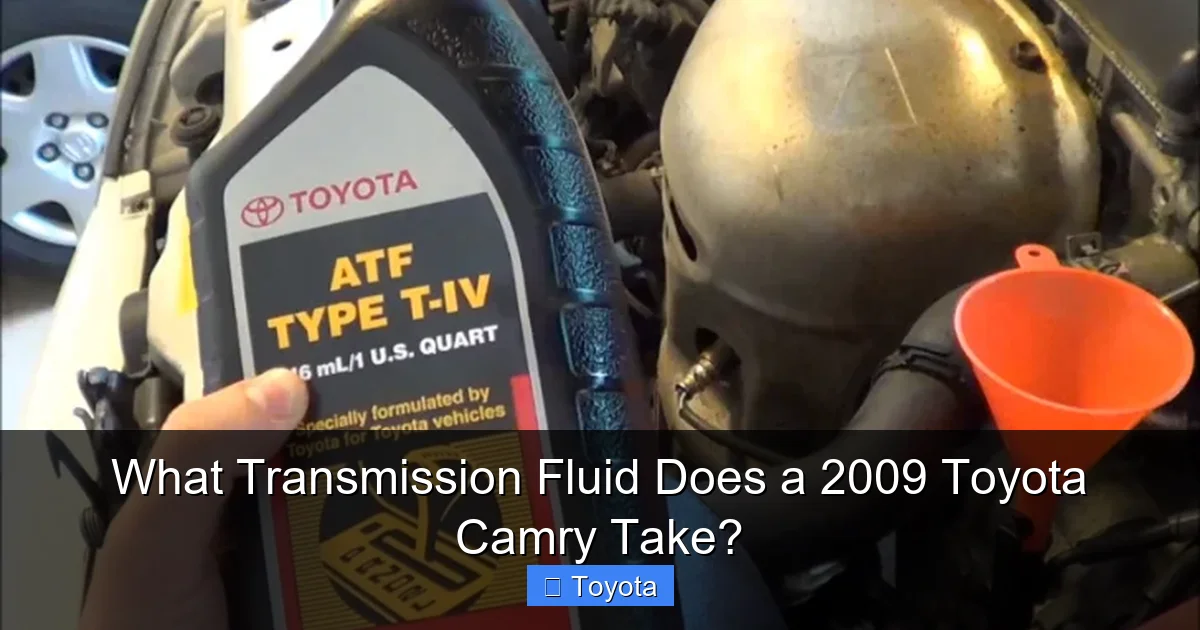
A small percentage of 2009 Camrys were built with the 3.5-liter V6 engine (code: 2GR-FE). This engine is paired with the U660E 6-speed automatic transmission. This transmission uses a different fluid: Toyota Type T-IV (also known as Toyota ATF Type T-IV). While both are Toyota-specific fluids, they are not interchangeable. Using WS in a T-IV transmission or vice versa will lead to performance issues and damage. This is why checking your owner’s manual or vehicle identification number (VIN) is so important.
How to Be 100% Sure: Your VIN is the Final Judge
Even within the 4-cylinder lineup, there are no other fluid variants for 2009. But to be absolutely, positively certain, your 17-digit VIN holds the code. You can decode it yourself online or, better yet, call a Toyota parts department with your VIN. They will look it up and tell you the factory-fill specification. It’s the only way to eliminate all doubt. You can also find the specification printed on the transmission fluid dipstick tube or dipstick itself on most models.
The Golden Fluid: A Deep Dive on Toyota WS Transmission Fluid
So, what exactly *is* Toyota WS? It’s not just oil with a red dye. It’s a complex cocktail of base oils and a sophisticated additive package.
Visual guide about What Transmission Fluid Does a 2009 Toyota Camry Take?
Image source: s1.cdn.autoevolution.com
What Makes WS Special?
WS fluid is a “low viscosity” formulation. This means it flows more easily when cold, improving shift feel in winter and reducing parasitic drag on the engine for a tiny fuel economy gain. The additive package includes:
- Friction Modifiers: These are the most critical additives. They control the exact amount of slip and grab in the clutch packs. The wrong friction level causes shuddering on take-off or burnt clutch material.
- Anti-Wear Agents: They form a protective film on metal surfaces to prevent scoring and wear.
- Viscosity Index Improvers: These help the fluid maintain its ideal thickness across a huge temperature range, from a cold Minnesota morning to a hot Arizona afternoon.
- Oxidation Inhibitors: They prevent the fluid from breaking down and turning into varnish and sludge when heated.
- Foam Suppressants: Air bubbles in the fluid are the enemy of hydraulic pressure. These additives keep the fluid aerated-free.
Genuine Toyota WS vs. Aftermarket “WS Equivalent”
You’ll see many aftermarket brands (like Valvoline, Pennzoil, Mobil) selling “WS-equivalent” or “Toyota WS” fluid. Are they okay? For the most part, yes. Major brands formulate their fluids to meet or exceed the Toyota WS specification (often listed as Toyota T-IV on the bottle for older WS, but *not* to be confused with T-IV for the V6). However, there can be subtle differences in the friction modifier package. For a daily driver, a high-quality aftermarket WS fluid is perfectly acceptable and will save you money. But for a car you plan to keep forever, or if you’re experiencing any shift quality issues, using Genuine Toyota WS is the ultimate peace of mind. It is the fluid the transmission was engineered and tested with from day one.
Never, Ever Use These Fluids
This bears repeating: Do not use Dexron-III, Mercon, Mercon-V, or any “Universal” ATF in your 2009 Camry’s 5-speed. These are for GM and Ford transmissions. Their friction formulas are wrong for Toyota’s internal components. You might get away with it for a short time, but you will slowly destroy the transmission’s ability to shift properly. The same goes for using motor oil or any other fluid. It’s a one-way ticket to a catastrophic failure.
How to Check Your Transmission Fluid Level: The Right Way
Checking the transmission fluid in your Camry is a simple process, but it’s done differently than checking engine oil. Getting it wrong means you’ll get a false reading, which is worse than not checking at all.

Visual guide about What Transmission Fluid Does a 2009 Toyota Camry Take?
Image source: parts4hybrid.co.uk
Preparation is Key: Warm It Up
The fluid must be at operating temperature to get an accurate reading. This means you need to drive the car for at least 15-20 minutes. Not just idle it—you need to get the transmission fluid circulating and hot. Aim for a temperature between 150°F and 170°F (65°C – 77°C). If you have an OBD2 scanner that reads transmission temperature, use it. Otherwise, a good 20-minute drive on surface streets is sufficient.
The Step-by-Step Check
- Park the car on level ground. Set the parking brake firmly.
- Leave the engine running. Shift the transmission through P-R-N-D-3-2-1 (or L) and back to Park, pausing for a few seconds in each gear. This ensures the fluid is distributed in the torque converter and valve body.
- With your foot on the brake, keep the engine running at idle.
- Pull the dipstick (it’s usually red-handled and located near the firewall, behind the engine). Wipe it clean with a lint-free cloth.
- Fully reinsert the dipstick all the way back into its tube.
- Pull the dipstick out again and read the level. There are two notches or “hot” marks on the dipstick. The fluid level should be between the lower and upper marks, ideally right in the middle. If it’s below the lower mark, you need to add fluid.
Common Checking Mistakes to Avoid
Mistake 1: Checking with the engine off. This will show the fluid level in the pan, not in the running system, and is always too high. Mistake 2: Not shifting through all the gears before checking. This can leave fluid trapped in the valve body. Mistake 3: Not wiping the dipstick. A film of old fluid on the stick can cause a misread. Mistake 4: Checking on a slope. The car must be perfectly level.
Adding or Changing Your Transmission Fluid: A Careful Process
If your check reveals the level is low, you need to add fluid. If it’s dirty, brown, or smells burnt, a change is needed. Here’s how to approach it.
The “Drain and Refill” Method (The Standard Service)
This is what a typical shop does. The transmission pan is dropped, the old fluid is drained, the filter is replaced (if accessible—on the A960E, it is), the pan is cleaned and reinstalled with a new gasket, and then fresh fluid is added through the dipstick tube.
- Capacity: Expect to use about 3.5 quarts (3.3 liters) of new WS fluid for this procedure after the drain. You will need to check and add in small increments, as the exact amount can vary based on how much old fluid remained in the torque converter.
- The Critical Final Step: After adding the initial 3 quarts, start the engine, warm it up, and check the level as described above. Add fluid in 0.25-quart (250ml) increments, rechecking each time, until the level is correct. This patience prevents overfilling.
The “Power Flush” Method (Use with Extreme Caution)
Some shops use a machine that connects to the transmission cooler lines and forces new fluid through the system while the engine runs, pushing out the old. While it can remove more old fluid, it also stirs up any settled debris and can force contaminated fluid into the valve body. Toyota’s official position for this generation is often against pressurized flushing. A drain and refill done 2-3 times, spaced a few thousand miles apart, is a safer way to replace over 90% of the fluid. If you choose a flush, ensure the shop uses a gentle, flow-based method and not a high-pressure blast.
DIY vs. Professional Service
This is a moderately difficult DIY job. You need to be comfortable working under the car, have the correct sockets to remove the pan bolts (which can be very tight), and be meticulous about cleaning and gasket installation. A major spill or cross-threaded bolt can cause a major leak. For most owners, this is a job for a trusted independent mechanic or the dealership. The cost of a professional drain and refill is reasonable insurance against a $3,000+ transmission rebuild.
Warning Signs: When Your Fluid is in Trouble
Your transmission will give you clues. Pay attention to them.
- Delayed Engagement: You shift into Drive or Reverse, and there’s a 2-3 second pause before the car moves. This is often the first sign of low fluid or degraded fluid.
- Harsh or Slipping Shifts: Shifts feel like a bang or a clunk. Or, the engine RPMs surge without a corresponding increase in speed (slipping). Both indicate poor hydraulic pressure or incorrect friction.
- Transmission Whine or Hum: A constant, high-pitched whine that changes with engine speed can mean the fluid is low, aerated (from overfilling), or worn out, causing pump starvation.
- Fluid Condition: If you check the dipstick and the fluid is dark brown or black, smells like burnt toast, or has metal shavings in it, it’s overdue for service. Healthy WS fluid is a clear, reddish-pink color.
- Leaks: Look for fresh, red fluid spots under the car, typically near the transmission tailshaft (where the driveshaft connects) or from the pan gasket. A small leak can become a big problem quickly.
Maintenance Schedule and Long-Term Thinking
Toyota’s original maintenance booklet for the 2009 Camry is famously conservative. Under “Normal” driving conditions, it lists “Inspect” for transmission fluid but does not mandate a change. Under “Severe” conditions (which includes most real-world driving: short trips, stop-and-go, extreme temps, dusty conditions), it recommends inspection every 30,000 miles and fluid change every 60,000-100,000 miles.
My strong recommendation: Treat your Camry as if it has a “Severe” service schedule. Have the fluid level checked at every oil change. Consider a drain and refill with genuine WS fluid at 60,000 miles, and then every 60,000 miles thereafter. This is cheap insurance. A transmission that has had regular fluid changes using the correct WS fluid can easily surpass 250,000 miles. One that has been neglected with the wrong fluid or no changes will likely fail long before.
Think of it this way: you wouldn’t put the wrong oil in your engine and expect it to last. Your transmission is even more sensitive to its fluid. Protecting it with the correct Toyota WS fluid and proper maintenance is the single most important thing you can do to ensure your 2009 Camry keeps shifting smoothly for the next decade.
Conclusion: Your 2009 Camry’s Transmission Depends on This
We’ve covered a lot of ground. The bottom line is refreshingly simple. Your 2009 Toyota Camry with the 4-cylinder engine and 5-speed automatic transmission needs Toyota WS (World Standard) fluid. About 3.5 quarts for a standard drain and refill. You must check the level with the engine warm and running, and you must never, ever use Dexron, Mercon, or any universal fluid. For the rare V6 model, you need Type T-IV fluid. When in doubt, use your VIN to confirm. This isn’t a place to experiment or save a few dollars. The right fluid, changed on a sensible schedule, is the key to extracting hundreds of thousands of reliable miles from one of the best-selling sedans ever made. Take care of your transmission, and it will take care of you.
Frequently Asked Questions
What happens if I accidentally put Dexron fluid in my 2009 Camry?
Using Dexron or Mercon fluid in a WS-spec transmission will cause shifting problems over time, such as harsh shifts, slippage, or shuddering. The friction properties are incorrect, leading to premature wear of the clutch packs. It should be flushed out and replaced with the correct WS fluid as soon as possible.
Can I use Valvoline WS or other aftermarket WS fluid?
Yes, high-quality aftermarket WS fluids from brands like Valvoline, Pennzoil, or Mobil 1 that meet the Toyota WS specification are perfectly suitable for everyday use. They are formulated to work correctly with your transmission’s components. For ultimate assurance, especially in a high-mileage vehicle, Genuine Toyota WS is the benchmark.
How often should I change the transmission fluid in my 2009 Camry?
While Toyota’s “Normal” schedule doesn’t specify a change, a prudent “Severe” service schedule recommends a drain and refill every 60,000 to 100,000 miles. Given the age of these vehicles now, if the fluid has never been changed, performing a drain and refill with WS fluid is a highly recommended maintenance item.
Is a transmission fluid flush necessary for a 2009 Camry?
A traditional high-pressure power flush is generally not recommended by Toyota for this generation. It can dislodge debris and force it into sensitive areas. A simple drain and refill, where the pan is dropped, the filter is replaced, and fresh fluid is added, is the preferred and safer method. You may need to perform this procedure 2-3 times in succession to replace most of the old fluid.
My transmission Fluid is brown and smells burnt. What now?
This is a serious red flag. Brown, gritty, or burnt-smelling fluid indicates the transmission has been overheating and the fluid has broken down. The protective additives are gone, and metal particles are contaminating the system. You should have the fluid changed immediately and inspect the transmission for any underlying issues causing the overheating, such as a clogged cooler or internal wear.
Why is my transmission fluid level low? Is it safe to just add more?
A low fluid level indicates a leak. Common leak points are the transmission pan gasket, the input/output shaft seals, or the cooler lines. Simply adding fluid is a temporary fix. You must find and repair the leak. Running the transmission low on fluid will cause severe damage very quickly due to lack of lubrication and hydraulic pressure. Check for leaks and address the root cause.