What Transmission Fluid Does a 2007 Toyota Camry Take?

Contents
- 1 Key Takeaways
- 2 📑 Table of Contents
- 3 Why Transmission Fluid Matters for Your 2007 Camry
- 4 The Exact Transmission Fluid Specification for 2007 Toyota Camry
- 5 How to Check and Add Transmission Fluid Properly
- 6 Common Mistakes and Misconceptions to Avoid
- 7 Transmission Fluid Maintenance Schedule and Best Practices
- 8 Conclusion: Protecting Your Camry’s Heart
- 9 Frequently Asked Questions



Your 2007 Toyota Camry requires Toyota Genuine Automatic Transmission Fluid Type T-IV, which meets the Dexron III specification. Using the correct fluid is critical for smooth shifting and long transmission life. Always check the fluid level when the engine is warm and on level ground, and follow the severe service maintenance schedule if you drive in harsh conditions. Never substitute with other fluids like Dexron VI or Mercon, as they can cause damage.
Key Takeaways
- Exact Fluid Specification: The 2007 Toyota Camry requires Toyota Genuine Automatic Transmission Fluid Type T-IV (often labeled as meeting Dexron III specifications).
- Capacity is Specific: The transmission fluid capacity for a standard drain and refill is approximately 4.2 quarts, but a full flush requires significantly more.
- Check Properly: Fluid level must be checked with the engine warmed up, transmission in Park, and on level ground using the dipstick.
- Never Substitute: Using incorrect fluid like Dexron VI, Mercon V, or universal fluids can lead to poor shifting and internal transmission damage.
- Maintenance Schedule: Toyota’s “severe service” schedule recommends fluid inspection every 30,000 miles and change every 60,000-100,000 miles.
- All Models Use Same Fluid: Both 2.4L 4-cylinder and 3.5L V6 2007 Camry models use the identical Type T-IV fluid specification.
- Color and Smell: Healthy Type T-IV fluid is a clear, reddish-brown color and has a slightly sweet, petroleum-based smell. Dark, burnt-smelling fluid indicates it’s time for a change.
📑 Table of Contents
- Why Transmission Fluid Matters for Your 2007 Camry
- The Exact Transmission Fluid Specification for 2007 Toyota Camry
- How to Check and Add Transmission Fluid Properly
- Common Mistakes and Misconceptions to Avoid
- Transmission Fluid Maintenance Schedule and Best Practices
- Conclusion: Protecting Your Camry’s Heart
Why Transmission Fluid Matters for Your 2007 Camry
Think of your 2007 Toyota Camry’s transmission fluid as its lifeblood. It does far more than just lubricate. This specialized liquid is the unsung hero that ensures every gear change is smooth, precise, and damage-free. It creates the hydraulic pressure needed to engage clutches and bands inside the complex valve body. It cools the intense friction generated by those metal components spinning at high speeds. It even protects seals from drying out and cracking. Without the right fluid, in the right amount, and in good condition, your Camry’s transmission is at risk of slipping, harsh shifting, overheating, and ultimately, catastrophic failure. A transmission rebuild or replacement is one of the most expensive repairs you can face, often costing thousands of dollars. Proactive care with the correct fluid is the single most effective and affordable insurance policy you have against that nightmare scenario.
The Multifunctional Role of ATF
Modern automatic transmission fluid (ATF) is a highly engineered product. For your 2007 Camry, it’s not just oil; it’s a hydraulic medium, a coolant, a lubricant, and a cleaner all in one. The fluid’s viscosity and friction properties are precisely calibrated. They ensure the clutch packs engage with the exact amount of “grab” needed—not so little that they slip and burn, and not so much that they engage too harshly. The fluid’s additive package contains detergents to keep internal passages clean of metal shavings and varnish, anti-wear agents to protect hard surfaces, and antioxidants to prevent the fluid itself from breaking down under heat. When you use the wrong fluid, you disrupt this delicate chemical and physical balance, leading to premature wear.
Cost of Neglect vs. Cost of Prevention
We get it. Maintenance can feel like an annoying expense. But let’s put it in perspective. A professional transmission fluid service (drain and refill) for a 2007 Camry typically costs between $150 and $300, depending on your location and whether you use genuine Toyota fluid or a high-quality equivalent. A full transmission flush might be more. Now, contrast that with a transmission rebuild, which starts around $2,500 and can easily exceed $4,000. Or a replacement transmission from a salvage yard, which is $1,500-$2,500 plus installation. The math is brutally simple. Regular fluid maintenance isn’t an expense; it’s an investment that pays massive returns by preserving your vehicle’s value and your peace of mind.
The Exact Transmission Fluid Specification for 2007 Toyota Camry
This is the most critical section. Using the wrong fluid is a fast track to transmission problems. So, what does a 2007 Toyota Camry take? The answer is definitive and must be followed precisely.
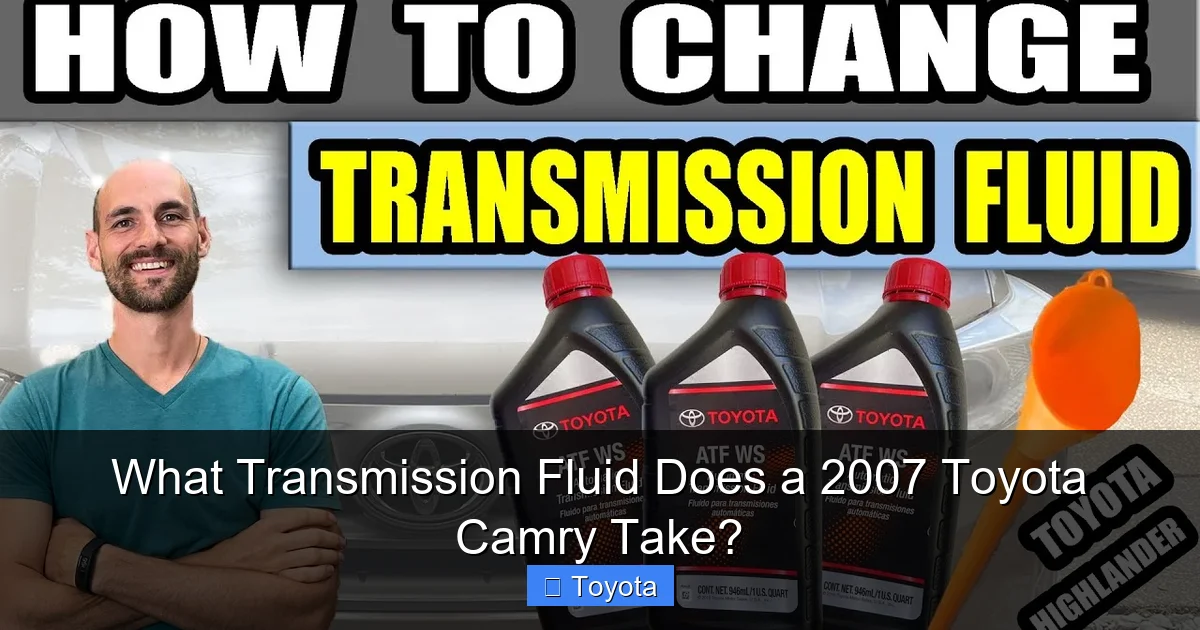
Visual guide about What Transmission Fluid Does a 2007 Toyota Camry Take?
Image source: i.ytimg.com
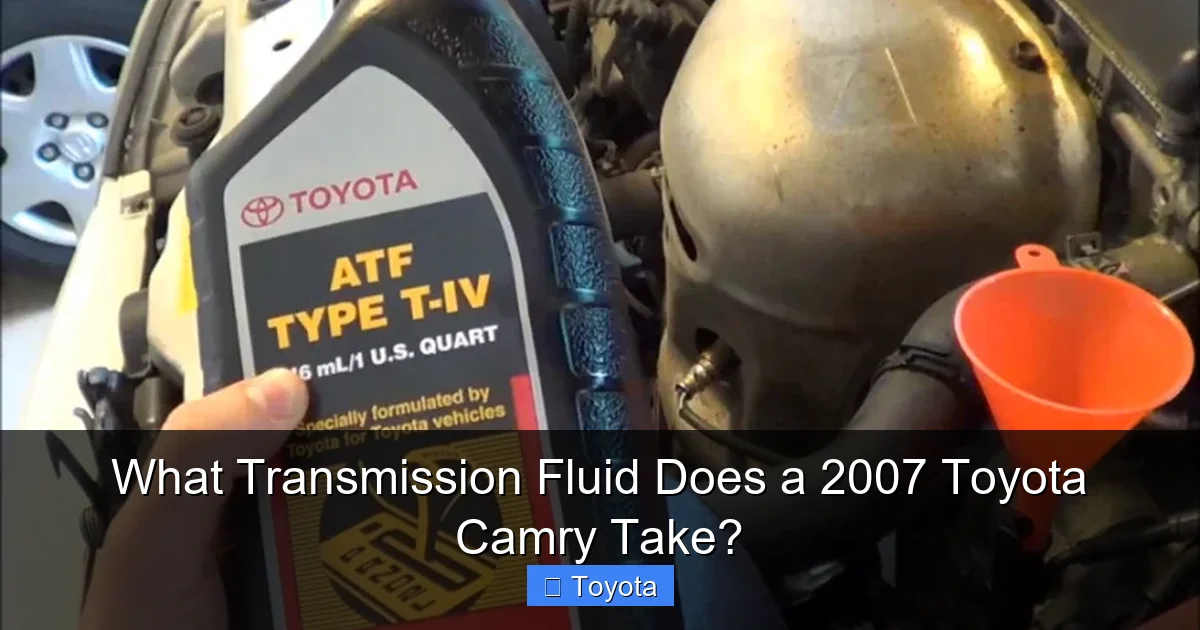
Toyota Genuine ATF Type T-IV
For all 2007 Toyota Camry models—whether equipped with the 2.4-liter 4-cylinder engine (2AZ-FE) or the 3.5-liter V6 (2GR-FE)—the manufacturer specification is Toyota Genuine Automatic Transmission Fluid Type T-IV. This is not a suggestion; it’s a requirement. This fluid is specifically engineered for Toyota’s electronically controlled automatic transmissions (the 4-speed A760E for V6 and the 4-speed U241E for 4-cylinder). It has a unique friction coefficient formulation that matches the materials used in the clutch packs and bands of these specific transmissions.
Dexron III as a Baseline, But Not a Direct Substitute
You will often see that Type T-IV “meets or exceeds” the General Motors Dexron III specification. This is true. In terms of basic lubrication and protection, it performs at or above that standard. However, this does not mean you can simply pour in any Dexron III-labeled fluid. The key difference lies in the friction properties. Toyota’s engineers tuned Type T-IV for the exact shift feel and durability required by their transmissions. Generic Dexron III fluids, while similar, can have slightly different additive packages. In the short term, you might not notice a problem. Over thousands of miles, the shift quality can degrade, leading to harsh shifts, slippage, or accelerated wear. For absolute safety and warranty compliance, genuine Toyota Type T-IV or an exact equivalent from a top-tier brand (like Valvoline MaxLife ATF, which is specifically formulated for Asian imports and meets T-IV specs) is the only correct choice. Never use Dexron VI, Mercon V, or “universal” ATF in a 2007 Camry.
What About WS Fluid? A Common Point of Confusion
Many Toyota owners hear about “WS” fluid (Toyota Genuine ATF WS) and wonder if they can use it. The answer is a firm no for the 2007 Camry. WS fluid was introduced later, primarily for models with the 6-speed automatic transmissions (starting around 2008-2009 for many models). It has different friction properties designed for those newer transmissions. Using WS in your 2007’s 4-speed can cause shuddering, slipping, and damage. This is a classic example of why you must follow the specification for your exact model year. If you’re unsure, your owner’s manual is the final authority. It will list “Toyota Genuine ATF Type T-IV” or its equivalent.
How to Check and Add Transmission Fluid Properly
Knowing how to check the fluid is a vital skill for any Camry owner. It’s a simple process, but the steps are critical to getting an accurate reading.
Visual guide about What Transmission Fluid Does a 2007 Toyota Camry Take?
Image source: s1.cdn.autoevolution.com
Preparation: The Golden Rules
First, understand that transmission fluid expands as it gets hot. The dipstick has a “Hot” and “Cold” mark, but the “Hot” mark is the one that matters for normal operating conditions. Therefore, you must check the fluid when the transmission is at full operating temperature. Here’s the correct procedure: Drive your Camry for at least 20-30 minutes to get the engine and transmission fully warmed up. Then, park it on a perfectly level surface. Set the parking brake firmly. With your foot on the brake, move the shifter through each gear (P, R, N, D, 4, 3, 2, 1—if equipped) and hold each for a few seconds, finally returning to Park. This ensures the fluid is distributed throughout the pan and torque converter.
The Step-by-Step Check
- Locate the Dipstick: Open the hood. The transmission fluid dipstick is typically red-handled and located near the back of the engine bay, on the passenger side (for left-hand drive models). It is distinct from the oil dipstick, which is usually yellow.
- Pull and Wipe: Pull the dipstick out completely. Wipe it clean with a lint-free cloth or paper towel.
- Reinsert and Pull: Fully reinsert the dipstick back into its tube until it seats completely. Then pull it out again.
- Read the Level: Look at the end of the dipstick. You will see two marked areas, often with cross-hatching or lines labeled “Hot” and “Cold,” or “Full” and “Add.” With the transmission hot, the fluid level should be at or very near the upper end of the “Hot” mark, typically between the two marks. If it’s below the lower mark, you need to add fluid.
How to Add Fluid Safely
If the level is low, you will need to add fluid. Use a long-neck funnel and pour the correct Toyota Type T-IV fluid slowly into the dipstick tube. Add about a half-quart at a time, then re-check the level. Do not overfill! Overfilling is just as bad as underfilling. It can cause aeration (foaming), leading to erratic shifting, slipping, and damage to the pump. The fluid should settle into the “Hot” mark range when the transmission is at temperature. If you are consistently low on fluid, you have a leak that must be diagnosed and repaired. Common leak points include the pan gasket, the input/output shaft seals, and the cooler lines. Ignoring a leak will lead to low fluid and certain damage.
Common Mistakes and Misconceptions to Avoid
Even well-meaning Camry owners can make critical errors. Here are the most common pitfalls to steer clear of.
Visual guide about What Transmission Fluid Does a 2007 Toyota Camry Take?
Image source: parts4hybrid.co.uk
The “It’s Just Oil” Fallacy
The biggest mistake is treating transmission fluid like engine oil. They are not interchangeable. Engine oil is designed for different temperatures, pressures, and friction environments. Putting engine oil in your transmission will destroy it within a short distance. Similarly, the myth that “any red fluid will work” is dangerously false. Many aftermarket fluids are red but have entirely different chemical compositions. Always use the specified fluid.
Ignoring the “Hot” Check Requirement
Checking fluid when the car is cold and topping it off to the “Cold” mark will lead to overfilling once the transmission heats up. Overfilled fluid has nowhere to go but out through vents and seals, causing leaks and aeration. Always follow the warm-hot procedure.
Chasing “Better” or “Upgraded” Fluids
You might see ads for “synthetic” or “extended life” ATF that claim to be “compatible with all transmissions.” Resist this. Your 2007 Camry’s transmission was designed and calibrated for the friction properties of Type T-IV. A fluid with a different coefficient of friction, even if it’s a “better” lubricant, will change how the clutches engage. This can result in a noticeable difference in shift feel—often worse—and can cause long-term wear. Stick to the specification.
The DIY Flush Trap
Many quick-lube shops recommend a “transmission flush” using a machine that forces new fluid through the system while the engine runs. While this can remove more old fluid than a simple drain-and-fill, it’s not without risk. If the shop uses the wrong fluid or if there is existing debris in the transmission, the flush can actually dislodge and circulate particles, causing a clog. For a high-mileage 2007 Camry, a series of 2-3 drain-and-fills over a few weeks is often a safer, more effective method to replace old fluid without shocking the system.
Transmission Fluid Maintenance Schedule and Best Practices
Toyota’s official maintenance schedule for the 2007 Camry provides guidance, but understanding “severe service” is key to making the right decision for your driving.
Official Toyota Recommendations
The standard maintenance schedule for a 2007 Camry under “normal” driving conditions states to inspect the automatic transmission fluid (ATF) at every major service interval and change it only if it is contaminated or the level is low. However, this “lifetime” fluid claim for many modern cars is heavily debated. For the 2007 model, Toyota’s more detailed “Severe Service” schedule, which applies to most real-world driving (short trips, extreme temperatures, dusty conditions, heavy loads, idling), recommends inspecting the ATF every 30,000 miles and changing it every 60,000 to 100,000 miles. Given that the 2007 Camry is now an older vehicle, erring on the side of caution with fluid changes is highly advisable.
Why Severe Service Applies to You
Think about your driving. Do you make frequent short trips where the transmission never fully warms up? Do you drive in stop-and-go traffic? Do you tow a small trailer or carry heavy cargo? Do you live in a very hot or very cold climate? If you answered yes to any of these, you are operating under severe service conditions. Heat and cold cycles break down fluid faster. Short trips cause water vapor to condense in the transmission, contaminating the fluid. Towing increases thermal load. For a 15+ year old Camry, treating it as if it’s always under severe service is the smartest approach to ensure longevity.
What a Professional Service Should Include
When you have the fluid changed, ensure the shop does it correctly. A proper service involves:
- Drain & Fill: Removing the transmission pan, replacing the filter and pan gasket, and refilling with the exact amount of new Type T-IV fluid. This replaces about 40-50% of the old fluid.
- Multiple Drain & Fills: For a more complete refresh, some shops perform 2-3 drain-and-fills in quick succession (driving between each) to replace over 90% of the fluid.
- Inspection: The mechanic should inspect the old fluid for color and smell (should be reddish-brown, not dark brown or black, and not smell burnt). They should also look at the pan for excessive metal shavings, which indicate internal wear.
- Scan for Codes: A good technician will scan the transmission control module for any stored trouble codes before and after the service.
Always specify “Toyota Type T-IV” or an exact equivalent. Don’t let them use a generic “Dex/Merc” fluid. This is your car, and you have the right to specify the correct lubricant.
Conclusion: Protecting Your Camry’s Heart
Your 2007 Toyota Camry is renowned for its reliability, and a major reason for that reputation is its robust engineering. But even the best engineering relies on proper, specified maintenance. The transmission fluid is not a “set it and forget it” item. It degrades over time. The seals and internal components age. By committing to using only Toyota Genuine ATF Type T-IV or a verified equivalent, and by following a proactive inspection and change schedule based on your actual driving conditions, you are performing the single most important action to ensure your Camry’s transmission provides another 100,000+ miles of smooth, dependable service. Don’t gamble with a generic fluid. Don’t ignore a low level. Treat your transmission with the specific care it demands, and your Camry will reward you with years of trouble-free driving. If you’re ever in doubt, consult your owner’s manual or speak with a Toyota specialist who respects the factory specifications.
Frequently Asked Questions
Can I use Dexron III or Mercon V fluid in my 2007 Camry instead of Toyota Type T-IV?
No. While Type T-IV meets the baseline Dexron III spec, it has a unique friction formula calibrated for your Camry’s transmission. Generic Dexron III or Mercon V fluids can cause shifting issues and damage over time. Always use Type T-IV or an exact equivalent.
How often should I change the transmission fluid in my 2007 Camry?
Under Toyota’s “severe service” schedule (which most drivers fall under), change the fluid every 60,000 to 100,000 miles. For a older Camry with high mileage, consider a change every 60,000 miles or even every 4-5 years to maximize longevity.
Where is the transmission fluid dipstick on a 2007 Toyota Camry?
The dipstick is located in the engine bay, near the firewall on the passenger side. It has a red plastic handle and is distinct from the yellow-handled oil dipstick. You check it with the engine warm, transmission in Park, and the car on level ground.
What are the symptoms of low or bad transmission fluid?
Symptoms include: delayed or harsh gear shifts, transmission slipping (engine revs high but car doesn’t accelerate proportionally), a burning smell, fluid leaks (red or brown spots under the car), and the transmission overheating warning light. If you notice any of these, check the fluid level and condition immediately.
My 2007 Camry has over 200,000 miles. Is it too late to start a fluid maintenance program?
It’s never too late. However, proceed with caution. If the fluid has never been changed, it is likely very dark and may contain significant wear particles. A single flush could dislodge debris and cause a blockage. The safer approach is to perform a series of 2-3 drain-and-fill services over several months, which gently replaces old fluid without shocking the system.
What happens if I accidentally put the wrong transmission fluid in my Camry?
If you’ve added the wrong fluid, do not start the engine or drive the car. Have a professional drain the incorrect fluid immediately and flush the system if necessary. Running the transmission, even briefly, with the wrong fluid can cause internal damage. The cost of a wrong-fluid flush is minor compared to a transmission replacement.