
What Is the Towing Capacity of the 2010 Toyota Tundra 5.7l V8

The 2010 Toyota Tundra with the 5.7L V8 engine delivers a maximum towing capacity of up to 10,400 pounds when properly equipped with the tow package and 4×2 drivetrain, making it a robust choice for heavy trailers. This powerhouse combines strength and reliability, ideal for demanding hauling tasks in the full-size truck segment.
Key Takeaways
- Max capacity is 10,400 lbs: Achievable only with a regular cab, 4×2, and specific gearing.
- Your truck’s rating is unique: Always verify the exact capacity on your driver’s door jamb sticker.
- GCWR is the critical number: Gross Combined Weight Rating dictates total safe weight of truck plus trailer.
- Payload is separate from towing: Do not confuse your truck’s payload capacity with its towing capacity.
- A brake controller is mandatory: Required by law for trailers over 1,500-3,000 lbs, depending on your state.
- Used trucks may have less capacity: Worn components or non-stock parts can reduce your actual safe towing limit.
- Proper loading is non-negotiable: Distribute trailer weight correctly and never exceed any manufacturer rating.
📑 Table of Contents
- What Is the Towing Capacity of the 2010 Toyota Tundra 5.7L V8?
- Understanding Towing Capacity: More Than Just a Number
- The 2010 Toyota Tundra 5.7L V8: Engine and Tow Package Specs
- Official 2010 Tundra 5.7L Towing Capacity Data Table
- Real-World Towing: What Can You Actually Pull?
- Factors That Can Reduce Your Actual Towing Capacity
- How the 2010 Tundra Stacks Up & Final Verdict
What Is the Towing Capacity of the 2010 Toyota Tundra 5.7L V8?
So, you’re looking at a used full-size truck, maybe a 2010 Toyota Tundra with that big, burly 5.7-liter V8 under the hood. You’ve got a boat, a camper, or a heavy-duty trailer in your future, and you need to know one critical thing: can this truck actually pull it? You’ve come to the right place. Let’s pop the hood, kick the tires, and get straight to the numbers on the towing capacity of the 2010 Toyota Tundra 5.7L V8. This isn’t just about a sticker on the door jamb; it’s about understanding what that number means for you, your cargo, and your peace of mind on the highway.
I remember shopping for a used truck a few years back. The listings were full of impressive max tow ratings, but nobody talked about the *real* story. The 2010 Tundra was a pivotal model for Toyota, a genuine competitor to the American stalwarts with its powerful engine and robust frame. But it’s also a 14-year-old vehicle now. That means its capability is only half the story; the other half is its condition, maintenance history, and how you plan to use it. We’ll cover it all, from the factory-stamped maximums to the practical, everyday realities of hooking up a heavy load.
Understanding Towing Capacity: More Than Just a Number
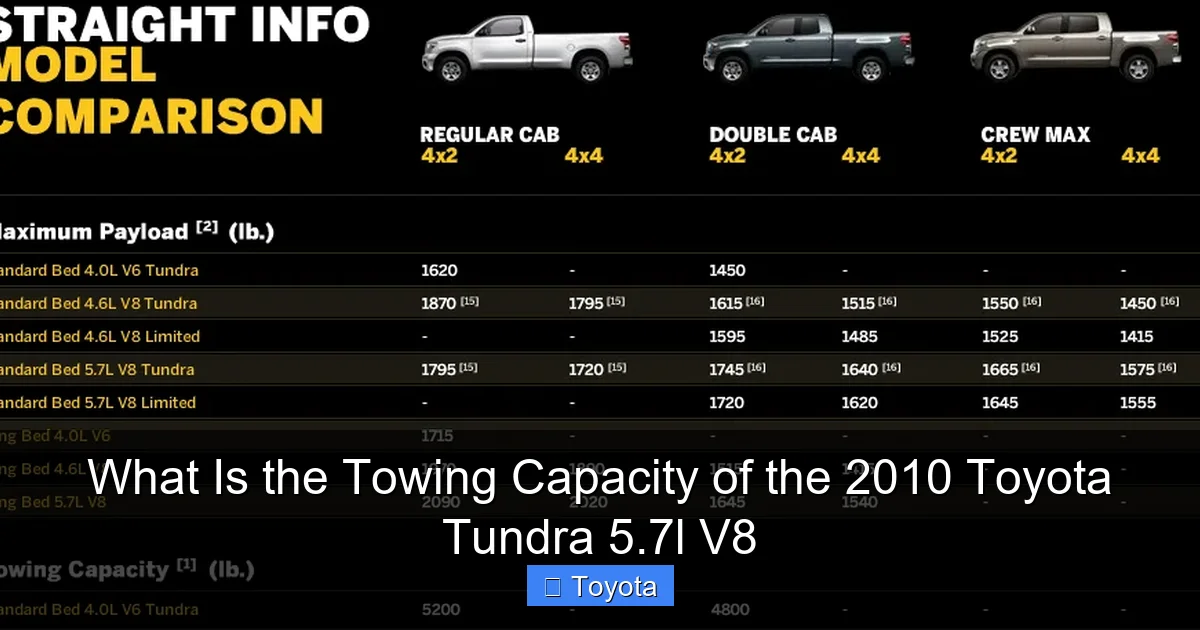
Before we dive into the Tundra’s specific figures, let’s quickly demystify the terminology. “Towing capacity” is the maximum weight a vehicle can safely pull, as determined by the manufacturer. It’s not a random guess; it’s a calculated limit based on the truck’s engine, transmission, frame, axles, brakes, and cooling system. Exceeding this limit isn’t just hard on the truck—it’s dangerous. You risk catastrophic brake failure, transmission overheating, and loss of control.
Visual guide about What Is the Towing Capacity of the 2010 Toyota Tundra 5.7l V8
Image source: img.ahtr.net
Two other numbers are just as important: Gross Vehicle Weight Rating (GVWR) and Gross Combined Weight Rating (GCWR). GVWR is the maximum total weight of the truck itself plus passengers, cargo, and the tongue weight of the trailer. GCWR is the absolute maximum combined weight of the fully loaded truck *and* the fully loaded trailer. Your actual, safe towing capacity can often be *less* than the max rating if your truck is loaded down with people and gear. Always calculate your real-world scenario.
The Golden Rule: Your Truck’s Actual Condition
For a used 2010 Tundra, the factory-stamped numbers on the driver’s door jamb are your starting point. But they assume a pristine, well-maintained vehicle. A truck with 200,000 miles, worn suspension components, or an overheating history will have a much lower *effective* towing capacity. Safety must come first. Before you even think about hitching up, get a thorough mechanical inspection focusing on the brakes, tires, transmission fluid condition, and cooling system. An older truck needs more love to handle its maximum load reliably.
The 2010 Toyota Tundra 5.7L V8: Engine and Tow Package Specs
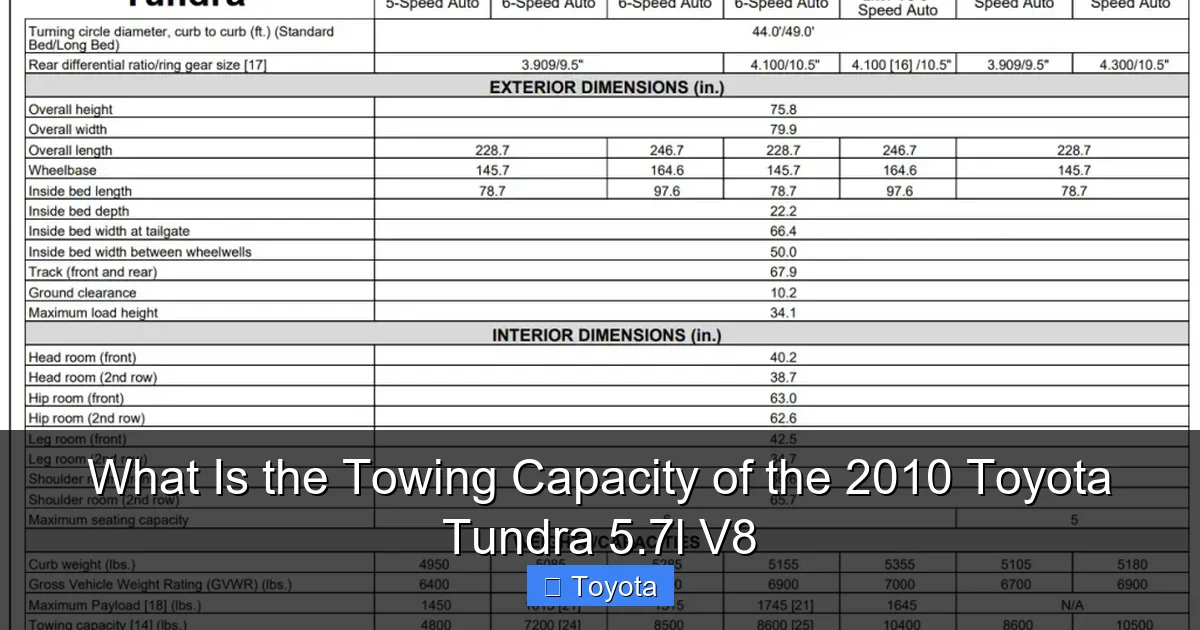
Now, for the meat of the matter. The 2010 Tundra with the 5.7-liter i-FORCE V8 (codenamed 3UR-FE) was a powerhouse. It churned out 381 horsepower and 401 lb.-ft. of torque, mated to a 6-speed automatic transmission. This was Toyota’s answer to the big V8s from Detroit, and it was more than up to the task.
Visual guide about What Is the Towing Capacity of the 2010 Toyota Tundra 5.7l V8
Image source: towengine.com
However, the towing capacity wasn’t a single, magic number. It varied significantly based on three key factors:
- Cab and Bed Configuration: Regular Cab, Double Cab, or CrewMax.
- Drivetrain: 2WD or 4WD.
- Axle Ratio: The standard ratio versus the optional limited-slip differential with a shorter (numerically higher) gear ratio for more pulling power.
The holy grail of max towing for the 2010 Tundra 5.7L was achieved with the Regular Cab, 2WD model equipped with the 4.30:1 axle ratio. This configuration was the lightest (lower payload used by the truck itself) and had the gearing optimized for pulling. Add a crew cab, 4WD, and the standard 4.10:1 axle, and your maximum drops because you’re carrying more truck weight and have less mechanical advantage.
The Essential Tow Package
You couldn’t just buy any 2010 Tundra 5.7L and expect to hit the max rating. It required the factory-installed Trailer Tow Package. This wasn’t just a hitch; it was a comprehensive system that included:
- An integrated Class IV receiver hitch (welded to the frame).
- Heavy-duty transmission and engine oil coolers.
- Upgraded alternator.
- Trailer wiring harness with a 7-pin connector.
- Sometimes, a supplemental stop lamp switch for the trailer.
If the truck you’re looking at doesn’t have this package, its towing capacity is significantly lower, and you’d be wise to add an aftermarket hitch and cooler system, but it still may not meet the factory max for that specific configuration. Always verify the presence of the tow package.
Official 2010 Tundra 5.7L Towing Capacity Data Table
Enough talk. Here are the hard numbers from Toyota’s official specifications for the 2010 model year. Remember, these are maximums under ideal conditions.
Visual guide about What Is the Towing Capacity of the 2010 Toyota Tundra 5.7l V8
Image source: towengine.com
| Cab Style | Bed Length | Drivetrain | Axle Ratio | Max Towing Capacity (lbs.) |
|---|---|---|---|---|
| Regular Cab | Long (8′) | 2WD | 4.30:1 | 10,400 |
| Regular Cab | Long (8′) | 2WD | 4.10:1 | 9,900 |
| Double Cab | Short (5.5′) | 2WD | 4.30:1 | 9,900 |
| Double Cab | Long (8′) | 2WD | 4.30:1 | 9,700 |
| CrewMax | Short (5.5′) | 2WD | 4.30:1 | 9,500 |
| CrewMax | Short (5.5′) | 4WD | 4.30:1 | 9,200 |
| (Any Cab) | (Any Bed) | 4WD | Standard 4.10:1 | ~8,900 – 9,100 |
Key Takeaways from the Table: The absolute king is the bare-bones, long-bed, 2WD Regular Cab with the 4.30 axle. As soon as you add a back seat (Double/CrewMax), 4WD, or a shorter bed (which often correlates with a different axle package), your maximum drops by 200 to 1,500 pounds. The standard axle ratio (4.10:1) on most models also shaves off a few hundred pounds compared to the optional 4.30.
Real-World Towing: What Can You Actually Pull?
Okay, so the sheet says 10,400 lbs. What does that look like in the real world? Here are some common trailer types and their typical loaded weights. This is where you do your homework.
Practical Examples and Weight Calculations
- Large Travel Trailer (30-35 ft): A well-equipped, loaded camper can easily hit 7,000 – 9,000 lbs. The max-capacity Tundra can handle this, but you’ll be near the limit. You’ll feel the weight, especially in hills and wind. A weight distribution hitch is non-negotiable at this weight.
- Large Fifth-Wheel Camper: These are heavier for their size due to the gooseneck design. A 30-footer can weigh 8,000 – 11,000 lbs. The 2010 Tundra is not recommended for fifth-wheels. Its bed length (even the long 8’) is typically too short for a stable fifth-wheel setup, and the pin weight would likely exceed the truck’s payload capacity. Look at a dedicated 3/4-ton or 1-ton truck for these.
- Boat & Trailer (24-28 ft): A bass boat or ski boat with trailer, gear, and fuel usually falls in the 4,500 – 6,500 lb range. This is a sweet spot for the Tundra. It’ll pull it effortlessly on the highway, though you’ll still want a good hitch and brake controller.
- Car Hauler Trailer (Open, 2-car): A basic open trailer plus two average sedans (like a Toyota Camry) can be 6,000 – 7,500 lbs. Again, very manageable. A large enclosed car trailer with a truck inside can push 9,000+ lbs, putting you at the upper edge.
- Large Utility/Equipment Trailer: A 7×16 enclosed trailer or a heavy-duty gooseneck for a tractor can vary wildly. You must know the exact loaded weight. If it’s over 8,000 lbs, you’re entering the zone where the Tundra’s capabilities and its age become serious considerations.
Critical Tip: Always go to a public scale with your fully loaded trailer and the fully loaded truck (with passengers, fuel, and cargo). Weigh the whole combo (GCW) and then just the truck (to find your actual payload/GVWR). This is the only way to know for sure you’re within safe limits. Guessing is how you break things.
Factors That Can Reduce Your Actual Towing Capacity
The number on the door sticker is your truck’s potential. Your real-world number is almost always lower. Here’s what eats away at it:
- Payload: This is the weight of passengers, cargo in the bed, and the trailer’s tongue weight. The tongue weight should be 10-15% of the trailer’s total weight. A 9,000 lb trailer has a tongue weight of 900-1,350 lbs. Add that to your passengers and bed cargo. If your truck’s payload capacity is 1,500 lbs and you have 5 people and a toolbox, you may only have 800 lbs left for tongue weight, which drastically reduces your safe towing weight.
- 4WD vs. 2WD: 4WD adds significant weight (200-300 lbs), which eats into your payload and GCWR. It also typically comes with the standard 4.10 axle, not the 4.30, further reducing max tow.
- Axle Ratio: As seen in the table, the 4.30:1 ratio provides more towing grunt. If your truck has the standard 4.10:1, your max is lower.
- Altitude and Temperature: The naturally aspirated 5.7L V8 loses power in high altitude and extreme heat. This isn’t a huge factor at sea level, but in the mountains on a 100-degree day, you’ll feel a lack of power, effectively lowering your safe towing capacity.
- Truck Condition: Worn spark plugs, a clogged catalytic converter, low transmission fluid, or weak brakes all diminish capability. An older truck needs to be in top mechanical shape to perform at its limit.
The “But My Truck Has a Big Engine” Fallacy
I’ve heard it: “Don’t worry, it’s a V8!” Engine power is only one part of the equation. Your brakes are designed to stop the GCWR. If you exceed it, you have a runaway situation. Your transmission is geared for a specific load. Overwork it, and it will overheat and fail. Your frame and suspension have a limit. Respect all of it. The 5.7L gives you the power, but the rest of the truck sets the ceiling.
How the 2010 Tundra Stacks Up & Final Verdict
For its time, the 2010 Toyota Tundra 5.7L was a formidable tow vehicle. A max of 10,400 lbs put it squarely in the ring with the Ford F-150 and Chevrolet Silverado 1500 of that era. It was (and still is) known for its reliability and strong, torquey engine. However, it’s important to compare it to modern standards and its own competition.
If you’re looking at a used Tundra for towing, you might also be cross-shopping other trucks. For instance, the towing capacity of a Nissan Frontier from the same era was significantly lower, making the Tundra a clear step up in the midsize vs full-size debate. But even within Toyota’s lineup, the capacity varies. You can see how the Tundra’s numbers dwarf the towing capacity of a Toyota RAV4, which is designed for light-duty, family-sized loads, not full-size trailers.
Where the 2010 Tundra shows its age is in transmission tuning and some advanced towing features. Newer trucks have 10-speed transmissions, adaptive tow/haul modes, and more sophisticated trailer brake controllers. The 6-speed in the Tundra is robust but can hunt for gears on steep grades when fully loaded.
Also, consider the legendary Toyota Tundra 1794 Edition. While primarily a luxury trim, it often came with the tow package and the desirable 4.30 axle, making it a great used buy if you find one in good shape.
The Bottom Line: Is It Right For You?
The 2010 Toyota Tundra 5.7L V8 is a capable, used full-size truck that can tow between approximately 8,900 lbs and 10,400 lbs when properly equipped. It’s a solid choice for:
- Large boat and ski boat trailers.
- Mid to large travel trailers (up to ~8,500 lbs loaded, with buffer).
- Large utility and car hauler trailers within its weight limits.
It is not the ideal choice for:
- Very heavy fifth-wheel campers (due to bed length and pin weight).
- Consistently maxing out its 10,400 lb rating with an older, high-mileage truck. You need significant margin for safety and component wear.
- Anyone who wants the latest in transmission technology or maximum fuel efficiency while towing.
Your Action Plan: Find the specific truck’s door jamb sticker. Confirm it has the factory tow package. Check the axle ratio (often on a tag in the rear differential or listed on the original window sticker). Get a pre-purchase inspection from a trusted mechanic. Then, use a scale to verify your actual trailer weight and tongue weight. If all those boxes check out and your trailer weight is 1,000-2,000 lbs below the max rating, you’ll have a reliable, powerful, and enjoyable towing experience with a 2010 Tundra.
Respect the numbers, maintain the truck diligently, and that 5.7-liter V8 will serve you well for many miles and many tow trips to come. It’s a testament to Toyota’s engineering that a 14-year-old truck can still be such a competent workhorse.
Frequently Asked Questions
What is the maximum towing capacity of the 2010 Toyota Tundra 5.7L V8?
The maximum towing capacity for a properly equipped 2010 Toyota Tundra with the 5.7L V8 is 10,400 pounds when configured as a 4×2 Regular Cab with the 6.5-foot bed. 4×4 models and those with larger cabs or beds have a slightly lower maximum rating, typically around 9,000 to 9,500 pounds.
How does the 2010 Toyota Tundra 5.7L V8 towing capacity compare to the 4.6L V8?
The 5.7L V8 in the 2010 Tundra offers a significantly higher towing capacity than the available 4.6L V8. The 5.7L is rated for up to 10,400 lbs, while the 4.6L tops out at approximately 6,900 lbs, making the larger engine the clear choice for heavy-duty towing.
What factors affect the actual towing capacity of my 2010 Tundra 5.7L?
Your specific 2010 Tundra’s capacity depends on its configuration, including cab style (Regular, Double, or CrewMax), bed length, and drivetrain (4×2 vs. 4×4). The Gross Combined Weight Rating (GCWR), which is the total weight of the truck, passengers, cargo, and trailer, is the ultimate limiting factor you must not exceed.
Is the 2010 Toyota Tundra 5.7L V8 towing capacity the same for all trim levels?
The engine and drivetrain are the primary determinants, not the trim level itself. However, higher trims like the Limited or Platinum often come with more standard features and may be more frequently ordered with the 4×4 system or larger cab, which can reduce the maximum trailer rating compared to a base-model 4×2 Regular Cab.
What is the difference between towing capacity and payload capacity in a 2010 Tundra 5.7L?
Towing capacity refers to the maximum weight your truck can pull *behind* it with a trailer. Payload capacity is the maximum weight you can carry *inside* the truck or in the bed, including passengers and cargo. For the 2010 Tundra 5.7L, payload is typically around 1,600 to 2,000 lbs, which is a separate limit from the much higher towing capacity.
How can I ensure I am towing safely at the maximum 2010 Toyota Tundra 5.7L V8 capacity?
Always calculate your actual Gross Combined Weight (GCWR) by adding the truck’s loaded weight, all passengers, cargo, and the trailer’s loaded weight. You must stay below the manufacturer’s GCWR. Additionally, use a proper weight-distributing hitch for trailers near the maximum limit and ensure your trailer brakes are fully functional.
