What Is the Maintenance Schedule for a 2019 Toyota Chr?

Contents
- 1 Key Takeaways
- 2 📑 Table of Contents
- 3 Understanding Your 2019 Toyota CH-R’s Maintenance Philosophy
- 4 Decoding the 2019 CH-R Maintenance Schedule Breakdown
- 5 Essential Fluid and Filter Services: The Lifeblood of Your CH-R
- 6 Tire and Brake Maintenance: Your Connection to the Road
- 7 Toyota Safety Sense (TSS) and Electronics Care
- 8 Making Maintenance Simple: Tips, Costs, and Your Rights
- 9 Frequently Asked Questions


Following the precise maintenance schedule for your 2019 Toyota CH-R is non-negotiable for preserving its performance, fuel efficiency, and long-term reliability. This comprehensive guide breaks down every service interval, from oil changes to complex system checks, based on Toyota’s official recommendations. Adhering to this schedule protects your investment, maintains your warranty, and prevents costly repairs down the road.
Key Takeaways
- The 2019 CH-R uses a flexible maintenance schedule that adapts to your driving conditions, with “Normal” and “Severe” service categories dictating interval frequency.
- Oil and filter changes are the most critical recurring service, required every 5,000-10,000 miles depending on your driving habits and oil type.
- Tire rotations are essential every 5,000 miles to ensure even tire wear, prolong tire life, and maintain optimal handling and fuel economy.
- The maintenance reminder system is your primary guide, but understanding the underlying mileage/time intervals helps you plan and budget effectively.
- Severe driving conditions (short trips, extreme temps, dusty roads) require more frequent service, often shortening standard intervals by 30-50%.
- Comprehensive multi-point inspections at every service catch potential issues early, from brake pad wear to battery health and fluid levels.
- Using genuine Toyota parts and fluids, especially for complex systems like the CVT, is crucial for performance and longevity.
[FEATURED_IMAGE_PLACEHOLDER]
📑 Table of Contents
- Understanding Your 2019 Toyota CH-R’s Maintenance Philosophy
- Decoding the 2019 CH-R Maintenance Schedule Breakdown
- Essential Fluid and Filter Services: The Lifeblood of Your CH-R
- Tire and Brake Maintenance: Your Connection to the Road
- Toyota Safety Sense (TSS) and Electronics Care
- Making Maintenance Simple: Tips, Costs, and Your Rights
Understanding Your 2019 Toyota CH-R’s Maintenance Philosophy
Congratulations on your 2019 Toyota CH-R! This stylish and efficient crossover SUV is designed for years of trouble-free driving. But like any sophisticated machine, it thrives on regular, proper care. The key to unlocking its full potential lies in understanding and strictly following the factory-prescribed maintenance schedule for a 2019 Toyota CH-R. This isn’t just about changing the oil; it’s a comprehensive, science-backed program developed by Toyota engineers to combat wear, ensure safety systems function perfectly, and maintain your vehicle’s value.
Toyota’s approach for the 2019 CH-R is intelligent and adaptable. Instead of a rigid “every 5,000 miles” rule for everything, they use a system that considers your actual driving environment. This is crucial because the stress on a car driven daily in stop-and-go city traffic is vastly different from one used primarily for long highway commutes. The schedule is divided into two primary categories: Normal and Severe service. Most drivers fall somewhere in between, but understanding these categories helps you make informed decisions. Your vehicle’s onboard maintenance reminder system (the little wrench icon on your dash) is the ultimate authority, but it bases its alerts on these underlying principles. Ignoring these alerts or delaying service is the fastest route to premature wear, poor fuel economy, and potentially voiding your powertrain warranty.
The “Normal” vs. “Severe” Service Dilemma
What constitutes “severe” service? It’s not just about driving in blizzards or deserts, though that counts. Toyota defines severe conditions as: frequent short trips (less than 5 miles in normal temps, or less than 10 miles in freezing temps), extensive idling or stop-and-go driving in hot weather, driving in dusty or sandy areas, towing a trailer, or using your CH-R for commercial purposes like delivery. If your daily drive involves multiple cold starts, heavy traffic, and a lack of long, steady-speed highway runs, you are likely operating under the “Severe” schedule. This typically means service intervals—especially for engine oil, spark plugs, and cabin air filters—will occur more frequently. Being honest about your driving style is the first step to proper maintenance.
Decoding the 2019 CH-R Maintenance Schedule Breakdown
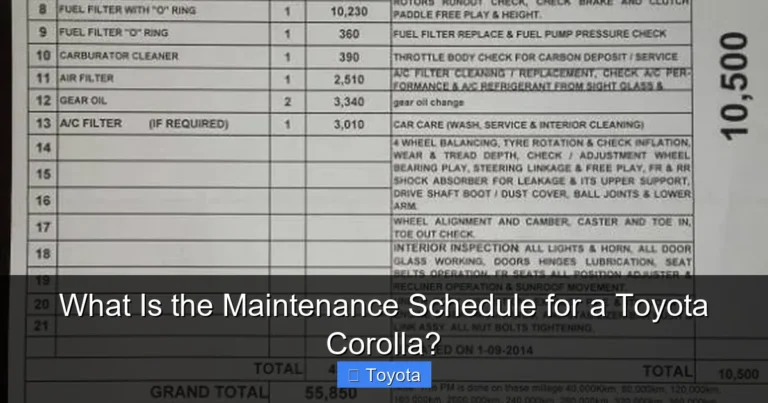
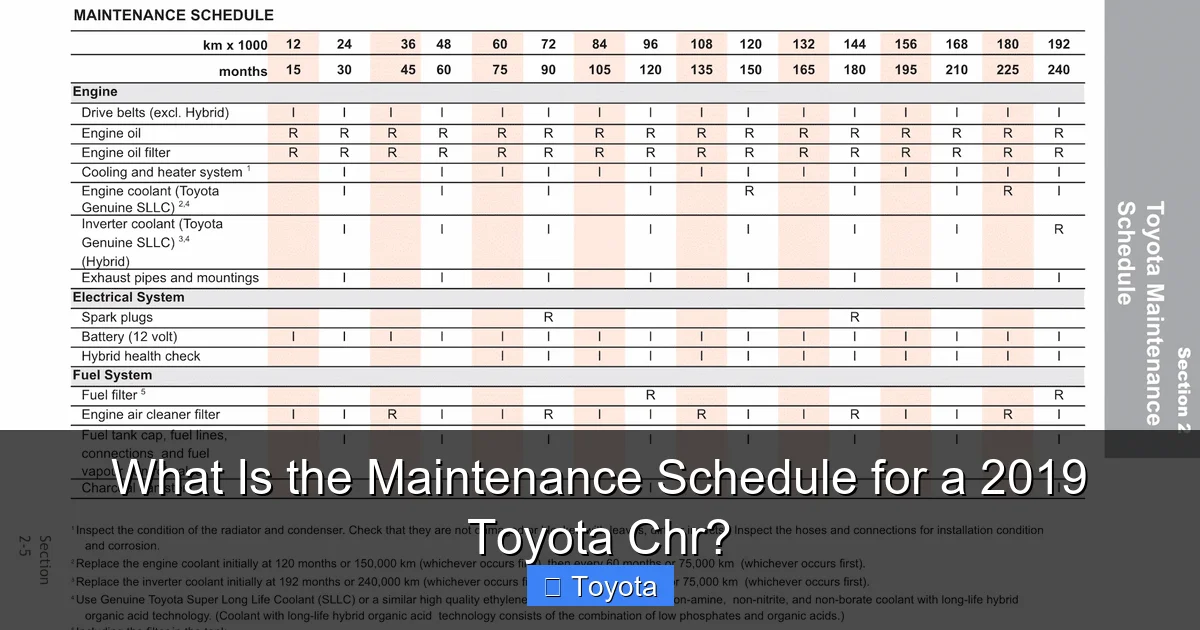
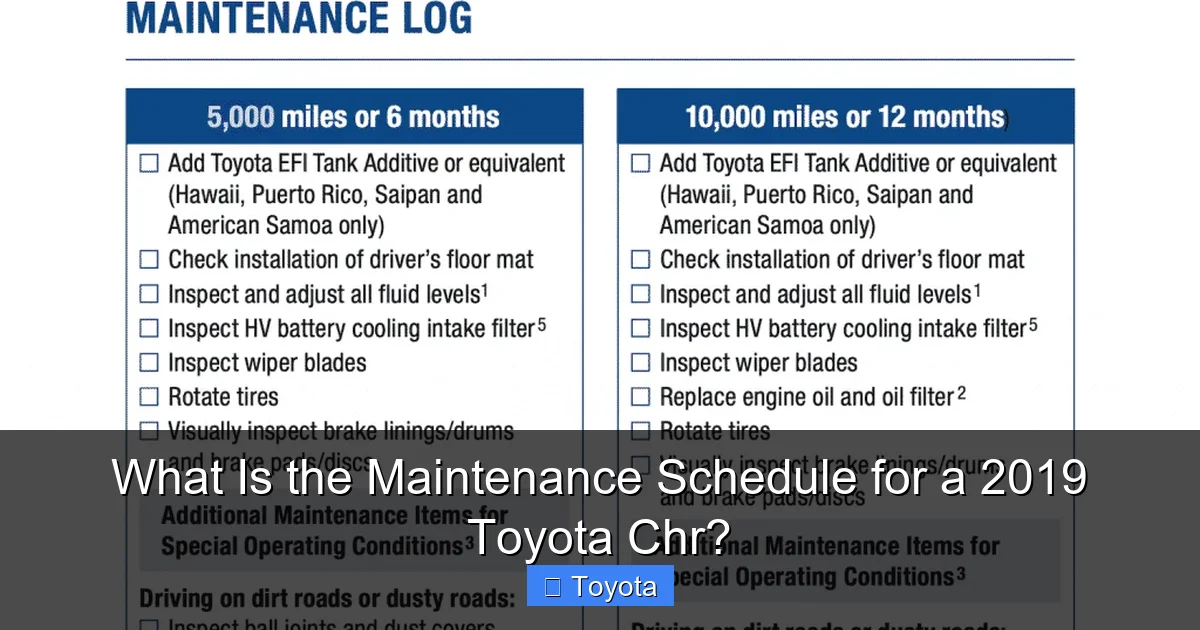
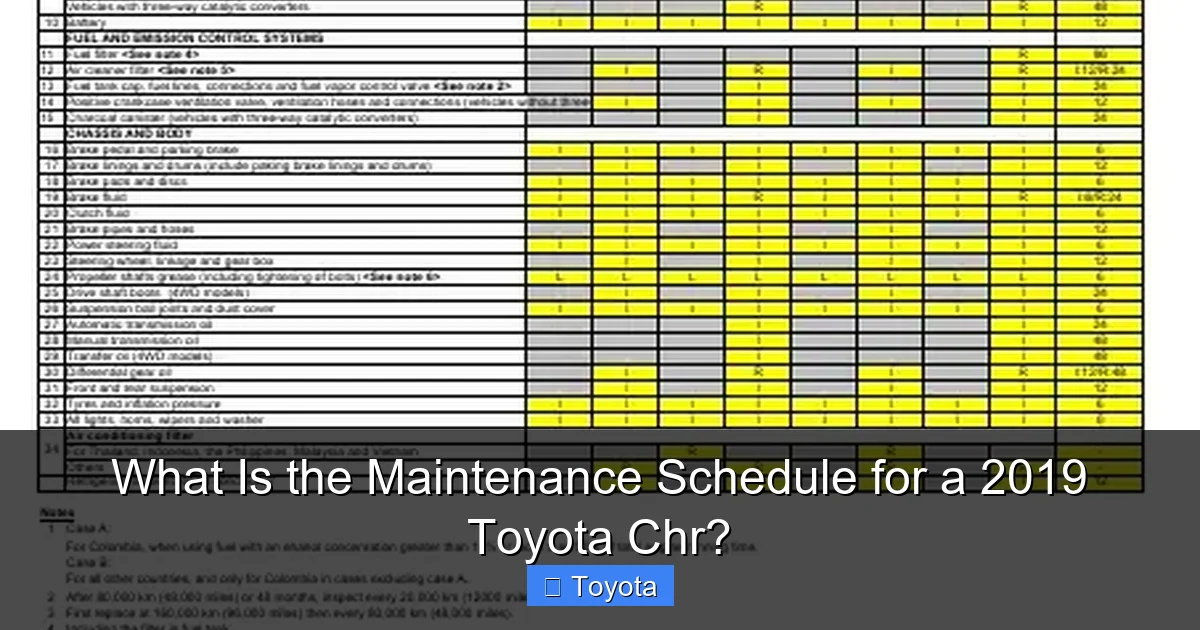
Let’s get into the nitty-gritty. The official schedule is presented as a chart with mileage intervals (5,000 miles, 10,000 miles, 15,000 miles, etc.) and time intervals (12 months, 24 months, etc.). You must service your vehicle at the first occurrence of either the mileage or time limit. For example, if you drive only 3,000 miles in a year, you still need to get the annual service done. The backbone of this schedule is the 5,000-mile/6-month interval for oil and filter changes under severe conditions, and 10,000 miles/12 months for normal conditions. Every other service builds around this core.
Visual guide about What Is the Maintenance Schedule for a 2019 Toyota Chr?
Image source: maintenanceschedule.com
Here is a simplified, mileage-based overview of the key service items. Remember, your specific service reminder will list exactly what’s due at your current interval.
- 5,000 miles / 6 months (Severe): Oil & filter change, tire rotation, multi-point inspection.
- 10,000 miles / 12 months (Normal): Oil & filter change, tire rotation, multi-point inspection.
- 15,000 miles / 18 months: All of the above, plus inspect/replace cabin air filter, check all fluid levels.
- 20,000 miles / 24 months: All of the above, plus inspect/replace engine air filter.
- 30,000 miles / 36 months: Comprehensive service including spark plug inspection/replacement (if needed), drive belt inspection, and more detailed brake system check.
- 40,000 miles / 48 months: All of the above, plus inspect/replace cabin air filter again, check steering linkage and suspension.
- 60,000 miles / 72 months: Major service milestone. Includes all previous items, plus a very thorough inspection of the entire vehicle, potential spark plug replacement, and checking/replacing various under-hood components as per the detailed schedule.
This pattern continues. The most critical takeaway is that no single service is optional. The multi-point inspection at every visit is your vehicle’s health checkup, designed to find small problems before they become big, expensive ones. A technician should be checking brake pad thickness, tire tread depth and condition, battery health, all fluid levels and conditions, steering and suspension components, and the operation of lights and wipers.
Following the Onboard Maintenance Reminder System
Your 2019 CH-R is equipped with a sophisticated maintenance reminder system. When it’s time for service, a “MAINTENANCE REQUIRED” message will appear on your multi-information display. This system calculates service needs based on engine operating conditions, mileage, and sometimes even engine run-time. When you see this message, it’s time to schedule your service. The system will typically reset after the oil change is performed, but a complete service may involve multiple codes or reminders. Always ask your service advisor for a detailed list of what the reminder indicates and what other scheduled maintenance is due based on your mileage. You can find the exact maintenance schedule chart in your owner’s manual—keep it in your glove compartment!
Essential Fluid and Filter Services: The Lifeblood of Your CH-R
Fluids are the unsung heroes of your vehicle. They lubricate, cool, clean, and transmit force. Neglecting them is a direct path to component failure. The 2019 CH-R has several critical fluid systems, each with its own service interval.
Visual guide about What Is the Maintenance Schedule for a 2019 Toyota Chr?
Image source: i.ytimg.com
Engine Oil & Filter: The #1 Priority
This is the most frequent and important service. The CH-R’s 2.0L Dynamic Force engine is paired with a Continuously Variable Transmission (CVT). Using the correct oil is paramount. Toyota specifies Genuine Toyota Motor Oil or an equivalent meeting Toyota specification. For the 2019 CH-R, this is typically 0W-16 or 0W-20 synthetic oil (check your manual for your specific engine code). Using the wrong viscosity can cause excessive wear, poor fuel economy, and potential CVT damage. The oil filter must be replaced with every oil change. A high-quality filter traps contaminants, protecting your engine’s internal components. For severe driving, stick to the 5,000-mile/6-month interval. For normal driving, 10,000 miles/12 months is acceptable, but many conservative owners and technicians still recommend 5,000-7,000 miles as a safer margin, especially to protect the CVT.
Transmission Fluid & CVT Health
This is a major point of discussion for CH-R owners. The CVT requires specific Toyota CVT fluid (TC). Toyota’s official maintenance schedule for the 2019 CH-R does not list a routine transmission fluid change interval under normal or severe conditions. This is a “lifetime” fill from the factory in Toyota’s view, meaning it’s designed to last the life of the vehicle under normal conditions. However, many independent mechanics and long-term owners advocate for a preventative transmission fluid change around 60,000-80,000 miles, especially for vehicles used in severe conditions or for longevity beyond 150,000 miles. This is a debated topic. If you plan to keep your CH-R for the long haul, budgeting for a CVT fluid flush at a reputable shop using genuine Toyota TC fluid around the 60k-mile mark is a prudent insurance policy. Always check the fluid’s color and smell during major services; it should be reddish and not smell burnt.
Other Critical Fluids
At every service, all other fluid levels should be checked and topped off as needed. This includes:
- Coolant (Engine Antifreeze): The engine coolant should be replaced approximately every 100,000 miles or 120 months. The system is sealed, but levels should be checked regularly.
- Brake Fluid: This is hygroscopic, meaning it absorbs water from the air over time, lowering its boiling point and reducing braking effectiveness. Toyota recommends inspection at every service and replacement approximately every 2 years, regardless of mileage.
- Windshield Washer Fluid: Check and fill regularly, especially in winter. Use a fluid with antifreeze properties in cold climates.
- Power Steering Fluid: The CH-R uses electric power steering (EPS), so there is no traditional power steering fluid to check or change.
For a deeper dive into another critical automotive fluid, understanding what engine oil actually does can help you appreciate why the correct type and change interval are so vital.
Tire and Brake Maintenance: Your Connection to the Road
Your tires are the only part of your CH-R touching the road, and your brakes are what stop you. Their maintenance is directly tied to safety and performance.
Visual guide about What Is the Maintenance Schedule for a 2019 Toyota Chr?
Image source: data.templateroller.com
Tire Rotation and Pressure
Rotate your tires every 5,000 miles. This is a firm recommendation because the CH-R’s front-wheel-drive layout and weight distribution cause front tires to wear faster. Regular rotation promotes even wear, extending the life of your tire set and ensuring consistent handling. During rotation, the technician should also check the tire pressure and adjust it to the manufacturer’s specification. The correct pressure is found on a sticker on the driver’s door jamb, not on the tire sidewall. Under-inflated tires wear on the edges, reduce fuel economy, and increase heat buildup. Over-inflated tires wear in the center and provide a harsh ride. For specific pressure guidelines for a different Toyota model, you can reference guides like the one for the Toyota Sienna, as the principle of checking the door jamb sticker is universal.
Brake System Inspection and Service
At every service visit, your brakes should be inspected. This includes:
- Brake Pad Thickness: Measured in millimeters. Typically, pads are replaced when they reach 3mm or less of friction material (new pads are usually 10-12mm).
- Brake Rotor Condition: Checked for scoring, warping, and minimum thickness.
- Brake Fluid Level and Condition: As mentioned, fluid should be replaced every 2 years.
- Brake Lines and Hoses: Inspected for cracks, leaks, or bulges.
Brake wear is highly dependent on driving style. Aggressive city driving will wear pads much faster than gentle highway cruising. The maintenance reminder system does not monitor brake pad wear; it relies on the physical inspection during scheduled services. Never ignore squealing or grinding noises from your brakes.
Toyota Safety Sense (TSS) and Electronics Care
Your 2019 CH-R comes standard with Toyota Safety Sense 2.0 (TSS 2.0), a suite of active safety features including Pre-Collision System with Pedestrian Detection, Lane Departure Alert with Steering Assist, Automatic High Beams, and Full-Speed Range Dynamic Radar Cruise Control. These systems rely on a network of sensors and cameras, primarily behind the windshield near the rearview mirror. Their proper function is critical for your safety.
Keeping TSS Systems Functional
The most common issue with these systems is a blocked or dirty forward-facing camera. This can be caused by:
- A dirty windshield (bugs, mud, snow, ice) directly in the camera’s field of view.
- Fogging or condensation inside the cabin near the mirror.
- A misaligned windshield after a replacement.
- Aftermarket windshield tint or coatings that interfere with the camera’s wavelength.
If your TSS warnings illuminate or the systems deactivate, the first step is to clean the windshield thoroughly in the area behind the rearview mirror. If the problem persists, it requires a dealer or specialist with the diagnostic tools to recalibrate the camera. Any windshield replacement must be done with a genuine Toyota windshield and followed by a professional recalibration. This is not a DIY job.
Battery and Electrical System
The CH-R uses a standard 12V lead-acid battery. At every service, the technician should check the battery’s state of charge and terminal condition. Corrosion on terminals can cause starting issues. The average battery life is 3-5 years. If you frequently take short trips, your battery may not get fully charged, shortening its life. Consider a battery tender if the car sits for long periods. The high-voltage hybrid battery is not a concern as the CH-R is not a hybrid; that’s a different Toyota model. For general battery health and understanding voltage, you can learn more about standard car battery voltage to better interpret a health check report.
Making Maintenance Simple: Tips, Costs, and Your Rights
Knowing the schedule is one thing; executing it affordably and conveniently is another.
Budgeting for Maintenance
Using Toyota’s official schedule, you can estimate costs. A basic oil change and tire rotation might run $60-$90 at an independent shop or $80-$120 at a dealer. As the mileage increases, costs rise with more complex services. At 30,000 miles, expect $200-$400. At 60,000 miles, a major service with potential spark plugs, fuel system cleaning, and thorough inspections can be $500-$900. Using a spreadsheet or a maintenance app to track services and costs is highly recommended. Sticking to the schedule prevents exponentially more expensive repairs from neglect, like a transmission rebuild ($3,000-$5,000) or engine failure.
Dealer vs. Independent Shop: Weighing Your Options
You are not required to have maintenance performed at a Toyota dealership to maintain your warranty. You can use any qualified repair shop, or even perform the work yourself, as long as you use quality parts and fluids that meet Toyota specifications and keep meticulous records (receipts, mileage, date, services performed). The key is documentation. Dealerships offer the advantage of factory-trained technicians, genuine Toyota parts, and seamless warranty integration. Independent shops are often less expensive for routine services like oil changes and brakes. For complex items like CVT work or TSS calibration, a dealer with proprietary diagnostic tools is usually necessary.
Your Warranty and Maintenance
Your 2019 CH-R came with a 3-year/36,000-mile basic warranty and a 5-year/60,000-mile powertrain warranty. To keep the powertrain warranty valid, you must follow the maintenance schedule outlined in your owner’s manual. Failure to do so can give Toyota grounds to deny a warranty claim for a related failure. However, they cannot deny a claim simply because an oil change was done at an independent shop instead of a dealer. The burden of proof (your receipts) is on you. Keep all records in a dedicated folder, either physical or digital.
Frequently Asked Questions
What is the oil change interval for a 2019 Toyota CH-R?
It depends on your driving conditions. For “Severe” driving (frequent short trips, extreme temperatures, heavy traffic), change the oil and filter every 5,000 miles or 6 months. For “Normal” driving, the interval extends to 10,000 miles or 12 months. Always use 0W-16 or 0W-20 synthetic oil as specified. Your maintenance reminder light will calculate this based on your driving habits.
How often should I rotate the tires on my 2019 CH-R?
Tire rotation is recommended every 5,000 miles, regardless of your driving conditions. This is a critical service to ensure even tire wear, maximize tire lifespan, and maintain proper handling and fuel efficiency. It’s typically performed at the same time as an oil change under the severe schedule.
How do I reset the maintenance required light on my 2019 Toyota CH-R?
The light is designed to reset automatically after a dealer or shop performs the required maintenance using their diagnostic tools. However, you can reset it manually after changing the oil. With the car parked and ignition on (engine off), go to the “Settings” menu on your multi-information display, navigate to “Maintenance” or “Vehicle Settings,” select “Maintenance Reset,” and follow the prompts to confirm. The process is similar to resetting the light on a 2019 Toyota Highlander, though menu names may vary slightly.
Does the 2019 CH-R require transmission fluid changes?
According to Toyota’s official maintenance schedule for normal driving, the Continuously Variable Transmission (CVT) fluid is considered “lifetime” and does not have a scheduled change. However, for severe driving conditions or if you plan to keep the vehicle beyond 150,000 miles, many experts recommend a preventative CVT fluid flush and replacement around 60,000-80,000 miles using genuine Toyota CVT fluid (TC).
What happens if I skip a scheduled maintenance service?
Skipping service compromises your vehicle’s reliability, fuel economy, and safety. Unaddressed minor issues (like a small coolant leak or worn brake pads) can escalate into major, costly failures. It also risks voiding your powertrain warranty if a failure can be linked to lack of maintenance. Always address the maintenance reminder as soon as possible.
Can I perform the maintenance myself and still keep my warranty?
Yes. You can perform your own maintenance or use any certified mechanic. To maintain your warranty, you must follow the exact maintenance schedule in your owner’s manual, use parts and fluids that meet Toyota’s specifications (genuine or equivalent), and keep detailed, dated receipts with the vehicle mileage. These records serve as proof of proper maintenance if a warranty claim is ever questioned.