
What Is the Maintenance Schedule for a 2017 Toyota Highlander

Keeping your 2017 Toyota Highlander on the road requires strict adherence to its factory maintenance schedule. Toyota provides two systems—the Maintenance Required light and the Multi-Information Display—to remind you of essential services. Following the schedule, which differs for standard and severe driving conditions, prevents costly repairs, ensures safety, and maintains your SUV’s value and performance. Key services include regular oil changes, tire rotations, and critical fluid and filter replacements at specific mileage intervals.
Key Takeaways
- The schedule has two tracks: Standard and Severe. Most drivers fall into the “Severe” category due to short trips, extreme temperatures, or dusty conditions, requiring more frequent service.
- Oil changes are the most critical recurring service. Use the correct 0W-20 synthetic oil and always replace the filter. The interval is 5,000-10,000 miles depending on your driving conditions.
- Tire rotation every 5,000 miles is non-negotiable. This promotes even tread wear, extends tire life, and is essential for maintaining the AWD system’s integrity and your safety.
- Your Highlander uses a Maintenance Required light and a detailed Multi-Info Display. The light is a simple interval counter, while the display lists specific upcoming services. You must reset the maintenance light after each service is performed.
- At 30,000 miles, major services begin. This includes spark plug replacement, transmission fluid inspection, and brake fluid flush, which are vital for performance and longevity.
- Never ignore the 100,000-mile milestone service. This comprehensive service includes timing belt inspection (if applicable to your engine), coolant system flush, and a full vehicle inspection to address aging components.
- Maintain perfect service records. Detailed records from reputable shops are crucial for warranty claims and significantly increase your Highlander’s resale value.
📑 Table of Contents
- Understanding Your 2017 Toyota Highlander’s Maintenance Reminder Systems
- Standard vs. Severe Driving Conditions: Which One Are You In?
- The Mileage-Based Maintenance Intervals: A Detailed Breakdown
- In-Depth: Key Maintenance Items Explained
- Seasonal and Driving Condition Considerations
- DIY vs. Professional Service: Finding the Right Balance
- Conclusion: Your Investment in Reliability
Understanding Your 2017 Toyota Highlander’s Maintenance Reminder Systems
Before we dive into the specific mileage intervals, it’s crucial to understand how your 2017 Highlander tells you it needs service. Toyota equipped this model with two distinct but related systems, and knowing the difference is the first step to proper care.
The Maintenance Required (Maint Req’d) Light
This is the simple, amber light on your instrument cluster that illuminates after you drive approximately 5,000 miles since the last reset. It’s a basic mileage counter, not a smart sensor. It does not assess your oil life or driving conditions; it simply says, “Hey, it’s probably time for an oil change based on a generic schedule.” After you get the oil changed, this light must be manually reset. If you don’t reset it, it will come on again in another ~5,000 miles, regardless of the actual service performed. This is a common point of confusion for owners.
The Multi-Information Display (MID) Messages
Your Highlander’s center screen is far more sophisticated. It can display specific, timed maintenance messages like “Oil Change Due,” “Tire Rotation,” or “Inspect Brakes.” These messages appear based on a combination of mileage, time, and sometimes sensor data (like engine runtime). This system gives you a clearer picture of what’s actually needed. For example, you might see a message for an oil change at 7,500 miles if your driving has been particularly severe. It’s important to address these specific messages, not just the generic Maint Req’d light.
Think of it this way: the Maint Req’d light is a friendly nudge, while the MID is your detailed checklist. Always consult your owner’s manual for the exact procedure to navigate the MID and review your vehicle’s specific service menu. It’s your most direct line to what your Highlander is asking for.
Standard vs. Severe Driving Conditions: Which One Are You In?
This is the single most important distinction in your maintenance schedule. Toyota defines “Severe” driving conditions as anything other than consistent, long-distance highway driving in moderate temperatures. Shockingly, most drivers’ real-world habits qualify as “Severe.” If you’re not sure, assume the severe schedule. It’s more protective and will save you money on premature wear.

Visual guide about What Is the Maintenance Schedule for a 2017 Toyota Highlander
Image source: peruzzitoyota.com
What Qualifies as Severe Service?
- Frequent Short Trips: Driving less than 5-10 miles in stop-and-go traffic, especially in cold weather. The engine and oil never fully warm up, leading to fuel dilution and increased moisture in the oil.
- Extreme Temperatures: Regular driving in very hot (above 90°F/32°C) or very cold (below 10°F/-12°C) weather. Heat breaks down fluids faster; cold makes engines work harder and oil thicker.
- Dusty or Sandy Conditions: Driving on unpaved roads, in construction zones, or in areas with high pollen/dust. This clogs air filters faster and contaminates fluids.
- Heavy Loads or Towing: Regularly carrying heavy cargo or towing a trailer near the maximum capacity. This puts extra stress on the engine, transmission, and brakes.
- Extreme Idling or Prolonged Low-Speed Driving: Taxis, delivery vehicles, or severe traffic jams where the engine runs but the vehicle doesn’t reach operating speed.
How the Schedule Changes
For a 2017 Highlander, the most common difference is the oil change interval. Under standard conditions, Toyota recommends changing the oil every 10,000 miles. Under severe conditions, that drops to every 5,000 miles. Other intervals, like tire rotation (every 5,000 miles regardless) and cabin air filter replacement (every 15,000 miles severe vs. 30,000 miles standard), also change. Your owner’s manual has a detailed chart comparing the two schedules side-by-side. Following the severe schedule when applicable is an investment in your engine’s longevity.
The Mileage-Based Maintenance Intervals: A Detailed Breakdown
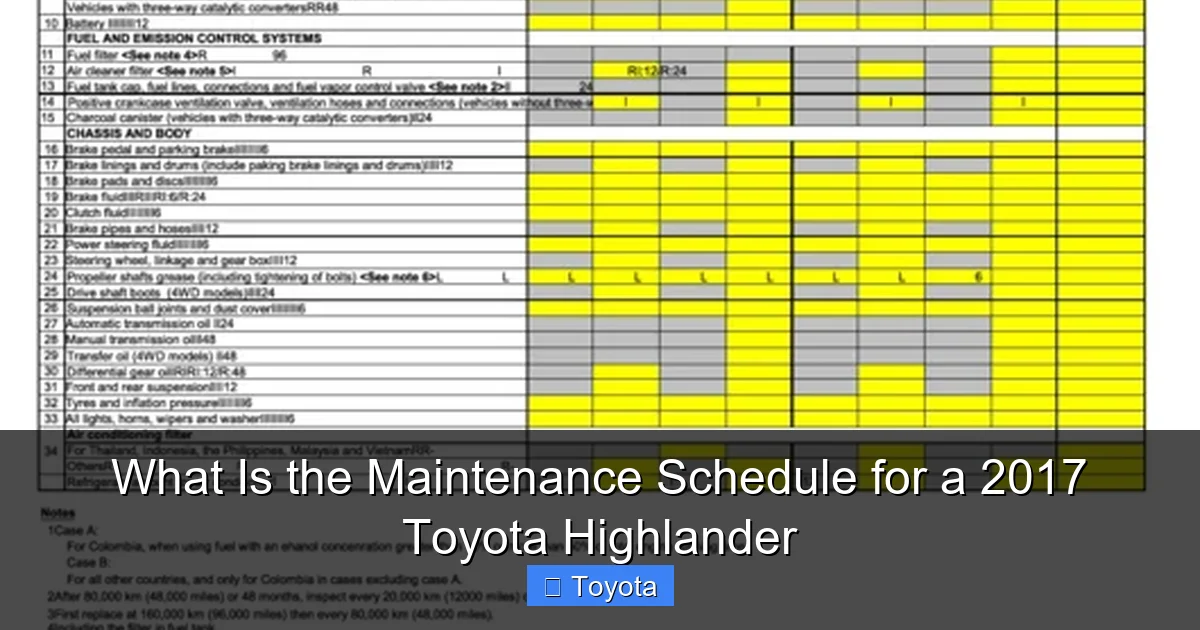
Now, let’s walk through the actual service milestones for your 2017 Highlander. We’ll list the severe condition intervals, as they are the most common. Remember, these are cumulative. A 30,000-mile service includes everything from the 5,000 and 10,000-mile services plus new items.
Visual guide about What Is the Maintenance Schedule for a 2017 Toyota Highlander
Image source: data.formsbank.com
Every 5,000 Miles: The Foundation of Maintenance
This is your most frequent stop. The core service is the oil and filter change. Use only Toyota Genuine Motor Oil or a high-quality synthetic that meets Toyota’s 0W-20 specification. While the oil is drained, the technician should perform a comprehensive safety and fluid check. This is the perfect time to rotate your tires (also required every 5,000 miles). Rotation patterns differ for FWD vs. AWD models, so ensure the shop knows your configuration. They should also inspect all fluid levels (coolant, brake, washer), check the battery, and look for any leaks or worn components. This regular check-up is the single best way to catch small problems before they become big, expensive ones.
Every 10,000 Miles: Adding Essential Checks
At this interval, you repeat the 5,000-mile service (oil, filter, rotation, inspection). Additionally, the cabin air filter should be inspected and replaced if necessary. In severe conditions, this is often needed at 15,000 miles. The mechanic will also inspect the brake pads, rotors, and calipers for wear and condition. They’ll check the drive belts for cracks or fraying and inspect the steering linkage and suspension components for any play or damage. This is a thorough health screen for your SUV’s vital systems.
Every 20,000 to 30,000 Miles: Major Service Landmarks
The 20,000-mile service is essentially a second 10,000-mile service. The 30,000-mile service is a major milestone. It includes all previous services plus the replacement of the engine air filter (critical for performance and fuel economy). The spark plugs are typically replaced at this interval on the 3.5L V6 engine (if equipped). The transmission fluid should be inspected for condition and level; while not always required at 30k, severe conditions may necessitate a change. The brake fluid should be inspected and typically flushed/replaced every 30,000 miles, as it absorbs moisture over time, reducing braking effectiveness. This is also when the fuel system (including the fuel filter, if equipped) gets a detailed inspection.
Every 40,000 to 60,000 Miles: Critical Component Replacement
These intervals involve parts that wear out over time. At 40,000 miles, repeat the 30,000-mile service. The 60,000-mile service is exceptionally comprehensive. It includes all prior services plus a strong likelihood of needing a transmission fluid and filter change (especially for severe service), a coolant system flush (engine and heater core), and a detailed inspection/replacement of all drive belts and hoses. The timing belt (or chain, depending on your specific engine code) must be inspected meticulously. While many 2017 Highlanders use a timing chain (lube-for-life), some markets or specific trims may have a belt. Your owner’s manual is the final authority. This service is often the most expensive single maintenance bill but is crucial for preventing catastrophic engine failure.
The 100,000-Mile Milestone: The Ultimate Refresh
Reaching 100,000 miles is a testament to your Highlander’s durability, but it requires a major overhaul. This service includes everything from the 60,000-mile service plus a complete fluid flush (transmission, differential if AWD, transfer case if AWD, power steering if applicable). All suspension and steering components (ball joints, tie rods, bushings) should be thoroughly inspected and likely replaced. The spark plugs are done again. This is a full “bumper-to-bumper” inspection and refresh designed to address a decade of wear and tear and set the stage for the next 100,000 miles.
In-Depth: Key Maintenance Items Explained
Let’s zoom in on the most important services and why they matter for your specific SUV.
Oil and Filter Changes: The Non-Negotiable Heartbeat
Your Highlander’s 3.5L V6 (or 2.7L I4 in some markets) is a sophisticated engine that demands 0W-20 synthetic oil. This thin oil improves cold-start flow and fuel economy. Using the wrong weight or poor-quality oil can trigger VVT-i (variable valve timing) errors, cause premature consumption, and lead to sludge. Always use a high-quality filter—OEM or a reputable brand like Mobil 1, Wix XP, or K&n. A cheap filter allows contaminants into your clean oil, negating the benefit of the oil change. For severe drivers, 5,000-mile intervals are mandatory. Consider using an oil life monitor if your MID has one, but don’t exceed 5,000 miles in severe conditions regardless of what the monitor says.
Tire Rotation and Pressure: Safety and AWD Health
Rotating tires every 5,000 miles is vital for even wear. On an AWD Highlander, uneven tire tread can cause unnecessary strain on the center differential and transfer case, leading to expensive damage. The correct tire pressure is typically 32-35 PSI (check the sticker on your driver’s door jamb), but it can vary with load. Under-inflated tires increase rolling resistance, killing fuel economy and causing overheating and premature failure. Over-inflated tires reduce the contact patch, harming handling and wear. Use a reliable handheld gauge monthly. For more on general Toyota tire care, you can reference guides on models like the Sienna, as the principles of pressure and rotation are identical across the lineup.
Brake System: Your Lifeline
Brakes are wear items. Inspect pads and rotors at every service (10k/20k/30k intervals). Highlanders are heavy, and towing or mountain driving accelerates wear. Listen for squealing (wear indicator) or grinding (rotor damage). Brake fluid is hygroscopic—it absorbs water from the air over time. This water lowers the fluid’s boiling point, which can cause brake fade or failure under hard use. A brake fluid flush every 30,000 miles is a critical safety service often overlooked. Don’t wait for a soft pedal.
Fluids and Filters: The Vehicle’s Lifeblood
Beyond oil, your Highlander has several critical fluids:
- Engine Coolant: Provides freeze/boil protection and corrosion inhibition. Flush every 60,000-100,000 miles. Never mix colors or types.
- Transmission Fluid: For severe service, change every 60,000 miles. This fluid lubricates and cools the transmission. Dark, burnt-smelling fluid indicates it’s overdue.
- Differential/Transfer Case Fluid (AWD): Often overlooked. This fluid lubricates the rear differential and transfer case. Inspect at 60k, change at 100k.
- Cabin Air Filter: Filters air for your HVAC system. Replace every 15k (severe) to 30k (standard). A clogged filter strains the blower motor and reduces air quality.
- Engine Air Filter: Replace every 30k miles. A dirty filter chokes your engine, reducing power and fuel economy.
Spark Plugs and Other Ignition Parts
Plugs on the 3.5L V6 are typically iridium and last 60,000-100,000 miles. However, at the 30,000-mile mark, they should be inspected. Worn plugs cause misfires, poor fuel economy, and rough idling. Ignition coils and wires (if equipped) should also be checked for resistance and cracks during these major inspections.
Seasonal and Driving Condition Considerations
Your maintenance schedule is a baseline. Smart owners adapt it to their environment and habits.
Winter Preparation is Key
If you live where it snows, your fall service (around October) should include a coolant system check to ensure proper freeze protection (-30°F/-34°C is a good target). Inspect wiper blades and fill the windwasher fluid with a winter formula that won’t freeze. Check your battery—cold cranking amps drop significantly in winter. Have it tested. Ensure your heater and defroster work perfectly. This is also when you should familiarize yourself with your Highlander’s Snow Button. This feature modifies the throttle response and AWD system for better traction on slippery surfaces. It’s a great tool, but it doesn’t replace proper winter tires, which are the single best safety upgrade for snow and ice.
Summer and Hot Weather Focus
Heat is the enemy of fluids and tires. Before summer, double-check your coolant level and condition. A low or weak coolant system can lead to overheating and expensive head gasket damage. Ensure your air conditioning system is charged and functioning—a failing A/C compressor can put extra load on the engine. Check tire pressure more frequently in summer, as heat increases pressure. Don’t overinflate. Inspect coolant and transmission hoses for signs of softening or cracking from heat exposure.
Towing and Heavy Use
If you regularly tow a trailer (up to your Highlander’s 5,000-lb limit) or carry heavy loads, you are in severe service. Be extra diligent with transmission fluid changes (consider every 40,000 miles). The transmission works much harder when loaded. Ensure your brakes are in perfect condition before any trip. Consider upgrading to high-performance brake pads if you do frequent mountain descents. After a heavy towing trip, check all fluid levels and inspect tires for unusual wear or heat buildup.
DIY vs. Professional Service: Finding the Right Balance
Not all maintenance requires a dealership or shop. Knowing what you can safely do saves money and builds knowledge.
Tasks Perfect for the Enthusiast
- Oil and Filter Change: With the right tools, jack, and a safe workspace, this is the most common DIY task. Dispose of old oil properly at a designated recycler.
- Cabin Air Filter: Usually located behind the glovebox and takes minutes to replace with a screwdriver. A $20 part can save you $80 in labor.
- Engine Air Filter: Typically in a black box on the engine bay. Unclip, swap, and re-clip. Takes 5 minutes.
- Wiper Blades: Simple clip-on designs. Replace them twice a year for optimal visibility.
- Basic Inspections: Check fluid levels (oil, coolant, washer) monthly. Inspect tires for pressure, tread depth, and damage.
Jobs Best Left to the Professionals
- Brake Fluid Flush: Requires a special machine to purge all air and old fluid from the system. Improper bleeding leads to spongy brakes.
- Transmission Fluid Change: While a drain-and-fill is possible, a true “flush” (using the transmission’s own pump) requires specialized equipment. An incomplete service can be worse than none.
- Timing Belt/Chain Inspection: This requires extensive disassembly. A mistake can destroy your engine. Trust the experts.
- Differential/Transfer Case Service: Requires specific fluid types and fill procedures. Incorrect fluid or level causes noise and failure.
- Major Suspension Work: Ball joints, control arms, and struts require proper torque, alignment, and sometimes pressing out old bushings.
The Importance of Meticulous Records
Whether you DIY or go to a shop, keep every receipt. Create a digital folder or a physical binder. Note the date, mileage, service performed, and parts used (part numbers if possible). For warranty purposes, use Toyota Genuine Parts or parts meeting Toyota’s specifications. For a vehicle like the Highlander, known for its longevity, a complete, unbroken service history is worth thousands of dollars at resale time. It’s proof of a well-cared-for vehicle and gives any future buyer complete peace of mind.
Conclusion: Your Investment in Reliability
The maintenance schedule for your 2017 Toyota Highlander isn’t just a suggestion from the manufacturer—it’s a science-based roadmap designed to prevent wear, ensure safety, and deliver the legendary Toyota reliability you expect. By understanding the two reminder systems, accurately assessing your driving conditions, and adhering to the severe service intervals (which likely apply to you), you are taking proactive control of your vehicle’s health. Don’t view maintenance as a cost; see it as an investment. An investment that prevents a $5,000 transmission repair, ensures your family’s safety in a braking emergency, and guarantees that your Highlander is ready for the next adventure, whether it’s a road trip or the daily school run. Start today: check your owner’s manual, review your last service record, and schedule your next appointment. Your future self, and your Highlander, will thank you.
Frequently Asked Questions
What is the absolute minimum oil change interval for a 2017 Toyota Highlander?
Under ideal, standard driving conditions (long highway trips, mild climate), Toyota states 10,000 miles is acceptable with 0W-20 synthetic oil. However, for the vast majority of drivers experiencing any severe conditions, the minimum is 5,000 miles. When in doubt, change it at 5,000 miles. It’s the cheapest insurance you can buy for your engine.
How do I reset the maintenance light on my 2017 Highlander after an oil change?
The process is done via the Multi-Information Display using the steering wheel stalk buttons. You’ll go to “Settings,” then “Maintenance,” and select “Oil Maintenance” to reset the interval. It’s a simple but specific sequence. If you’re unsure, your technician should do it, or you can follow a detailed step-by-step guide for how to reset the maintenance light on a 2017 Toyota Highlander.
My driving is mostly city with short trips. Does that mean I’m in the “severe” schedule?
Almost certainly, yes. If your trips are regularly under 10 miles in stop-and-go traffic, especially in cold weather, you are operating under severe conditions. This means you should follow the 5,000-mile oil change interval and the more frequent cabin air filter replacements. The severe schedule is designed for exactly this type of real-world use.
What is the correct tire pressure for a 2017 Toyota Highlander?
The recommended pressure is printed on a sticker on the driver’s side door jamb. For most trims and loads, it’s typically 32 PSI for the front and 32-35 PSI for the rear, but always use the spec on your specific vehicle’s sticker. This pressure is for cold tires (driven less than 2 miles). Check pressures monthly and before long trips. Proper inflation is critical for safety, tire wear, and fuel economy.
I just bought a used 2017 Highlander with no service history. What should I do first?
Assume the worst-case scenario. Start with a complete 30,000-mile severe service. This means full synthetic oil/filter change, tire rotation, new engine and cabin air filters, full fluid inspection (and likely flush of brake fluid and coolant), brake inspection, and a full safety check of belts, hoses, and suspension. This “reset” gives you a known baseline of maintenance and helps identify any neglected items.
Can I use any 0W-20 synthetic oil, or does it have to be Toyota brand?
You can use any high-quality 0W-20 synthetic oil that meets the API SN or SP and ILSAC GF-6 standards. Look for these certifications on the bottle. Toyota Genuine Oil is formulated to their specs and is a safe choice, but brands like Mobil 1, Pennzoil Platinum, and Castrol EDGE are also excellent. Never use conventional oil or the wrong viscosity. Using the correct oil is critical for engine longevity and warranty compliance.
