What Is the Highest Recorded Mileage on a Toyota Tacoma?

Contents
- 1 Key Takeaways
- 2 📑 Table of Contents
- 3 The Million-Mile Marvel: A Legend on Wheels
- 4 Why the Tacoma is Built to Last: Engineering for the Ages
- 5 The Unsexy Truth: Obsessive Maintenance is the Real Secret
- 6 Beyond the Record: Other High-Mileage Tacoma Heroes
- 7 What to Look For: Buying a High-Mileage Tacoma
- 8 Your Action Plan: Applying the Lessons to Your Tacoma
- 9 Conclusion: The Tacoma Legend Is Built by Owners
- 10 Frequently Asked Questions


The highest verified mileage on a Toyota Tacoma is over 1.2 million miles, achieved by a 1996 model owned by Victor Shepard. This legendary status isn’t just a fluke; it’s a testament to the Tacoma’s bulletproof engineering, legendary reliability, and, most critically, meticulous, consistent maintenance. While reaching a million miles is exceptionally rare, Tacomas regularly surpass 300,000 to 500,000 miles with proper care, making them one of the most durable vehicles on the planet.
Key Takeaways
- The Verified Record is Over 1.2 Million Miles: A 1996 Toyota Tacoma holds the official, documented record, proving the platform’s ultimate potential with flawless maintenance.
- Engineering is Only Half the Story: The Tacoma’s robust design, including its simple inline-4 and bulletproof transmissions, provides the foundation, but obsessive owner care is the real key to extreme mileage.
- Maintenance is Non-Negotiable: The common thread among all high-mileage Tacomas is strict adherence to factory maintenance schedules, especially frequent oil changes, fluid flushes, and timing belt replacements.
- 300,000+ Miles is Achievable and Common: While a million is rare, Tacomas comfortably reaching 300,000, 400,000, and even 500,000 miles are frequent in the used market, a testament to their everyday durability.
- Inspect Before You Buy a High-Mileage Example: A well-documented service history is crucial. Look for signs of neglect and have a trusted mechanic check for rust, drivetrain wear, and suspension components.
- It’s a Testament to a Bygone Era of Simplicity: The highest-mileage examples are from the 1990s and early 2000s, benefiting from less complex electronics and more over-engineered mechanical components.
- Your Tacoma’s Longevity Starts Today: The principles from the million-mile truck apply to every model: use quality parts, fluids, and never skip scheduled service, no matter how mundane it seems.
📑 Table of Contents
- The Million-Mile Marvel: A Legend on Wheels
- Why the Tacoma is Built to Last: Engineering for the Ages
- The Unsexy Truth: Obsessive Maintenance is the Real Secret
- Beyond the Record: Other High-Mileage Tacoma Heroes
- What to Look For: Buying a High-Mileage Tacoma
- Your Action Plan: Applying the Lessons to Your Tacoma
- Conclusion: The Tacoma Legend Is Built by Owners
The Million-Mile Marvel: A Legend on Wheels
When you hear about a car hitting a million miles, it sounds like automotive folklore. It’s the stuff of truck stop legends and internet forums. But for one particular Toyota Tacoma, it’s cold, hard, documented fact. The undisputed, highest recorded mileage on a Toyota Tacoma—and indeed, on most vehicles—belongs to a 1996 model owned by Victor Shepard of Mesa, Arizona. As of the last verified reports, this white workhorse had sailed past an astonishing 1,220,000 miles. It wasn’t a publicity stunt. It was a daily driver, a tool for a tradesman, that logged its incredible distance through 26 years of faithful service.
Seeing that odometer roll over to seven figures is a jaw-dropping moment. It forces us to ask: How is this even possible? Is it a freak of nature? The answer, as it turns out, is a powerful combination of old-school engineering and new-school discipline. This truck isn’t just a survivor; it’s a masterclass in vehicle stewardship. Its story isn’t just about a number; it’s a blueprint for anyone who wants their own Tacoma to be a lifelong companion. Before we dive into the secrets of this legend, let’s first understand what makes the Tacoma a platform capable of such an epic journey.
Why the Tacoma is Built to Last: Engineering for the Ages
To understand the highest recorded mileage on a Toyota Tacoma, you must first appreciate its DNA. The Tacoma, especially those from the mid-1990s to the mid-2000s, was designed and built with a specific, rugged purpose in mind: to be a reliable, no-nonsense work truck for the American landscape. This philosophy permeated every nut, bolt, and component.

Visual guide about What Is the Highest Recorded Mileage on a Toyota Tacoma?
Image source: autoowa.com
Over-Engineered Powertrains
At the heart of these early Tacomas were the legendary 2RZ-FE (2.4L) and 3RZ-FE (3.4L) inline-4 engines. These were not high-revving, peaky racing motors. They were low-stress, torque-focused engines designed for durability. Their iron block and head construction could absorb incredible heat and pressure. The 3.4L, in particular, is renowned for its massive low-end grunt and a reputation for easily surpassing 300,000 miles when cared for. Paired with these engines were transmissions built like tanks. The 5-speed manual (R151) is arguably one of the strongest light-duty manual gearboxes ever made, known for its simplicity and strength. The 4-speed automatic (A340F) was also exceptionally robust, with a simple, proven design that, with regular fluid changes, can last for hundreds of thousands of miles. You won’t find complex dual-clutch setups or tiny, high-pressure turbochargers here—just proven, mechanical simplicity.
The Frame and Body: A Rust-Proof Legacy (Mostly)
One of the most critical factors for extreme longevity is a solid, un-rusted frame. The second-generation Tacomas (1995-2004) are famous for their fully-boxed, heavily-galvanized frame rails. Toyota used an advanced electro-deposition coating process that provided exceptional corrosion resistance. While no vehicle from this era is completely immune to rust—especially in the “rust belt” states where road salt is king—the Tacoma’s frame is notoriously resilient. The million-mile truck spent its life in the dry Arizona climate, a huge advantage. For the vast majority of Tacomas, body and frame rust is the ultimate killer, not mechanical failure. This inherent resistance to corrosion gives the core structure a fighting chance to last for decades.
Simplicity is the Ultimate Sophistication
Pop the hood of a 1996 Tacoma. You’ll see an engine bay with ample space, straightforward hose and wire routing, and components that are easy to access. There’s no tangled mess of sensors, no plastic engine covers hiding the works. This mechanical transparency is a blessing for longevity. It means DIY maintenance is easier, parts are cheaper and more readily available, and there are simply fewer complex, failure-prone electronic modules. As one mechanic who has worked on countless high-mileage Tacomas puts it, “These trucks are 90% mechanical. You can fix almost anything with a basic set of tools and a factory manual.” That philosophy of user-friendly serviceability is a huge reason why owners can keep them running indefinitely.
The Unsexy Truth: Obsessive Maintenance is the Real Secret
You can have the most over-engineered truck on the planet, but without disciplined care, it will succumb to wear and tear. The single most important factor in the highest recorded mileage on a Toyota Tacoma isn’t a special part or a magic additive—it’s a human: an owner who treated maintenance as a religion. Victor Shepard didn’t just change the oil when the light came on; he changed it every 3,000 miles, without fail, using high-quality oil and filters. This philosophy extended to every single system.

Visual guide about What Is the Highest Recorded Mileage on a Toyota Tacoma?
Image source: andymohrtoyota.com
The Holy Trinity: Oil, Fluids, and Filters
Engine oil is the lifeblood. Frequent changes prevent sludge buildup, which is the silent killer of engines. But it doesn’t stop there. Transmission fluid, differential fluid, power steering fluid, and coolant all have finite lifespans. The million-mile truck likely had its transmission fluid changed every 30,000-60,000 miles. Differential fluid, which lubricates the axles, is often neglected but is critical for preventing expensive whining and gear wear. Coolant breaks down over time, losing its anti-corrosion and boiling point properties, leading to overheating and internal rust. A strict, proactive fluid maintenance schedule is non-negotiable for extreme mileage.
Timing Belts and Water Pumps: The Critical Intervals
On the 3.4L engine, the timing belt is a wear item with a recommended interval of every 90,000 miles. This belt synchronizes the engine’s valves and pistons. If it snaps, the pistons can collide with the valves, causing catastrophic, often terminal, engine damage. Replacing it on schedule is one of the most important—and expensive—maintenance items. The million-mile owner did this religiously. The water pump, often driven by the same belt, is typically replaced at the same time as a preventative measure. Ignoring this interval is the single biggest gamble you can take with a high-mileage Tacoma’s heart.
Practical Tip: When buying any used Tacoma, especially a high-mileage one, the first question must be: “Do you have records of the timing belt/water pump service?” If the answer is vague or “I think so,” walk away or budget for an immediate replacement. This is where a link to an article about where the oil filter is located is useful, as it speaks to the owner’s likely attention to basic, accessible maintenance points.
Beyond the Record: Other High-Mileage Tacoma Heroes
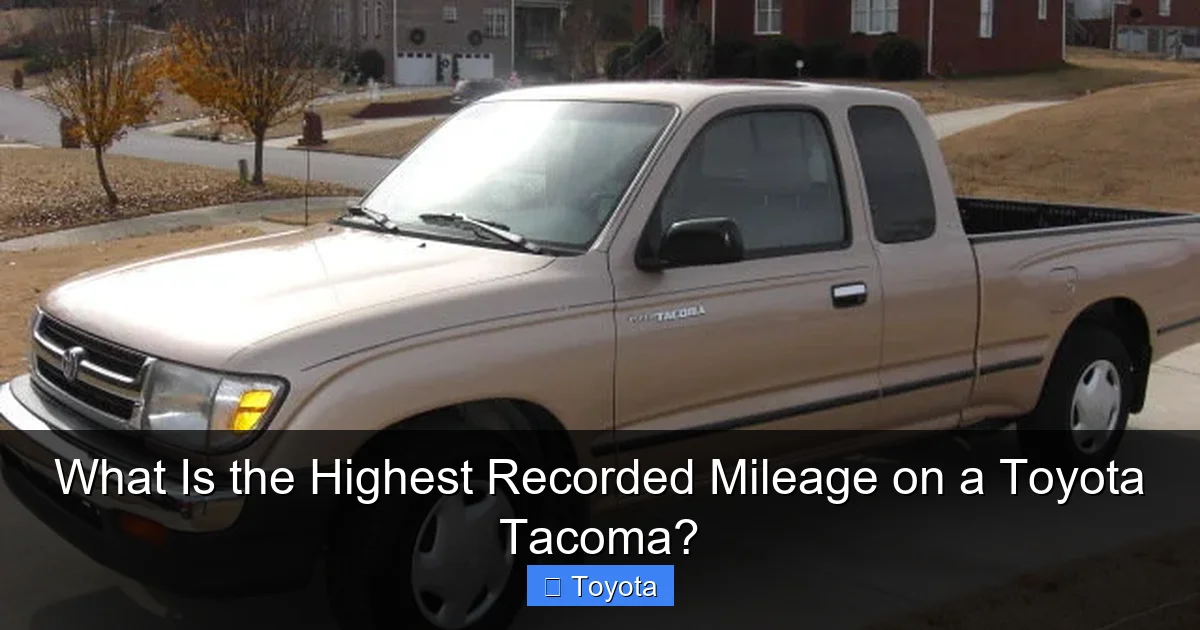
While Victor Shepard’s truck holds the official crown, it is far from alone in the 500,000+ mile club. Scour any Tacoma forum (Tacoma4G, Reddit’s r/ToyotaTacoma), and you’ll find countless threads celebrating these geriatric warriors. A 2001 double cab with 550,000 miles, a 2005 access cab at 480,000, a 1999 regular cab pushing 600,000. The stories are remarkably similar: original engine, original transmission (or a transmission rebuilt at 400,000 miles), and a cabin that, while worn, is still functional. The common denominator is always the same: a single, long-term owner who kept every receipt, followed the manual to the letter, and addressed small problems before they became big ones.

Visual guide about What Is the Highest Recorded Mileage on a Toyota Tacoma?
Image source: andymohrtoyota.com
These community examples prove a vital point: the million-mile truck isn’t an anomaly; it’s the logical extreme of a very reliable formula. It shows that the Tacoma’s potential isn’t limited to a single pristine example in a dry climate. With committed ownership, these trucks can deliver incredible service in a variety of conditions, from snowy Minnesota to humid Florida. The key is that unwavering commitment to service. It turns a reliable truck into an heirloom.
What to Look For: Buying a High-Mileage Tacoma
The idea of buying a Tacoma with 300,000, 400,000, or more miles can be thrilling or terrifying, depending on its history. A neglected high-mileage truck is a money pit. A well-maintained one can be the best value in the used car market. So, how do you tell the difference?
The Holy Grail: A Complete Service History
This is your #1 priority. A stack of receipts, a detailed maintenance logbook, or even a digital record from a single mechanic is worth its weight in gold. It proves the owner was proactive. You should see consistent oil change intervals, timing belt/water pump records, transmission and differential fluid services, and brake jobs. Gaps in the history are red flags. If the owner says “I did it myself” but has no receipts for parts, take that with a grain of salt. Ask for specifics.
The Rust Report
Get underneath the truck. Use a magnet to check for bondo on the frame (original frame metal won’t attract a magnet if it’s fully galvanized). Look at the frame rails, especially behind the rear wheels and along the sills. Surface rust is one thing; deep, pitting rust that compromises structural integrity is a deal-breaker. Also, check the cab mounts and the areas where the body attaches to the frame. Severe rust here can lead to a “separating” cab, which is incredibly dangerous and expensive to fix.
Drivetrain and Suspension Audit
On a test drive, listen and feel. Does the transmission shift smoothly, or are there hard clunks or delayed engagement? Does the engine run cool and steadily, or does it run hot or have a rough idle? A slight whine from the differential at certain speeds is common, but a roaring noise is not. Check for leaks around the transmission, differential, and transfer case (if 4×4). Push down on each corner of the truck and release; it should bounce once and settle. More than that indicates worn shocks or springs. Listen for clunks over bumps, which point to worn ball joints, tie rod ends, or control arm bushings. For any Tacoma, knowing how to pop the hood safely is a basic skill that allows you to check fluid levels and general engine bay cleanliness, which can be a quick indicator of owner pride.
The Interior Clues
The interior tells a story. Is the fabric shredded or the driver’s seat bolster completely worn through? This suggests hard use. Is it overly worn but clean and intact? That suggests long-term, careful use. Do all the electrical accessories work—windows, locks, HVAC, stereo? While not deal-breakers, multiple failed switches or a malfunctioning HVAC system can indicate a general lack of care or expensive upcoming repairs. A clean, well-kept interior, even with high mileage, often correlates with a well-maintained mechanical history.
Your Action Plan: Applying the Lessons to Your Tacoma
Maybe you just bought a Tacoma with 150,000 miles. Maybe you’ve had your 2005 model since new and it’s now at 220,000. The goal isn’t necessarily to chase a million miles, but to maximize reliability, value, and the joyful years you get from your truck. The principles from the world-record holder are your guide.
Embrace the Schedule, Not the Light
Don’t wait for the maintenance required light. Use your owner’s manual as your bible. Set reminders for oil changes based on time/miles, not just the light. For severe driving conditions (towing, dusty roads, extreme temps), shorten all intervals. Use the oil weight and specification (often 0W-20 or 5W-30 for newer models, 5W-30 for older) that Toyota calls for. Don’t cheap out on filters.
Proactive, Not Reactive, Component Replacement
Learn the major service intervals. At around 100,000 miles, plan for a major service: all fluids, spark plugs, possibly a coolant system overhaul (thermostat, hoses, water pump). At 120,000-150,000 miles on a 3.4L, budget for the timing belt/water pump job. This is an expensive service ($800-$1,200), but it’s a fraction of the cost of an engine rebuild. See it as an investment. Similarly, listen for the first signs of a failing alternator or starter and replace them before they strand you.
Keep It Clean and Protected
Rust is the enemy. Wash your truck regularly, especially in winter or after driving on salted roads. Pay special attention to the undercarriage. Apply a quality undercoating if you live in a corrosive environment. Keep the interior clean to prevent wear and odors that are impossible to remove. A clean truck is a truck its owner cares about, and that care translates to the mechanical side.
Build a Relationship with a Trusted Mechanic
Find a good, independent Toyota specialist or a trustworthy shop. Take your truck there for major services. They will learn your truck’s history and can spot developing problems early. This relationship is priceless. They can also help you understand which wear items are normal for your model/year and which are precursors to failure. Understanding features like Auto LSD can help you use your truck correctly and avoid unnecessary drivetrain stress, contributing to long-term health.
Conclusion: The Tacoma Legend Is Built by Owners
The highest recorded mileage on a Toyota Tacoma—over 1.2 million miles—stands as a monumental achievement. It is a testament to a specific era of thoughtful, robust engineering from Toyota. But more powerfully, it is a monument to one person’s unwavering dedication. That white 1996 Tacoma didn’t become a million-miler by accident. It became one through thousands of oil changes, hundreds of fluid flushes, and a meticulous, unglamorous commitment to the schedule in the owner’s manual. It proves that the Tacoma’s legendary status isn’t just marketing hype; it’s a tangible, measurable reality.
For the rest of us, the lesson is clear. Your Tacoma has the potential to be an incredibly durable, long-lasting vehicle. The engineering foundation is there. The final variable is you. By embracing proactive maintenance, addressing issues small and large with equal seriousness, and treating your truck with respect, you write the next chapter in the Tacoma’s story of longevity. You may not hit a million miles, but you can absolutely achieve 300,000, 400,000, or more, creating your own reliable, trusted companion for the long haul. The road to extreme mileage is paved not with special parts, but with consistent, caring action.
Frequently Asked Questions
Is 300,000 miles too much for a Toyota Tacoma?
Not at all. For a well-maintained Tacoma, 300,000 miles is considered the beginning of its “high-mileage” phase, not the end. Many Tacomas regularly surpass this milestone with their original engine and transmission, provided they have a complete service history. The key is the truck’s documented care, not just the odometer reading.
What are the most common failures on very high-mileage Tacomas?
Common wear items include suspension components (ball joints, control arm bushings, shocks), exhaust system parts (mufflers, hangers), and minor electrical gremlins (window regulators, switch failures). The major components—engine block, transmission case, frame—are the real strengths. The most critical potential failure is a neglected timing belt on 3.4L engines, which can cause catastrophic engine damage.
How long do Tacoma transmissions last?
With regular fluid changes, both the manual (R151) and automatic (A340F) transmissions in pre-2005 Tacomas are known to last 300,000 to 500,000 miles or more. The automatic’s longevity is directly tied to fluid service. Neglecting transmission fluid is the fastest way to shorten its life. The manual is simpler and often even more resilient.
Will a high-mileage Tacoma hold its value?
Absolutely. The used Tacoma market is famously strong due to their reputation for reliability. A high-mileage Tacoma with a clean title, no rust, and a solid service history can still command a premium price. Buyers specifically seek out these proven, long-lasting trucks, understanding that a well-documented 250,000-mile example can be a better buy than a neglected 150,000-mile one.
Should I buy a high-mileage Tacoma with no service records?
Extreme caution is advised. Without records, you are buying a mystery. The vehicle could be a time bomb with a neglected timing belt or a transmission on its last legs. You can have a pre-purchase inspection, but even a mechanic can’t see past abuse or skipped services. It’s generally recommended to only consider high-mileage examples with comprehensive, verifiable maintenance documentation.
What is the most important maintenance item for a high-mileage Tacoma?
If we must choose one, it is the timing belt/water pump service on the 3.4L engine at the recommended interval (typically 90,000 miles). This is an interference engine design, meaning a broken belt causes severe internal damage. Missing this service is the single greatest risk to the engine’s survival. For overall health, however, consistent oil and fluid changes are the foundation that supports all other components.