What Is the Gas Mileage for a Toyota Tacoma in 2023?

Contents
- 1 Key Takeaways
- 2 📑 Table of Contents
- 3 Official EPA Gas Mileage Ratings for the 2023 Tacoma
- 4 The Gap Between EPA Estimates and Real-World MPG
- 5 Tacoma MPG vs. The Competition: A 2023 Midsize Truck Showdown
- 6 Practical Tips to Maximize Your 2023 Tacoma’s MPG
- 7 Understanding Your Truck’s Actual MPG: The Math
- 8 The Future: What to Expect from the Next-Gen Tacoma
- 9 Conclusion: A Realistic View of Tacoma Fuel Economy
- 10 Frequently Asked Questions
Reflective Safety Triangle

Portable Work Light
Foam Cannon

Windshield Cleaning Tool
The 2023 Toyota Tacoma’s gas mileage varies by configuration, with the most efficient 4×2 V6 model achieving an EPA-estimated 20 mpg city / 24 mpg highway. The 4×4 models and those with the TRD Off-Road package see a slight decrease. Real-world results often differ from EPA estimates based on driving habits, load, and terrain.
So, you’re eyeing a 2023 Toyota Tacoma. You love the idea of its legendary reliability, off-road prowess, and rugged good looks. But then a practical question bubbles up: “What is the gas mileage for a Toyota Tacoma in 2023?” It’s a fair and crucial question. After all, this is a truck you might be driving every day, towing a weekend toy, or conquering backcountry trails. Fuel costs are a real part of the ownership equation.
Let’s be clear upfront: the Toyota Tacoma is not a hybrid. It’s not a small, efficient crossover. It’s a midsize pickup truck with a body-on-frame design, built to haul and endure. Because of that, its fuel economy numbers won’t compete with a Prius or even a modern V6 SUV. But within its class—midsize trucks—the Tacoma’s efficiency is a key talking point, especially as its competitors have evolved. This guide will break down the official EPA numbers, explain what they *really* mean, dive into the factors that make your actual mileage vary wildly, and give you actionable tips to get the most miles per gallon from your mid-size workhorse.
Key Takeaways
- EPA ratings are estimates: The official 20-24 mpg for the V6 is a lab-tested benchmark, not a guarantee for your daily drive.
- Configuration matters: 4×2 models are consistently more efficient than 4×4. The automatic transmission is standard and more efficient than the manual (which is discontinued for 2023).
- Driving style is key: Aggressive acceleration, high speeds, and excessive idling can drop your real-world MPG by 20% or more.
- Maintenance impacts efficiency: Proper tire inflation, clean air filters, and regular oil changes are critical for hitting target fuel economy.
- Accessories add drag: Roof racks, large off-road tires, and aftermarket bumpers can significantly reduce highway fuel economy.
- Fuel type is fixed: All 2023 Tacomas require regular 87-octane gasoline; using premium offers no benefit. See our guide on what gas a Toyota Tacoma takes.
- New model changes: The 2024 redesign promises hybrid options, but for 2023, you’re limited to the proven but aging V6 powertrain.
📑 Table of Contents
- Official EPA Gas Mileage Ratings for the 2023 Tacoma
- The Gap Between EPA Estimates and Real-World MPG
- Tacoma MPG vs. The Competition: A 2023 Midsize Truck Showdown
- Practical Tips to Maximize Your 2023 Tacoma’s MPG
- Understanding Your Truck’s Actual MPG: The Math
- The Future: What to Expect from the Next-Gen Tacoma
- Conclusion: A Realistic View of Tacoma Fuel Economy
Official EPA Gas Mileage Ratings for the 2023 Tacoma
The U.S. Environmental Protection Agency (EPA) puts every new vehicle through standardized tests to estimate city, highway, and combined fuel economy. For the 2023 Tacoma, the story is straightforward because there’s only one engine option, but drivetrain choice makes a difference.
The Powertrain: One Engine to Rule Them All
For 2023, Toyota offers a single engine across all Tacoma trims: a 3.5-liter V6 (2GR-FKS) producing 278 horsepower and 265 lb.-ft. of torque. The long-running 2.7-liter 4-cylinder was discontinued after the 2021 model year. This V6 is paired exclusively with a 6-speed automatic transmission. The manual transmission option, a beloved feature for enthusiasts, was also discontinued for 2023. So, every new 2023 Tacoma you can buy from a dealer will have this specific V6/automatic combo.
MPG Breakdown by Drivetrain
The choice between 4×2 (two-wheel drive) and 4×4 (four-wheel drive) is the primary factor affecting the EPA rating. The added weight, friction, and mechanical complexity of the 4×4 system inevitably reduce fuel efficiency.
- 2023 Tacoma 4×2 (2WD): 20 mpg city / 24 mpg highway / 22 mpg combined. This is the most efficient configuration. If your life is mostly on pavement and you don’t need serious off-road or severe weather capability, this model will give you the best fuel numbers.
- 2023 Tacoma 4×4 (4WD): 18 mpg city / 22 mpg highway / 19 mpg combined. This is the more common configuration and the one most people think of when they picture a Tacoma. The 2 mpg drop across the board is the direct cost of the part-time 4WD system’s added weight and parasitic drag.
It’s important to note that these ratings apply to the base SR and mid-grade TRD Sport, TRD Off-Road, and Limited trims. The heavy-duty TRD Pro model, with its lifted suspension, all-terrain tires, and heavy-duty bumper, is not rated separately by the EPA. Its real-world mileage will be lower than the standard 4×4 ratings, often by a significant margin, due to increased rolling resistance and aerodynamic drag.
The Gap Between EPA Estimates and Real-World MPG
Here’s where the rubber meets the road. The EPA numbers are a fantastic baseline for comparison shopping, but they are not a promise. Think of them as a best-case scenario achieved under very specific, gentle test conditions. Your real-world “miles per gallon” will be a unique number shaped by a dozen variables.
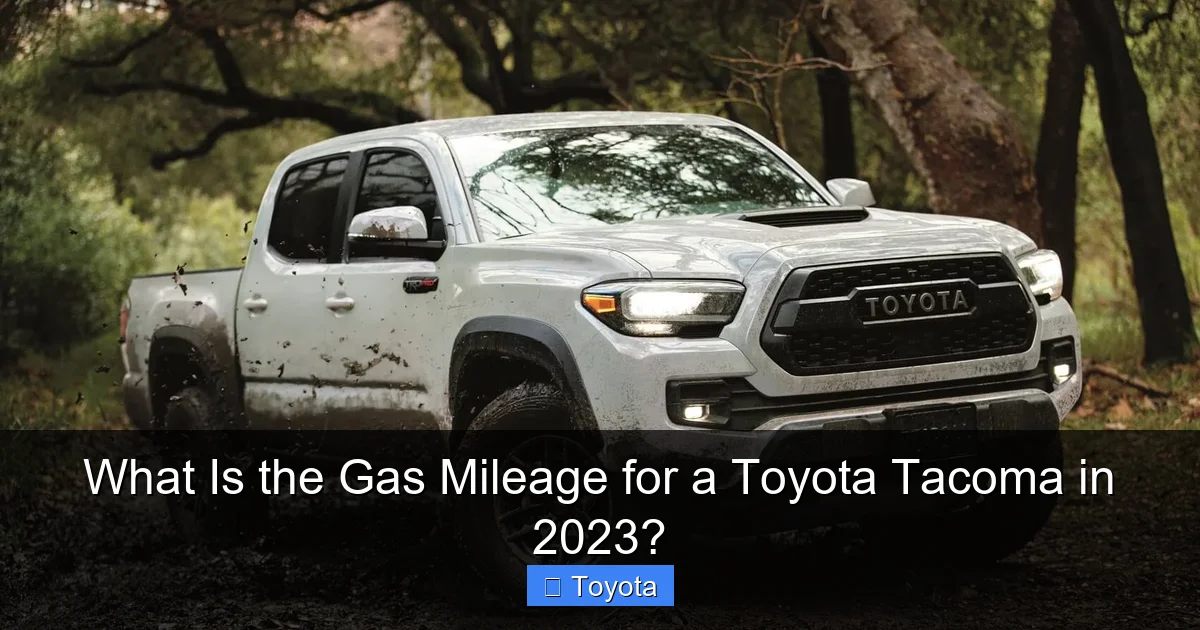
Visual guide about What Is the Gas Mileage for a Toyota Tacoma in 2023?
Image source: andymohrtoyota.com
Driving Environment: City vs. Highway
The EPA’s city test simulates stop-and-go traffic with an average speed of 21 mph and many idling periods. The highway test averages 48 mph with no stops. Most drivers have a mixed commute. If your “city” driving involves highway speeds with few lights, your average might skew closer to the highway number. If you’re in dense urban traffic with constant acceleration from stoplights, you’ll likely see numbers below the EPA city estimate. The Tacoma’s V6 is powerful, but it’s working hard in city traffic.
Driving Style: The Lead Foot Tax
This is the single biggest factor you control. The Tacoma’s V6 is eager. It’s fun to use that power to merge onto the highway or pass a slow-moving vehicle. But every time you slam the accelerator, you’re injecting a precise amount of fuel to meet that demand. Rapid acceleration uses exponentially more fuel than smooth, gradual speed increases. Similarly, cruising at 75 mph on the highway will burn significantly more fuel than cruising at 65 mph due to exponentially increased aerodynamic drag. Adopting a smoother, more anticipatory driving style can easily net you 2-4 extra mpg.
Load, Altitude, and Terrain
Are you carrying a ton of tools in the bed? Towing a 5,000-lb trailer? Driving through the mountains? All of these dramatically increase the workload on the engine. Towing is the biggest mileage killer—expect to see 30-50% lower MPG while towing near the Tacoma’s maximum capacity (6,400 lbs for 4×2, 6,400 lbs for 4×4). High altitude reduces air density, which can slightly reduce efficiency in a naturally aspirated engine like the Tacoma’s. Constant uphill grades require sustained power, draining the tank faster.
Vehicle Maintenance and Health
A neglected truck is an inefficient truck. Here’s a quick checklist:
- Tire Pressure: Under-inflated tires increase rolling resistance. Check monthly. The factory recommendation is on the driver’s door jamb sticker, not the tire sidewall.
- Air Filter: A clogged engine air filter chokes the engine, making it work harder for the same power. Replace it as per your maintenance schedule, or sooner if you drive in dusty conditions.
- Oil: Using the correct grade and viscosity of oil (typically 0W-20) reduces internal engine friction. Old, sludgy oil hurts efficiency.
- Spark Plugs: Worn plugs cause misfires and poor combustion. Replace them on schedule.
Accessories and Aerodynamics
The Tacoma’s boxy shape isn’t aerodynamic. Adding to that makes it worse. A roof rack, even without a cargo box, creates significant turbulent drag at highway speeds, potentially costing 1-3 mpg. Large, knobby all-terrain tires (like those on the TRD Pro) have higher rolling resistance than standard all-season tires. Aftermarket bumpers and larger tires also add unsprung weight and rotational mass, which the engine must work to spin.
Tacoma MPG vs. The Competition: A 2023 Midsize Truck Showdown
How does the 2023 Tacoma’s fuel economy stack up? Frankly, it’s a mixed bag. The midsize truck segment is aging, with the Tacoma and Chevrolet Colorado/GMC Canyon being the oldest designs. The Ford Ranger is newer but still uses a similar powertrain philosophy. The new for 2022 Nissan Frontier is a direct rival.

Visual guide about What Is the Gas Mileage for a Toyota Tacoma in 2023?
Image source: andymohrtoyota.com
| 2023 Model (V6/4×4) | EPA City/Hwy/Combined | Key Notes |
|---|---|---|
| Toyota Tacoma | 18 / 22 / 19 | Reliable, proven, but oldest design. No turbo or hybrid. |
| Ford Ranger | 20 / 24 / 21 | Uses a 2.3L turbo 4-cylinder (270 hp). More efficient, less torque than Tacoma V6. |
| Chevrolet Colorado | 18 / 22 / 19 (2WD: 20/24/22) | Offers a 2.7L turbo 4-cylinder (310 hp) or 2.5L 4-cyl diesel. Turbo gas model is similar to Tacoma. |
| Nissan Frontier | 18 / 22 / 19 | Uses the same 3.8L V6 (310 hp) as the aging Nissan Titan. Power is up, efficiency is similar to Tacoma. |
The takeaway? The Tacoma is competitive on paper with the Colorado and Frontier, but it trails the more efficient, turbocharged Ford Ranger. However, the Ranger’s turbo 4-cylinder doesn’t quite match the Tacoma’s V6 for low-end grunt and traditional truck feel. The 2024 Tacoma is set to receive a complete redesign with a turbo 2.4L 4-cylinder and a hybrid option, which should dramatically improve these numbers. For 2023, you’re buying into the last of the old guard, where fuel economy is acceptable but not class-leading.
Practical Tips to Maximize Your 2023 Tacoma’s MPG
You’ve bought the truck. Now, how do you squeeze every last drop of gasoline from its tank? It’s about smart habits and smart choices.

Visual guide about What Is the Gas Mileage for a Toyota Tacoma in 2023?
Image source: cdn.dlron.us
Driving Habits That Save Fuel
This is your most powerful tool. Use the “ECON” mode if your Tacoma has it (available on many trims). This remaps the throttle response to be less aggressive and adjusts the climate control to be more efficient. But the real change is behavioral:
- Accelerate Slowly: Pretend there’s an egg under your foot. Take 5-7 seconds to reach cruising speed from a stop.
- Maintain Steady Speeds: Use cruise control on flat highways. It’s more consistent than your right foot.
- Anticipate Traffic: Look far ahead. Slow down gradually before a red light instead of braking hard at the last second.
- Limit Idling: Modern engines don’t need to “warm up.” Drive gently for the first few minutes. If you’re stopped for more than 60 seconds (outside of traffic), turn the engine off.
Maintenance Must-Dos
Stick to the factory maintenance schedule religiously. A well-tuned engine is an efficient one. Pay special attention to:
- Tire Pressure: Check it cold, once a month. The factory spec is typically 30-33 PSI, but it can vary by trim and load. Proper tire pressure is a universal fuel-saving tip across all vehicles.
- Use Recommended Oil: Toyota specifies 0W-20 synthetic. Don’t deviate.
- Wheel Alignment: A misaligned truck drags its tires. Get it checked after hitting a pothole or curb.
Smart Accessory Choices
If you need a roof rack for occasional cargo, remove it when not in use. The same goes for heavy front bumper guards. When it’s time for new tires, consider a low-rolling-resistance all-season tire if you do mostly on-road driving. Save the aggressive all-terrains for dedicated off-road use. Every 100 lbs of cargo reduces MPG by about 1-2%, so clean out the bed and cab regularly.
Understanding Your Truck’s Actual MPG: The Math
Don’t just guess. Track it. The most accurate way to measure your Tacoma’s real-world fuel economy is the “full tank method.”
- Fill the tank completely. Reset the trip meter to zero.
- Drive normally until you need to refuel again. Try to get as close to empty as is safe (don’t run it bone dry).
- Fill the tank completely again. Note how many gallons it took.
- Formula: Miles Driven (trip meter) ÷ Gallons Added = Your MPG.
Do this 3-4 times to get a reliable average that reflects your specific driving mix. The trip computer in your Tacoma is a good guide, but it’s not infallible. The full-tank method is the gold standard. You can then compare your number to the EPA estimate and see how your habits and environment stack up.
The Future: What to Expect from the Next-Gen Tacoma
It’s impossible to talk about the 2023 Tacoma’s MPG without looking ahead. For the 2024 model year, Toyota is unleashing a completely redesigned Tacoma. The big news is the powertrain: a turbocharged 2.4-liter 4-cylinder engine will be standard, with a hybrid version (i-FORCE MAX) pairing that engine with an electric motor for a combined system output of up to 326 horsepower. Early estimates and Toyota’s claims suggest the hybrid model will achieve estimated 25 mpg combined or better, a significant leap over the 2023’s 19-22 mpg combined.
If fuel economy is your top priority and you’re not in a rush, waiting for the 2024 hybrid Tacoma is the smart move. However, you’ll likely pay a premium for the new technology and design. The 2023 model represents the end of an era—a reliable, simple, and proven truck with known, if unspectacular, fuel economy. For many buyers, its legendary reliability and proven off-road capability will outweigh the MPG disadvantage.
Conclusion: A Realistic View of Tacoma Fuel Economy
So, what is the gas mileage for a 2023 Toyota Tacoma? The definitive, EPA-rated answer is 20 mpg city / 24 mpg highway / 22 mpg combined for 4×2 models, and 18 mpg city / 22 mpg highway / 19 mpg combined for 4×4 models. But the true, personalized answer lives in your driveway, your commute, and your right foot. It’s the number you get from the full-tank method after a month of mixed driving.
Go in with realistic expectations. This is a heavy, capable, body-on-frame truck. You are not buying a commuter car. You are buying a tool that can also be your daily driver. If you prioritize maximum efficiency, the 4×2 model is the clear choice. Drive it gently, maintain it meticulously, and keep it clean of unnecessary weight and drag. You’ll be rewarded with mileage at or near the EPA estimates.
If you frequently tow, drive in mountains, or own a TRD Pro with aggressive tires, your numbers will drop. Plan your budget accordingly. And if the current Tacoma’s efficiency leaves you wanting, keep a close eye on the 2024 hybrid model. But for now, the 2023 Tacoma remains a compelling, if thirsty, icon of the midsize truck world. Its gas mileage is what it is—average for its class and type—but its overall value proposition, anchored by Toyota’s reputation for durability, continues to make it a best-seller.
Frequently Asked Questions
What is the real-world gas mileage for a 2023 Tacoma?
Real-world mileage varies. Most owners report 16-20 mpg for 4×4 models in mixed driving, with highway-only trips reaching 22-23 mpg. The 4×2 model typically adds 1-2 mpg in the same conditions. Your results depend heavily on driving style and load.
Does the 2023 Tacoma require premium gas?
No. All 2023 Tacoma models are designed to run on regular unleaded gasoline with an 87 octane rating. Using premium fuel provides no performance or efficiency benefit and is not recommended by Toyota.
How does the TRD Off-Road package affect gas mileage?
The TRD Off-Road package adds Bilstein shocks, a rear locker, and all-terrain tires. The tires are the biggest factor, increasing rolling resistance. Expect a 1-2 mpg drop in combined driving compared to a similar TRD Sport model with standard all-season tires.
Is there a break-in period for better gas mileage on a new Tacoma?
Yes. For the first 1,500 miles, avoid prolonged constant-speed driving. Vary your engine speed and avoid hard acceleration. This helps the engine and transmission components seat properly. Some owners report slightly better MPG after the break-in period.
How much does towing affect Tacoma fuel economy?
Towing is the biggest MPG killer. When towing near the Tacoma’s max capacity (6,400 lbs), you can expect a 30-50% reduction in fuel economy. Towing a 3,000-lb trailer might reduce MPG by 15-25%. Always calculate your needs based on loaded trailer weight.
Does using the ECON button actually save gas?
Yes, but the savings are modest (typically 0.5-1.5 mpg). The ECON mode softens throttle response and adjusts the HVAC system for efficiency. It’s most effective in city traffic. On the highway, its impact is minimal. It’s a helpful tool, but it can’t overcome aggressive driving habits.