What Is the Fuel Capacity of a 2020 Toyota Highlander?

Contents
- 1 Key Takeaways
- 2 📑 Table of Contents
- 3 Understanding Fuel Capacity: It’s More Than Just a Number
- 4 The 2020 Toyota Highlander: Fuel Capacity by Trim and Powertrain
- 5 Real-World Range: Putting the Capacity to Work
- 6 Factors That Affect Your Fuel Range (Beyond the Tank)
- 7 How Does the Highlander’s Capacity Stack Up Against the Competition?
- 8 Practical Tips to Maximize Every Gallon in Your Highlander
- 9 Conclusion: Knowledge is Power (and Miles)
- 10 Frequently Asked Questions


The 2020 Toyota Highlander has a standard fuel tank capacity of 14.4 gallons for most gas-powered models, while the Hybrid variant uses a slightly smaller 14.1-gallon tank. This capacity, combined with its EPA-estimated fuel economy, gives it a competitive driving range for a three-row midsize SUV. Understanding this spec helps with trip planning and managing fuel stops for family adventures.
Key Takeaways
- Standard Gas Tank: The vast majority of 2020 Highlander gas models (L, LE, XLE, Limited, Platinum) are equipped with a 14.4-gallon fuel tank.
- Hybrid Exception: The 2020 Highlander Hybrid uses a 14.1-gallon tank, a minor reduction to accommodate its battery system.
- Range is Key: Actual distance per tank depends heavily on driving style, load, and conditions, not just the tank size.
- Competitive Standing: Its 14.4-gallon tank is typical for the midsize SUV segment, comparing closely to rivals like the Honda Pilot and Ford Explorer.
- Efficiency Matters More: With the Hybrid’s superior MPG, its smaller tank often yields a greater total range than the gas models.
- Plan for the Long Haul: For road trips with a full family and cargo, expect the real-world range to be 10-15% less than the optimistic EPA combined estimates.
- Simple Spec, Big Impact: Knowing your exact tank capacity allows for precise fuel budgeting and eliminates “range anxiety” on longer journeys.
📑 Table of Contents
- Understanding Fuel Capacity: It’s More Than Just a Number
- The 2020 Toyota Highlander: Fuel Capacity by Trim and Powertrain
- Real-World Range: Putting the Capacity to Work
- Factors That Affect Your Fuel Range (Beyond the Tank)
- How Does the Highlander’s Capacity Stack Up Against the Competition?
- Practical Tips to Maximize Every Gallon in Your Highlander
- Conclusion: Knowledge is Power (and Miles)
Understanding Fuel Capacity: It’s More Than Just a Number
So, you’re looking at a 2020 Toyota Highlander. It’s a fantastic choice for a family hauler, known for its reliability, comfortable ride, and spacious three rows. But before you hit the road for that big cross-country vacation, a very practical question bubbles up: “How far can I actually go on one tank?” The answer lies in a single, often-overlooked specification: fuel tank capacity.
Simply put, fuel capacity is the maximum volume of gasoline or hybrid fuel your vehicle’s tank can hold, measured in gallons. It’s the physical “bucket” that holds your energy source. For an SUV like the Highlander, designed for both daily school runs and weekend getaways, this number is a critical piece of your ownership puzzle. It directly dictates your maximum range between gas stations, influences your trip planning, and even impacts your fuel budgeting. A larger tank means fewer stops on a long journey, but it also adds a bit of weight, which can slightly affect efficiency. It’s a fundamental balance.
Why Does This Spec Matter for a Family SUV?
Imagine loading up the Highlander with the whole family, luggage, sports equipment, and maybe a rooftop carrier. You’re heading to a national park 300 miles away. You don’t want to be hunting for a gas station in the middle of nowhere with tired kids in the back. Knowing your tank size, paired with your expected fuel economy, lets you calculate a reliable “floor” for your range. It’s about confidence and control. Furthermore, in areas with long stretches between service stations, that extra gallon or two in a larger tank can be a real safety margin. For the 2020 Highlander, this spec is fairly consistent but has one important nuance.
The 2020 Toyota Highlander: Fuel Capacity by Trim and Powertrain
For the 2020 model year, Toyota offered the Highlander with two distinct powertrain families: the standard gas V6 and the efficient Hybrid. The fuel tank capacity varies ever so slightly between them, but it’s crucial to know the exact figure for your specific configuration. Here’s the breakdown.
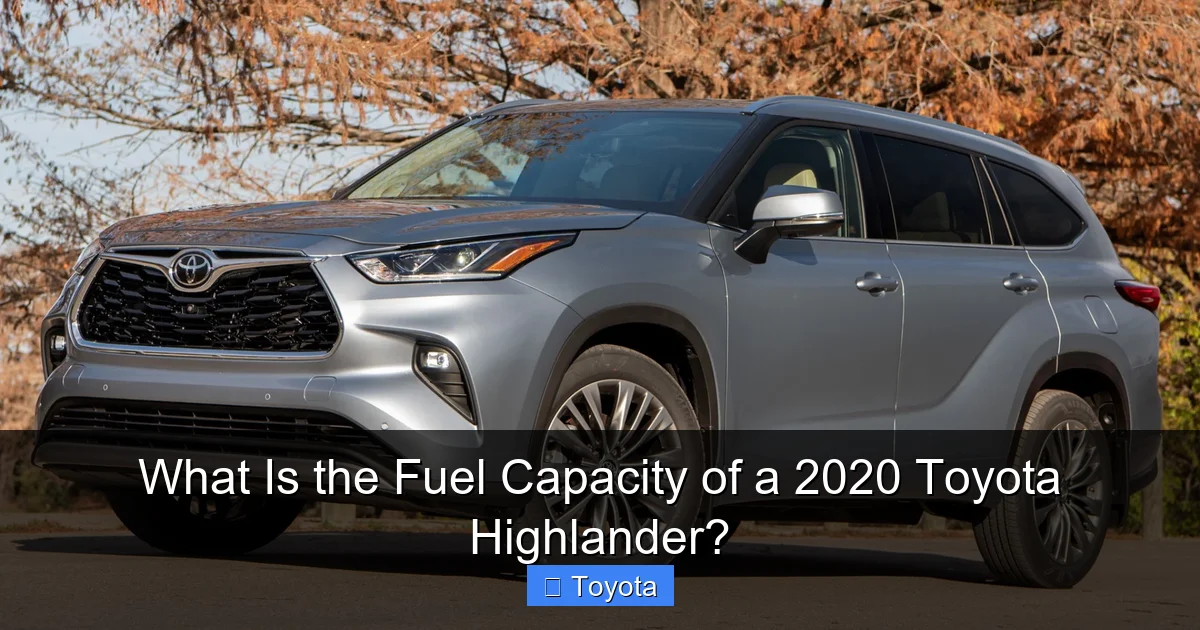
Visual guide about What Is the Fuel Capacity of a 2020 Toyota Highlander?
Image source: oilcapacityguide.com
Gas-Powered Models (V6): The Standard 14.4-Gallon Tank
If you’re looking at any of the gas-powered 2020 Highlander trims—the base L, the popular LE and XLE, the upscale Limited, or the top-tier Platinum—you’re getting the same robust fuel tank. Across all these models, the fuel capacity is a consistent 14.4 gallons. This includes the all-wheel drive (AWD) versions as well; the system for sending power to the rear wheels doesn’t alter the tank’s size. This 14.4-gallon figure is a sweet spot for the segment, offering a substantial range without the bulk and weight penalty of an even larger tank.
Hybrid Models: A Slightly Different Story
The 2020 Highlander Hybrid is a different beast entirely, pairing a 2.5-liter 4-cylinder engine with electric motors. To make room for the hybrid battery pack, which is typically located under the second-row seats or in the cargo floor, some component packaging has to change. This sometimes affects the fuel tank’s shape or, in this case, its capacity. The 2020 Highlander Hybrid has a fuel capacity of 14.1 gallons. It’s a difference of just 0.3 gallons, which is negligible in practical terms—less than a quart. You won’t notice it at the pump. However, it’s a precise spec worth noting for the technically curious or for exact range calculations.
How to Find Your Exact Tank Capacity
While this guide gives you the definitive answer for the 2020 model year, it’s always good to verify for your specific vehicle. The easiest way is to open the fuel door and look for a sticker, often on the cap or the door itself, that states “Fuel Capacity: XX gal.” You can also find it in your owner’s manual, usually in the “Capacities and Specifications” chapter. For the 2020 Highlander, you can confidently expect 14.4 gallons on gas models and 14.1 on the Hybrid.
Real-World Range: Putting the Capacity to Work
Knowing the tank size is only half the equation. The magic number you really care about is range: how many miles you can drive before the low fuel light flickers on. Range is calculated simply: Tank Capacity (gallons) x Fuel Economy (MPG) = Estimated Range (miles). But here’s where things get interesting, because the “Fuel Economy” part has two very different answers.
Visual guide about What Is the Fuel Capacity of a 2020 Toyota Highlander?
Image source: autoauxiliary.com
EPA Estimates vs. Your Actual Experience
The EPA provides official MPG ratings for every vehicle. For the 2020 Highlander, those numbers vary by drivetrain and drive mode (FWD vs. AWD). For example, a gas-powered AWD Highlander might have an EPA estimate of 21 MPG combined (20 city/24 highway). The Hybrid AWD, meanwhile, soars to an estimated 35 MPG combined (36 city/35 highway).
Let’s do some quick math with our tank capacities:
- Gas AWD Example: 14.4 gal tank x 21 MPG (combined) = ~302 miles on a theoretical full tank.
- Hybrid AWD Example: 14.1 gal tank x 35 MPG (combined) = ~494 miles on a theoretical full tank.
See the dramatic difference? The Hybrid’s smaller tank is more than made up for by its vastly superior efficiency. However, these are best-case, lab-condition estimates. Your real-world range will almost certainly be different.
The Reality Check: Why You’ll Get Fewer Miles
Several factors conspire to reduce your actual miles per tank below the EPA sticker. First, the EPA tests are conducted with a single, lightweight occupant and no cargo. Load up your Highlander with seven people and a week’s worth of luggage? That’s hundreds of extra pounds, and weight is the enemy of efficiency. Second, aggressive driving—rapid acceleration and hard braking—can slash your MPG by 15-30%. Third, city driving with constant stops is far less efficient than steady highway cruising. Finally, extreme temperatures (both bitter cold and extreme heat) force the engine and climate control to work harder, reducing efficiency. A safe, realistic estimate is to shave 10-15% off your calculated EPA range. So, that gas Highlander’s 302-mile estimate becomes a more reliable 260-270 miles in real-world mixed driving with a typical family load.
Factors That Affect Your Fuel Range (Beyond the Tank)
Think of your fuel capacity as the maximum potential. Everything else determines how much of that potential you actually realize. Let’s explore the key variables that will make your “miles per tank” number fluctuate from one fill-up to the next.
Visual guide about What Is the Fuel Capacity of a 2020 Toyota Highlander?
Image source: autoauxiliary.com
The Obvious Ones: Load and Driving Style
We touched on this, but it bears repeating. A fully loaded Highlander, with all seats occupied and the cargo area brimming, is working much harder than an empty one. The engine has to overcome greater inertia. Towing is the ultimate range-killer; if you’re planning to use your Highlander’s towing capacity, you must adjust your expectations drastically. Your right foot is the most powerful control over your range. Smooth, gradual acceleration and anticipating traffic flow to minimize braking are the hallmarks of an efficient driver. It’s not just about saving fuel; it’s about a smoother, more relaxed ride for everyone inside.
The Environment: Terrain and Weather
Hilly or mountainous terrain? Your engine will be downshifting and revving higher to climb, consuming more fuel. Driving into a strong headwind creates aerodynamic drag that the engine must overcome. Cold weather is a double whammy: your engine runs less efficiently until it warms up, and you’re likely using the heater and defroster constantly. In winter, your Hybrid’s battery may also be less effective. Hot weather means constant air conditioning, which puts a significant parasitic load on the engine. All these conditions can easily knock 5-20% off your expected range.
Vehicle Health and Maintenance
A well-maintained Highlander will deliver closer to its potential range. Proper tire pressure is non-negotiable for efficiency. Under-inflated tires create more rolling resistance, forcing the engine to work harder. You can find the correct tire pressure for your specific 2020 Highlander on a sticker inside the driver’s door jamb. Regular oil changes with the correct oil viscosity, clean air filters, and healthy spark plugs all contribute to optimal combustion and efficiency. Neglecting these basics can silently drain your range and your wallet. For specific maintenance details like this, resources on your vehicle’s specific needs are invaluable.
How Does the Highlander’s Capacity Stack Up Against the Competition?
The midsize three-row SUV segment is incredibly crowded. How does the Highlander’s 14.4-gallon tank compare? Pretty well, actually. Most of its direct competitors play in the same ballpark.
- Honda Pilot: The Pilot has a 19.5-gallon tank. That’s notably larger, which helps offset its slightly worse fuel economy, giving it a similar overall range to the Highlander gas model.
- Ford Explorer: Tank sizes vary by engine, but most gas Explorers hold about 18 gallons. Again, a larger tank compensates for lower MPG numbers.
- Toyota RAV4: The smaller, 5-seat RAV4 has a 14.5-gallon tank (on most trims). It’s remarkably similar to the Highlander’s, but its lighter weight and more efficient 4-cylinder engine give it a much longer range per gallon. This size similarity makes sense as they share platform DNA.
The takeaway? The Highlander’s tank size is average for its class. What truly sets it apart, especially with the Hybrid model, is its exceptional fuel efficiency. You’re not getting an abnormally large or small tank; you’re getting a very efficient powertrain paired with a sensible tank size. This philosophy extends to other Toyota models; for instance, understanding the towing capacity of a Toyota RAV4 shows how Toyota optimizes different models for different priorities—efficiency for the RAV4, space and power for the Highlander.
Practical Tips to Maximize Every Gallon in Your Highlander
Now that you know the numbers, let’s talk strategy. Getting the most out of that 14.4 (or 14.1) gallons is about smart habits and using your Highlander’s features to your advantage.
Drive with a Light Foot and a Plan
This is the single biggest factor. Use your Highlander’s fuel economy display (if equipped) as a game. Try to beat your average MPG on each trip. Combine errands to reduce cold-start trips, which are very inefficient. If you have a lead foot, consider using the “Eco” drive mode (if equipped), which softens throttle response and tweaks the A/C for better efficiency. On the highway, use cruise control to maintain a steady speed. Speeding is a massive fuel drain; every 5 mph over 60 MPH is like paying an extra $0.20 per gallon.
Maintain Your Rig for Peak Efficiency
Stick to your service schedule. Use the recommended oil. Keep tires inflated to the exact PSI on the door jamb sticker, not the max on the tire sidewall. A good rule of thumb is to check them monthly. A clogged cabin air filter makes your A/C fan work harder, drawing more engine power. These small maintenance items compound into significant savings over a year.
Leverage All-Wheel Drive Intelligently
If you have an AWD Highlander, know that it’s not always engaged. Most systems are front-wheel drive by default and only send power to the rear wheels when slip is detected. However, you can manually engage full-time AWD with the Snow Button (or “AWD” mode on some trims). While great for slippery conditions, leaving it in this mode on dry pavement creates constant drag in the drivetrain, reducing fuel economy. Use it only when needed. For normal, dry driving, let the smart system do its job in auto mode.
Conclusion: Knowledge is Power (and Miles)
So, what is the fuel capacity of a 2020 Toyota Highlander? For the gas models you’ll most commonly see, it’s a solid and segment-standard 14.4 gallons. The Hybrid, despite its efficiency-focused design, carries a very similar 14.1 gallons. But this number is just the starting point of your fuel story. The real magic happens when you combine that capacity with your vehicle’s MPG rating and your own driving realities.
For the gas V6 Highlander, plan on a realistic, mixed-driving range of 250-280 miles per tank. For the Hybrid, you can confidently expect 450-500 miles, making it one of the most road-trip-friendly three-row SUVs on the market. By understanding your tank size, maintaining your vehicle, and driving efficiently, you transform that simple specification into a tool for stress-free, economical, and far-reaching adventures. Whether you’re carpooling or crossing state lines, you’ll know exactly when you need to fill up and how far you can go. That’s the true value of knowing your Highlander’s fuel capacity.
Frequently Asked Questions
What is the exact fuel tank size for a 2020 Toyota Highlander LE AWD?
The 2020 Highlander LE with the gas V6 engine and AWD has a fuel tank capacity of 14.4 gallons. This is the same capacity for all gas-powered trims regardless of drivetrain (FWD or AWD).
Does the 2020 Highlander Hybrid have a smaller gas tank?
Yes, but only slightly. The 2020 Highlander Hybrid uses a 14.1-gallon fuel tank, which is 0.3 gallons smaller than the 14.4-gallon tank in the gas models. This minor reduction is to accommodate the hybrid battery pack.
How can I calculate my real-world driving range?
Multiply your vehicle’s actual average miles per gallon (MPG), which you can track via your odometer and fuel fill-ups, by your tank’s capacity. For a 2020 gas Highlander, a realistic average MPG in mixed driving is 19-20 MPG. So, 14.4 gallons x 19.5 MPG = approximately 280 miles of real-world range.
Will towing a trailer drastically reduce my miles per tank?
Absolutely. Towing adds significant weight and aerodynamic drag, which can reduce fuel economy by 25% or more. If you plan to tow, you must recalculate your expected range. For example, if your normal MPG drops from 20 to 15 while towing, your range from a 14.4-gallon tank shrinks from 288 miles to just 216 miles.
Where can I find the official fuel capacity specification for my vehicle?
The most reliable sources are the fuel door sticker (often on the cap or the door itself), the owner’s manual’s “Capacities and Specifications” section, or the window sticker (Monroney label) that was on the car when it was new. All will state the exact fuel capacity in gallons.
Is the fuel capacity different for the 2020 Highlander compared to the 2021 model?
For the gas-powered models, the 14.4-gallon tank remained the same for the 2021 model year. However, the 2021 Highlander was redesigned, and the Hybrid model’s tank size may have been adjusted with the new platform. Always check the specifications for the exact model year you own or are considering.