What Is the Difference Between a Toyota Corolla and a Hatchback?

Contents
- 1 Key Takeaways
- 2 📑 Table of Contents
- 3 The Toyota Corolla: More Than Just a Sedan
- 4 Body Styles: Sedan vs. Hatchback Compared
- 5 Interior Space and Cargo Practicality
- 6 Performance and Driving Dynamics
- 7 Trim Levels and Feature Availability
- 8 Target Audience: Who’s Each For?
- 9 Conclusion: The Right Tool for Your Job
- 10 Frequently Asked Questions
Side Window Sunshade

Torque Wrench Set

Car Fog Light Bulb

OBD2 Scanner Tool
The Toyota Corolla is available as both a traditional sedan and a versatile hatchback, sharing the same core platform, engines, and fuel efficiency. The primary difference lies in the roofline and cargo area: the sedan has a separate trunk for a sleek profile, while the hatchback features a liftgate and fold-flat seats for maximum practical space. Your choice should depend on lifestyle needs—sedan for classic comfort, hatchback for active flexibility.
If you’re shopping for a reliable, efficient, and affordable compact car, the Toyota Corolla is almost certainly on your list. It’s a legendary nameplate for a reason. But here’s a common point of confusion that trips up many buyers: what’s the real difference between a Toyota Corolla sedan and a Toyota Corolla hatchback? Are they completely different cars? Is one better than the other? The answer is both simple and nuanced, and it all comes down to one word: practicality. Let’s break it down, friend-to-friend.
Think of it this way: under the skin, the Corolla sedan and Corolla hatchback are twins. They share the exact same modern GA-C platform, the same engine choices (the reliable 2.0L Dynamic Force 4-cylinder or the hybrid powertrain), the same continuously variable transmission (CVT), and the same suite of Toyota Safety Sense 3.0 driver-assistance features. You’ll find the same comfortable front seats, the same driver-focused cockpit, and the same overall driving character. The divergence happens at the B-pillar and everything behind it. It’s a change in silhouette that creates a world of difference in how you use the car every single day.
Key Takeaways
- Core Identity: Both body styles are fundamentally the same Toyota Corolla, built on the GA-C platform with identical powertrain options and Toyota Safety Sense.
- Cargo is King: The hatchback’s defining advantage is its massive, flexible liftgate cargo area versus the sedan’s traditional, but smaller, enclosed trunk.
- Price & Trims: Hatchbacks typically start slightly higher and offer sportier SE/XSE trims, while sedans focus on comfort-focused LE/XLE grades.
- Fuel Efficiency Parity: Aerodynamic differences are minimal; both body styles achieve nearly identical EPA-estimated MPG ratings.
- Target Driver: The sedan appeals to commuters seeking a classic, quiet ride; the hatchback suits urban dwellers and active lifestyles needing easy cargo access.
- Identical cabin: Front seating, dashboard, and rear passenger legroom are virtually indistinguishable between the two models.
- Test Drive Imperative: The feel of loading cargo and the slight weight difference are best experienced firsthand.
📑 Table of Contents
The Toyota Corolla: More Than Just a Sedan
A Brief History of the Corolla
The Toyota Corolla debuted in 1966 as a compact sedan, quickly becoming the world’s best-selling car due to its reputation for bulletproof reliability and value. For decades, “Corolla” was synonymous with a sensible, four-door sedan. However, the compact car market evolved. The 1970s and 80s saw the rise of the “hot hatch,” but Toyota’s North American Corolla lineup largely stuck to the sedan formula for a long time, with the Corolla FX (a short-lived wagon/hatch) being a notable but distant exception.
The Hatchback’s Return to Form
For the 2019 model year, Toyota reintroduced the Corolla hatchback to the U.S. market based on the global Corolla Sport design. This wasn’t a quirky add-on; it was a strategic move to capture buyers who desired the Corolla’s famed reliability in a more versatile, sportier-styled package. It directly competed with popular hatchbacks like the Honda Civic Hatchback and Mazda3 Hatchback. The return was significant because it gave buyers a clear, modern choice within the same model line.
Shared DNA: Platform and Powertrain
This is the most important concept to grasp. Both body styles are built on Toyota’s GA-C (Global Architecture-C) platform. This means the wheelbase, front suspension, steering rack, and core structure are identical. You get the same 169-horsepower 2.0L four-cylinder engine paired with a CVT in both, or the same hybrid system producing a net 134 horsepower. The driving experience—the steering feel, the ride quality, the acceleration—is calibrated to be nearly indistinguishable. Any minor differences in feel come from the hatchback’s slightly higher structural rigidity (from the liftgate opening) and marginally different weight distribution due to the rear structure. For all intents and purposes, you are choosing between two different wrappers for the same fantastic mechanical package.
Body Styles: Sedan vs. Hatchback Compared
Exterior Design and Proportions
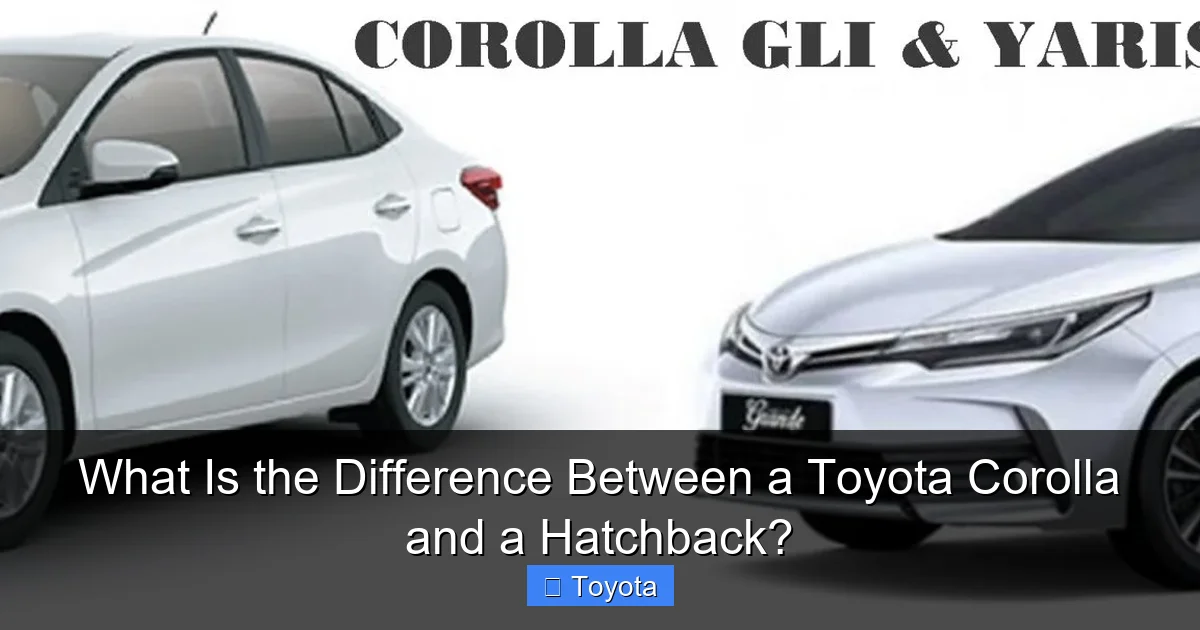
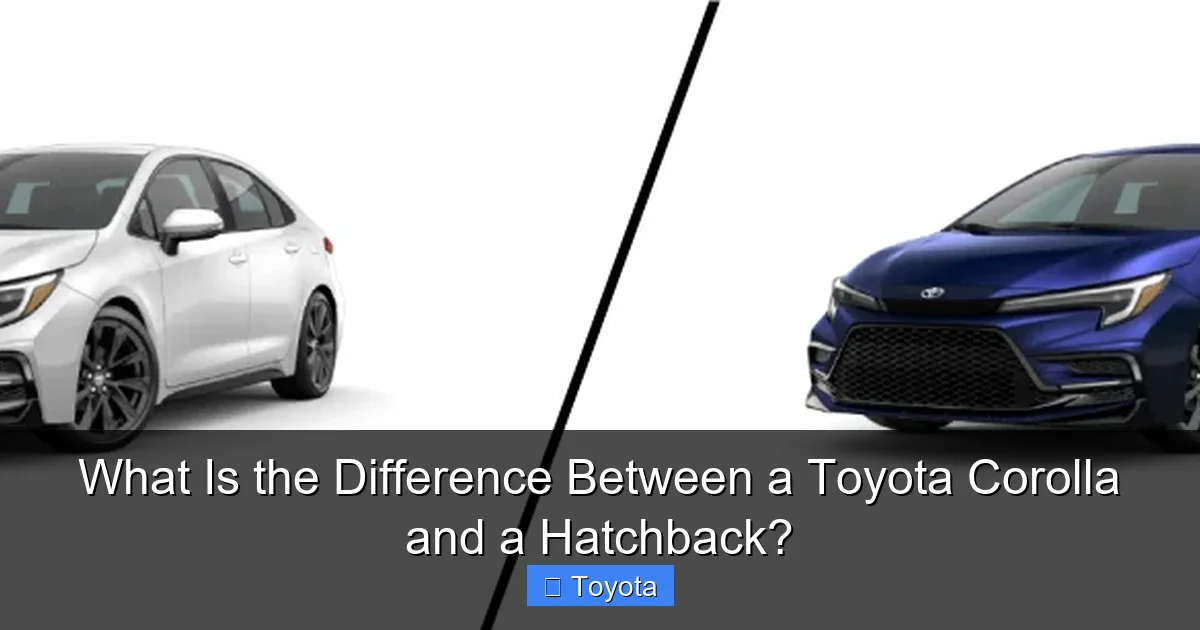
This is the most obvious difference. The Corolla sedan presents a classic, three-box silhouette: a distinct hood, passenger cabin, and trunk. Its lines are clean, conservative, and elegant, stretching the roofline back to a traditional trunklid. It looks like a car your parents would have bought—in the best way. It’s a shape that screams “refined efficiency.”
Visual guide about What Is the Difference Between a Toyota Corolla and a Hatchback?
Image source: ardmoretoyota.com
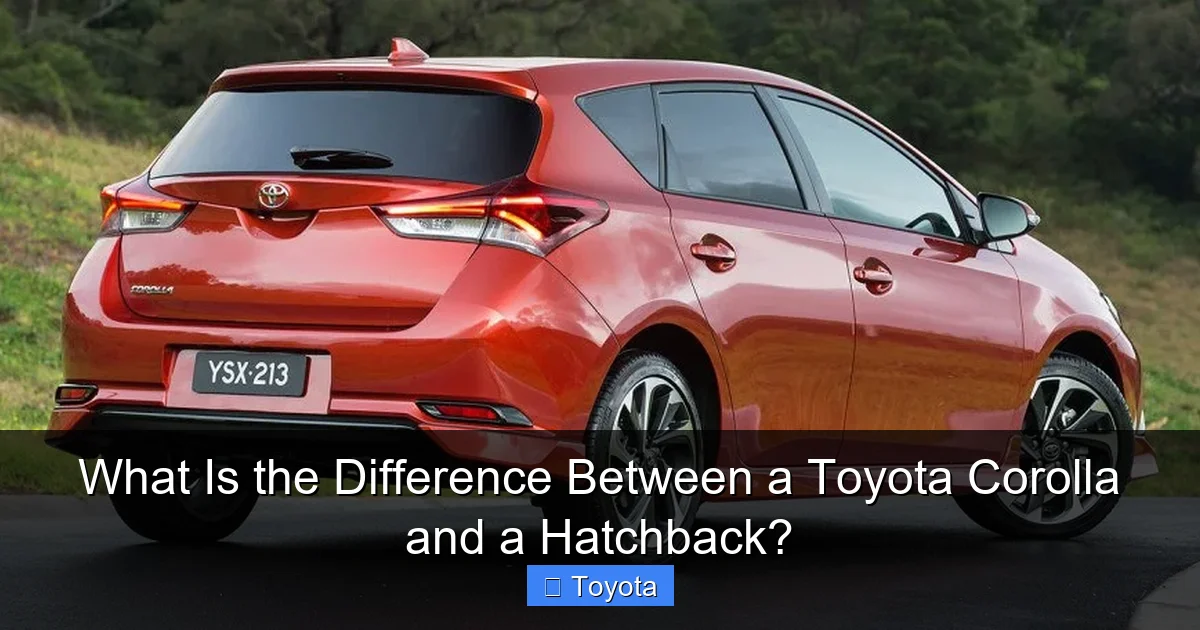
The Corolla hatchback, in contrast, uses a two-box, or “one-motion” design. The roofline swoops continuously from the windshield to the rear, culminating in a large glass hatch that lifts upward. This gives it a sportier, more dynamic, and modern appearance. It looks fast even when standing still. The hatchback’s rear overhang is shorter, and the overall stance can feel more agile. If you value a bold, contemporary look, the hatchback wins hands down.
Rear Passenger Space: Is There a Difference?
Here’s a fun fact: there is virtually no difference in rear-seat passenger space. Because both share the same wheelbase (106.3 inches) and the same front seat design, rear legroom and headroom are nearly identical. You can fit three adults (or two with car seats) in the back of either body style with similar comfort levels. The roofline in the hatchback does taper slightly more at the very rear, but the difference is measured in millimeters, not inches. So, if your priority is hauling kids or friends, you can cross this off your worry list. Both do the job equally well.
The Cargo Area: Trunk vs. Liftgate
And here we arrive at the heart of the matter. The sedan has a trunk. A conventional, opening-down lid that covers a fixed cargo well. It’s secure, quiet, and keeps your items hidden from view. Its capacity is respectable for the class, around 13 cubic feet. But it’s a fixed space. You have to bend over and reach in. Loading large, bulky items like a bike, a big cooler, or a flat-pack furniture box is a contortionist act.
The hatchback has a liftgate. This single piece of glass and metal swings upward, opening the entire rear of the car to the passenger compartment. The rear seats fold down (a 60/40 split in all trims), creating a vast, flat-load floor. This transforms the car from a passenger hauler into a mini-cargo van in seconds. Cargo capacity jumps dramatically to about 23 cubic feet behind the rear seats, and a staggering 66 cubic feet with the seats folded. This isn’t a theoretical advantage; it’s a daily-game-changer for anyone who shops at warehouse clubs, goes hiking, or has a dog. The act of loading and unloading is effortless. You simply roll or slide items right in. This is the single biggest functional reason people choose the hatchback.
Interior Space and Cargo Practicality
Measuring the Real-World Cargo Capacity
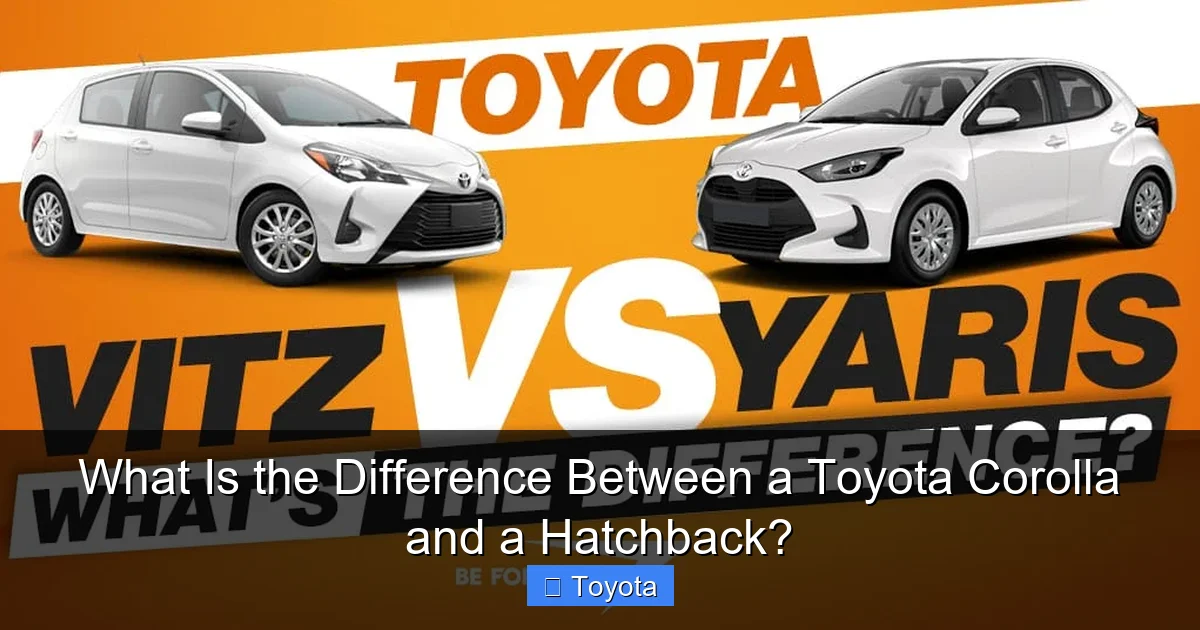
Numbers on a spec sheet tell part of the story, but real-world usability tells the rest. That 13 cubic feet in the sedan trunk is deep but narrow, bounded by wheel wells. A standard golf bag fits, but two might be tight. A carry-on suitcase sits on the floor. In the hatchback, that 23 cubic feet behind the rear seat is a wide, tall, and square space. You can stand a small cabinet on end, lay a flat-screen TV box flat, or stack multiple duffel bags without playing Tetris. The fold-flat seats are key. In the sedan, the rear seatback folds, but the cushion does not, creating a sloped load floor. In the hatchback, the seat cushion pivots forward before the back folds, creating a completely level surface from the tailgate to the front seats. This is a monumental advantage for moving long items like lumber, ladders, or rolled-up yoga mats.
Visual guide about What Is the Difference Between a Toyota Corolla and a Hatchback?
Image source: blog.beforward.jp
Loading and Unloading: The Hatchback Advantage
Imagine it’s raining. You’re at the grocery store with a cart full of bags. With a sedan, you must open the trunk, fumble with the key or fob, and carefully place each bag into the dark recess, likely getting rained on. With the hatchback, you press the button on the fob, the liftgate rises, and you can simply roll the entire cart right up to the load floor and transfer bags in seconds, staying mostly dry. The same applies to loading a stroller, a wheelchair, or a pet. The threshold is lower, and the opening is massive. For city dwellers who parallel park in tight spots, being able to access cargo from the sidewalk without opening a trunklid that might hit a wall is a huge convenience. This ease of use is the hatchback’s killer feature.
Rear Seat Flexibility: Fold-Down Rates
As mentioned, both offer 60/40 split-folding rear seats. However, the *result* of folding them is different. In the sedan, you get a decent, but sloped, extended cargo area. The load floor is not continuous with the trunk. In the hatchback, you get that perfectly flat, continuous floor. This means you can fit items that are longer than the cabin itself—like a 6-foot ladder or a small kayak—by placing them from the tailgate, over the folded seats, and into the front footwells. The sedan simply cannot accommodate such items without a roof rack. This flexibility is what defines a true “lifestyle” vehicle.
Performance and Driving Dynamics
Powertrain Parity: Same Engines, Same Transmissions
Let’s be crystal clear: you do not get a more powerful engine or a different transmission in the hatchback. Both body styles are available with the same two powertrains. The standard is the 2.0L four-cylinder with 169 hp and 151 lb-ft of torque, mated to a CVT with a physical first gear for smoother launches. The hybrid uses a 1.8L four-cylinder paired with electric motors for a net 134 hp, delivering exceptional fuel economy. Whether you choose sedan or hatchback, the acceleration, engine note (or lack thereof in the hybrid), and transmission behavior are programmed to be identical. Any perceived difference is psychological, born from the slightly different cabin acoustics or the visual sensation of the hatchback’s rear window.
Visual guide about What Is the Difference Between a Toyota Corolla and a Hatchback?
Image source: s3.amazonaws.com
Weight and Handling: The Slight Edge
Here’s where a tiny difference emerges. The hatchback body structure is slightly different to accommodate the large liftgate opening and reinforced frame around it. This makes the hatchback marginally heavier than the equivalent sedan trim—usually by about 50 to 100 pounds. In a car of this size, this is negligible for straight-line performance. However, in the world of handling, every pound counts. The sedan’s slightly lower mass and potentially slightly different rear torsion beam suspension tuning (though both use a torsion beam rear suspension) can, in theory, give it a razor-thin edge in turn-in responsiveness. For 99% of drivers on public roads, this difference is imperceptible. On a racetrack, an expert might feel it. For daily driving, they behave identically. If you’re curious about Toyota’s specific traction systems that enhance handling, you can read more about Toyota’s A-Trac system, which is standard on both and helps manage wheel slip.
Fuel Efficiency: Aerodynamics and Real-World MPG
This is a major concern for Corolla buyers. The EPA ratings tell the story: they are identical or nearly so. For example, the 2024 Corolla sedan and hatchback with the 2.0L engine both rate at 32 mpg city / 41 mpg highway / 35 mpg combined. The hybrid models are also identically rated at 50 mpg combined. Why? Because the aerodynamic differences between a well-designed sedan and a modern hatchback are minimal. Both are shaped to slice through air efficiently. The hatchback’s taller rear end might create a tiny bit more drag, but it’s offset by other factors. In real-world driving, you can expect nearly identical fuel bills. The only variable is your right foot and driving conditions. The hatchback’s flexibility might even lead to *better* efficiency for some, as you can carry cargo more efficiently without needing a roof rack, which adds significant drag. For tips on maximizing your Corolla’s efficiency, understanding features like Eco Heat Cool can help manage cabin system energy use.
Trim Levels and Feature Availability
Sedan-Exclusive Trims (LE, XLE)
The Corolla sedan lineup is tailored towards comfort and traditional value. The base L and LE trims are the volume sellers, focusing on essential features and a smooth, quiet ride. The range-topping XLE trim adds premium amenities like SofTex synthetic leather seats, a power driver’s seat, and heated front seats. These comfort-oriented features are designed with the sedan’s isolated, trunk-based cargo philosophy in mind. The sedan does not offer a sport-focused trim with aggressive styling or suspension tuning from the factory.
Hatchback-Exclusive Trims (SE, XSE)
The hatchback lineup is all about sporty aesthetics and a more engaging feel. It starts with the SE trim, which adds a sport front bumper, black exterior accents, and a more dynamic interior. The crown jewel is the XSE, which features a unique front fascia, 18-inch black machined-finish alloy wheels, a rear spoiler, and premium black interior accents with red stitching. The XSE also comes standard with a sport-tuned suspension (the same as the SE) that offers slightly firmer damping for better body control during spirited driving. This trim differentiation is a key reason people choose the hatchback—it looks and feels more like a “driver’s car” from the driver’s seat.
Feature Overlap and Unique Offerings
Core technology is shared across both lineups. Toyota Safety Sense 3.0 (with pre-collision warning, automatic emergency braking, lane departure alert with steering assist, and dynamic radar cruise control) is standard on every new Corolla. The infotainment system (7- or 8-inch touchscreen) with Apple CarPlay and Android Auto is also standard. However, some features are exclusive to one body style due to packaging. For instance, the sedan’s higher trims might offer a premium JBL audio system that the hatchback doesn’t, while the hatchback’s SE/XSE might come with a black roof panel or specific interior trim not found in the sedan. Always check the specific window sticker for the exact feature set of the trim you’re comparing.
Target Audience: Who’s Each For?
The Sedan Lover: Commuters and Families
The Corolla sedan is the quintessential “appliance.” It’s for the driver who prioritizes a quiet, comfortable, and fuel-sipping commute. It’s for families who want the security of a fixed trunk to keep groceries or luggage out of sight and secure. It appeals to those who prefer the traditional, elegant look of a three-box sedan and don’t regularly need to haul bulky items. It’s the choice for the person who says, “I just need a reliable car to get from A to B.” Its lower starting price and comfort-focused trims make it a perennial favorite for ride-share drivers and fleet buyers. If your cargo needs are mostly suitcases, grocery bags, and a stroller, the sedan’s trunk is perfectly adequate and offers a more insulated, rattle-free environment.
The Hatchback Enthusiast: Active Lifestyles and Urban Dwellers
The Corolla hatchback is for the person whose life spills out of the car. It’s for the cyclist who needs to toss a bike in the back, the camper with a cooler and tent, the DIYer with a trip to the hardware store, or the dog owner with a muddy pup. It’s for city residents who value the convenience of a low liftgate for curbside loading. It’s for the young professional who wants a car that looks sharper and feels a bit more special than the standard sedan. The sportier SE/XSE trims also attract buyers who want a touch of visual flair and a slightly more engaging drive without paying for a full hot-hatch like a GTI. If your cargo needs are irregular, large, or messy, the hatchback’s open, flexible interior is not just an advantage—it’s a necessity.
Resale Value and Long-Term Ownership
Both body styles hold their value exceptionally well, thanks to the Corolla’s legendary reliability. Historically, sedans have held a slight edge in resale value due to their traditional dominance in the rental and fleet markets, which creates steady used-car demand. However, the growing popularity of crossovers and hatchbacks for their utility means the Corolla hatchback’s resale trajectory is strong and may even be surpassing the sedan in some markets as buyer preferences shift. Long-term, both will be cheap and easy to maintain, with identical mechanical parts for most repairs. The choice here is a toss-up, heavily dependent on local market demand for body styles.
Conclusion: The Right Tool for Your Job
So, what is the difference between a Toyota Corolla and a hatchback? The core answer is: the hatchback *is* a Toyota Corolla. The difference is not in quality, reliability, or fundamental engineering, but in form factor and the resulting utility. The sedan is the classic, sleek, and secure choice. The hatchback is the modern, versatile, and practical evolution of that same platform.
Your decision should be based on a single, honest question: how do you plan to use the cargo area? If you rarely need to carry anything larger than a set of golf clubs or a week’s worth of groceries, the sedan’s trunk is sufficient and offers a quieter, more traditional experience. If you frequently find yourself needing to load large, awkward, or dirty items, the hatchback’s liftgate and flat-folding seats are a transformative feature you will appreciate every single time you use it. There is no “better” car here—only the better car for your specific life. The best way to decide? Visit a dealer. Sit in both. Pop the trunk on the sedan, then hit the button and watch the hatchback’s glass lift open. Fold the seats. Picture your life’s cargo in each space. The right answer will become instantly, practically clear.
Frequently Asked Questions
Is the Toyota Corolla hatchback more fuel-efficient than the sedan?
No. Both body styles use the same engines and transmissions and have nearly identical EPA fuel economy ratings. Any real-world difference would be negligible and based solely on driving style and conditions, not the body style itself.
Do the Corolla sedan and hatchback have the same engine?
Yes, they do. Both are available with the identical 2.0L four-cylinder engine or the identical hybrid powertrain. Performance and efficiency are designed to be the same.
Which has more cargo space, the Corolla sedan or hatchback?
The hatchback has dramatically more usable cargo space. With the rear seats up, it offers about 23 cubic feet vs. the sedan’s 13. With the seats folded, the hatchback provides a massive 66 cubic feet of flat-load space, which the sedan cannot match.
Why is the Corolla hatchback usually more expensive than the sedan?
The hatchback typically has a slightly higher starting price due to its more complex body structure (the liftgate mechanism and reinforced frame) and because its trim lineup (SE/XSE) starts at a higher feature level with sportier appointments than the sedan’s base L/LE trims.
Is the rear passenger room different in the Corolla hatchback?
No. Because both share the same wheelbase and front cabin design, rear legroom and headroom are virtually identical. The difference in rear headroom is minimal and not noticeable for average-sized adults.
Are the Toyota Corolla sedan and hatchback built on the same platform?
Absolutely. Both are built on Toyota’s identical GA-C (Global Architecture-C) platform. This means the core structure, suspension, steering, and overall vehicle dynamics are engineered to be the same, with the body style change happening behind the B-pillar.