What Is the Blue Book Value of a 2013 Toyota Camry Xle?

Contents
- 1 Key Takeaways
- 2 📑 Table of Contents
- 3 What Exactly Is “Blue Book Value”?
- 4 Why the 2013 Toyota Camry XLE Is a Value Retention Champion
- 5 The Critical Factors That Change Your 2013 Camry XLE’s Blue Book Value
- 6 XLE vs. Other Trims: Does the Premium Pay Off?
- 7 How to Get the Most Accurate Blue Book Value for Your Specific Car
- 8 Practical Tips: Buying and Selling a 2013 Toyota Camry XLE
- 9 The Bottom Line: What You Can Expect in 2024
- 10 Frequently Asked Questions


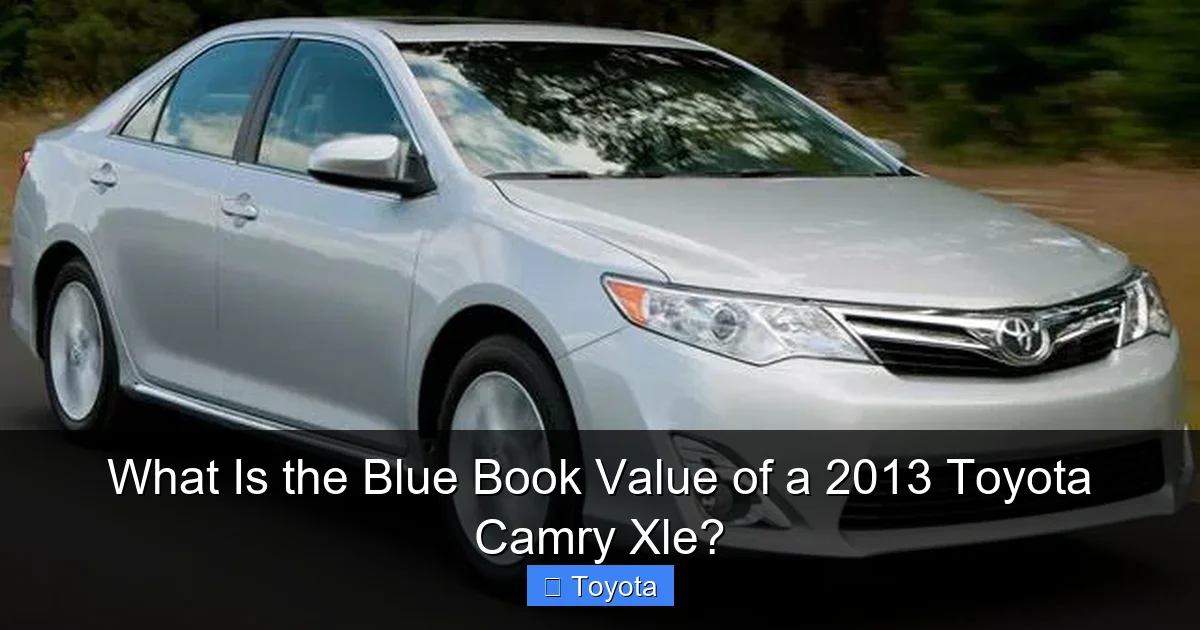
The 2013 Toyota Camry XLE is a highly sought-after midsize sedan known for its reliability, comfort, and strong resale value. Its Blue Book value, determined by Kelley Blue Book (KBB), varies significantly based on mileage, condition, location, and optional features. Understanding these factors and using KBB’s tools correctly is crucial for getting an accurate price, whether you’re buying or selling this popular sedan.
Key Takeaways
- Base Value is a Starting Point: The “Blue Book value” is an estimate from Kelley Blue Book, not a fixed price. For a 2013 Camry XLE, it provides a range (e.g., Trade-in, Private Party, Suggested Retail) based on aggregated sales data.
- Mileage is King: For a 10-year-old car like the 2013 Camry XLE, mileage is the single biggest value driver. A car with 60,000 miles will command a significantly higher price than one with 120,000 miles, all else being equal.
- Condition Trumps All: A vehicle with a clean maintenance history, no accidents, and well-kept interior/exterior will fall at the top of the KBB value range. Any damage, even cosmetic, can drop the value.
- XLE Trim Adds Premium Value: The XLE was the luxury trim in 2013, featuring leather seats, a sunroof, and advanced tech. This commands a $1,500-$3,000 premium over the base LE model when comparably equipped.
- Location and Season Matter: Values can fluctuate by region. A Camry in a mild climate with no road salt corrosion will be worth more than the same car in the Northeast. Convertibles and RVs have seasonality; sedans like the Camry are less affected but still see minor shifts.
- Market Demand is Dynamic: In 2023/2024, used car prices remain elevated from pandemic-era shortages. This means a 2013 Camry XLE might be worth more now than its “typical” historical average.
- Get Multiple Opinions: Don’t rely solely on KBB. Cross-check with NADAguides and Edmunds. For a precise value, get a professional appraisal or obtain trade-in offers from multiple dealers.
📑 Table of Contents
- What Exactly Is “Blue Book Value”?
- Why the 2013 Toyota Camry XLE Is a Value Retention Champion
- The Critical Factors That Change Your 2013 Camry XLE’s Blue Book Value
- XLE vs. Other Trims: Does the Premium Pay Off?
- How to Get the Most Accurate Blue Book Value for Your Specific Car
- Practical Tips: Buying and Selling a 2013 Toyota Camry XLE
- The Bottom Line: What You Can Expect in 2024
What Exactly Is “Blue Book Value”?
If you’re asking about the Blue Book value of a 2013 Toyota Camry XLE, you’re already on the right track to becoming a savvy car buyer or seller. But let’s clear up a common point of confusion first: “Blue Book” is a trademarked term owned by Kelley Blue Book (KBB). When people say “Blue Book value,” they are almost always referring to the vehicle valuation estimates published by Kelley Blue Book. It’s not a government or official registry; it’s a private company that has been collecting and analyzing used car sales data since 1926.
Think of KBB as a massive, constantly updated pricing database. They gather millions of actual transaction prices from dealerships, auctions, and private sales across the country. Their analysts then adjust for vehicle condition, mileage, optional equipment, and local market trends to produce their famous value ranges. For your 2013 Camry XLE, KBB will provide several key numbers: the Trade-in Value (what a dealer might offer you), the Private Party Value (what you could expect selling it yourself), and the Suggested Retail Value (what a dealer might ask for a similar car on their lot).
Why is this so important? Because it removes the guesswork. The “sticker price” on a used car is almost always negotiable. Walking in knowing the KBB range for your specific vehicle—with its exact mileage and condition—gives you immense negotiating power. It transforms the process from a game of verbal poker into a data-driven discussion. For a perennial favorite like the Camry, which holds value exceptionally well, having this benchmark is non-negotiable.
Why the 2013 Toyota Camry XLE Is a Value Retention Champion
Before we dive into the specific numbers, we must understand why this particular car has such a solid Blue Book value. The 2013 model year represents the final year of the XV50-generation Camry before a significant redesign for 2014. This is a critical point for value. Often, the last year of a generation sees minor refinements and can be viewed as a “capstone” model, which enthusiasts and pragmatic buyers alike may prefer. More importantly, the 2013 Camry solidified a reputation that Toyota had built for decades.

Visual guide about What Is the Blue Book Value of a 2013 Toyota Camry Xle?
Image source: cdn.dealrimages.com
The Pillars of Resale Value: Reliability, Comfort, and Practicality
The 2013 Camry XLE wasn’t the fastest, the most tech-laden, or the most stylish sedan on the market. It was, however, arguably the most complete. Under the hood, the standard 2.5-liter 4-cylinder engine (178 hp) was a paragon of smooth, reliable, and fuel-efficient motoring. The optional 3.5-liter V6 (268 hp) offered robust power. Both were mated to a 6-speed automatic transmission known for its smooth shifts and durability. This powertrain reliability is the bedrock of its value. A decade later, many of these engines and transmissions are still on the road, requiring only basic maintenance.
The XLE trim elevated the experience. It came standard with leather-trimmed seats, a power driver’s seat with lumbar support, a 4.2-inch multi-information display, a premium 6-speaker audio system, and a power moonroof. It offered the quiet, comfortable, and spacious cabin that families and commuters dream of. This blend of Toyota’s legendary reliability with near-luxury appointments created a sweet spot in the used market. People trust that a well-maintained 2013 Camry XLE will start every morning and get them where they need to go without drama. That trust translates directly into a higher residual value.
Furthermore, the Camry’s status as America’s best-selling sedan for years means parts are plentiful and cheap. Repair costs are generally low compared to European rivals. This low cost of ownership is a huge factor that KBB’s algorithms factor into their valuation. A car that is cheap and easy to fix is simply worth more on the used market than one that requires a specialist and a second mortgage for a common repair.
The Critical Factors That Change Your 2013 Camry XLE’s Blue Book Value
Now, let’s get practical. KBB will give you a baseline, but your specific car’s value lives within a band. Here’s what pushes it to the top or bottom of that band.
Visual guide about What Is the Blue Book Value of a 2013 Toyota Camry Xle?
Image source: discounttire.scene7.com
1. Mileage: The Single Most Important Number
For a 2013 vehicle, average annual mileage is around 12,000-15,000 miles. So, a 2023 example with 90,000-120,000 miles is in the average range. A 2013 Camry XLE with 60,000 miles is considered “low mileage” and will command a premium. One with 180,000 miles is “high mileage” and will be discounted, often significantly, regardless of cosmetic condition. The mechanical wear associated with high miles is a major red flag for buyers. When you get your KBB estimate, you’ll input the exact mileage. Be brutally honest here. The difference between 89,000 and 91,000 miles can be a few hundred dollars.
2. Condition: The Honesty Test
KBB has clear condition definitions: Excellent, Very Good, Good, Fair, Poor. “Excellent” is reserved for cars with no mechanical issues, a flawless exterior and interior, and a complete service history. This is rare for a 10-year-old car. “Very Good” means minor cosmetic blemishes (a small door ding, slight wear on the driver’s seat bolster) but no accidents. “Good” is the most common—normal wear and tear for the age and mileage, no major damage. “Fair” means significant wear, possible minor accidents, or issues that need repair. “Poor” is for cars with major problems or severe damage.
Your job is to categorize your car accurately. Overstating condition to get a higher number will only lead to a failed sale when a buyer sees the car. Understating leaves money on the table. Be objective. Does the leather have cracks? Are there stains on the ceiling? Does the sunroof operate smoothly? These details matter.
3. Vehicle History Report: The Digital Skeleton
In the modern era, a clean Carfax or AutoCheck report is practically a requirement for a top-tier sale. A single reported accident, even if repaired “perfectly,” can knock 10-20% off the value. Multiple accidents or a salvage title destroy value. Before you even check KBB, order a report on the specific VIN. If you’re selling, have it ready to show. If you’re buying, insist on seeing it. This is non-negotiable data that overrides almost any other factor in a buyer’s mind.
4. Optional Equipment and Packages
The XLE came loaded, but options existed. Did it have the premium JBL audio system? A navigation system? Heated rear seats? These factory-installed options add value. Conversely, aftermarket modifications (rims, stereo systems, lift kits) are value subtractors for most mainstream buyers. They can limit your buyer pool and create reliability concerns. When entering your car into KBB, you’ll select from a list of available options for the 2013 Camry XLE. Select everything that was factory-installed on your specific vehicle. The window sticker (if you have it) is the ultimate source of truth here.
5. Geographic Location and Local Market
KBB adjusts for region. A 2013 Camry XLE in sunny Arizona or California, free from rust and road salt damage, is worth more than an identical one in Michigan or upstate New York, where corrosion is a constant battle. Supply and demand also play a role. In a major metro area with high demand and lots of traffic, values might be firmer. In a rural area where trucks and SUVs dominate, a sedan might sit longer and sell for less. KBB tries to account for this, but local knowledge is key. Check local listings on Autotrader, Facebook Marketplace, and Craigslist to see what similar cars are actually selling for in your zip code.
XLE vs. Other Trims: Does the Premium Pay Off?
The 2013 Camry was available in L, LE, SE, and XLE trims. The XLE was the top non-hybrid trim. But is the Blue Book value difference between an XLE and an LE enough to justify the higher initial cost (and higher sale price)? Let’s break it down.

Visual guide about What Is the Blue Book Value of a 2013 Toyota Camry Xle?
Image source: file.kelleybluebookimages.com
Standard XLE Features That Drive Value
The XLE wasn’t just about badges. It included key features that buyers consistently pay for:
- Leather-Trimmed Seats: A huge perceived luxury over cloth. More durable, easier to clean, and considered premium.
- Power Driver’s Seat with Lumbar Support: A major comfort upgrade for long commutes.
- Power Moonroof: A must-have for many buyers and a $1,000+ option on lower trims.
- Auto-Dimming Rearview Mirror: A convenience and safety feature.
- Premium Audio: While not audiophile-grade, it was a step up.
When you compare a base 2013 Camry LE (cloth seats, manual driver’s seat, no sunroof) to a fully-optioned XLE, the Blue Book value gap is typically $1,500 to $2,500 for similarly mileaged and conditioned vehicles. This premium holds up remarkably well over time because these are desirable, permanent features. They don’t wear out like an engine, but they do enhance the daily driving experience.
The SE Trim: The Sporty Alternative
The SE trim was the “sport” model, with a stiffer suspension, black interior accents, and different wheels. It appealed to a different buyer. Its value can be slightly higher than an LE but often trades places with a well-equipped XLE depending on the buyer’s priority (sportiness vs. luxury). A 2013 Camry XLE with the V6 engine is a particularly desirable combination, as it pairs the luxury trim with the more powerful powertrain. This combo will be at the very top of the value spectrum for non-hybrid models.
How to Get the Most Accurate Blue Book Value for Your Specific Car
So, you’re ready to look it up. Here is your step-by-step guide to getting the most accurate KBB estimate for a 2013 Toyota Camry XLE.
- Start with the Basics: Go to the KBB website or app. Select “Get KBB Value.” Enter the year (2013), make (Toyota), model (Camry), and trim (XLE). This is your starting sandbox.
- Input the Exact Mileage: Be precise. Odometer readings make a tangible difference.
- Select Your Zip Code: This is crucial for regional adjustments. Use your actual zip code if selling/buying locally, or the zip code of the area where the car is located.
- Choose the Correct Vehicle Condition: This is the hardest and most important step. Review KBB’s condition descriptions carefully. Be honest. Does it have any scratches over 2 inches? Any interior stains? Any warning lights on the dash? Lean towards “Good” for an average, well-maintained 10-year-old car. “Very Good” requires near-perfect cosmetic and mechanical condition.
- Add All Factory Options: Click through the options list. Did it have a sunroof? (Yes, standard on XLE). Leather seats? (Yes). Navigation? (Maybe). Check your old window sticker if possible. Adding options increases the value.
- Review All Three Values: Look at the Trade-in, Private Party, and Suggested Retail values. Understand what each means. The Trade-in value is what a dealer will likely offer you before negotiation. The Private Party value is your target if selling yourself. The Suggested Retail is what a dealer would ask for a similar car on their lot—this is your benchmark if buying.
Pro Tip: After getting your KBB number, do the same on Edmunds and NADAguides. You’ll often see a spread of a few hundred to a thousand dollars. The true market value is somewhere in the middle. KBB is generally considered the most consumer-friendly and widely cited, so it’s your best starting point for negotiations.
Practical Tips: Buying and Selling a 2013 Toyota Camry XLE
Knowing the number is only half the battle. Here’s how to use that information effectively.
If You’re Selling:
Your goal is to achieve the top of the KBB Private Party range. To do that:
- Prep the Car: Spend $50-$100 on a professional detail. Clean it inside and out meticulously. Fix minor cosmetic issues: replace burnt-out bulbs, top off all fluids, fix a cracked window sticker. This presentation signals care.
- Gather All Records: Have your maintenance receipts, the owner’s manual, and both keys available. A stack of oil change records is worth $500 in buyer confidence.
- Get a Pre-Sale Inspection: For $150-$200, take it to a trusted independent mechanic for a pre-purchase inspection report. A clean bill of health is a powerful selling tool and justifies your asking price.
- Price It Competitively: Look at local private party listings for sold cars (not just active listings). Price yours 3-5% below the top of your KBB range to attract serious buyers quickly. A car that sits for 30 days looks stale.
- Disclose Everything: Be upfront about any flaws. A small scratch is better disclosed than discovered by a buyer during a test drive, which kills trust.
If You’re Buying:
Your goal is to pay at or below the lower end of the KBB Private Party range for a car in “Good” condition.
- Use KBB as a Weapon: When you find a car you like, print out the KBB Private Party value for that exact mileage, zip code, and condition. Present it to the seller as a fair, third-party valuation. This anchors the negotiation in data, not emotion.
- Always Get a Vehicle History Report: Never buy without one. If the seller won’t provide one, walk away. The $40 for a report is the best insurance you can buy.
- Inspect Relentlessly: Check for signs of accidents (misaligned panels, uneven gaps, paint overspray). Test every electronic feature—sunroof, power seats, climate control. Check the gas tank for rust if in a salt state. Listen for unusual noises during the test drive. Consider a pre-purchase inspection.
- Factor in Repairs: If the car needs new tires ($600), brakes ($400), or has a minor issue, deduct that cost from your offer. The KBB value assumes a mechanically sound vehicle.
- Negotiate from the Bottom Up: Start your offer at the lower end of the KBB range or slightly below, justified by any flaws you find. Be prepared to meet in the middle. Knowing the KBB number gives you the confidence to make a firm, fair offer.
The Bottom Line: What You Can Expect in 2024
As of early 2024, the used car market is normalizing from its pandemic peak but remains elevated compared to pre-2020 levels. For a 2013 Toyota Camry XLE in average condition (Good) with average mileage (around 100k), here is a realistic Blue Book value snapshot:
- Trade-in Value (Dealer): $8,500 – $10,500
- Private Party Value: $9,500 – $11,500
- Dealer Retail (Suggested): $11,000 – $13,500
Important: These are national averages. Your specific number will change based on the factors we’ve discussed. A low-mileage (60k), well-documented, accident-free XLE in a non-rust state could easily push into the $12,000-$14,000 private party range. A high-mileage (150k+) model with wear and a minor accident history might fall into the $6,000-$8,000 trade-in territory.
The 2013 Toyota Camry XLE remains one of the smartest used car buys on the market. Its combination of proven reliability, comfortable luxury, and low ownership costs creates a floor of value that is remarkably high. By understanding how the Blue Book value is calculated and honestly assessing your own vehicle’s place within that system, you can navigate the buying or selling process with confidence and get a fair price. Remember, the number is a tool, not a gospel. Use it wisely, do your local research, and you’ll be miles ahead.
Frequently Asked Questions
What’s the difference between Kelley Blue Book (KBB) and NADAguides?
KBB and NADAguides are both major valuation sources, but they use different data sets and methodologies. KBB leans heavily on actual consumer sales data and is often considered more consumer-focused. NADAguides traditionally uses auction and dealer wholesale data, which can sometimes result in slightly higher values. For a complete picture, check both.
How much does an accident report lower the Blue Book value?
There’s no fixed percentage. A single, minor reported accident with no airbag deployment might reduce value by 5-10%. A major accident with structural damage can reduce it by 20% or more. The severity, location of damage, and quality of repair all play a role. A clean history report is always worth a premium.
When is the best time of year to sell a 2013 Camry XLE?
For a reliable family sedan like the Camry, there isn’t a drastic seasonal swing like with convertibles. However, spring and early summer (April-June) typically see more used car buying activity as people prepare for summer trips and students graduate. Tax return season (February-March) can also bring buyers with cash. The worst time is often late fall/winter around the holidays.
My 2013 Camry XLE has a rebuilt title. What’s it worth?
A rebuilt (or salvage) title drastically reduces value, typically by 40-60% compared to a clean-title counterpart. Insurance can be harder to get and more expensive. Financing is also a challenge. The Blue Book value for a clean car is essentially a ceiling you will not reach. The value is highly dependent on the quality of the rebuild and local demand for project cars or budget transportation.
Should I use the Trade-in or Private Party value when buying from a dealer?
When buying from a dealer, use the Dealer Retail / Suggested Retail value as your benchmark. This is what KBB estimates the dealer would ask for the car. Your negotiation goal is to get as close to the lower end of that range as possible, or even below it. The Trade-in value is what you would get for your own trade; it’s not directly relevant to the price of the car you’re buying.
What are common high-cost maintenance items for a 2013 Camry XLE that affect its value?
While generally reliable, major services can impact value if they are due. At 100,000 miles, the transmission fluid, spark plugs, and timing belt (if equipped with the V6; the 4-cylinder has a timing chain) are due. This is a $1,000-$1,500 service. If the car is being sold with 105,000 miles and these services haven’t been done, a savvy buyer will deduct that cost from their offer. Similarly, if the tires are worn or the brakes are at the wear indicator, expect a price reduction. A well-documented, complete 100k-mile service history is a major value booster.