What Is the Blue Book Value of a 2012 Toyota Camry Le

Contents
- 1 Key Takeaways
- 2 📑 Table of Contents
- 3 Understanding the Blue Book: More Than Just a Number
- 4 The 2012 Toyota Camry LE: A Benchmark of Reliability
- 5 Decoding the Price: What Affects Your 2012 Camry LE’s Value?
- 6 Getting Your Specific Number: A Step-by-Step Guide
- 7 How Does the Camry LE Compare? Trims and Rivals
- 8 Buying and Selling Smart: Practical Tips for the 2012 Camry LE
- 9 The Long-Term View: Depreciation and Future Value
- 10 Conclusion: The Blue Book Value is Your Foundation
- 11 Frequently Asked Questions

Anti-Slip Dashboard Mat

Car Sunshade for Windshield

Car Wash Mitt
Car Inverter
The 2012 Toyota Camry LE’s Blue Book value typically ranges from $4,000 to $9,000, depending heavily on mileage, condition, location, and optional features. This reliable midsize sedan holds its value well, but a precise figure requires checking current listings and using the official Kelley Blue Book tool. Understanding these values is crucial whether you’re buying, selling, or trading in this popular model.
Key Takeaways
- Value Range: A 2012 Toyota Camry LE’s worth generally falls between $4,000 and $9,000 for private party sales, with trade-in values being lower.
- Mileage is King: The single biggest factor is mileage. A car with 60,000 miles can be worth thousands more than an identical model with 150,000 miles.
- Condition is Critical: “Excellent” condition with a clean title, full service history, and no accidents commands a premium over “Fair” or “Good” condition.
- Location Matters: Prices vary by region; convertibles and trucks hold value better in the Sun Belt, while sedans like the Camry have strong nationwide appeal.
- LE Trim Specifics: The LE is the base model, so its value is lower than the sportier SE or luxury XLE trims, but it’s also the most common and easiest to compare.
- Use Official Tools: Always get a value from Kelley Blue Book (KBB.com) yourself, as third-party sites often use outdated or generalized data.
- It’s a Snapshot: The Blue Book value is a starting point for negotiation; real-world final prices depend on local market demand and individual buyer motivation.
📑 Table of Contents
- Understanding the Blue Book: More Than Just a Number
- The 2012 Toyota Camry LE: A Benchmark of Reliability
- Decoding the Price: What Affects Your 2012 Camry LE’s Value?
- Getting Your Specific Number: A Step-by-Step Guide
- How Does the Camry LE Compare? Trims and Rivals
- Buying and Selling Smart: Practical Tips for the 2012 Camry LE
- The Long-Term View: Depreciation and Future Value
- Conclusion: The Blue Book Value is Your Foundation
Understanding the Blue Book: More Than Just a Number
So, you’re looking at a 2012 Toyota Camry LE, or maybe you’re thinking of selling yours. The first question that pops up is, “What’s it worth?” That’s where the term “Blue Book value” comes in. But what does it really mean? The “Blue Book” refers to the Kelley Blue Book, a company that has been grading and pricing used cars since 1926. Think of them as the original, trusted source for car valuation. Their value isn’t a guess; it’s a calculated estimate based on a massive amount of real sales data from auctions, dealerships, and private transactions across the country.
For a specific car like the 2012 Toyota Camry LE, KBB doesn’t just pull one number out of a hat. They analyze thousands of similar sales—same year, same make, same model, similar mileage, and condition—to establish a fair market range. This range is broken down into several key categories: Trade-In Value (what a dealer will likely offer you), Private Party Value (what you can sell it for to an individual), and Suggested Retail Value (what a dealer might ask for it on their lot). The 2012 Camry LE, being a workhorse of a sedan with a reputation for bulletproof reliability, has a very well-established and widely tracked value. But that value isn’t static. It’s a living number that changes with the seasons, the economy, and the local market. Before we dive into the specific numbers for this model, it’s essential to grasp that the Blue Book value is your most powerful negotiating tool. It’s the objective data you take to the bargaining table.
The 2012 Toyota Camry LE: A Benchmark of Reliability
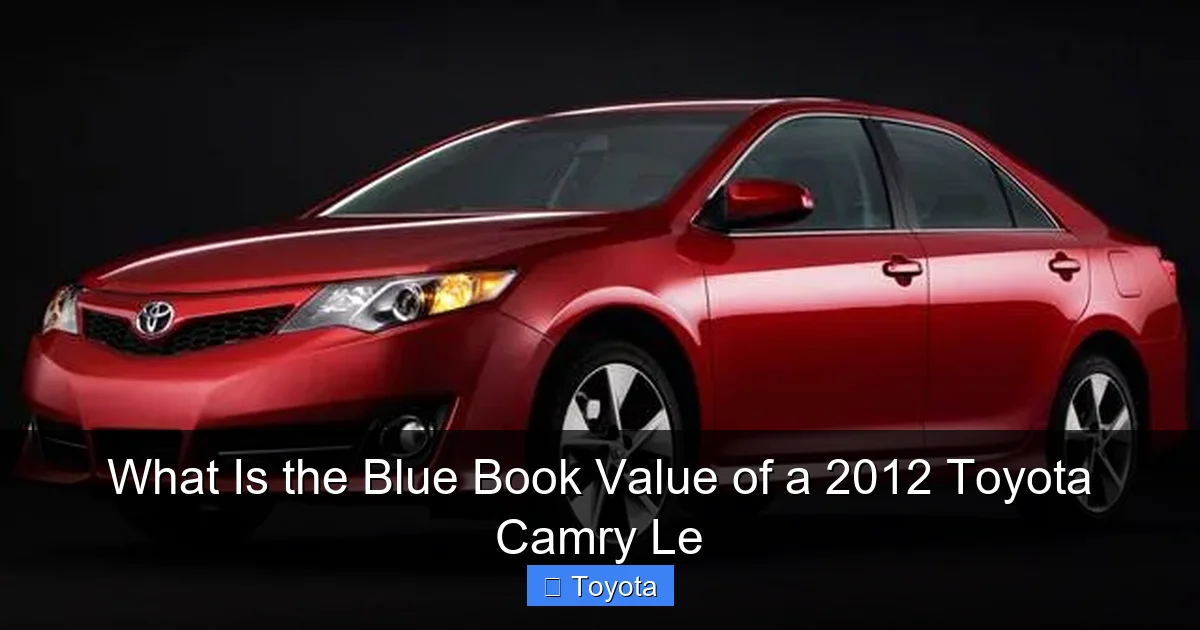
To understand its value, you have to understand the car itself. The 2012 model year was part of the XV50 generation Camry, a complete redesign that focused on improved fuel efficiency, a quieter ride, and more refined styling while keeping that classic Camry dependability. The LE trim was (and still is) the entry-level, no-frills workhorse. For 2012, the LE came standard with a 2.5-liter 4-cylinder engine mated to a 6-speed automatic transmission, pumping out 178 horsepower. It wasn’t a sports car, but it was smooth, efficient, and incredibly reliable. Key standard features included air conditioning, power windows/locks, a tilt/telescoping steering wheel, and a basic AM/FM/CD stereo system.

Visual guide about What Is the Blue Book Value of a 2012 Toyota Camry Le
Image source: file.kelleybluebookimages.com
Why This Generational Camry Holds Its Value So Well
Toyota’s reputation for longevity is a huge value driver. The 2012 Camry’s 2AR-FE engine is known to easily surpass 200,000 miles with basic maintenance. This creates immense buyer confidence in the used market. Furthermore, the 2012 redesign was very well-received, addressing previous criticisms about bland styling and road noise. It consistently ranked at the top of its class in reviews from Consumer Reports and Edmunds. High initial quality and strong predicted resale value are a virtuous cycle. A car that people know will be worth something in five years is more desirable today. This inherent strength means that even a decade later, a well-maintained 2012 Camry LE remains a compelling, low-risk purchase for budget-conscious buyers, taxi fleets, and first-time car owners. Its value depreciation curve is famously shallow compared to many competitors.
Decoding the Price: What Affects Your 2012 Camry LE’s Value?
Now, for the meat of the matter. You can’t just say “a 2012 Camry LE is worth X dollars.” You have to look at the specifics. KBB’s algorithm weighs several factors, and as an owner or buyer, you need to assess them honestly. Here’s a breakdown of the biggest value drivers and detractors for this specific model.
Visual guide about What Is the Blue Book Value of a 2012 Toyota Camry Le
Image source: file.kelleybluebookimages.com
1. Mileage: The Odometer’s Tale
This is the heavyweight champion of value factors. The national average annual mileage is about 12,000-15,000 miles. For a 2012 model, that puts a “typical” example around 108,000 to 135,000 miles in 2024. A 2012 Camry LE with 80,000 miles will command a significant premium over one with 160,000 miles. The difference can be $1,500 to $2,500 or more. High mileage suggests more wear and tear on everything from the engine and transmission to the suspension and interior. It also means the vehicle is closer to major service intervals (timing belt/water pump, transmission fluid, etc.). When checking your value, be brutally honest about the mileage. The KBB tool will ask for it first for a reason.
2. Condition: Inside and Out
KBB defines condition in tiers: Excellent, Very Good, Good, Fair. An “Excellent” 2012 Camry LE has no accidents, a clean title, all original body panels (no mismatched paint), a flawless interior with no stains, tears, or cracks, and all equipment functioning perfectly. It has complete service records. This is a unicorn for a 12-year-old car. “Very Good” means it has minor cosmetic flaws (a small door ding, slight wear on the driver’s seat bolster) but is mechanically sound. “Good” is the most common—normal wear and tear for its age, maybe a repaired scratch, but no major issues. “Fair” means significant problems: accident damage, rust, mechanical issues, or a salvage title. The jump from “Good” to “Very Good” can add $500-$1,000. The drop from “Good” to “Fair” can slash the value by half.
3. Optional Equipment and Packages
The LE is the base trim, but many had options. Did it have the popular All-Weather Package (which added a leather-wrapped steering wheel, heated front seats, and a 12V outlet)? Did it have a sunroof? A premium sound system? Navigation? These features add value. A sunroof alone can add $300-$500 to the private party value. The All-Weather Package is highly desirable in colder climates and adds similar value. Conversely, if it’s a bare-bones LE with manual windows and locks (rare but possible), it will be at the very bottom of the range.
4. Geographic Location and Season
Supply and demand are local. A 2012 Camry LE in a major metropolitan area with lots of competition might sell for less than the same car in a smaller town with fewer used sedans available. Regionally, convertibles and trucks sell for more in warm states, while AWD vehicles command a premium in snowy regions. For a front-wheel-drive sedan like the Camry LE, the differences are less pronounced but still exist. A car listed in a high-cost-of-living area (California, New York) will often have a higher sticker price than the same car in the Midwest, though the final negotiated price may converge. KBB’s valuation tool asks for your ZIP code to adjust for these local market conditions.
5. Vehicle History Report
A clean Carfax or AutoCheck report is worth real money. It verifies no accidents, no title problems (like salvage or flood damage), and provides a maintenance history if reported by dealers or shops. A car with a reported accident, even if perfectly repaired, will be worth 10-20% less than an identical car with a clean history. It’s a major red flag for savvy buyers. Always run a history report before buying or provide one when selling to justify your asking price.
Getting Your Specific Number: A Step-by-Step Guide
Enough theory. Let’s get practical. How do you actually find the Blue Book value for a specific 2012 Toyota Camry LE? Follow these steps for the most accurate result.

Visual guide about What Is the Blue Book Value of a 2012 Toyota Camry Le
Image source: file.kelleybluebookimages.com
Step 1: Go to the Source
Bookmark KBB.com. This is the only official source for a “Kelley Blue Book Value.” Do not rely solely on other websites (like Edmunds or NADA) for the “Blue Book” figure—they have their own valuations. While they are also reputable, the term “Blue Book” is trademarked by Kelley. On KBB’s homepage, you’ll see a prominent “Get Your Car’s Value” button. Click it.
Step 2: Input the Exact Details
You’ll be prompted for:
- Year: 2012
- Make: Toyota
- Model: Camry
- Trim/Engine: You must select “LE” and the engine type. For 2012 LE, it’s almost certainly the 2.5L 4-cylinder (2AR-FE). The V6 was only available on SE and XLE trims. Selecting the wrong engine will throw off the value.
- Mileage: Enter the current odometer reading.
- ZIP Code: Use your local code for the most relevant pricing.
- Transmission: Almost all were automatic, but confirm.
Step 3: Assess Condition Honestly
This is the hardest part. KBB will show you a series of questions about the car’s condition: exterior (scratches, dents, rust), interior (stains, cracks, odors), mechanical (any check engine lights, leaks, unusual noises?), and tires. Answer based on the car’s actual state, not your hopes. If you’re selling, understating the condition to get a higher number is pointless—a serious buyer will discover the flaws and either walk away or offer less. If you’re buying, be conservative. It’s better to expect a “Good” condition value and find a “Very Good” car than the reverse.
Step 4: Understand the Three Values
After you submit, you’ll see three primary numbers:
- Typical Trade-In Range: This is what a dealer will likely offer you at wholesale. It’s the lowest of the three numbers. It assumes the dealer will recondition the car and sell it for a profit. For a 2012 Camry LE in average condition with ~120k miles, this might be in the $3,500 – $5,500 range.
- Private Party Value: This is the “as-is” price you can expect selling to an individual. It’s higher than the trade-in because there’s no dealer markup. This is the most relevant number for most people. Our target range of $4,000-$9,000 falls here. A well-maintained, lower-mileage example could hit the top of that range.
- Suggested Retail Value: This is what a dealership might ask for a similar car on their lot, after they’ve cleaned it, reconditioned it, and added a warranty. It’s the highest number, often $1,000-$2,000 above the private party value. You should never pay this as a buyer unless it’s a certified pre-owned vehicle with a significant warranty.
Pro Tip: Always print or save the KBB report. It’s your evidence when negotiating, whether you’re telling a dealer “Your offer is below KBB trade-in” or a private buyer “My asking price is in line with KBB private party for this condition.”
How Does the Camry LE Compare? Trims and Rivals
The LE is the value leader in the Camry lineup, but it’s not the only option. Understanding the value hierarchy helps you know if you’re looking at a good deal. The 2012 Camry trims, in order from base to premium, were L (a very rare, even more basic fleet model), LE, SE, and XLE. The SE added a sport suspension, 17-inch wheels, a spoiler, and a leather-wrapped steering wheel. The XLE added leather seats, a power sunroof, woodgrain trim, and a premium JBL audio system. A comparable 2012 Camry SE with the same mileage and condition will typically be worth $800 to $1,500 more than an LE. An XLE can be $1,500 to $2,500 more valuable. So, if you’re shopping for an LE, seeing a similarly priced SE might be a better value.
How does the Camry LE stack up against its arch-rival, the 2012 Honda Accord LX (the Accord’s base trim)? Historically, the Camry and Accord have been neck-and-neck in value retention. A 2012 Accord LX with similar mileage and condition will have a value almost identical to a Camry LE. The deciding factor often comes down to personal preference and specific vehicle history. Some years, one might have a slight edge. In 2012, both were excellent, so focus more on the individual car’s condition than the badge. You might also compare it to the 2012 Ford Fusion S or the 2012 Nissan Altima 2.5. These competitors often start with a slightly lower private party value, reflecting a slightly lower perceived long-term reliability in the collective consciousness of used car buyers, which directly impacts Blue Book calculations.
Buying and Selling Smart: Practical Tips for the 2012 Camry LE
Knowing the number is only half the battle. Here’s how to use that knowledge effectively.
For Buyers: Don’t Pay Too Much
First, use KBB to establish a fair private party price for the specific car you’re looking at. Then, do your homework. Always get a vehicle history report (Carfax or AutoCheck). A clean report is non-negotiable for a reliable car like this. Have a trusted mechanic perform a pre-purchase inspection. It costs $100-$150 and can save you thousands by revealing hidden problems (transmission issues, rust, accident damage). When negotiating, start your offer at the lower end of the KBB “Good” condition range if the car has any flaws. Use the KBB printout as your anchor. Remember, the seller’s asking price is just a starting point. Also, consider long-term costs. A 2012 Camry needs regular maintenance. You might want to check resources like what size battery a 2012 Toyota Camry needs to budget for a replacement, or how big the gas tank is on a Toyota Camry to calculate real-world fuel stops. These small details contribute to the total cost of ownership.
For Sellers: Get Top Dollar
If you’re selling, your goal is to position your car in the highest condition tier possible. Start by giving it a thorough detail—clean every nook, shampoo the carpets, and remove all odors. Fix minor, inexpensive issues: replace burnt-out bulbs, top off all fluids, and address any check engine lights (a cheap scan at an auto parts store can tell you the issue). Gather all your service records. A binder of oil changes and tire rotations is worth hundreds of dollars in a buyer’s eyes. Take excellent photos: clean car, good lighting, all angles, and clear shots of the engine and interior. Price it at the higher end of the KBB “Good” or solidly in “Very Good” if it truly deserves it. Be prepared to show the KBB report and your service records to justify your price. Be realistic—if your car has 180,000 miles, pricing it like a 60,000-mile example will waste everyone’s time.
The Long-Term View: Depreciation and Future Value
A 2012 Camry LE has already taken its biggest depreciation hit in the first 3-4 years. That’s when a new car loses the most value. Now, at 12 years old, its value is depreciating at a much slower, more linear rate. It’s reached a point of relative price stability. Barring a major economic downturn or a catastrophic failure in Camry reputation (neither is likely), we can project its value in a few years. A well-maintained 2015 Camry LE today is worth roughly $9,000-$12,000. By 2027, your 2012 model will likely be worth between $2,500 and $5,000, depending on mileage and condition. The sweet spot for this generation is now: it’s old enough to be very affordable, but not so old that parts become scarce or reliability plummets. For the next 3-5 years, it will remain a cornerstone of the affordable used sedan market. Its value will eventually plateau as it becomes a “classic” or “project car,” but that’s many years and miles away.
Conclusion: The Blue Book Value is Your Foundation
So, what is the Blue Book value of a 2012 Toyota Camry LE? The honest answer is: it depends. It depends on your specific car’s story—its mileage, its health, its history, and where you live. The national landscape shows a range from about $4,000 for a high-mileage, fair-condition car to about $9,000 for a low-mileage, excellent-condition example with desirable options. Your job is not to find a single magic number, but to accurately place your car (or the car you want to buy) within that spectrum. The Kelley Blue Book tool is your indispensable guide for this. Use it. Respect it. Bring it to the negotiation table. The 2012 Toyota Camry LE is a fantastic vehicle precisely because its value is so predictable and well-founded in its legendary reliability. By understanding the factors that drive that value, you empower yourself to make a smart financial decision, whether you’re handing over cash or handing over the keys. Remember, the best price is always the one based on facts, data, and a clear-eyed assessment of the metal and plastic in front of you.
Frequently Asked Questions
How accurate is the Kelley Blue Book value for a 2012 Camry LE?
KBB values are highly accurate as they are based on millions of real transaction data points. It’s the industry standard for a reason. However, it’s a national average adjusted for your ZIP code. The final sale price can still vary based on local dealer markup, private seller urgency, and the specific emotional appeal of that one car. Use it as a powerful baseline, not an absolute decree.
Does the color of my 2012 Camry LE affect its Blue Book value?
Only marginally. Popular, conservative colors like white, silver, black, and gray often sell slightly faster and may command a tiny premium (maybe $100-$200) over less common or more personal colors like bright blue, red, or green. For a mainstream sedan like the Camry LE, color is a very distant fourth factor behind mileage, condition, and history.
What’s the difference between the “Trade-In” and “Private Party” values?
The Trade-In value is what a dealer will offer you for your car, usually at wholesale. They must account for reconditioning costs, warranty, and their profit margin, so it’s the lowest figure. The Private Party value is what you can expect selling directly to an individual buyer. It’s higher because there’s no middleman. You should always aim for at least the midpoint of the Private Party range when selling yourself.
How much does a clean vehicle history report add to the value?
It doesn’t add a fixed dollar amount; instead, it preserves the full value. A car with an accident on its record can be worth 10-20% less than an identical car with a clean history. A clean Carfax is the baseline expectation for a well-priced 2012 Camry. A car without one will struggle to achieve its full KBB value.
Should I use the value for my exact ZIP code or a nearby major city?
Always use your own ZIP code for the most accurate local adjustment. KBB’s algorithm is designed to account for urban vs. rural pricing differences. If you live in a small town but are selling in a big city an hour away, you might check both. However, you should price your car for the market where you will actually complete the sale.
My 2012 Camry LE has a salvaged title. What’s it worth?
A salvage title drastically reduces value, typically by 50-65% compared to a clean-title car. KBB’s tool will not give you a value for a salvage title; you must select “Salvage” in the condition section, and it will provide a very low range. These cars are for expert buyers only, as financing and insurance are difficult, and long-term reliability is never guaranteed. Their value is highly speculative and varies wildly.