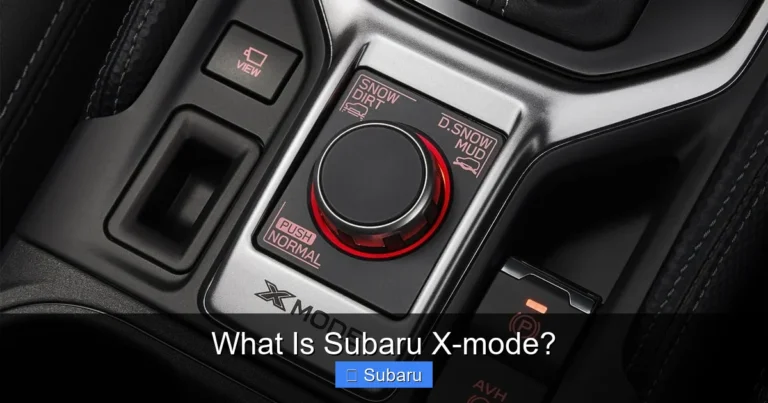
What Is Subaru X Mode

Contents
- 1 Key Takeaways
- 2 📑 Table of Contents
- 3 How Subaru X Mode Works
- 4 Types of X Mode: Standard vs. Deep Snow/Mud
- 5 X Mode in Action: Real-World Scenarios
- 6 Which Subaru Models Have X Mode?
- 7 Limitations and Considerations
- 8 X Mode vs. Competitors: How Does It Stack Up?
- 9 Conclusion: Why X Mode Matters
- 10 Frequently Asked Questions


Subaru X Mode is an advanced traction control system designed to enhance off-road performance and low-speed stability on slippery or uneven terrain. It optimizes engine output, transmission response, and braking to help drivers maintain control in challenging conditions like snow, mud, or steep inclines.
If you’ve ever driven a Subaru—especially on a snowy mountain road, a muddy trail, or a steep gravel driveway—you’ve probably noticed something special about how it handles. It’s not just the legendary all-wheel drive. There’s another secret weapon under the hood: Subaru X Mode. This clever technology is designed to give drivers more confidence when the road gets tough. Whether you’re navigating a slippery forest path or climbing a snowy hill, X Mode steps in to help keep your Subaru stable, controlled, and moving forward.
But what exactly is Subaru X Mode? At its core, it’s an advanced electronic driver assistance system that enhances your vehicle’s off-road and low-speed performance. It’s not a standalone drivetrain—it works hand-in-hand with Subaru’s Symmetrical All-Wheel Drive (AWD) system to optimize traction, braking, and power delivery. Think of it as your co-pilot when the terrain turns challenging. X Mode doesn’t just help you go faster; it helps you go *smarter*, with better control and safety.
You might be wondering: Do I really need X Mode? If you live in an area with harsh winters, enjoy weekend camping trips, or simply want extra peace of mind when driving on wet or uneven roads, the answer is likely yes. X Mode isn’t just for hardcore off-roaders. It’s for everyday drivers who want their Subaru to handle whatever Mother Nature throws at it. From deep snow to muddy backroads, this system is built to make tough conditions feel more manageable.
Key Takeaways
- X Mode enhances off-road capability: It improves traction and control on rough, slippery, or uneven surfaces by managing power delivery and braking.
- Two modes available: Most Subaru models offer Standard and Deep Snow/Mud modes, each tailored for different terrain challenges.
- Works with AWD system: X Mode integrates seamlessly with Subaru’s Symmetrical All-Wheel Drive for maximum grip and stability.
- Automatic engagement below 12 mph: The system activates when speeds are low and terrain demands extra control, such as climbing hills or navigating trails.
- Improves hill descent control: X Mode includes a hill descent feature that maintains a steady, safe speed when going downhill on steep or loose surfaces.
- Not a replacement for driver skill: While X Mode helps, safe driving practices and proper tire choice remain essential for off-road success.
- Available on most modern Subarus: Found in models like the Outback, Forester, Crosstrek, and Ascent, typically with manual activation via a dashboard button.
📑 Table of Contents
How Subaru X Mode Works
So, how does X Mode actually do what it does? It’s not magic—it’s smart engineering. X Mode is essentially an intelligent traction management system that monitors wheel slip, terrain conditions, and driver input, then adjusts the vehicle’s performance in real time. It does this by communicating with several key components of your Subaru’s drivetrain and braking system.
When you activate X Mode, the system takes control of the engine, transmission, and brakes to maximize grip and minimize wheel spin. For example, if one wheel starts to slip on ice or mud, X Mode can instantly reduce engine power to that wheel and apply braking force to keep it from spinning uselessly. At the same time, it sends more torque to the wheels with better traction. This process happens seamlessly and almost instantly, often before the driver even notices a loss of grip.
One of the most impressive features of X Mode is its ability to manage hill descent. When you’re driving down a steep, slippery slope—like a snowy hill or a rocky trail—X Mode can automatically maintain a slow, steady speed without you having to constantly brake. This is called Hill Descent Control (HDC), and it’s a lifesaver when you’re trying to keep your cool on a tricky downhill. The system uses the anti-lock brakes to pulse gently, keeping your speed under control so you can focus on steering.
X Mode also adjusts the response of the continuously variable transmission (CVT) in most Subaru models. Instead of shifting through traditional gears, the CVT mimics lower gear ratios when X Mode is active. This provides more engine braking and better torque delivery at low speeds, which is essential for crawling over rocks or through deep snow. The result? Smoother, more controlled movement in conditions where abrupt acceleration or braking could cause you to lose traction.
Integration with Symmetrical All-Wheel Drive
X Mode doesn’t work alone. It’s designed to complement Subaru’s Symmetrical All-Wheel Drive system, which is already one of the best in the industry. The AWD system constantly sends power to all four wheels, adjusting torque distribution based on driving conditions. When X Mode is engaged, it enhances this capability by adding another layer of control.
For instance, if you’re driving through a muddy trail and the front wheels start to slip, the AWD system will redirect power to the rear. X Mode takes this a step further by applying selective braking to the slipping wheels and reducing engine output just enough to regain traction. This dual-action approach—power redistribution and brake-based traction control—makes X Mode especially effective in low-grip situations.
The symmetry of Subaru’s AWD layout also plays a role. Because the drivetrain is balanced and centered, weight distribution is even, which improves stability. X Mode leverages this balance to maintain control during sharp turns on loose surfaces or when navigating uneven terrain. It’s a perfect partnership: the AWD system provides the foundation, and X Mode fine-tunes the response for maximum safety and performance.
Sensors and Real-Time Adjustments
Under the surface, X Mode relies on a network of sensors to monitor what’s happening with your vehicle. These include wheel speed sensors, steering angle sensors, yaw rate sensors, and even a tilt sensor to detect hill angles. All this data is fed into the vehicle’s electronic control unit (ECU), which processes it in real time and makes adjustments as needed.
For example, if the system detects that the vehicle is starting to slide sideways on a snowy curve, it can reduce engine power and apply the brakes to individual wheels to correct the trajectory. This is similar to how electronic stability control (ESC) works, but X Mode is specifically tuned for off-road and low-speed scenarios.
The system also monitors throttle input. If you press the accelerator too hard on a slippery surface, X Mode will limit power to prevent wheel spin. This doesn’t mean you lose control—it means the system helps you maintain it. It’s like having a driving instructor in the car who gently reminds you to ease off the gas when conditions get tricky.
Types of X Mode: Standard vs. Deep Snow/Mud
Not all X Mode systems are created equal. Depending on your Subaru model and year, you may have access to one or two different X Mode settings. The most common setup includes two modes: Standard X Mode and Deep Snow/Mud X Mode. Each is designed for specific types of terrain and driving challenges.
Standard X Mode
Standard X Mode is the default setting and is ideal for everyday low-traction situations. This includes driving on snow-covered roads, wet pavement, gravel driveways, or mild off-road trails. When you activate Standard X Mode, the system focuses on maintaining smooth power delivery and preventing wheel slip during acceleration and cornering.
This mode is particularly useful in winter driving conditions. If you’re pulling out of a snowy parking lot or climbing a slippery hill, Standard X Mode helps ensure that your wheels don’t spin out. It also enhances hill descent control, allowing you to drive down steep slopes with confidence.
One of the best things about Standard X Mode is that it’s easy to use. Simply press the X Mode button on your dashboard (usually located near the gear shifter), and the system activates automatically. A green light on the instrument panel confirms it’s on. The system remains active as long as your speed stays below 12 mph (about 20 km/h). Once you exceed that speed, X Mode disengages automatically, but you can reactivate it when needed.
Deep Snow/Mud X Mode
For more extreme conditions, many Subaru models offer a second setting: Deep Snow/Mud X Mode. This mode is designed for situations where traction is severely limited—think deep snowdrifts, thick mud, loose gravel, or rocky trails. When you switch to this mode, the system becomes even more aggressive in managing power and braking.
In Deep Snow/Mud mode, the transmission holds lower “gears” longer, providing more torque at very low speeds. This is essential for crawling over obstacles without stalling or losing momentum. The system also allows for slightly more wheel slip than Standard mode, which can help the tires dig through soft surfaces like mud or snow.
For example, if you’re driving through a muddy trail and your tires start to spin, Deep Snow/Mud mode will let them spin just enough to clear the mud, then quickly reapply power to the wheels with grip. This “dig and go” approach is a hallmark of serious off-road systems, and Subaru has adapted it beautifully for its crossover SUVs.
It’s important to note that Deep Snow/Mud mode also has a speed limit—typically around 12 mph—but it’s optimized for even slower, more deliberate movement. This mode is perfect for off-road adventures, farm roads, or winter expeditions where conditions are unpredictable.
When to Use Each Mode
Choosing the right X Mode depends on the terrain and your driving goals. Here’s a quick guide:
– Use **Standard X Mode** for: Snowy roads, icy driveways, wet trails, light off-roading, or steep hills with moderate traction.
– Use **Deep Snow/Mud X Mode** for: Deep snow, thick mud, loose gravel, rocky paths, or when you need maximum low-speed control.
A practical example: Imagine you’re driving to a remote cabin in the mountains during a winter storm. On the paved road, you might not need X Mode. But when you turn onto a snow-covered forest road, Standard X Mode helps you maintain control. If you hit a section with deep snowdrifts, switching to Deep Snow/Mud mode gives you the extra traction and torque needed to push through.
X Mode in Action: Real-World Scenarios
To truly understand the value of Subaru X Mode, it helps to see it in action. Let’s walk through a few real-world scenarios where X Mode makes a noticeable difference.
Scenario 1: Climbing a Snowy Hill
It’s a cold January morning, and you need to get up a steep, snow-covered driveway to reach your home. Without X Mode, you might spin your wheels or slide backward. But with X Mode engaged, the system manages power delivery to prevent wheel slip. It also uses hill descent control to keep you stable if you need to back down slowly. The result? You make it up the hill smoothly, without drama.
Scenario 2: Navigating a Muddy Trail
You’re on a weekend camping trip, and the trail to your site is a mess of mud and puddles. Your Subaru Crosstrek is equipped with Deep Snow/Mud X Mode. As you drive, the system detects wheel slip and instantly adjusts power and braking. It allows the tires to spin just enough to clear the mud, then grips again. You move forward steadily, without getting stuck.
Scenario 3: Driving Down a Steep Gravel Road
You’re descending a steep, loose gravel road after a hike. Without X Mode, you’d have to ride the brakes, which could cause skidding or overheating. With X Mode on, the system automatically controls your speed using gentle brake pulses. You focus on steering, while X Mode handles the speed. It’s like having cruise control for downhill driving.
Scenario 4: Parking on an Icy Slope
You’re at a ski resort, and the parking lot is a sheet of ice with a steep incline. Pulling out without X Mode could mean spinning wheels or sliding into another car. But with Standard X Mode active, the system limits power and applies brakes to keep you moving forward safely. It’s a small detail that makes a big difference in winter driving.
Tips for Getting the Most Out of X Mode
– **Use the right tires:** X Mode works best with all-season or all-terrain tires. Winter tires will enhance its effectiveness in snow and ice.
– **Don’t rely on it alone:** X Mode helps, but it’s not a substitute for safe driving. Always adjust your speed to conditions.
– **Know when to turn it off:** X Mode disengages above 12 mph. Don’t try to force it—use it when it’s needed.
– **Practice in safe areas:** If you’re new to off-roading, try X Mode in a controlled environment like an empty parking lot covered in snow.
– **Check your owner’s manual:** X Mode behavior can vary slightly between models. Your manual will have model-specific details.
Which Subaru Models Have X Mode?
X Mode is available on most modern Subaru SUVs and crossovers. It’s not typically found on sedans like the Impreza or Legacy, as those are more road-focused. Here’s a breakdown of which models include X Mode:
– **Subaru Outback:** Standard on most trims, with both Standard and Deep Snow/Mud modes.
– **Subaru Forester:** Available on higher trims, with dual-mode capability.
– **Subaru Crosstrek:** Standard on most versions, including the hybrid.
– **Subaru Ascent:** Comes with X Mode on all trims, optimized for its larger size and family use.
– **Subaru Wilderness Models:** The Outback Wilderness and Forester Wilderness come with enhanced X Mode tuning, including a more aggressive Deep Snow/Mud mode and additional off-road features.
Even within these models, availability can vary by year and trim level. Generally, X Mode is included on models with the manual or CVT transmission and Symmetrical AWD. It’s often paired with other off-road features like roof rails, skid plates, and all-terrain tires.
How to Activate X Mode
Activating X Mode is simple. Look for a button on your dashboard or center console labeled “X-MODE.” It’s usually near the gear shifter or climate controls. Press it once to activate Standard mode. On models with two modes, press it again to switch to Deep Snow/Mud. A corresponding light will appear on your instrument panel.
The system will remain active as long as your speed stays below the threshold (usually 12 mph). If you exceed that speed, X Mode will turn off automatically, but you can reactivate it when needed. Some newer models also allow you to customize X Mode settings through the infotainment system.
Limitations and Considerations
While X Mode is a powerful tool, it’s not a magic wand. It has limitations, and understanding them will help you use it safely and effectively.
Speed Limitations
X Mode is designed for low-speed driving. It automatically disengages when you exceed 12 mph (20 km/h). This means it’s not useful for highway driving or high-speed off-roading. If you’re planning a high-speed desert run, X Mode won’t help—and shouldn’t be used.
Not a Replacement for Proper Tires
X Mode can’t overcome the limits of your tires. If you’re driving on summer tires in deep snow, even the best traction control system won’t save you. Always use the right tires for the season and terrain. Winter tires, in particular, make a huge difference in snow and ice.
Driver Responsibility
X Mode assists the driver—it doesn’t replace them. You still need to steer, brake, and make smart decisions. The system can’t prevent accidents caused by excessive speed, poor judgment, or mechanical failure. Always drive within your limits and the vehicle’s capabilities.
Maintenance Matters
Like any electronic system, X Mode relies on sensors and software. Keep your vehicle well-maintained. Check tire pressure regularly, ensure brake pads are in good condition, and follow the recommended service schedule. A well-maintained Subaru will make the most of X Mode.
X Mode vs. Competitors: How Does It Stack Up?
Subaru isn’t the only automaker offering off-road assistance systems. Brands like Jeep, Toyota, and Ford have their own versions—such as Jeep’s Selec-Terrain or Toyota’s Multi-Terrain Select. So how does Subaru X Mode compare?
One of X Mode’s biggest advantages is its simplicity. While some systems require multiple dials or menus, X Mode is activated with a single button. It’s intuitive and user-friendly, even for drivers who aren’t off-road experts.
Another strength is its integration with Symmetrical AWD. Many competitors use part-time or on-demand AWD systems, which aren’t always active. Subaru’s full-time AWD, combined with X Mode, provides constant traction and responsiveness.
That said, hardcore off-roaders might prefer systems with locking differentials or low-range gearing—features found in vehicles like the Jeep Wrangler or Toyota 4Runner. But for most drivers, X Mode offers the perfect balance of capability and everyday usability.
Conclusion: Why X Mode Matters
Subaru X Mode is more than just a fancy feature—it’s a practical tool that enhances safety, confidence, and capability. Whether you’re navigating a snowy driveway, exploring a muddy trail, or simply driving in wet conditions, X Mode helps your Subaru perform at its best.
It’s not about making your vehicle invincible. It’s about giving you the support you need when the road gets tough. By managing power, braking, and traction, X Mode turns challenging conditions into manageable ones. It’s one of the reasons Subaru owners love their vehicles—and why the brand has such a loyal following.
If you drive a Subaru with X Mode, take the time to learn how it works. Practice in safe conditions, use the right tires, and always drive responsibly. With X Mode on your side, you’ll be ready for whatever adventure comes your way.
Frequently Asked Questions
What does Subaru X Mode do?
Subaru X Mode enhances traction and control on slippery or uneven terrain by managing engine power, transmission response, and braking. It helps prevent wheel spin and maintains stability during low-speed off-road or adverse weather driving.
Is X Mode always on?
No, X Mode is not always on. It must be manually activated using the X-MODE button on the dashboard. It automatically disengages when vehicle speed exceeds 12 mph (20 km/h).
Can I drive with X Mode on the highway?
No, X Mode is designed for low-speed use only and will turn off above 12 mph. It’s not intended for highway driving or high-speed conditions.
Does X Mode work in snow?
Yes, X Mode is very effective in snow. It helps maintain traction on snowy roads and includes hill descent control for safe downhill driving in winter conditions.
Do I need special tires for X Mode?
While X Mode works with standard tires, it performs best with all-season or winter tires. Proper tire choice greatly enhances the system’s effectiveness in snow, ice, or mud.
Can X Mode get me unstuck from mud or snow?
X Mode can help in mild to moderate situations by managing power and braking. However, it’s not a recovery system—getting severely stuck may still require physical assistance like traction mats or a tow.