What Is Rab on a Subaru

Contents
- 1 Key Takeaways
- 2 📑 Table of Contents
- 3 Understanding Reverse Automatic Braking (RAB)
- 4 How RAB Works: Sensors, Alerts, and Braking
- 5 Which Subaru Models Include RAB?
- 6 Real-World Benefits of RAB
- 7 Limitations and Maintenance of RAB
- 8 RAB vs. Similar Systems in Other Brands
- 9 Conclusion
- 10 Frequently Asked Questions

Car Window Tint Film

Car LED Headlight Bulb

Jack Stands

Engine Oil Additive
RAB on a Subaru stands for Reverse Automatic Braking, a smart safety feature that helps prevent low-speed collisions while backing up. It uses sensors to detect obstacles and can automatically apply the brakes if you don’t react in time—making parking and reversing safer and less stressful.
If you’ve ever backed out of a parking spot only to hear a loud *thud*—or worse, a startled yelp from a shopping cart you didn’t see—you know how stressful reversing can be. Even with rearview cameras and mirrors, blind spots and distractions make it easy to miss obstacles. That’s where Subaru’s Reverse Automatic Braking, or RAB, comes in. It’s one of those quiet, behind-the-scenes technologies that doesn’t get as much attention as all-wheel drive or EyeSight, but it’s just as important for everyday safety.
RAB is part of Subaru’s broader commitment to driver and pedestrian protection. While many automakers offer similar systems under different names—like Ford’s Rear Automatic Braking or Toyota’s Rear Cross-Traffic Braking—Subaru’s version is known for its reliability and seamless integration with the brand’s other safety features. Whether you’re navigating a crowded grocery store lot, backing out of a narrow driveway, or helping your kid load their bike into the trunk, RAB acts like a second set of eyes—and sometimes, a second foot on the brake pedal.
In this article, we’ll dive deep into what RAB on a Subaru really is, how it functions, which models include it, and how it fits into Subaru’s overall safety philosophy. We’ll also cover real-world scenarios where RAB can make a difference, common misconceptions, and tips for keeping the system in top shape. By the end, you’ll understand not just what RAB stands for, but why it’s a valuable ally in your daily drives.
Key Takeaways
- What RAB Means: RAB stands for Reverse Automatic Braking, a driver-assist technology designed to prevent or reduce the severity of collisions when reversing.
- How It Works: The system uses rear radar or ultrasonic sensors to monitor the area behind your vehicle and can automatically apply the brakes if an obstacle is detected and the driver doesn’t respond.
- Available Models: RAB is commonly found on newer Subaru models like the Outback, Forester, Crosstrek, Ascent, and Legacy, especially in higher trims or with optional safety packages.
- Safety Benefits: RAB helps prevent fender benders, protects pedestrians and pets, and reduces stress during tight parking maneuvers.
- Limitations: The system works best at low speeds and may not detect all objects, such as thin poles or objects below sensor height—driver attention is still essential.
- Maintenance Tips: Keep rear sensors clean and unobstructed, and have the system inspected during regular service to ensure proper function.
- Complements Other Features: RAB often works alongside other Subaru safety tech like Rear Cross-Traffic Alert (RCTA) and Blind Spot Detection for a more comprehensive safety net.
📑 Table of Contents
Understanding Reverse Automatic Braking (RAB)
Reverse Automatic Braking, or RAB, is a proactive safety system designed to help drivers avoid collisions while moving in reverse. Unlike passive alerts that simply warn you of danger, RAB takes action by automatically applying the brakes if it detects an imminent collision and the driver hasn’t responded. It’s not meant to replace attentive driving, but rather to act as a safety net in those split-second moments when reaction time isn’t enough.
The system typically activates when the vehicle is in reverse and moving at speeds below 10 mph. This makes it ideal for parking lots, driveways, and tight spaces where most low-speed collisions occur. RAB uses a combination of sensors—usually mounted in the rear bumper—to scan the area behind the vehicle. These sensors can detect objects, vehicles, and even pedestrians within a certain range, typically up to 6 to 8 feet directly behind the car.
When the system identifies a potential obstacle, it first alerts the driver through visual and audible warnings, often displayed on the infotainment screen or dashboard. If the driver doesn’t brake or steer away, RAB will intervene by applying the brakes automatically. The goal isn’t necessarily to bring the car to a complete stop every time, but to reduce speed enough to prevent or minimize impact.
It’s important to note that RAB is not the same as a parking assist system that steers the car for you. Instead, it’s focused solely on braking. This makes it simpler and more reliable in many situations, especially when you’re in control of the steering but just need help with the pedal.
How RAB Differs from Other Subaru Safety Features
Subaru offers a suite of advanced driver-assist technologies under its EyeSight and STARLINK Safety Plus systems. While RAB is often grouped with these, it’s distinct in both function and operation. For example, EyeSight primarily monitors the road ahead using stereo cameras and helps with adaptive cruise control, lane departure warnings, and pre-collision braking at higher speeds. RAB, on the other hand, is specifically designed for low-speed reversing and uses rear-mounted sensors instead of forward-facing cameras.
Another related feature is Rear Cross-Traffic Alert (RCTA), which warns you of vehicles approaching from the sides when you’re backing out of a parking spot. RCTA alerts you with beeps and lights, but doesn’t apply the brakes. RAB goes a step further by actually stopping the car if needed. In many Subaru models, RAB and RCTA work together—RCTA warns you of a car coming from the left, and if you don’t stop, RAB might step in to prevent a collision.
This layered approach to safety is a hallmark of Subaru’s design philosophy. Instead of relying on a single system, the brand combines multiple technologies to cover different angles and scenarios. RAB is a key part of that strategy, especially for drivers who frequently navigate tight spaces or drive in areas with high pedestrian traffic.
How RAB Works: Sensors, Alerts, and Braking

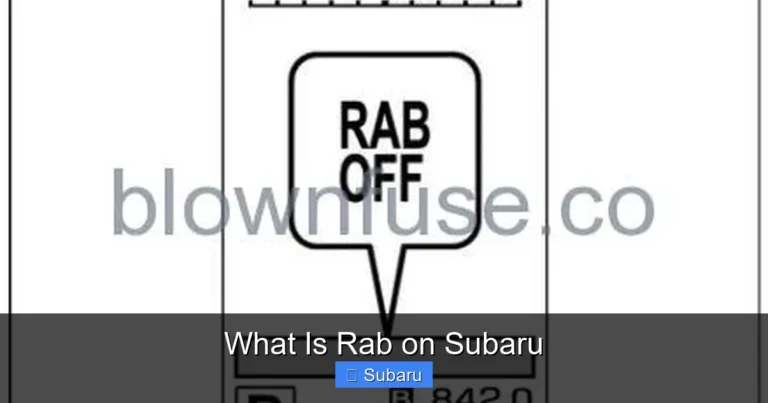
Visual guide about What Is Rab on a Subaru
Image source: images.simplepart.com
To understand how RAB functions, it helps to break down the process into three main stages: detection, alert, and intervention. Each stage plays a critical role in preventing accidents and giving drivers peace of mind.
Detection: The Role of Rear Sensors
At the heart of RAB are the rear sensors—typically ultrasonic or radar-based—mounted in the rear bumper. These sensors emit signals that bounce off objects behind the vehicle and return to the sensor. By measuring the time it takes for the signal to return, the system calculates the distance to the obstacle. Some newer Subaru models use radar sensors, which are more accurate in detecting objects at greater distances and in various weather conditions.
The detection range for RAB is usually between 6 and 8 feet directly behind the vehicle. It’s most effective for objects that are at bumper height or above, such as other cars, walls, shopping carts, or people. However, it may not detect low-lying objects like small rocks, curbs, or objects below the sensor’s line of sight. This is why Subaru emphasizes that RAB is a driver-assist feature, not a replacement for checking your surroundings.
Alert: Visual and Audible Warnings
Once an obstacle is detected within the critical range, RAB triggers a warning sequence. This usually starts with a visual alert on the dashboard or infotainment screen, often accompanied by an icon showing a car with a warning triangle. At the same time, an audible beep or tone will sound, increasing in frequency as the vehicle gets closer to the object.
For example, if you’re backing up toward a parked car, you might first see a yellow warning light. As you get closer, the light turns red, and the beeping becomes rapid. This escalation gives you time to react—whether that means hitting the brake, turning the wheel, or shifting to drive.
Some Subaru models also integrate RAB alerts with the rearview camera display. When the camera is active, a dynamic guideline system may appear, showing predicted paths and highlighting areas where obstacles are detected. This visual feedback makes it easier to judge distance and avoid collisions.
Intervention: Automatic Braking
If the driver doesn’t respond to the warnings—perhaps because they’re distracted or misjudging the distance—RAB will take control and apply the brakes automatically. The system calculates the necessary braking force based on speed, distance, and rate of closure. In most cases, it applies enough pressure to slow the vehicle significantly or bring it to a stop before impact.
It’s worth noting that RAB doesn’t always stop the car completely. In some scenarios, it may reduce speed to minimize damage rather than prevent it entirely. For instance, if you’re backing up at 8 mph and a shopping cart is 3 feet behind you, RAB might slow you down to 2 mph, reducing the force of impact and potentially avoiding injury or damage.
After the system intervenes, the driver will usually see a message on the dashboard, such as “Automatic Braking Activated” or “Collision Avoided.” The brakes will release once the obstacle is no longer in the path or the vehicle has stopped.
Which Subaru Models Include RAB?

Visual guide about What Is Rab on a Subaru
Image source: cararac.com
RAB is not standard on every Subaru, but it’s widely available across the brand’s lineup—especially in newer models and higher trim levels. Subaru has been gradually expanding its safety technology offerings, and RAB is now a common feature in vehicles equipped with the STARLINK Safety Plus package or advanced driver-assist options.
Outback
The Subaru Outback, one of the brand’s most popular models, often includes RAB in trims like the Limited, Touring, and Onyx Edition XT. These higher-end versions typically come with the full suite of EyeSight and STARLINK features, including RAB and RCTA. Even some mid-tier trims may offer RAB as part of an optional safety package.
For example, a 2023 Outback Limited with the Technology Package will have RAB standard, while a base Premium trim might require an upgrade to access it. Always check the specific model year and trim when shopping, as availability can vary.
Forester
The Forester, known for its rugged capability and family-friendly design, also offers RAB on most trims starting from the Premium level and above. The Sport, Limited, and Touring trims almost always include RAB, along with other advanced safety features like adaptive cruise control and lane-keeping assist.
In the 2024 Forester lineup, RAB is standard on all trims except the base Base model, reflecting Subaru’s push to make safety technology more accessible.
Crosstrek
The compact Crosstrek brings RAB to urban drivers and outdoor enthusiasts alike. While the base trim may not include it, the Premium, Sport, and Limited trims typically feature RAB as part of the STARLINK Safety Plus package. This makes the Crosstrek a great option for city dwellers who frequently park in tight spaces or navigate busy streets.
Ascent
As Subaru’s largest SUV, the Ascent is designed with families in mind—and safety is a top priority. RAB is standard on all Ascent trims, including the Base, Premium, Limited, and Touring. Given the vehicle’s size and blind spots, RAB is especially valuable when backing up in driveways or parking lots.
Legacy
The midsize Legacy sedan also offers RAB on higher trims like the Limited and Touring. While sedans have smaller blind spots than SUVs, RAB still adds an extra layer of protection, particularly in urban environments where pedestrians and cyclists are common.
Checking for RAB on Your Subaru
If you’re unsure whether your Subaru has RAB, there are a few ways to check. First, look for rear sensors in the bumper—small circular or rectangular modules, usually grouped in pairs. You can also consult your owner’s manual or look for the STARLINK Safety Plus badge on the vehicle.
Another option is to use Subaru’s online VIN decoder or contact your local dealership. They can confirm which safety features are included based on your vehicle identification number.
Real-World Benefits of RAB

Visual guide about What Is Rab on a Subaru
Image source: kledo.com
While RAB might seem like a small feature, its impact on everyday driving can be significant. Here are some practical scenarios where RAB can make a real difference.
Preventing Parking Lot Fender Benders
Parking lots are hotspots for low-speed collisions. Between shopping carts, poles, and other cars, it’s easy to misjudge distance or get distracted. RAB helps prevent these minor but frustrating incidents. For example, if you’re backing out of a tight space and don’t see a shopping cart rolling into your path, RAB can detect it and apply the brakes before you hit it.
These small accidents might not cause major damage, but they can lead to expensive repairs, insurance claims, and stress. RAB helps avoid all of that.
Protecting Pedestrians and Pets
Children and pets are especially vulnerable when vehicles are reversing. A child chasing a ball or a dog darting behind the car can be hard to see, even with a rearview camera. RAB adds an extra layer of protection by detecting movement and intervening if necessary.
In one real-world example, a Subaru owner in Oregon reported that RAB activated when their dog ran behind the car while they were backing out of the driveway. The system stopped the vehicle just in time, preventing what could have been a tragic accident.
Reducing Driver Stress
Reversing can be nerve-wracking, especially for new drivers or those with large vehicles. RAB helps reduce anxiety by providing an added safety net. Knowing that the car can stop itself if needed allows drivers to focus more on steering and less on panic-braking.
This is particularly helpful in tight garages, crowded driveways, or when teaching a teen to drive. RAB gives both the driver and passengers more confidence.
Complementing Other Safety Features
RAB doesn’t work in isolation. It’s part of a broader ecosystem of Subaru safety tech. For instance, when combined with Rear Cross-Traffic Alert, RAB can detect a car approaching from the side and either warn you or brake if you don’t stop. Similarly, when used with the rearview camera, it provides both visual and automatic protection.
This layered approach means that even if one system misses something, another might catch it. It’s a smart, redundant design that enhances overall safety.
Limitations and Maintenance of RAB
While RAB is a powerful tool, it’s not perfect. Understanding its limitations and maintaining it properly ensures it works when you need it most.
What RAB Cannot Detect
RAB is designed for objects within its sensor range and at a certain height. It may not detect:
– Objects below bumper level (like small rocks, curbs, or low walls)
– Thin poles or wires that don’t reflect sensor signals well
– Objects moving very quickly from the side (though RCTA helps here)
– Snow, ice, or heavy rain can sometimes interfere with sensor performance
This is why Subaru emphasizes that RAB is a driver-assist feature, not an autonomous system. You should always check your mirrors, use your camera, and look over your shoulder when reversing.
Weather and Environmental Factors
Extreme weather can affect RAB’s performance. Heavy rain, snow, or fog may reduce sensor accuracy. Dirt, mud, or ice buildup on the rear bumper can also block sensors and prevent them from working properly.
If you live in a snowy area, make it a habit to clear snow and ice from the rear bumper before driving. Even a thin layer of grime can interfere with detection.
System Maintenance Tips
To keep RAB functioning optimally:
– Clean the rear sensors regularly with a soft cloth and mild cleaner
– Avoid using high-pressure washes directly on the sensors
– Have the system inspected during routine service, especially after a collision or bumper repair
– If you notice reduced performance or warning lights, have a technician check the sensors and software
Most Subaru dealerships can run a diagnostic test to ensure RAB is calibrated correctly. It’s a quick check that can save you from a costly mistake down the road.
When RAB Might Not Activate
There are situations where RAB may not engage, such as:
– Driving in reverse at speeds above 10 mph
– Sudden, unexpected obstacles that appear too close for the system to react
– Sensor malfunctions due to damage or obstruction
Always stay alert and ready to brake manually, even with RAB active.
RAB vs. Similar Systems in Other Brands
Many automakers offer reverse braking systems, but Subaru’s RAB stands out for its integration and reliability. Here’s how it compares to similar features:
– **Ford’s Rear Automatic Braking:** Available on models like the Explorer and Escape, this system works similarly but may not be as finely tuned for low-speed precision.
– **Toyota’s Rear Cross-Traffic Braking:** Found on RAV4 and Highlander, it’s effective but sometimes slower to react than Subaru’s system.
– **Honda’s Rear Automatic Braking:** Offered on the CR-V and Pilot, it’s comparable but may have a shorter detection range.
Subaru’s advantage lies in its holistic safety approach. RAB works seamlessly with EyeSight, RCTA, and other features to create a comprehensive safety net. Plus, Subaru’s all-wheel-drive system adds stability, making RAB even more effective in slippery conditions.
Conclusion
Reverse Automatic Braking (RAB) on a Subaru is more than just a fancy acronym—it’s a smart, life-saving technology that helps prevent collisions when reversing. By using rear sensors to detect obstacles and automatically applying the brakes when needed, RAB adds an essential layer of protection in everyday driving scenarios.
Whether you’re navigating a packed parking lot, backing out of a driveway with kids playing nearby, or simply trying to avoid a shopping cart, RAB gives you peace of mind. It’s available on many popular Subaru models, works in tandem with other safety features, and is designed to complement—not replace—attentive driving.
While it has limitations and requires proper maintenance, RAB is a testament to Subaru’s commitment to safety. It’s one of those features you hope you never need, but will be glad to have when the unexpected happens. So the next time you hear that familiar beep while backing up, remember: it’s not just a warning—it’s your Subaru looking out for you.
Frequently Asked Questions
What does RAB stand for on a Subaru?
RAB stands for Reverse Automatic Braking. It’s a safety feature that automatically applies the brakes when reversing if an obstacle is detected and the driver doesn’t respond.
Does every Subaru have RAB?
No, RAB is not standard on all Subaru models. It’s typically available on higher trims or as part of optional safety packages, especially in newer vehicles like the Outback, Forester, and Ascent.
Can RAB detect people and animals?
Yes, RAB can detect pedestrians and pets within its sensor range, typically up to 6–8 feet behind the vehicle. However, it works best with objects at bumper height or above.
Will RAB stop my car completely?
RAB is designed to reduce speed or stop the vehicle to prevent or minimize impact. It may not always bring the car to a full stop, depending on speed and distance.
What should I do if RAB activates?
If RAB activates, take your foot off the accelerator and allow the system to brake. Afterward, check your surroundings and continue driving cautiously. Have the system inspected if it activates unexpectedly.
Can I turn off RAB on my Subaru?
Yes, RAB can usually be disabled through the vehicle settings menu. However, it’s recommended to keep it on for safety. The setting may reset to “on” after each ignition cycle, depending on the model.