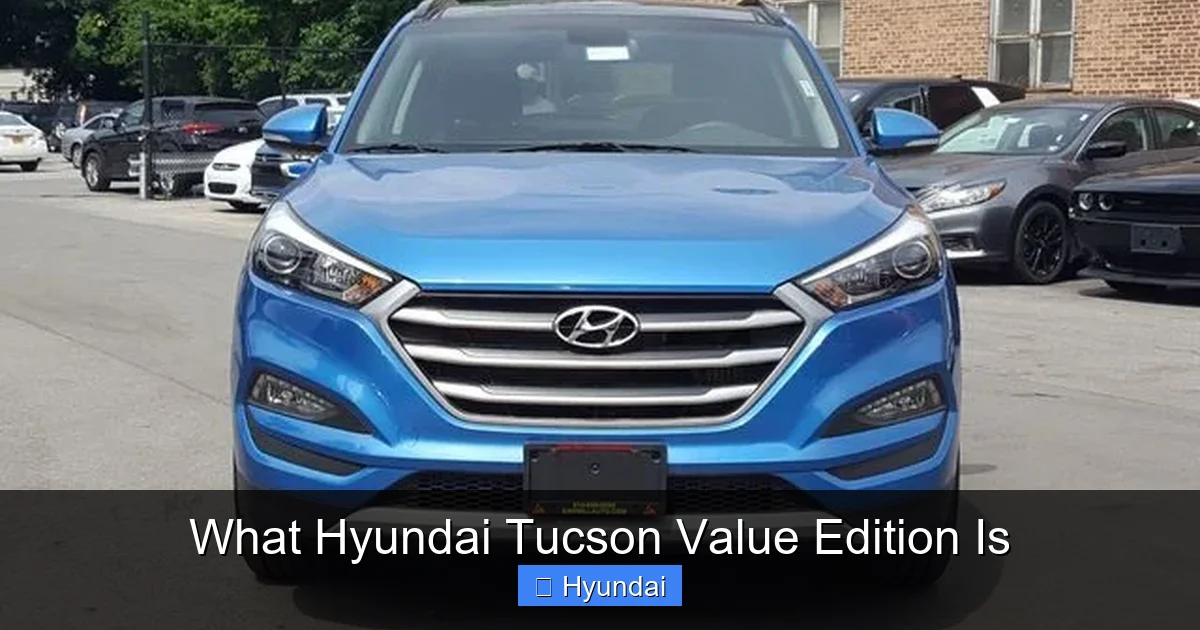
What Hyundai Tucson Value Edition Is

Contents
- 1 Key Takeaways
- 2 📑 Table of Contents
- 3 Demystifying the Name: What Does “Value Edition” Actually Mean?
- 4 Finding Its Place: The Tucson Trim Hierarchy Explained
- 5 The Crown Jewels: Standard Features That Define the Value Edition
- 6 Performance, Powertrain, and Fuel Efficiency: What’s Under the Hood?
- 7 The Bottom Line: Pricing, Value Analysis, and How It Stacks Up
- 8 Who Is the Tucson Value Edition For? (The Ideal Buyer Profile)
- 9 Making the Decision: Is the Tucson Value Edition Right for You?
- 10 Frequently Asked Questions


The Hyundai Tucson Value Edition is a special, well-equipped trim level designed to deliver exceptional bang for your buck. It slots between the base model and higher trims, bundling popular comfort, tech, and convenience features at a price that often undercuts competitors. Think of it as Hyundai’s answer to buyers who want a loaded compact SUV without the luxury-brand price tag, making it one of the most compelling choices in its segment.
Let’s be honest: car shopping can be a confusing maze of trims, packages, and acronyms. You see a base model that’s cheap but bare, then a fully loaded model that has everything but costs a fortune. Where’s the sweet spot? For Hyundai Tucson shoppers, that sweet spot often has a very specific name: the Value Edition. It’s not just a marketing buzzword; it’s a carefully crafted trim level built around a single, powerful idea: delivering maximum value for your money. If you’ve ever wondered, “What exactly is the Hyundai Tucson Value Edition?” you’re in the right place. We’re tearing off the label and looking inside to see what makes this particular Tucson such a standout proposition.
Imagine walking into a dealership and finding a compact SUV that already has the features you’d normally have to pay extra for—like a sunroof, heated seats, and a suite of advanced driver aids—all included at one clear price. That’s the promise of the Value Edition. It’s Hyundai’s way of saying, “We know what you want, and we’ve done the work to package it up for you.” But to truly understand its appeal, we need to see where it fits in the broader Tucson family, what you actually get for your money, and who it’s truly built for. So, buckle up as we take a deep, comprehensive dive into everything that defines the Hyundai Tucson Value Edition.
Key Takeaways
- It’s a Strategic Trim, Not a Package: The Value Edition is a distinct, standalone trim level in the Tucson lineup, not just an option package. This means it comes with a specific set of standard features tied to its price point.
- Targets Value-Conscious Buyers: It’s aimed directly at shoppers who want key upgrades (like heated seats, a sunroof, and advanced safety tech) but aren’t willing to pay for the top-tier Limited or N Line trims.
- Packs Popular Features as Standard: Hyundai bundles highly desirable items—such as a panoramic sunroof, heated front seats, Hyundai SmartSense safety suite, and an 8-inch touchscreen—as standard equipment, eliminating costly add-ons.
- Offers a Significant Price Jump from Base: While more expensive than the entry-level SE or SEL trims, the Value Edition’s price increase is justified by the substantial added value of its included features.
- Competes with Rivals’ Mid-Trims: It goes head-to-head with the likes of the Toyota RAVLE LE XLE, Ford Escape SEL, and Honda CR-V EX, often offering more standard content for a similar or lower MSRP.
- Focus on Comfort and Convenience: The upgrade emphasis is on creature comforts (heated seats, dual-zone climate) and tech convenience (Apple CarPlay/Android Auto, proximity key) over performance or luxury materials.
- Resale Value Booster: Because it includes so many sought-after features, a used Tucson Value Edition typically holds its value better than a base-model Tucson, making it a smarter long-term purchase.
📑 Table of Contents
- Demystifying the Name: What Does “Value Edition” Actually Mean?
- Finding Its Place: The Tucson Trim Hierarchy Explained
- The Crown Jewels: Standard Features That Define the Value Edition
- Performance, Powertrain, and Fuel Efficiency: What’s Under the Hood?
- The Bottom Line: Pricing, Value Analysis, and How It Stacks Up
- Who Is the Tucson Value Edition For? (The Ideal Buyer Profile)
- Making the Decision: Is the Tucson Value Edition Right for You?
Demystifying the Name: What Does “Value Edition” Actually Mean?
In the automotive world, “Value Edition” isn’t a standardized term. What it means at one brand might be different at another. For Hyundai, however, it has a very specific and consistent meaning across its lineup, including the Tucson. The Value Edition is a mid-tier trim level, but its philosophy is what sets it apart. It’s not about adding flashy body kits or sportier suspensions (that’s usually the job of the N Line). Instead, it’s a content-focused trim. Its sole mission is to bundle a high concentration of comfort, convenience, and technology features that research shows customers want most, and offer them at a price point that represents a significant leap in value over the base model.
The Philosophy: Bundling Over A La Carte
Think about buying tech. You could buy a basic laptop, then buy a bigger screen, more memory, and a better keyboard separately. Or, you could buy a pre-configured model that already includes all those upgrades for one price, often saving you money. The Value Edition is Hyundai’s pre-configured model. Instead of asking you to navigate a confusing menu of option packages (“Do you want the Comfort Package? How about the Tech Package?”), Hyundai says, “Here’s the package you’re most likely to want, and it’s all included.” This simplifies the buying process and provides instant clarity on what you’re getting. For the dealer, it’s a simpler inventory. For you, it’s a simpler decision.
How It Differs from Other “Special Edition” Monikers
You’ll see other brands use terms like “Special Edition,” “Limited Edition,” or “Nightshade Edition.” These often focus on cosmetic differentiation—unique paint colors, blacked-out trim, special wheels. The Hyundai Value Edition is fundamentally different. Its differentiation is almost entirely functional. While it may have unique wheel designs or badging, its primary value comes from the features it adds to the vehicle’s capability and daily usability, not just its appearance. This makes it a more practical and long-term valuable choice for the average family or commuter.
Finding Its Place: The Tucson Trim Hierarchy Explained
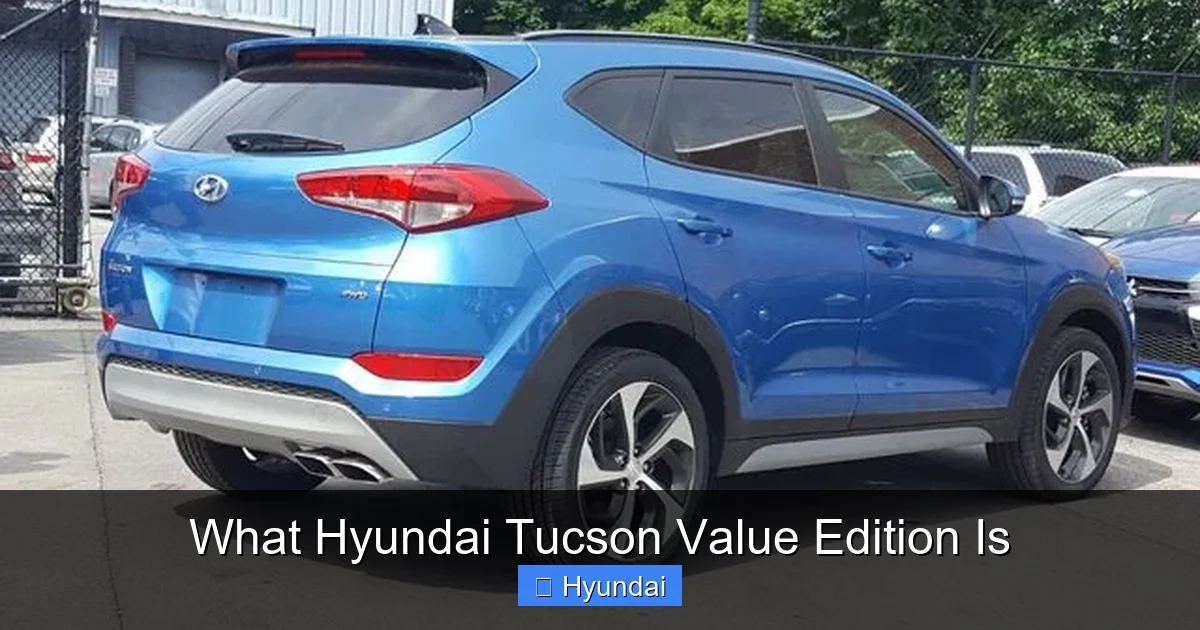
To appreciate the Value Edition’s role, you need to see the entire Tucson lineup. For the current generation (2025 model year discussed here, though the concept is consistent), the typical structure from base to top looks like this: SE, SEL, Value Edition, N Line, Limited, and sometimes a top Hybrid or Plug-in Hybrid variant. The Value Edition sits proudly in the middle, acting as the gateway to a truly premium ownership experience.
Visual guide about What Hyundai Tucson Value Edition Is
Image source: cdn.ebizautos.media
The Stepping Stones: From SE/SEL to Value Edition
The journey starts with the SE or SEL. These are fantastic, no-frills workhorses. They have the essential Tucson DNA: great space, solid fuel economy, and standard Hyundai SmartSense safety. But they lack the “nice-to-have” features that transform a commuter car into a comfortable, enjoyable companion. The jump to the Value Edition is where the transformation happens. You’re not just getting more metal or a bigger engine; you’re getting a fundamental upgrade in daily comfort and convenience.
What You Gain (and What You Skip) by Choosing Value
Moving up to the Value Edition from an SEL typically adds: a panoramic sunroof, heated front seats, a heated steering wheel, dual-zone automatic climate control, an 8-inch touchscreen (vs. a smaller one), proximity key with push-button start, and often a premium audio system. It’s a massive list. Now, what do you not get compared to the range-topping Limited? Usually, you skip genuine leather seats (getting premium cloth or simulated leather), a more powerful engine (the N Line has a sport-tuned 2.0L turbo), a 360-degree camera, or a head-up display. For most buyers, these are acceptable trade-offs for the significant cost savings. You get 80% of the luxury feel for about 60% of the Limited’s price.
The Crown Jewels: Standard Features That Define the Value Edition
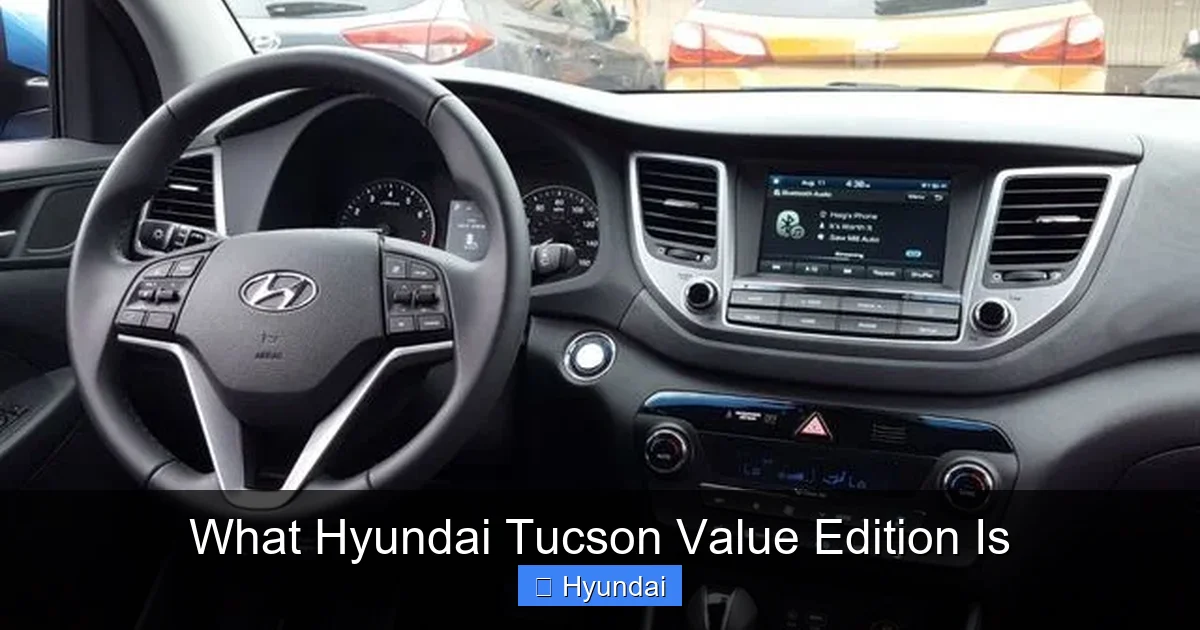
This is the heart of the matter. Let’s break down the feature set that makes this trim so special. We’ll categorize them so you can see exactly where your money goes.
Visual guide about What Hyundai Tucson Value Edition Is
Image source: cdn.ebizautos.media
Comfort & Convenience: The Daily Upgrade
This is where the Value Edition shines brightest. The feature list reads like a “top 10 most requested comforts” list:
- Panoramic Sunroof: This isn’t a tiny pop-up hatch. It’s a large, fixed glass panel that floods the cabin with natural light, making the interior feel airy and spacious. It’s a feature that constantly reminds you that you didn’t buy the base model.
- Heated Front Seats & Steering Wheel: In cold climates, these are not luxuries; they are necessities. The Value Edition includes both, a combination often reserved for much pricier trims.
- Dual-Zone Automatic Climate Control: Allow the driver and front passenger to set their own ideal temperatures. It’s a small detail that makes a big difference in shared comfort.
- Proximity Key & Push-Button Start: Walk up, the car unlocks. Press the button, and you’re gone. No fumbling for keys. It’s the modern, convenient standard.
- Power-Adjustable Driver’s Seat: Often with 8-way adjustment and lumbar support, ensuring you find your perfect driving position every time.
Technology & Infotainment: Staying Connected
The tech suite is significantly upgraded:
- 8-inch Touchscreen: Larger and more responsive than the base screen. It’s the hub for all media, navigation, and vehicle settings.
- Wireless Apple CarPlay & Android Auto: No more plugging in your phone. Connect via Bluetooth and your apps (maps, music, messages) appear on the screen seamlessly. This is a huge daily convenience.
- Premium Audio System: Typically an 8-speaker system from a brand like Bose or Hyundai’s own premium brand. The sound quality is noticeably richer and clearer than the standard 6-speaker setup.
- Multiple USB Ports: Both front and rear passengers get charging ports, eliminating the “who gets the charger?” fight on road trips.
Safety & Driver Assistance: Peace of Mind Included
Here’s the critical part: the Value Edition doesn’t just add comfort; it adds crucial safety tech. Hyundai SmartSense is usually standard on all trims, but the Value Edition often adds features that are optional elsewhere:
- Blind-Spot View Monitor: When you signal to change lanes, a camera feed of your blind spot appears on the cluster screen, virtually eliminating that area of doubt.
- Rear Cross-Traffic Alert: Warns you of traffic crossing behind you when backing up, perfect for crowded parking lots.
- Safe Exit Assist: When you’re about to open a door, it checks for approaching traffic or cyclists from behind and can even prevent the door from opening briefly.
These aren’t gimmicks. They are active systems that prevent accidents. Getting them as standard on a mid-tier trim is a huge value proposition.
Performance, Powertrain, and Fuel Efficiency: What’s Under the Hood?
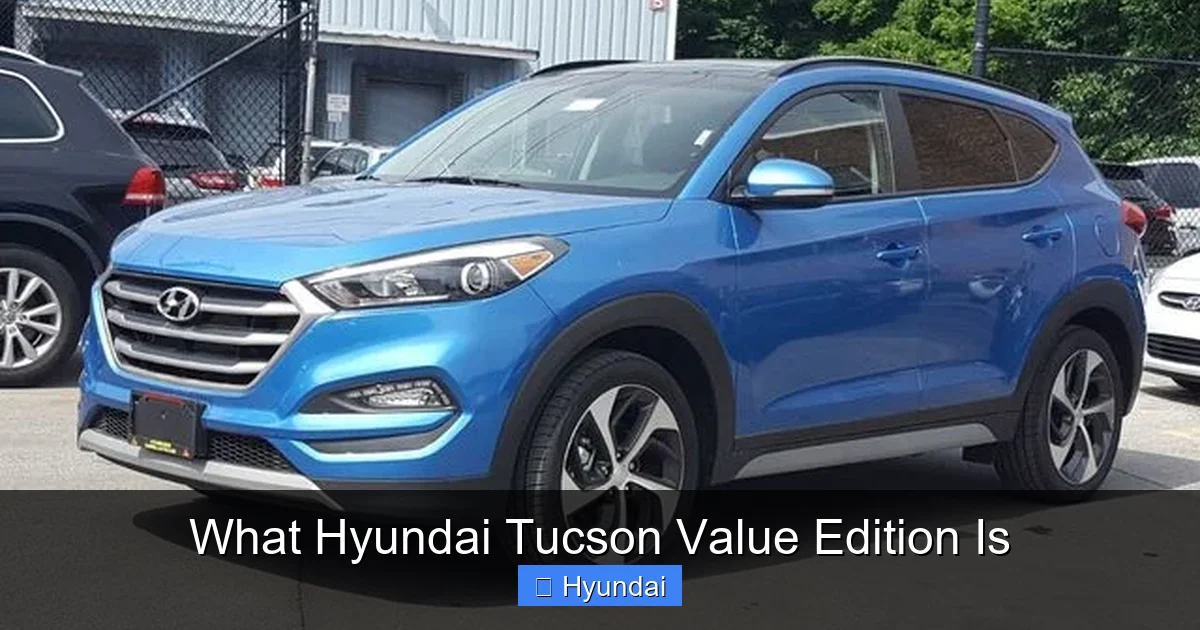
Here’s an important clarification: the Value Edition is not a performance trim. You do not get a more powerful engine by choosing it. The powertrain is typically identical to the SEL trim it’s based on. For the gas-only Tucson, that means the reliable and efficient 2.5-liter 4-cylinder engine producing about 187 horsepower, paired with an 8-speed automatic transmission. For the Hybrid Tucson, the Value Edition (if offered) uses the hybrid powertrain. This is a strategic choice by Hyundai. They assume if you’re shopping for a Value Edition, your priorities are features and efficiency, not 0-60 times.
Visual guide about What Hyundai Tucson Value Edition Is
Image source: cdn.ebizautos.media
Real-World Fuel Economy: Efficient and Predictable
Since the engine doesn’t change, the EPA fuel economy ratings for the Value Edition are exactly the same as the SEL. For the front-wheel-drive gas model, you can expect around 26 mpg city / 33 mpg highway / 29 mpg combined. All-wheel-drive models see a slight drop, typically to 24/29/26. These are competitive numbers in the compact SUV segment. The hybrid version, if available in a Value Edition trim, would offer significantly better numbers, often in the 35-40 mpg combined range. The key takeaway: you get all the feature upgrades without any fuel economy penalty.
Driving Experience: Comfort-Focused
The driving experience is characterized by smooth, quiet, and comfortable manners. The suspension is tuned for comfort, soaking up bumps well. The cabin is well-insulated from road and wind noise. Steering is light and easy, perfect for daily commuting and family duties. It’s not engaging or sporty—that’s the N Line’s job—but it is supremely competent and relaxed. The added comfort features like the heated seats and dual-zone climate make every drive, whether a three-minute run to the store or a three-hour highway journey, more pleasant.
The Bottom Line: Pricing, Value Analysis, and How It Stacks Up
Now, the all-important question: is it actually good value? To answer that, we need to look at the MSRP and compare it to what you’d pay to get the same features on another trim or in a competitor’s vehicle.
Decoding the MSRP: What You’re Really Paying For
Let’s use illustrative 2025 pricing (always check current local deals). Suppose the Tucson SEL starts at $28,500 (including destination). The Value Edition might start at $31,500. That’s a $3,000 premium. For that $3,000, you’re getting a panoramic sunroof (a $1,200-$1,500 option on an SEL), heated seats/steering wheel ($800-$1,000), premium audio ($500), dual-zone climate ($400), and the advanced safety features. If you added all those options à la carte to an SEL, you’d likely spend $4,000-$4,500. The Value Edition package saves you $1,000-$1,500 right off the bat. That’s the core of its value.
Head-to-Head with Competitors
How does it compare? The Toyota RAV4 LE XLE is its closest competitor. The XLE adds a sunroof, heated seats, and keyless entry over the LE, but its infotainment screen is smaller, and it may not have a standard premium audio system. The pricing is often very similar. The Ford Escape SEL is another rival with a strong feature set. The Tucson Value Edition often edges them out with its superior warranty (10-year/100,000-mile powertrain) and the inclusion of the panoramic sunroof as standard, which is frequently a costly option on the Escape SEL. For a deeper dive into how different brands structure their mid-tier value trims, you can read about What Is Toyota Nightshade Edition, which takes a similar value-focused approach but with a cosmetic twist.
The Long-Term Value Equation: Resale and Reliability
Value isn’t just about the purchase price. It’s about total cost of ownership. A well-equipped car like the Value Edition tends to have stronger resale value than a bare-bones model because it has broader appeal in the used market. Buyers looking for a used Tucson are often hunting for these exact features. Furthermore, Hyundai’s excellent 10-year/100,000-mile powertrain warranty is a massive hedge against future repair costs, providing incredible peace of mind. While routine maintenance costs are similar to rivals, the warranty buffer is a unique financial safety net that enhances the long-term value proposition.
Who Is the Tucson Value Edition For? (The Ideal Buyer Profile)
This trim isn’t for everyone. The enthusiast will want the N Line. The budget absolutist will stick with the SE. The Value Edition has a very specific, and very large, target audience. It’s the car for the pragmatic optimist—someone who wants a great daily driver that also feels special and thoughtfully equipped.
The Perfect Fit: Family Focused & Comfort-Seeking
This is the prime buyer. A family of four or five needs space, safety, and comfort for school runs, soccer practices, and road trips. The Value Edition delivers: the spacious cabin, the rear USB ports to keep devices charged, the dual-zone climate so the kids can have it warmer, the heated seats for those chilly morning drop-offs, and the sunroof for a bit of fun on scenic drives. The added safety tech like Blind-Spot View and Safe Exit Assist provides immense peace of mind when loading and unloading children in busy areas.
The Smart Commuter & First-Time SUV Buyer
If you’re upgrading from a sedan or a smaller crossover, you want your new SUV to feel like a genuine step up. The Value Edition provides that “wow” factor with the sunroof and premium sound, making your commute feel less like a chore. It’s also an ideal choice for a first-time new-car buyer who wants to avoid the “I should have gotten the one with the sunroof” regret. It packages in the most desirable upgrades from the start.
Who Should Look Elsewhere?
If your priority is maximum cargo space or towing capacity, you might look at a larger SUV. If you crave a sportier, more engaging drive with a turbocharged engine, the Tucson N Line is your target, though you’ll sacrifice some of the comfort features. If your budget is absolutely fixed at the lowest possible monthly payment, the SE or SEL is the way to go. But if your budget allows for a modest monthly increase in exchange for a car that feels significantly more special, refined, and feature-packed every single day, the Value Edition is your logical and excellent choice.
Making the Decision: Is the Tucson Value Edition Right for You?
So, we’ve unpacked it. The Hyundai Tucson Value Edition is a masterclass in strategic product packaging. It’s not the cheapest, and it’s not the most powerful or luxurious. Instead, it is, by definition, the smartest-all-around value in the lineup. It identifies the features that matter most to the mainstream buyer—comfort on cool mornings, natural light in the cabin, seamless phone integration, and enhanced safety—and makes them all standard at a price that represents a genuine bargain.
Your decision comes down to a simple question: do you want a fantastic, efficient, spacious SUV that also comes with a panoramic sunroof, heated seats, and a premium sound system as part of the deal? If the answer is yes—and for the vast majority of compact SUV shoppers, it should be—then the Value Edition isn’t just a good option; it’s likely the best option. It removes the guesswork, the option-list anxiety, and the future regret. You get in, you drive, and you enjoy a vehicle that feels thoughtfully equipped and genuinely valuable from day one. In a segment crowded with good choices, the Tucson Value Edition consistently stands out as the choice that delivers the most car for the dollar, making it a perennial favorite and a benchmark for what a “value” trim should be.
Frequently Asked Questions
What is the main difference between a Tucson SEL and a Value Edition?
The Value Edition adds significant comfort and convenience features over the SEL, most notably a panoramic sunroof, heated front seats and steering wheel, dual-zone automatic climate control, a larger 8-inch touchscreen with wireless Apple CarPlay/Android Auto, a premium audio system, and advanced safety features like Blind-Spot View Monitor. The engine and core driving dynamics remain the same.
Who is the target buyer for the Tucson Value Edition?
The ideal buyer is a value-conscious family or commuter who wants a well-equipped compact SUV without paying luxury-brand prices. They prioritize daily comfort (heated seats, sunroof), convenience (keyless entry, great infotainment), and safety tech, but don’t need the highest horsepower or genuine leather seats of the top Limited trim.
Is the Value Edition available with all-wheel drive?
Yes, typically the Value Edition is offered with both front-wheel drive (FWD) and all-wheel drive (AWD) configurations. AWD adds a cost premium and a slight reduction in fuel economy but provides enhanced traction in slippery conditions.
Does the Value Edition have worse fuel economy than other Tucson trims?
No. Since it uses the exact same 2.5-liter 4-cylinder engine and transmission as the SEL trim, its EPA-estimated fuel economy is identical. You get all the added features with zero penalty at the pump.
How does the Hyundai warranty compare to competitors on the Value Edition?
Hyundai’s industry-leading 10-year/100,000-mile powertrain warranty applies to the Value Edition just like every other new Hyundai. This is significantly longer than the 5-year/60,000-mile warranties offered by most competitors like Toyota, Honda, and Ford, adding immense long-term value and peace of mind.
Are there any popular accessories or upgrades that are NOT available on the Value Edition?
The Value Edition’s feature set is fixed. You typically cannot add options that are reserved for higher trims, such as a more powerful turbocharged engine (from the N Line), genuine leather seats, a 360-degree surround-view camera, or a head-up display. These features are exclusive to the Limited or N Line trims. For post-purchase accessories like all-weather floor mats or a dash cam, you’d need to look at the aftermarket, where guides for the best floor mats for Hyundai Tucson or best dash cam for Hyundai Tucson can be helpful.