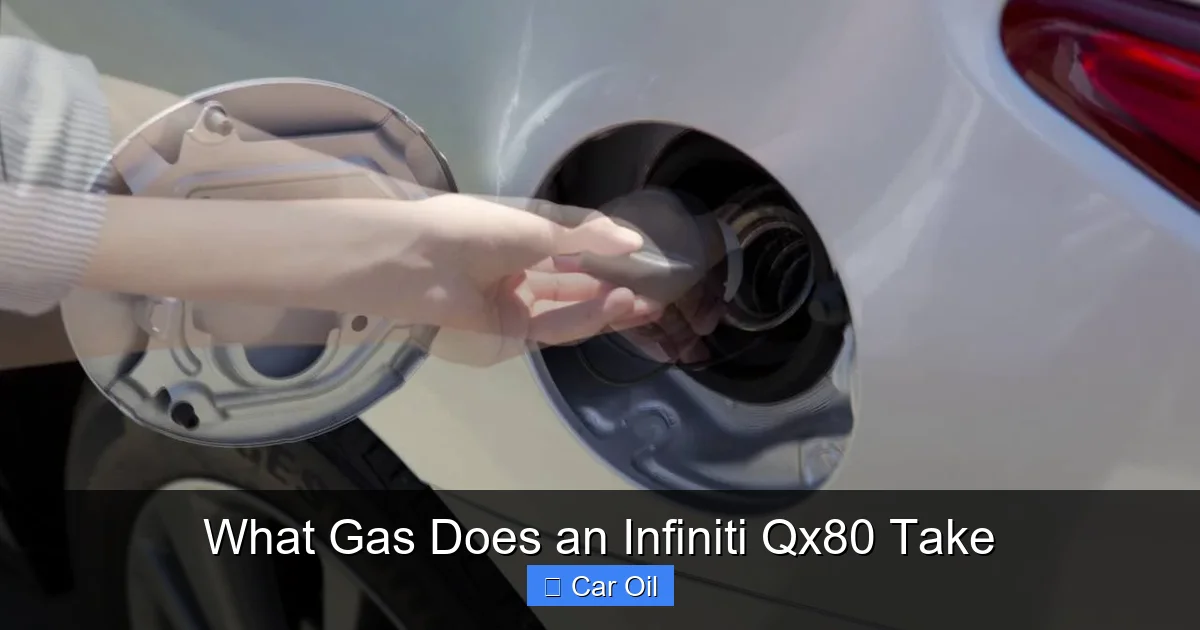
What Gas Does an Infiniti Qx80 Take

Contents
- 1 Key Takeaways
- 2 📑 Table of Contents
- 3 Understanding Octane Ratings: It’s Not About “Quality” or “Power”
- 4 Infiniti QX80 Engine Specifications: The Reason for the Requirement
- 5 Why Premium Unleaded is Mandatory: The Official Stance and Engineering Reality
- 6 What Happens If You Use Regular Unleaded (87 AKI)?
- 7 The Benefits of Sticking to Premium: Protecting Your Investment
- 8 Model Year Considerations and Common Myths
- 9 Frequently Asked Questions


The Infiniti QX80 requires premium unleaded gasoline with a minimum octane rating of 91 AKI (95 RON) for all model years. Its high-performance 5.6L V8 engine is specifically tuned for premium fuel to prevent damaging engine knock and ensure you get the full power and torque payload it was designed for. Using regular unleaded (87 AKI) can cause engine knocking, reduced performance, and potential long-term damage, negating the benefit of its luxury engineering. Always consult your owner’s manual, but the rule is clear: premium fuel is non-negotiable for your QX80.
So, you’ve got the keys to a magnificent Infiniti QX80. That imposing presence, that serene ride, that cavernous interior—it’s the full-size luxury SUV experience. But to keep that powerful 5.6-liter V8 humming smoothly and delivering the effortless torque you expect, there’s one absolutely critical question you must have the right answer to: what gas does an Infiniti QX80 take? It’s not just a suggestion; it’s a fundamental engineering requirement that directly impacts your vehicle’s health, performance, and your wallet. Let’s dive deep into the world of octane, compression, and engine knock to give you a complete, no-nonsense understanding.
You might be thinking, “It’s just gas, right? Can’t I just put the cheaper stuff in this big SUV to save a few bucks?” It’s a common and tempting thought, especially with today’s fuel prices. But the Infiniti QX80 is not your average commuter car. Under its hood lies a sophisticated, high-output engine that was meticulously engineered in Japan to run on a specific fuel grade. Deviating from that specification isn’t just about suboptimal performance; it’s a direct path to expensive engine repairs. This article will serve as your definitive guide, explaining the “why” behind the requirement, the severe consequences of ignoring it, and practical tips to always get it right. We’ll clear up all the confusion so you can fuel up with confidence and protect your significant investment.
Key Takeaways
- Mandatory Premium Fuel: All Infiniti QX80 models from 2011 to present require premium unleaded gasoline with a minimum octane rating of 91 AKI (Anti-Knock Index) or 95 RON (Research Octane Number).
- Engine Design is Key: The QX80’s 5.6-liter V8 engine (VK56VD) features a high compression ratio and advanced timing, making it susceptible to harmful “knock” or “pinging” if lower-octane fuel is used.
- Regular Gas Causes Damage: Using 87 AKI regular unleaded can lead to persistent engine knock, which over time can cause piston, ring, and valve damage, and will trigger the check engine light.
- Performance Suffers Immediately: Even if knock is controlled by the engine computer, it will retard timing, resulting in noticeable losses in power, acceleration, and throttle response, along with worse fuel economy.
- No “Break-In” Exception: There is no break-in period where regular gas is acceptable. The requirement applies from the first mile of a new vehicle and for the entire life of the engine.
- Mid-Grade is a Gamble: 89 AKI mid-grade fuel is not a safe substitute. Its octane is too low to reliably prevent knock under load (towing, hot weather, steep hills) and is not recommended by Infiniti.
- Manual is the Final Authority: While this guide is accurate, your vehicle’s specific owner’s manual is the ultimate source for fuel requirements and should be referenced for any doubts.
📑 Table of Contents
- Understanding Octane Ratings: It’s Not About “Quality” or “Power”
- Infiniti QX80 Engine Specifications: The Reason for the Requirement
- Why Premium Unleaded is Mandatory: The Official Stance and Engineering Reality
- What Happens If You Use Regular Unleaded (87 AKI)?
- The Benefits of Sticking to Premium: Protecting Your Investment
- Model Year Considerations and Common Myths
Understanding Octane Ratings: It’s Not About “Quality” or “Power”
Before we talk specifically about the QX80, we need to demystify octane. This is where a lot of confusion starts. Octane rating is not a measure of a fuel’s energy content, cleanliness, or overall “quality.” All gasoline has roughly the same amount of chemical energy. Instead, octane is a measurement of a fuel’s ability to resist “knock.”
What is Engine Knock (or Pre-Ignition)?
In a perfect world, the spark plug fires, and the air-fuel mixture burns in a controlled, smooth wave from the spark plug outward. Engine knock (also called detonation or pre-ignition) is a violent, uncontrolled combustion. It happens when the fuel-air mixture ignites from the heat and pressure in the cylinder before the spark plug fires, or when multiple ignition points occur simultaneously. This creates a sharp, metallic pinging or knocking sound, like shaking a can of marbles. It’s the sound of your engine destroying itself.
High-compression engines, turbocharged engines, and engines with sophisticated variable valve timing (like the QX80’s VK56VD) generate much higher cylinder pressures and temperatures. These conditions make the fuel-air mixture more likely to spontaneously ignite, causing knock. Higher-octane fuel has a higher resistance to this spontaneous ignition. It can withstand more compression and heat before detonating, allowing the engine to run its designed advanced ignition timing safely.
AKI vs. RON: Decoding the Pump Numbers
You see two numbers at the pump: 87, 89, 91, and sometimes 93. In the United States and Canada, we use the Anti-Knock Index (AKI), which is the average of the Research Octane Number (RON) and the Motor Octane Number (MON). The number you see (e.g., 91 AKI) is what matters. Most of the rest of the world uses RON. For our purposes, Infiniti’s specification of 91 AKI (minimum) is equivalent to 95 RON. When you travel, this conversion is useful. Never assume a “95” pump in Europe is the same as “91” in the U.S.; it usually is, but it’s good to know the difference.
Infiniti QX80 Engine Specifications: The Reason for the Requirement
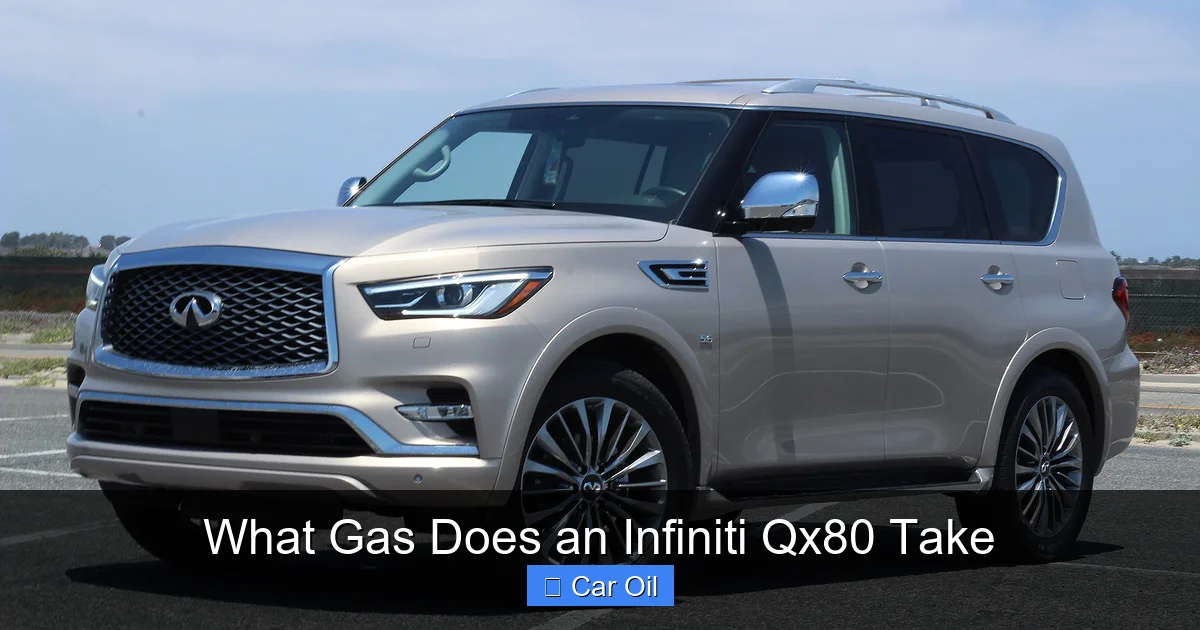
Now, let’s look at the heart of the matter. The Infiniti QX80, for its entire modern generation (2011-present), has been powered by the legendary 5.6-liter V8 engine, codenamed VK56VD. This is not a low-stress, economy-oriented engine. It’s a high-output, high-compression unit designed for the weight of a nearly 3-ton luxury SUV.
Visual guide about What Gas Does an Infiniti Qx80 Take
Image source: motortrend.com
The High Compression Ratio
The VK56VD has a compression ratio of 10.3:1. For context, many standard V6 or V8 engines designed for regular 87 AKI fuel have compression ratios closer to 9.0:1 or 10.0:1. That extra 0.3 to 1.3 points of compression is a big deal. It’s what allows the engine to extract more power and efficiency from each combustion cycle. But that higher compression creates much greater heat and pressure in the cylinder, dramatically increasing the risk of knock with lower-octane fuel. The engine’s computer has sensors to detect knock and will pull back timing (retard it) to prevent damage, but this is a protective measure that robs you of power and economy.
Direct Injection and Variable Valve Timing
The “VD” in VK56VD stands for “Variable Valve Event and Lift System.” This is Nissan/Infiniti’s advanced variable valve timing on both intake and exhaust camshafts. It optimizes airflow for power and efficiency across the rev range. Combined with direct fuel injection (fuel is injected directly into the combustion chamber at very high pressure), these technologies create an intense, efficient burn that is highly sensitive to fuel octane. They are part of why this engine makes 400+ horsepower and 413 lb-ft of torque—figures that are only safely achievable with premium fuel.
So, when you ask what gas does an Infiniti QX80 take, the engineering answer is: it takes a fuel with a high enough octane rating to support the high compression and advanced ignition timing of its high-performance V8 engine without causing destructive knock.
Why Premium Unleaded is Mandatory: The Official Stance and Engineering Reality
Infiniti’s official position, stated clearly in every QX80 owner’s manual, is unequivocal: “Use premium unleaded gasoline with an octane rating of at least 91 AKI (Research octane number 95).” The manual will also state that using fuel with an octane lower than recommended can cause annoying and damaging engine knock. This isn’t a recommendation; it’s a requirement. Let’s break down the two main reasons why.

Visual guide about What Gas Does an Infiniti Qx80 Take
Image source: i.infocar.ua
1. Prevention of Engine Knock (The Primary Reason)
This is the #1, non-negotiable reason. The engine control unit (ECU) is constantly monitoring for knock via sensors on the engine block. If you put 87 AKI regular gas in your QX80, the ECU will almost certainly detect knock under acceleration, when climbing a hill, or in hot ambient temperatures. Its first response is to retard the ignition timing. This means it sparks the plug later in the piston’s cycle. While this stops the dangerous knock, it also:
- Drastically reduces power output and throttle response.
- Worsens fuel economy (you’re burning more gas to go slower).
- Can cause the engine to feel sluggish and unresponsive—the opposite of what you bought a 400-hp V8 for.
If the knock is severe or persistent, or if the sensors fail, the uncontrolled combustion can physically damage pistons, piston rings, connecting rods, and valves. This is a multi-thousand-dollar repair.
2. Optimized Performance and Efficiency
Even if the ECU’s knock control manages to prevent audible knock on regular gas, the engine is never running at its optimized calibration. Infiniti’s engineers tuned the VK56VD to make its peak power and torque curve on premium fuel. The advanced valve timing and direct injection mapping are all calculated for 91+ AKI. Using lower-octane fuel means you are not getting the performance, smoothness, or fuel efficiency you paid for. You are effectively driving a detuned, less efficient version of your own vehicle. The premium fuel cost is an investment in the vehicle’s intended driving experience and long-term health.
It’s a similar story for other high-performance vehicles. For instance, the Dodge Challenger with its V8 engines also mandates premium fuel for its higher-output trims to manage their high compression ratios and boost pressures. It’s a universal principle of internal combustion engineering.
What Happens If You Use Regular Unleaded (87 AKI)?
Let’s be brutally honest about the consequences. While one or two accidental fill-ups might not cause immediate catastrophic failure (thanks to the ECU’s safeguards), consistently using regular gas is a terrible idea. Here’s the progression of what you can expect:

Visual guide about What Gas Does an Infiniti Qx80 Take
Image source: d.newsweek.com
The Immediate Symptoms: “Ping” and “Knock”
The first thing you’ll notice (or hear) is a distinct metallic pinging or knocking sound from the engine, especially under load—when accelerating from a stop, passing on the highway, or climbing a grade. This is engine knock. It’s not just an annoying noise; it’s the sound of your air-fuel mixture exploding unevenly and hammering against the piston crown and cylinder head. If you hear this, you must switch to premium fuel immediately. Do not ignore it.
The Electronic Response: Check Engine Light and Reduced Performance
Modern engines like the QX80’s will detect the knock via sensors and try to compensate. The primary tool is ignition timing retard. You’ll feel this as a lack of power. The SUV will feel sluggish, slower to respond to the gas pedal, and generally “flat.” Your 0-60 mph times will suffer. Simultaneously, the ECU will likely log a diagnostic trouble code (DTC), such as P0325 (Knock Sensor 1 Circuit) or P0300-P0308 (Random/Multiple Cylinder Misfire Detected). This will illuminate your check engine light. A diagnostic scan will reveal the knock-related codes, pointing directly to the cause: incorrect fuel.
The Long-Term Damage: A Costly Mistake
This is the worst-case scenario. Persistent, severe knock—even if not always audible—creates extreme pressure spikes in the cylinder. These pressure spikes act like a tiny hammer, constantly impacting the pistons, rings, and head. Over time, this can lead to:
- Piston Damage: Erosion or cracking of the piston crown.
- Piston Ring Failure: Rings can break or lose their tension, leading to oil consumption and loss of compression (blue smoke, poor performance).
- Connecting Rod Stress: The big end bearings can be damaged.
- Valve and Head Damage: In extreme cases, valves can bend or the head can crack.
Repairing any of these issues means a major engine rebuild or replacement, costing thousands of dollars. It completely voids the argument that you were “saving money” on fuel.
The Benefits of Sticking to Premium: Protecting Your Investment
Now that we’ve scared you straight (and we should have), let’s talk about the positive side of using the correct fuel. Filling up with 91+ AKI premium unleaded isn’t just about avoiding disaster; it’s about actively enjoying and preserving your QX80.
Optimal Performance and Drivability
This is the most tangible benefit. With premium fuel, the engine’s advanced timing and valve events operate as designed. You get the full 400 horsepower and 413 lb-ft of torque. The acceleration is strong, confident, and linear. The throttle response is immediate. The V8 sounds smooth and authoritative, not strained. The transmission shifts at the optimal points because the engine is making the power it expects. You are experiencing the vehicle exactly as Infiniti’s engineers intended.
Maximum Fuel Efficiency
It might seem counterintuitive, but using the correct higher-octane fuel often provides better real-world fuel economy than using lower-octane fuel. Why? Because the engine isn’t fighting knock and constantly pulling timing. It can run its most efficient combustion cycle. The ECU doesn’t have to enrich the fuel mixture as much to cool the cylinders and prevent knock. While the difference might be 1-2 MPG on average, over thousands of miles, it can offset part of the premium fuel cost. More importantly, you’re getting the miles per gallon the window sticker estimated.
Long-Term Engine Health and Reliability
This is the ultimate benefit. By preventing knock, you are eliminating the primary cause of internal engine stress. Your pistons, rings, bearings, and valves operate within their designed stress parameters. This leads to:
- Reduced wear and tear over the life of the engine.
- No carbon buildup from inefficient, knock-affected combustion cycles.
- Maintained compression and power output as the vehicle ages.
- Peace of mind and avoidance of costly, catastrophic failures.
Think of premium fuel as a cheap insurance policy for a very expensive asset. It’s a small, recurring cost that protects a multi-thousand-dollar component.
Model Year Considerations and Common Myths
Is the requirement different for a 2012 QX80 versus a 2024? Are there any exceptions? Let’s clear up some common points of confusion.
Consistency Across All Model Years
The requirement has been steadfast. From the first QX56 (which became the QX80 for 2014) with the 5.6L V8 in the 2011 model year, through every refresh and update, Infiniti has always specified premium unleaded fuel (91 AKI minimum). There is no model year where it’s “okay” to use regular. The engine’s fundamental design—its compression ratio and tuning—has remained in this high-performance bracket. Even the latest 2024 QX80 with its mild updates still carries the same requirement. Don’t let anyone tell you “the newer ones can handle regular.” They cannot.
What About “Flex Fuel” or E85?
The Infiniti QX80 is not a flexible fuel vehicle (FFV). It is not designed or certified to run on ethanol blends higher than E10 (10% ethanol). The standard gasoline you buy at the pump in the U.S. is already E10. Do not put E15 (15% ethanol) or E85 (51-83% ethanol) in your QX80. These higher ethanol blends have different combustion properties and can damage fuel system components (seals, hoses, injectors) not designed for them, and can also cause lean conditions and engine damage. Your fuel door or owner’s manual will clearly state if a vehicle is FFV. The QX80 is not.
The “Top Tier” Detergent Gasoline Myth
You may have heard of “Top Tier” gasoline. This is a separate, excellent standard set by major automakers (including Infiniti’s parent company, Nissan) for detergent additives that help keep engines clean. Using Top Tier premium gasoline is the absolute best choice. However, “Top Tier” is about detergent quality, not octane. You can find Top Tier regular, mid-grade, and premium. The octane requirement and the detergent requirement are two different things. Always choose premium octane (91+ AKI), and when possible, choose a brand that is also Top Tier certified (most major brands are). This gives you the correct octane and superior cleaning additives to keep your fuel injectors and intake valves free of deposits, which is especially important for direct-injected engines like the VK56VD.
What About High-Altitude or Extreme Weather?
Some drivers think that in high-altitude areas (like Denver) where 85 AKI fuel is sometimes sold as “regular,” they can get away with it. Do not be tempted. The QX80’s requirement is 91 AKI minimum, period. The engine’s knock sensors and ECU are designed around that baseline. While higher altitude slightly reduces cylinder pressure, the engine may still operate under high load (towing, mountain passes) where 85 AKI will cause knock. Similarly, in very hot weather, the intake air charge is hotter, increasing knock tendency. The requirement doesn’t change with the seasons. Always use 91+ AKI.
It’s also worth noting that other manufacturers have similar strict requirements for their large SUVs. The Kia Telluride’s V6 engine, for example, also recommends premium fuel for optimal performance, showing that this isn’t an Infiniti-specific quirk but an industry-wide engineering practice for powerful, heavy vehicles.
Frequently Asked Questions
Can I put regular unleaded (87 AKI) in my Infiniti QX80 in an emergency?
In a true, one-time emergency where only regular is available, you can fill the tank but must drive gently—no hard acceleration, no towing, avoid steep hills. As soon as possible, add a bottle of octane booster or refill with premium. Do not make this a habit. The ECU will likely detect knock and retard timing, so performance will be poor. The goal is to dilute the low-octane fuel with premium as quickly as possible.
What happens if I accidentally use mid-grade (89 AKI) fuel?
Mid-grade is not recommended and is a significant risk. While it’s better than regular, its octane is still below the minimum 91 AKI specification. Under moderate or heavy load (like highway merging or a warm day), you will likely still experience engine knock. The ECU will again retard timing to prevent damage. You should avoid mid-grade and always use premium. If you accidentally use it, treat it like regular: drive gently and refill with premium at your next stop.
Does using premium gas in my QX80 improve horsepower or towing capacity?
Yes, but only relative to using lower-octane fuel. The engine is designed to make its rated 400 hp and 413 lb-ft on premium fuel. If you use regular or mid-grade, the ECU will pull timing to prevent knock, and you will have less power and towing capacity than the specification. Using premium ensures you get the full, intended performance. It does not typically unlock “extra” power beyond the factory rating, but it prevents the power loss that occurs with lower octane.
Is it okay to mix premium and regular gas in my QX80?
Mixing fuels results in an average octane level. If you accidentally add a few gallons of regular to a mostly full tank of premium, the resulting blend may still be above 91 AKI, especially if your tank was nearly full. The risk is highest when you intentionally fill up with regular or when a tank of mostly regular is topped with premium. To be safe, always use pure premium. If you suspect you have a low-octane mix, drive gently and refill with premium at the next opportunity to bring the tank’s average octane back up.
Does the fuel requirement change if I’m towing a heavy trailer?
No, the requirement does not change, but the risk of knock increases significantly when towing. Towing puts the engine under constant high load and stress, generating much more heat and cylinder pressure. This is the exact condition where lower-octane fuel is most likely to cause dangerous knock. This makes using premium fuel even more critical when towing. Never tow with regular or mid-grade fuel in a QX80.
What about older QX80 models (2011-2013)? Do they have the same requirement?
Yes, absolutely. The requirement for premium unleaded (91 AKI minimum) has been consistent since the vehicle’s introduction. The 5.6L V8 engine (VK56VD) has had the same high compression ratio and performance targets throughout its production run. There is no “older model can use regular” exception. The owner’s manual for a 2012 model states the same requirement as a 2024 model. This is a universal rule for all model years of the Infiniti QX80.