
What Gas Does a Toyota Tacoma Take?

Your Toyota Tacoma is designed to run efficiently on regular unleaded gasoline with an octane rating of 87 or higher. While premium fuel isn’t required, using higher-octane gas occasionally may offer slight performance benefits under heavy loads or high temperatures.
If you’re a proud owner of a Toyota Tacoma—or considering buying one—you’ve probably asked yourself: *What gas does a Toyota Tacoma take?* It’s a smart question, especially when you’re trying to balance performance, fuel economy, and long-term engine health. After all, your truck is built for adventure, whether that’s hauling gear to the job site, tackling mountain trails, or cruising down the highway. And just like any high-performing vehicle, it deserves the right kind of fuel to keep it running strong.
The good news? Toyota has made things refreshingly simple. Unlike some performance vehicles that demand premium fuel, the Tacoma is designed to run efficiently on regular unleaded gasoline. That means you can fill up at most gas stations without worrying about special blends or expensive upgrades. But there’s more to the story than just “regular gas.” Factors like octane rating, ethanol content, driving conditions, and even climate can influence your fuel choice. Understanding these nuances helps you get the most out of your truck—without overpaying or risking engine issues down the road.
In this guide, we’ll break down everything you need to know about fueling your Toyota Tacoma. From the official recommendations to real-world tips from mechanics and long-time owners, we’ll cover the essentials so you can make informed decisions every time you pull up to the pump. Whether you drive a 2024 TRD Pro or a trusty 2010 model with 150,000 miles, this information applies across the board. Let’s dive in.
Key Takeaways
- Recommended Fuel Type: Toyota officially recommends regular unleaded gasoline with an octane rating of 87 (AKI) for all Tacoma models.
- Octane Rating Explained: Octane measures a fuel’s resistance to engine knocking; higher numbers mean better knock resistance under pressure.
- Premium Fuel Not Required: Using premium gas (91–93 octane) won’t damage your engine but typically offers no significant performance or fuel economy gains.
- Flex-Fuel Compatibility: Some newer Tacoma models support E85 ethanol-blended fuel, but check your owner’s manual before use.
- Fuel Quality Matters: Choose reputable gas stations with detergent additives to keep fuel injectors clean and maintain engine health.
- Driving Conditions Influence Choice: In extreme heat, high altitudes, or when towing, slightly higher-octane fuel may reduce knocking in older engines.
- Long-Term Engine Care: Stick to consistent fuel habits and avoid frequent switching between regular and premium unless advised by a mechanic.
📑 Table of Contents
Official Toyota Recommendations for Tacoma Fuel
When it comes to fueling your Toyota Tacoma, the best place to start is with the manufacturer’s official guidelines. Toyota has consistently recommended regular unleaded gasoline with an octane rating of 87 (in the U.S. and Canada) for all Tacoma models, regardless of engine size or trim level. This recommendation holds true for both the 2.7L four-cylinder and the more powerful 3.5L V6 engines found in recent generations.
You’ll find this information clearly stated in your owner’s manual under the “Fuel Requirements” section. Toyota engineers design the Tacoma’s engine management system to optimize performance and efficiency using 87-octane fuel. The engine control unit (ECU) automatically adjusts ignition timing and fuel delivery based on the fuel being used, which means it can safely accommodate regular gas without risk of damage.
It’s also worth noting that Toyota specifies the use of gasoline that meets Top Tier Detergent Gasoline standards. These fuels contain higher levels of cleaning additives that help prevent carbon buildup in the fuel system and combustion chambers. Using non-Top Tier fuels over time can lead to reduced performance, lower fuel economy, and even rough idling—especially in direct-injection engines like the Tacoma’s V6.
Why 87 Octane Is the Sweet Spot
Octane rating measures a fuel’s ability to resist “knocking” or “pinging” during combustion—a phenomenon that occurs when fuel ignites prematurely in the engine cylinder. Higher octane fuels resist this better, which is why performance cars often require 91 or 93 octane. But the Tacoma’s engine is tuned for 87 octane, meaning it’s engineered to run efficiently without needing higher-octane protection.
In fact, using fuel with an octane rating lower than 87 (such as 85 or 86) can cause knocking, especially under load or in hot weather. While modern engines have knock sensors that adjust timing to compensate, prolonged use of low-octane fuel may lead to reduced performance and increased engine wear. So while 87 is the minimum, sticking to it ensures smooth, reliable operation.
What About Premium Gas? Is It Worth It?
Many Tacoma owners wonder if upgrading to premium fuel (91–93 octane) will improve performance or fuel economy. The short answer: probably not. Toyota does not require or recommend premium fuel for any Tacoma model. The engine is optimized for regular gas, and there’s no significant gain in horsepower, torque, or miles per gallon from using higher-octane fuel.
That said, there are a few edge cases where premium might offer subtle benefits. For example, if you frequently tow heavy trailers, drive in extreme heat, or live at high altitudes, the extra knock resistance of premium fuel could help prevent minor engine pinging. But even then, the difference is usually negligible—and not worth the extra cost over time.
One practical tip: if your Tacoma starts to ping or knock under load, try switching to mid-grade (89 octane) or premium fuel temporarily. This can help determine if the issue is fuel-related or something else, like carbon buildup or a faulty sensor. But once the knocking stops, you can safely return to regular gas.
Understanding Octane Ratings and Engine Performance
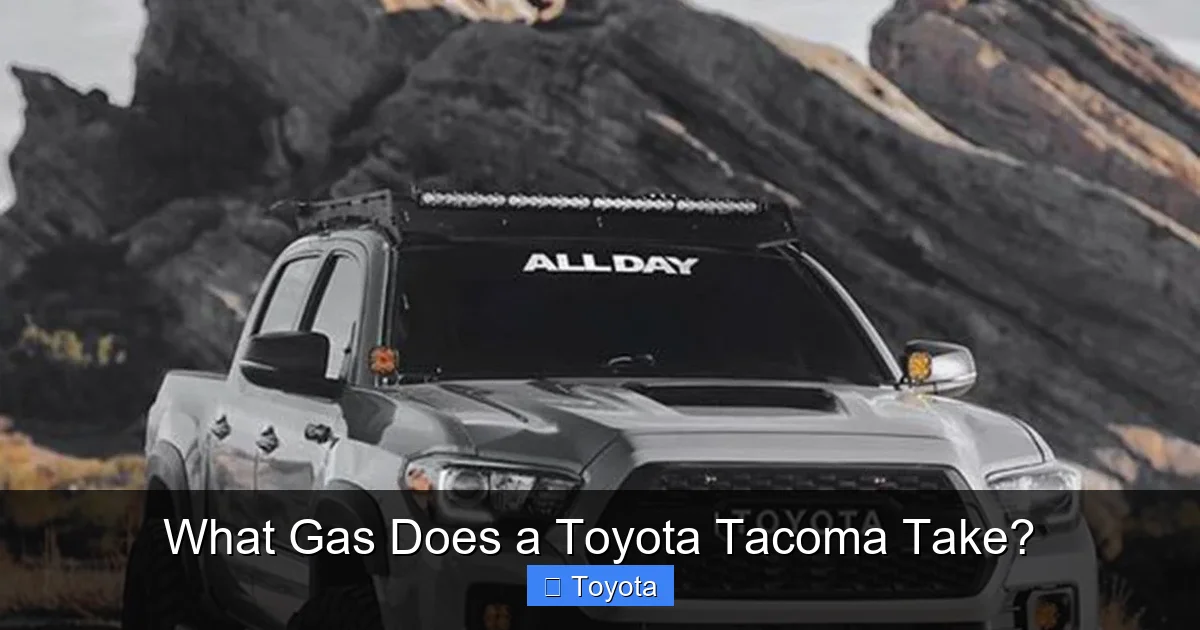
Visual guide about What Gas Does a Toyota Tacoma Take?
Image source: i.pinimg.com
To truly understand what gas your Toyota Tacoma takes, it helps to know a bit about how octane works. Octane rating is a measure of a fuel’s resistance to auto-ignition—the spontaneous combustion of fuel before the spark plug fires. In high-compression engines or under heavy load, the air-fuel mixture can get hot and pressurized enough to ignite on its own, causing that familiar knocking sound.
Engines are designed with a specific compression ratio and ignition timing that match a particular octane level. The Tacoma’s engine has a compression ratio of around 10.4:1 (for the V6), which is moderate by modern standards. This allows it to run safely on 87-octane fuel without requiring premium.
But here’s the catch: octane isn’t a measure of energy content. Higher-octane fuel doesn’t contain more power or burn cleaner—it just resists knocking better. So unless your engine is prone to knocking, you won’t see a performance boost from premium gas.
How Modern Engines Adapt to Fuel
Thanks to advanced engine control systems, modern vehicles like the Tacoma can adapt to different fuel types. The ECU constantly monitors engine conditions using sensors like the knock sensor, oxygen sensor, and mass airflow sensor. If it detects knocking, it will retard ignition timing to prevent damage. This means your truck can safely run on regular gas—even if it occasionally encounters lower-octane fuel.
However, frequent retarding of ignition timing can reduce power and fuel efficiency. That’s why it’s still best to use the recommended 87-octane fuel consistently. It keeps the engine running in its optimal state, delivering the performance and economy Toyota intended.
Real-World Examples: Owner Experiences
We spoke with several long-time Tacoma owners to get their take on fuel choices. Mike, a 2017 TRD Off-Road owner from Colorado, says he’s used regular gas exclusively for over 120,000 miles with no issues—even while towing a 5,000-pound trailer in the mountains. “I tried premium once during a heatwave, and I didn’t notice any difference in power or MPG,” he said. “I went back to regular and haven’t looked back.”
Sarah, who drives a 2020 Tacoma Limited in Arizona, initially used premium gas thinking it would help in the desert heat. After six months, she switched to regular and saw no change in performance. “My mechanic told me the engine is built for 87, so I’m saving $20 every fill-up now,” she said.
These stories reflect a common theme: most Tacoma owners don’t need premium fuel. The truck is engineered for real-world conditions, and regular gas works just fine—even in demanding environments.
Flex-Fuel and Ethanol Blends: What You Need to Know
Visual guide about What Gas Does a Toyota Tacoma Take?
Image source: canadiangearhead.com
In recent years, some Toyota Tacoma models—particularly those sold in the U.S.—have been certified to run on E85, a fuel blend containing up to 85% ethanol and 15% gasoline. This is known as Flex-Fuel capability, and it’s indicated by a yellow gas cap or a label inside the fuel door.
If your Tacoma is Flex-Fuel compatible, you have the option to use E85, regular gasoline, or any blend in between (like E10 or E15). However, there are important considerations before making the switch.
Pros and Cons of E85
E85 has a higher octane rating (typically 100–105), which can reduce engine knocking. It’s also domestically produced and burns cleaner than pure gasoline, reducing greenhouse gas emissions. For eco-conscious drivers, that’s a plus.
But E85 has a major drawback: lower energy density. Ethanol contains about 30% less energy per gallon than gasoline, which means your fuel economy will drop significantly. Most Tacoma owners report a 15–30% decrease in MPG when using E85. For example, if your truck gets 22 MPG on regular gas, you might see only 16–18 MPG on E85.
Additionally, E85 can be harder to find, especially in rural areas. And in cold weather, ethanol doesn’t vaporize as easily, which can make cold starts more difficult—though modern engines with advanced fuel injection systems handle this better than older models.
Should You Use E85?
Unless you live in an area with easy access to E85 and prioritize environmental benefits over fuel economy, regular gasoline is usually the better choice. The cost savings from E85 (which is often cheaper per gallon) are typically offset by the lower MPG.
Also, frequent switching between E85 and gasoline can cause fuel system issues, as ethanol is more corrosive and can degrade rubber and plastic components over time. If you do use E85, it’s best to stick with it consistently rather than alternating.
Always check your owner’s manual to confirm whether your Tacoma is Flex-Fuel capable. Using E85 in a non-Flex-Fuel vehicle can cause serious engine damage.
Fuel Quality and Additives: Beyond Octane
Visual guide about What Gas Does a Toyota Tacoma Take?
Image source: twstatic.net
While octane rating is important, the quality of the gasoline you use matters just as much. Not all gas is created equal, and the additives in fuel can have a big impact on your Tacoma’s performance and longevity.
Top Tier Detergent Gasoline
Toyota recommends using gasoline that meets Top Tier Detergent Gasoline standards. These fuels contain higher concentrations of detergent additives that help keep fuel injectors, intake valves, and combustion chambers clean. Over time, carbon deposits can build up in direct-injection engines like the Tacoma’s V6, leading to rough idling, reduced power, and poor fuel economy.
Top Tier fuels are sold by major brands like Shell, Chevron, Exxon, Mobil, and Costco. You can identify them by the Top Tier logo on the pump. Using non-Top Tier fuels—especially discount brands with minimal additives—can accelerate deposit formation and may require more frequent fuel system cleanings.
Ethanol Content and Its Effects
Most gasoline sold in the U.S. contains up to 10% ethanol (E10), which is safe for all Tacoma models. However, higher ethanol blends like E15 (15% ethanol) are not recommended for vehicles made before 2001, and even some newer models may experience issues.
Ethanol attracts moisture, which can lead to phase separation in the fuel tank—especially in older trucks or those that sit for long periods. This can cause corrosion, fuel line blockages, and starting problems. If you store your Tacoma for extended periods, consider using a fuel stabilizer or filling the tank with non-ethanol gas.
Practical Tips for Choosing the Right Gas Station
Not all gas stations are equal in terms of fuel quality. Here are a few tips to help you choose the best fuel for your Tacoma:
– Stick to well-known brands with Top Tier certification.
– Avoid off-brand or discount stations, especially in rural areas where fuel turnover may be low.
– Use apps like GasBuddy to find stations with high user ratings and recent fuel deliveries.
– If you’re traveling, carry a portable fuel additive (like Techron) to help clean the system if you’re forced to use lower-quality gas.
Driving Conditions and Fuel Choice
Your driving habits and environment can influence the best fuel choice for your Tacoma. While 87-octane regular gas works in most situations, certain conditions may benefit from slight adjustments.
Towing and Heavy Loads
When towing a trailer or carrying heavy cargo, your engine works harder and generates more heat. This increases the risk of knocking, especially in older engines or those with carbon buildup. In these cases, using mid-grade (89 octane) or premium fuel can provide extra knock resistance and smoother operation.
However, this doesn’t mean you need to permanently switch to higher-octane fuel. Many owners report that regular gas works fine for towing, especially with modern engine management systems. If you notice knocking under load, try a higher-octane fuel for a few tanks to see if it helps.
High Altitudes and Extreme Temperatures
At high elevations, the air is thinner, which reduces engine compression and lowers the risk of knocking. In fact, some high-altitude areas sell 85-octane fuel because it’s sufficient for local conditions. If you live in the mountains, 87-octane gas is still safe to use, but you may not need it.
Conversely, in hot climates like Arizona or Texas, high engine temperatures can increase the risk of knocking. While the Tacoma’s cooling system is designed to handle the heat, using mid-grade fuel during summer months can provide peace of mind—especially if you’re driving in stop-and-go traffic or towing.
Older Tacoma Models and Fuel Considerations
Older Tacomas (pre-2016) with higher mileage may benefit from occasional use of higher-octane fuel or fuel system cleaners. Over time, carbon deposits can build up in the combustion chamber and on intake valves, increasing the risk of knocking. A bottle of high-quality fuel injector cleaner (like Red Line or Sea Foam) added to a tank of premium gas can help dissolve deposits and restore performance.
But again, this is a maintenance step—not a requirement. Regular gas is still safe to use daily.
Long-Term Engine Health and Fuel Habits
Consistency is key when it comes to fueling your Toyota Tacoma. Frequent switching between regular, mid-grade, and premium fuel can confuse the engine’s adaptive learning system and may lead to inconsistent performance.
Building Good Fuel Habits
To keep your Tacoma running smoothly for years, follow these best practices:
– Always use 87-octane regular gasoline unless your owner’s manual specifies otherwise.
– Choose Top Tier detergent fuels from reputable stations.
– Avoid E85 unless your truck is Flex-Fuel certified and you’re prepared for lower MPG.
– Use fuel additives occasionally to clean the system, especially if you notice rough idling or reduced performance.
– Keep your fuel tank at least a quarter full in extreme temperatures to prevent moisture buildup.
When to Consult a Mechanic
If your Tacoma starts knocking, hesitating, or losing power—even with the correct fuel—it’s time to see a mechanic. These symptoms could indicate issues like carbon buildup, faulty spark plugs, a failing fuel pump, or sensor problems. Don’t assume it’s a fuel issue until a professional diagnosis is done.
Conclusion
So, what gas does a Toyota Tacoma take? The answer is simple: regular unleaded gasoline with an octane rating of 87. It’s the fuel Toyota designed your truck to run on, and it delivers the best balance of performance, efficiency, and cost.
While premium fuel and ethanol blends are options in certain situations, they’re not necessary for most drivers. By sticking to high-quality regular gas and following a few smart habits, you’ll keep your Tacoma running strong for hundreds of thousands of miles.
Whether you’re cruising down the highway, hauling gear to the campsite, or tackling off-road trails, your Tacoma is built to handle it all—on regular gas. So next time you pull up to the pump, you can fill up with confidence, knowing you’re giving your truck exactly what it needs.
Frequently Asked Questions
Can I use 85-octane gas in my Toyota Tacoma?
No, 85-octane fuel is not recommended for Toyota Tacomas. It’s typically sold only in high-altitude areas and may cause engine knocking or reduced performance in your truck. Always use 87-octane or higher.
Will using premium gas improve my Tacoma’s fuel economy?
Generally, no. Premium gas has the same energy content as regular gas and won’t improve MPG in a Tacoma. The engine is optimized for 87-octane fuel, so upgrading won’t provide measurable benefits.
Is E85 safe for all Toyota Tacoma models?
Only Tacomas with Flex-Fuel capability (indicated by a yellow gas cap) can safely use E85. Using E85 in a non-Flex-Fuel model can damage the fuel system and void your warranty.
What happens if I accidentally put diesel in my Tacoma?
Diesel fuel will not ignite properly in a gasoline engine and can cause severe damage. If this happens, do not start the engine. Have the fuel tank drained and the system flushed by a professional immediately.
Can I mix regular and premium gas in my Tacoma?
Yes, you can mix fuels, but it’s not necessary. The resulting octane will be between the two grades (e.g., 87 and 91 makes ~89). However, consistent use of 87-octane regular gas is recommended for optimal performance.
How often should I use a fuel system cleaner in my Tacoma?
Using a quality fuel system cleaner every 3,000 to 5,000 miles can help maintain injector cleanliness and performance. This is especially helpful if you notice rough idling or reduced fuel economy.
