What Gas Does a Toyota Corolla Take

Contents
- 1 Key Takeaways
- 2 What Gas Does a Toyota Corolla Take?
- 3 Understanding Octane Ratings and Why They Matter
- 4 Toyota Corolla Fuel Recommendations by Model Year
- 5 Flex-Fuel and Ethanol Blends: Can You Use E85?
- 6 The Importance of Fuel Quality and Detergent Additives
- 7 Tips for Maximizing Fuel Efficiency in Your Corolla
- 8 Common Myths About Fueling Your Corolla
- 9 Conclusion: Stick to Regular, Choose Quality, Drive Smart
- 10 Frequently Asked Questions


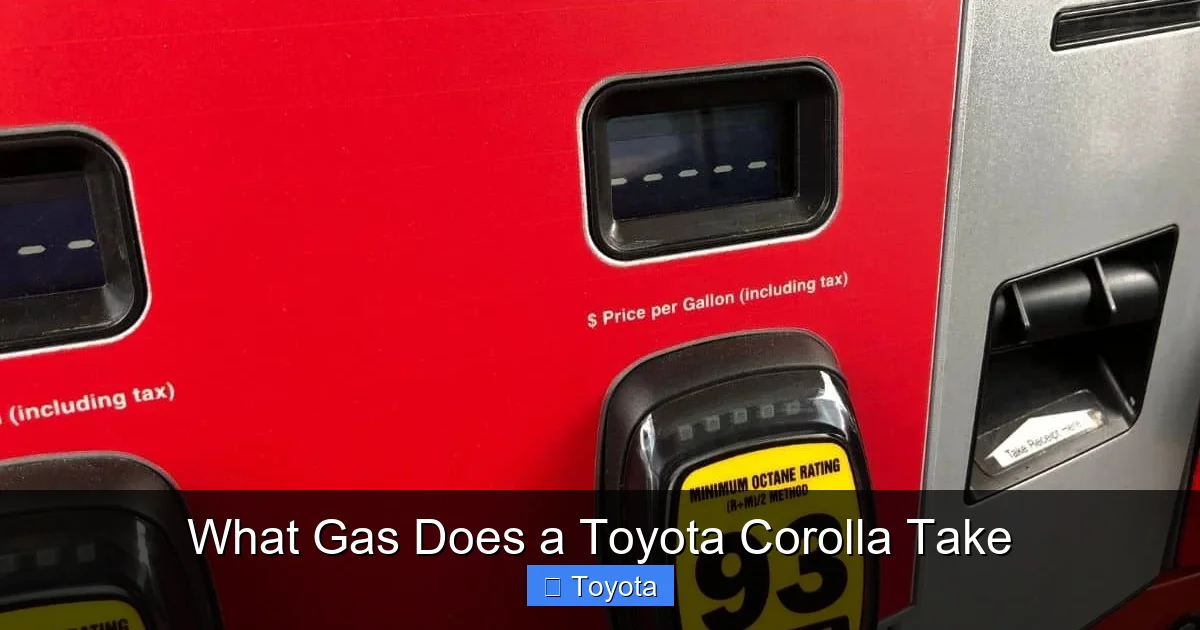
Most Toyota Corolla models are designed to run efficiently on regular unleaded gasoline with an octane rating of 87. While premium fuel isn’t required, using higher-octane gas occasionally may benefit performance in certain conditions.
This is a comprehensive guide about What Gas Does a Toyota Corolla Take.
Key Takeaways
- Regular Unleaded Gas (87 Octane): The standard recommendation for nearly all Toyota Corolla models, ensuring optimal performance and fuel economy.
- Premium Fuel Not Required: Higher-octane gasoline (91–93) is not necessary and won’t improve performance unless specified for performance trims or older models.
- Flex-Fuel Compatibility: Some newer Corolla models support E85 ethanol-blended fuel, but only if explicitly labeled as Flex-Fuel (FFV).
- Fuel Additives and Detergents: Toyota recommends using Top Tier detergent gasoline to maintain engine cleanliness and longevity.
- Seasonal and Regional Considerations: Fuel blends may vary by season and location, but Corollas are engineered to adapt without driver intervention.
- Avoiding Low-Quality or Contaminated Fuel: Using substandard gasoline can harm engine components and reduce fuel efficiency over time.
- Maintenance Tips for Fuel Efficiency: Regular tune-ups, clean air filters, and proper tire inflation help maximize gas mileage regardless of fuel type.
[FEATURED_IMAGE_PLACEHOLDER]
What Gas Does a Toyota Corolla Take?
If you’re a proud owner of a Toyota Corolla—or considering buying one—you’ve probably asked yourself: “What kind of gas does this car need?” It’s a smart question. After all, fuel is the lifeblood of your vehicle, and using the right type can make a big difference in performance, efficiency, and long-term reliability.
The Toyota Corolla is one of the most popular compact sedans in the world, known for its dependability, fuel efficiency, and low maintenance costs. But to keep it running smoothly, you need to feed it the right kind of fuel. The good news? For the vast majority of Corolla models, the answer is simple: regular unleaded gasoline with an octane rating of 87. That’s the standard fuel you’ll find at almost every gas station across the U.S. and many other countries.
But there’s more to the story. While 87 octane is the baseline, there are nuances depending on your Corolla’s year, engine type, and even where you live. Some newer models offer flex-fuel capability, and certain performance-oriented trims might benefit from higher-octane fuel under specific conditions. Plus, fuel quality—like the presence of detergents and ethanol content—can impact your engine over time.
In this guide, we’ll break down everything you need to know about fueling your Toyota Corolla. From understanding octane ratings to choosing the best gas stations and maintaining fuel efficiency, we’ve got you covered. Whether you drive a 2024 Corolla Hybrid or a 2010 base model, this information will help you make smart decisions at the pump.
Understanding Octane Ratings and Why They Matter
Before diving into what gas your Corolla needs, it helps to understand what “octane” actually means. Octane rating is a measure of a fuel’s ability to resist “knocking” or “pinging” during combustion—unwanted detonation that can damage your engine over time.
In simple terms, higher-octane fuels are more resistant to premature ignition. That’s why high-performance engines, which compress air-fuel mixtures more intensely, often require premium fuel (91–93 octane). But the Toyota Corolla isn’t a high-performance sports car. It’s designed for everyday driving, efficiency, and reliability. As such, its engine is engineered to run perfectly fine on regular unleaded gasoline with an octane rating of 87.
Using higher-octane fuel in a Corolla that doesn’t require it won’t hurt the engine, but it also won’t provide any meaningful benefits. You won’t see improved acceleration, better fuel economy, or cleaner emissions. Your car’s engine control unit (ECU) is calibrated for 87 octane, so it won’t take advantage of the extra resistance to knocking that premium fuel offers.
What Happens If You Use the Wrong Octane?
Using lower-octane fuel than recommended can cause engine knocking, especially under heavy load or high temperatures. However, modern Corollas are equipped with knock sensors that detect abnormal combustion and adjust ignition timing to prevent damage. So while you *can* accidentally fill up with mid-grade (89 octane) or even premium, your car will adapt—but it won’t run optimally.
On the flip side, consistently using premium fuel in a car designed for regular gas is a waste of money. You’re paying more per gallon for no real gain. Toyota explicitly states that using higher-octane fuel than recommended does not improve performance or efficiency in standard Corolla models.
Regional and Seasonal Fuel Variations
Fuel formulations can vary by region and season. For example, in colder climates, winter blends of gasoline contain more volatile compounds to help engines start in low temperatures. In warmer areas, summer blends reduce evaporative emissions to meet environmental regulations.
The good news? Toyota engineers design the Corolla to handle these variations. Your car’s fuel system and engine management are built to adapt to different fuel blends without requiring driver input. So whether you’re filling up in Minnesota in January or Arizona in July, your Corolla will run smoothly on regular 87-octane gas.
Toyota Corolla Fuel Recommendations by Model Year
While the general rule is “regular unleaded, 87 octane,” it’s worth checking your owner’s manual for your specific model year. Toyota occasionally updates engine specifications, and some trims or engine types may have different requirements.
2020–2024 Toyota Corolla
The latest Corolla models, including the 2024 Corolla LE, SE, and XSE trims, are powered by either a 2.0-liter four-cylinder engine or a 1.8-liter hybrid system. Both are designed to run on regular unleaded gasoline with an octane rating of 87.
Toyota emphasizes that using higher-octane fuel is not necessary and will not enhance performance. However, the 2023 and 2024 Corolla SE and XSE trims—especially those with sport-tuned suspensions and slightly more aggressive tuning—may benefit from premium fuel during spirited driving. But even then, it’s optional, not required.
2014–2019 Toyota Corolla
These models typically feature a 1.8-liter four-cylinder engine. Again, Toyota recommends regular unleaded gasoline (87 octane). The engine is tuned for efficiency and reliability, not high performance, so premium fuel offers no advantage.
One thing to note: some 2018 and 2019 Corolla models introduced direct injection technology. While this improves fuel atomization and efficiency, it also makes the engine more sensitive to carbon buildup on intake valves. Using Top Tier detergent gasoline (more on that later) is especially important for these models.
2009–2013 Toyota Corolla
Older Corollas, including the 2009–2013 models, also run on regular unleaded gas. These vehicles use port fuel injection, which is less prone to carbon deposits than direct injection. Still, using quality fuel with good detergents helps maintain engine cleanliness.
Pre-2009 Models
Even the earlier Corolla models (2000s and late 1990s) were designed for regular gasoline. While engine technology was less advanced, the fuel requirements remained consistent: 87 octane unleaded.
One exception: some high-performance variants, like the rare Corolla XRS (2009–2010), featured a 2.4-liter engine with higher compression. These models *recommended* 91 octane fuel for optimal performance, though 87 octane could still be used with minor timing adjustments.
Flex-Fuel and Ethanol Blends: Can You Use E85?
In recent years, ethanol-blended fuels like E10 (10% ethanol) and E15 (15% ethanol) have become common at gas pumps. Most modern vehicles, including the Toyota Corolla, are designed to run on E10 without issues. In fact, E10 is the standard gasoline blend in the U.S. and many other countries.
But what about E85—a fuel blend containing up to 85% ethanol? Can you use it in your Corolla?
The short answer: only if your Corolla is specifically labeled as a Flex-Fuel Vehicle (FFV). As of 2024, Toyota does not offer any Corolla models as factory-equipped Flex-Fuel vehicles. That means using E85 in a standard Corolla can cause serious damage.
Why E85 Is a No-Go for Most Corollas
Ethanol has a lower energy density than gasoline, meaning E85 provides fewer miles per gallon. More importantly, ethanol is corrosive and can degrade rubber seals, gaskets, and fuel lines not designed for high ethanol content. Using E85 in a non-FFV Corolla can lead to fuel leaks, engine misfires, and costly repairs.
Additionally, E85 requires different air-fuel ratios and ignition timing. Non-flex-fuel engines aren’t calibrated to handle these changes, so performance and efficiency will suffer.
How to Identify Flex-Fuel Capability
If you’re unsure whether your Corolla can use E85, check for these signs:
– A yellow gas cap or “Flex-Fuel” badge on the vehicle.
– A label inside the fuel door indicating E85 compatibility.
– The owner’s manual stating that Flex-Fuel is supported.
If none of these are present, stick to regular unleaded gasoline.
The Importance of Fuel Quality and Detergent Additives
While octane rating gets most of the attention, fuel quality is just as important—especially for modern engines. Over time, carbon deposits can build up on fuel injectors, intake valves, and combustion chambers, leading to reduced performance, rough idling, and lower fuel efficiency.
To combat this, Toyota recommends using “Top Tier” detergent gasoline. This is a voluntary standard adopted by major fuel retailers to ensure their gasoline contains higher levels of detergent additives.
What Is Top Tier Gasoline?
Top Tier is a certification program created by automakers, including Toyota, to promote cleaner-burning fuel. Gasoline that meets Top Tier standards contains more effective detergents that help prevent deposit buildup.
Major brands like Shell, Chevron, Costco, and Exxon often sell Top Tier gasoline. You can identify it by looking for the Top Tier logo at the pump or checking the retailer’s website.
Using Top Tier fuel in your Corolla—especially models with direct injection—can help maintain engine performance and extend the life of critical components.
Ethanol Content and Its Effects
As mentioned earlier, most gasoline contains up to 10% ethanol (E10). This is safe for all Corolla models. However, ethanol can attract moisture, which may lead to phase separation in older vehicles or those driven infrequently.
If you own an older Corolla or don’t drive often, consider using a fuel stabilizer or filling up with ethanol-free gasoline (often labeled “recreational fuel” or “REC-90”) to prevent moisture buildup.
Tips for Maximizing Fuel Efficiency in Your Corolla
Using the right gas is just one part of the equation. To get the most out of every gallon, follow these practical tips:
Maintain Proper Tire Pressure
Underinflated tires increase rolling resistance, which reduces fuel economy. Check your tire pressure monthly and inflate to the recommended PSI (found on the driver’s door jamb or in the owner’s manual).
Keep Up with Regular Maintenance
A well-maintained engine runs more efficiently. Replace air filters, spark plugs, and fuel filters as recommended. A clogged air filter, for example, can reduce fuel economy by up to 10%.
Avoid Excessive Idling
Idling burns fuel without moving the car. If you’re stopped for more than a minute (except in traffic), turn off the engine.
Drive Smoothly
Aggressive acceleration and hard braking waste fuel. Use cruise control on highways and anticipate stops to reduce speed gradually.
Reduce Weight and Drag
Remove unnecessary items from your trunk and avoid roof racks when not in use. Extra weight and aerodynamic drag decrease efficiency.
Use the Correct Motor Oil
Toyota recommends using 0W-20 synthetic oil for most modern Corollas. This low-viscosity oil reduces engine friction and improves fuel economy.
Common Myths About Fueling Your Corolla
There’s a lot of misinformation out there about gasoline and car performance. Let’s clear up a few common myths:
Myth: Premium Gas Makes Any Car Run Better
Fact: Only cars designed for high-octane fuel benefit from premium gas. Your Corolla isn’t one of them. Using premium fuel in a regular-gas engine is like buying a sports car for city driving—it’s overkill.
Myth: All Gas Stations Sell the Same Quality Fuel
Fact: Fuel quality varies. Top Tier stations use better additives, which help keep your engine clean. Stick to reputable brands when possible.
Myth: Ethanol-Free Gas Is Always Better
Fact: While ethanol-free gas has a higher energy content, it’s more expensive and not necessary for most drivers. E10 is perfectly safe and widely available.
Myth: You Can “Clean” Your Engine with Additives
Fact: Fuel system cleaners can help in some cases, but they’re not a substitute for regular maintenance. Prevention—using quality fuel and changing filters—is more effective.
Conclusion: Stick to Regular, Choose Quality, Drive Smart
So, what gas does a Toyota Corolla take? The answer is clear: regular unleaded gasoline with an octane rating of 87. This is the fuel your Corolla was designed for, and it delivers the best balance of performance, efficiency, and cost.
While premium fuel won’t hurt your engine, it won’t help either—unless you’re driving a rare performance trim or live in an area with consistently poor fuel quality. And unless your Corolla is a Flex-Fuel model (which most aren’t), avoid E85 entirely.
The real key to long-term reliability and fuel efficiency lies in using high-quality gasoline—preferably Top Tier—and maintaining your vehicle properly. Combine that with smart driving habits, and your Corolla will keep delivering excellent mileage for years to come.
Remember, your owner’s manual is your best resource. It contains the most accurate, model-specific information about fuel requirements. When in doubt, refer to it.
At the end of the day, the Toyota Corolla is built to be simple, reliable, and economical. Feed it the right fuel, treat it well, and it will reward you with dependable service mile after mile.
Frequently Asked Questions
Can I use premium gas in my Toyota Corolla?
Yes, you can use premium gas, but it’s not necessary. Your Corolla is designed for regular unleaded gasoline (87 octane), and using higher-octane fuel won’t improve performance or efficiency.
What happens if I accidentally put diesel in my Corolla?
Putting diesel in a gasoline engine can cause severe damage. Do not start the car. Call a tow truck and have the fuel system drained and cleaned immediately.
Is E15 (15% ethanol) safe for my Corolla?
Most modern Corollas can safely use E15, but Toyota recommends sticking to E10 (10% ethanol) for optimal performance and longevity. Check your owner’s manual for confirmation.
Does using Top Tier gas really make a difference?
Yes. Top Tier gasoline contains more effective detergent additives that help prevent carbon buildup in your engine, especially in direct-injection models.
Can I use fuel additives to clean my Corolla’s engine?
Occasional use of quality fuel system cleaners can help, but they’re not a substitute for regular maintenance. Prevention through quality fuel and timely tune-ups is more effective.
Why does my Corolla get worse gas mileage in winter?
Colder temperatures reduce engine efficiency, increase fuel viscosity, and lead to longer warm-up times. Winter fuel blends also have slightly lower energy content, which can reduce mileage.