
How Much Horsepower Does a Maserati Have?

Maserati vehicles pack serious horsepower, ranging from 345 hp in the Ghibli to over 620 hp in the MC20 supercar. Each model blends Italian craftsmanship with high-performance engines, delivering thrilling acceleration and top-tier driving dynamics.
Key Takeaways
- Maserati horsepower varies by model: From 345 hp in the Ghibli sedan to 621 hp in the MC20, each vehicle is engineered for distinct performance levels.
- Twin-turbo V6 and V8 engines dominate: Most Maseratis use forced-induction engines for responsive power and smooth delivery.
- The MC20 leads the pack: With a 3.0L twin-turbo V6 producing 621 hp, it’s Maserati’s most powerful production car to date.
- Hybrid and electric models are emerging: The Grecale Folgore and future EVs will offer high horsepower with improved efficiency.
- Horsepower translates to real-world performance: 0-60 mph times range from under 3 seconds to around 5 seconds depending on the model.
- Italian engineering enhances driving experience: Beyond raw power, Maserati focuses on sound, handling, and luxury.
- Regular updates keep performance competitive: Maserati refreshes its lineup frequently to stay ahead in the luxury performance segment.
📑 Table of Contents
How Much Horsepower Does a Maserati Have?
If you’ve ever heard the deep, throaty growl of a Maserati engine or watched one streak past on a coastal highway, you know this isn’t just another luxury car. Maserati is synonymous with Italian passion, precision engineering, and, of course, serious horsepower. But how much horsepower does a Maserati actually have? The answer isn’t one-size-fits-all. Depending on the model, year, and engine configuration, Maserati vehicles deliver anywhere from around 345 horsepower to a jaw-dropping 621 horsepower.
From the sleek Ghibli sedan to the thunderous MC20 supercar, Maserati’s lineup is a showcase of performance diversity. Each model is crafted not just for speed, but for the emotional experience of driving. Whether you’re commuting in style or carving up mountain roads, Maserati ensures that power is always within reach. And while horsepower is just one part of the equation, it’s a crucial one—especially when you’re talking about a brand that traces its roots back to racing legends like the Tipo 26 and the iconic Birdcage.
In this article, we’ll dive deep into the horsepower figures across Maserati’s current and recent models. We’ll explore what drives these numbers, how they translate to real-world performance, and what sets Maserati apart in the high-end automotive world. Whether you’re a longtime fan or just curious about Italian performance machines, you’ll walk away with a clear picture of what makes Maserati tick.
Maserati’s Engine Philosophy: Power with Passion
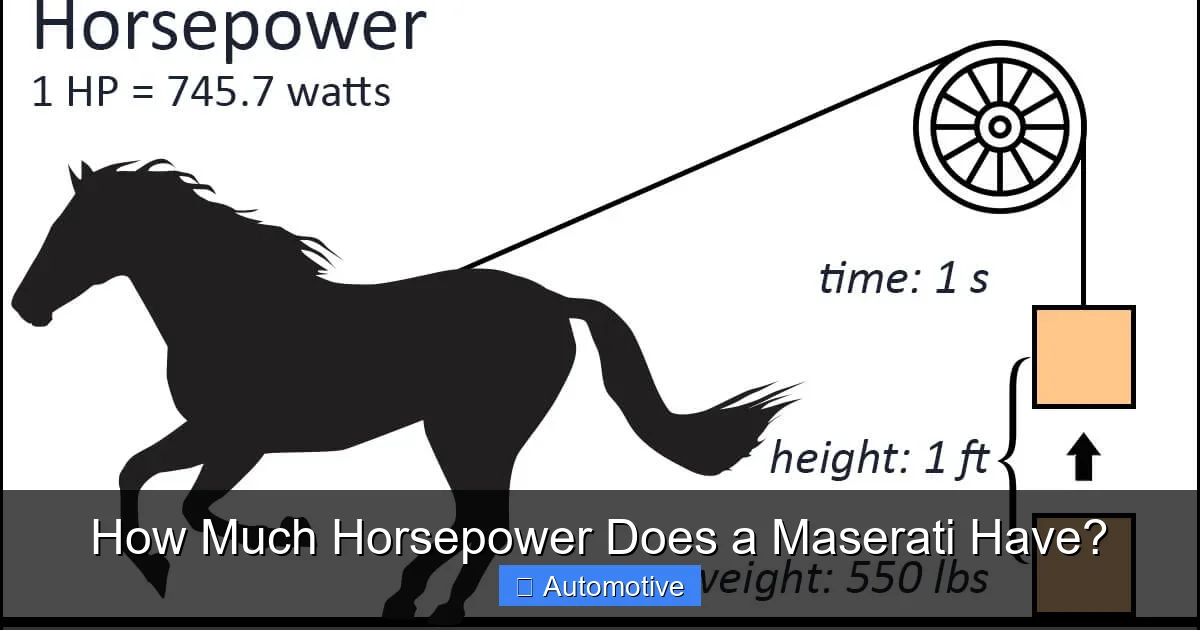
Visual guide about How Much Horsepower Does a Maserati Have?
Image source: icrfq.net
Maserati doesn’t just build fast cars—it builds emotional ones. The brand’s approach to horsepower isn’t just about shoving the biggest engine under the hood. Instead, it’s about balance: blending raw power with refined engineering, luxury, and that unmistakable Italian flair. Every Maserati engine is designed to deliver not only impressive numbers on a spec sheet but also an engaging, visceral driving experience.
At the heart of this philosophy is Maserati’s commitment to naturally aspirated and turbocharged engines that produce both high horsepower and a thrilling exhaust note. Unlike some competitors who rely heavily on hybrid systems or electric motors for peak power, Maserati has traditionally leaned on internal combustion engines—especially twin-turbo V6 and V8 configurations. These engines are tuned to deliver immediate throttle response, strong mid-range torque, and a soundtrack that turns heads.
But Maserati is evolving. With the introduction of the Grecale Folgore (the brand’s first fully electric SUV) and plans for more electrified models, the definition of “horsepower” is expanding. Electric motors can deliver instant torque and staggering acceleration, often exceeding traditional horsepower figures in real-world performance. Still, even in this new era, Maserati remains focused on the driver experience—ensuring that whether it’s a V8 or an electric motor, the car feels alive.
The Role of Twin-Turbo Technology
One of the key reasons Maserati engines produce such high horsepower is the widespread use of twin-turbocharging. By forcing more air into the combustion chamber, turbochargers allow smaller engines to generate power levels once reserved for much larger ones. This means Maserati can deliver supercar-level performance without sacrificing efficiency or packaging.
For example, the 3.0-liter twin-turbo V6 in the MC20 produces 621 horsepower—more than many V8s from just a decade ago. This engine, known as the Nettuno, was developed in-house and features advanced technologies like pre-chamber combustion and dual injection. It’s a testament to how far turbocharging has come, and how Maserati leverages it to maximize output.
Even in more practical models like the Ghibli and Levante, twin-turbo V6 engines produce over 400 horsepower, ensuring that even the brand’s sedans and SUVs feel quick and responsive. This consistent use of forced induction across the lineup helps Maserati maintain a reputation for performance, regardless of body style.
Balancing Power and Luxury
While horsepower is important, Maserati knows that raw numbers alone don’t make a great car. The brand’s vehicles are designed to be driven daily, not just on track days. That means balancing high horsepower with comfort, refinement, and usability.
Take the Quattroporte, for instance. With up to 580 horsepower from its 3.8-liter twin-turbo V8, it can rocket from 0 to 60 mph in under 4.5 seconds. But it also offers a plush ride, hand-stitched leather interiors, and advanced driver aids. Maserati engineers spend countless hours tuning suspension, steering, and sound to ensure that power feels controlled and enjoyable, not overwhelming.
This balance is what sets Maserati apart from some of its more track-focused rivals. It’s not just about going fast—it’s about enjoying the journey. Whether you’re cruising through the city or pushing the limits on a backroad, a Maserati delivers horsepower with purpose.
Horsepower by Model: A Breakdown of Maserati’s Lineup
Visual guide about How Much Horsepower Does a Maserati Have?
Image source: launchknowledge.com
Now that we’ve covered the philosophy behind Maserati’s engines, let’s get into the numbers. Here’s a detailed look at how much horsepower each current and recent Maserati model delivers, along with key performance specs and what makes each one unique.
Maserati Ghibli: The Sporty Sedan
The Ghibli is Maserati’s entry-level sedan, but don’t let that fool you—it’s still a performance powerhouse. Available in multiple trims, the Ghibli offers a range of horsepower options to suit different driving preferences.
The base Ghibli GT comes with a 3.0-liter twin-turbo V6 producing 345 horsepower and 369 lb-ft of torque. That’s enough to get you from 0 to 60 mph in about 5.5 seconds—impressive for a luxury sedan. Step up to the Modena trim, and you get 424 horsepower, cutting the 0-60 time down to around 4.8 seconds. The top-tier Ghibli Trofeo bumps things up further with a 3.8-liter twin-turbo V8 delivering 580 horsepower and a 0-60 time of just 4.3 seconds.
What’s notable about the Ghibli is how it blends everyday usability with sports car DNA. It’s not as extreme as some competitors, but it offers a perfect mix of comfort, style, and performance. The exhaust note, in particular, is a highlight—Maserati tunes it to deliver a deep, resonant growl that builds with the revs.
Maserati Levante: The Performance SUV
The Levante brought Maserati into the luxury SUV segment, and it did so with serious horsepower under the hood. Like the Ghibli, it’s available in multiple trims, each offering a different level of performance.
The base Levante GT features the same 3.0-liter twin-turbo V6 as the Ghibli GT, producing 345 horsepower. The Modena trim increases output to 424 horsepower, while the Trofeo version uses the 3.8-liter V8 to deliver 580 horsepower. All versions come with all-wheel drive and an 8-speed automatic transmission, ensuring strong traction and smooth power delivery.
Despite its size, the Levante handles like a much smaller car. Maserati’s Skyhook adaptive suspension and precise steering make it surprisingly agile, even on twisty roads. And with up to 580 horsepower, it can keep up with many sports cars in a straight line. It’s a perfect example of how Maserati applies its performance ethos to different vehicle types.
Maserati Quattroporte: The Grand Tourer
The Quattroporte is Maserati’s flagship sedan, and it’s built for long-distance comfort and high-speed cruising. It’s also one of the most powerful sedans in the brand’s lineup.
The base Quattroporte GT uses a 3.0-liter twin-turbo V6 with 345 horsepower. The Modena trim bumps that to 424 horsepower, and the Trofeo version delivers a full 580 horsepower from its 3.8-liter V8. With that much power, the Quattroporte Trofeo can hit 60 mph in just 4.2 seconds—faster than many sports cars.
What sets the Quattroporte apart is its grand touring character. It’s designed for high-speed Autostrada runs, with a focus on stability, comfort, and refinement. The cabin is whisper-quiet at speed, and the ride is smooth even over rough pavement. Yet, when you press the throttle, the V8 comes alive with a surge of power and a thunderous exhaust note.
Maserati MC20: The Supercar King
If you want to know how much horsepower a Maserati can truly have, look no further than the MC20. This mid-engine supercar is Maserati’s halo model, and it’s packed with cutting-edge technology and mind-bending performance.
At the heart of the MC20 is the Nettuno engine—a 3.0-liter twin-turbo V6 developed entirely in-house. It produces 621 horsepower and 538 lb-ft of torque, allowing the MC20 to sprint from 0 to 60 mph in just 2.9 seconds. Top speed exceeds 202 mph, placing it firmly in supercar territory.
But the MC20 isn’t just about speed. It features a carbon fiber monocoque chassis, active aerodynamics, and a driver-focused cockpit. The engine placement behind the driver improves weight distribution and handling, making it incredibly agile. And despite its extreme performance, the MC20 is surprisingly usable—it has a front trunk and a surprisingly compliant ride in comfort mode.
The MC20 also marks Maserati’s return to the supercar scene after a long hiatus. It’s a statement of intent: Maserati is back, and it’s here to compete with the best.
Maserati Grecale: The Compact Luxury SUV
The Grecale is Maserati’s newest model, slotting below the Levante as a compact luxury SUV. It offers a range of powertrains, including mild-hybrid and fully electric options.
The base Grecale GT uses a 2.0-liter turbocharged four-cylinder engine with 325 horsepower. The Modena trim increases output to 396 horsepower with a more powerful version of the same engine. The Trofeo version, however, is where things get serious—it uses a 3.0-liter twin-turbo V6 producing 523 horsepower, making it one of the most powerful compact SUVs on the market.
The Grecale also introduces the Folgore (Italian for “lightning”) electric variant, which uses dual electric motors to deliver over 500 horsepower and instant torque. While official figures are still being finalized, early reports suggest 0-60 mph times under 4 seconds.
With the Grecale, Maserati is embracing both traditional performance and electrification, showing that horsepower can come from multiple sources.
What Horsepower Means for Real-World Performance
Visual guide about How Much Horsepower Does a Maserati Have?
Image source: cdn.seriouslyequestrian.com
So, how much horsepower does a Maserati have? As we’ve seen, the answer varies widely. But horsepower is just one piece of the performance puzzle. To truly understand what these numbers mean, we need to look at how they translate into real-world driving.
Acceleration and 0-60 Times
Horsepower directly affects how quickly a car can accelerate. More power generally means faster 0-60 mph times, though weight, traction, and transmission also play a role.
For example, the MC20’s 621 horsepower allows it to hit 60 mph in under 3 seconds—faster than many Ferraris and Lamborghinis. The Ghibli Trofeo, with 580 horsepower, does it in 4.3 seconds, which is quicker than a base BMW M5. Even the base Ghibli GT, with 345 horsepower, feels quick and responsive in everyday driving.
Maserati’s use of twin-turbo engines ensures strong low-end torque, which means you don’t have to rev the engine high to access power. This makes acceleration feel immediate and effortless, whether you’re merging onto a highway or passing on a two-lane road.
Top Speed and High-Speed Stability
High horsepower also contributes to top speed. The MC20 tops out at over 202 mph, while the Quattroporte Trofeo can reach 203 mph. These speeds are only achievable on closed tracks, but they reflect the car’s capability and engineering.
More importantly, high horsepower allows Maseratis to maintain stability and control at high speeds. The Quattroporte, for instance, feels planted and composed even when cruising at 150 mph on the Autostrada. This is due to a combination of aerodynamic design, suspension tuning, and powerful brakes.
Driving Dynamics and Handling
While horsepower gets the headlines, Maserati’s true strength lies in how it integrates power with handling. The brand’s vehicles are known for their balanced weight distribution, precise steering, and responsive chassis.
The MC20, with its mid-engine layout, offers near-perfect 40:60 front-to-rear weight distribution. This makes it incredibly agile, allowing it to change direction quickly and confidently. The Levante, despite its size, uses adaptive suspension and all-wheel steering to feel nimble and composed.
Even the Ghibli and Quattroporte, which are front-engine sedans, are tuned to feel sporty and engaging. Maserati’s engineers spend countless hours on track and road testing to ensure that power is delivered in a way that enhances, rather than overwhelms, the driving experience.
The Future of Horsepower at Maserati
As the automotive world shifts toward electrification, Maserati is adapting its definition of horsepower. The brand has committed to going fully electric by 2030, and its upcoming models will reflect that transition.
Electrification and Instant Torque
Electric motors produce maximum torque instantly, which can result in breathtaking acceleration—even without high horsepower figures. The Grecale Folgore, for example, is expected to deliver over 500 horsepower and 0-60 mph times under 4 seconds, thanks to its dual-motor setup.
Maserati is also developing a fully electric version of the MC20, which could produce even more power while maintaining the supercar’s handling and sound character (via synthetic engine noise). The challenge will be preserving the emotional connection that drivers feel with traditional engines.
Hybrid and Plug-In Options
In the near term, Maserati will continue to offer hybrid and plug-in hybrid versions of its models. These combine internal combustion engines with electric motors to boost power and efficiency. For example, a future Ghibli hybrid might use a V6 paired with an electric motor to deliver over 500 horsepower while reducing emissions.
This transitional approach allows Maserati to meet regulatory demands while still offering the high horsepower its customers expect.
Conclusion: More Than Just a Number
So, how much horsepower does a Maserati have? The answer depends on the model, but across the lineup, you’re looking at anywhere from 325 to 621 horsepower. That’s enough to satisfy even the most demanding performance enthusiasts.
But horsepower is just the beginning. What truly sets Maserati apart is how it uses that power—delivering it with Italian flair, emotional engagement, and a focus on the joy of driving. Whether you’re behind the wheel of a Ghibli, a Levante, or the MC20, you’re not just driving a fast car. You’re experiencing a piece of automotive art.
As Maserati embraces electrification and new technologies, one thing remains constant: its commitment to performance, passion, and prestige. The future of horsepower at Maserati may look different, but the spirit will remain the same.
Frequently Asked Questions
How much horsepower does a Maserati Ghibli have?
The Maserati Ghibli offers between 345 and 580 horsepower, depending on the trim. The base GT model has 345 hp, while the top-tier Trofeo version delivers 580 hp from a twin-turbo V8 engine.
What is the most powerful Maserati currently available?
The Maserati MC20 is the most powerful production model, with 621 horsepower from its 3.0-liter twin-turbo V6 engine. It can accelerate from 0 to 60 mph in just 2.9 seconds.
Do all Maseratis have V8 engines?
No, not all Maseratis have V8 engines. Most current models use twin-turbo V6 engines, including the Ghibli, Levante, and MC20. The Quattroporte Trofeo is one of the few that still offers a V8.
How does Maserati’s horsepower compare to competitors like BMW and Mercedes?
Maserati’s horsepower is competitive with German rivals. For example, the Ghibli Trofeo’s 580 hp matches the BMW M5 and Mercedes-AMg E63 S. The MC20’s 621 hp rivals supercars from Ferrari and Lamborghini.
Will future Maseratis have less horsepower due to electrification?
Not necessarily. Electric motors can deliver instant torque and high power outputs. The Grecale Folgore, for instance, is expected to have over 500 horsepower, proving that electrification can enhance performance.
Is horsepower the only factor that matters in a Maserati?
No. While horsepower is important, Maserati also focuses on handling, sound, luxury, and driving emotion. The brand’s cars are designed to be engaging and enjoyable, not just fast.
