What Does the Maintenance Required Light Mean on a 2014 Toyota Highlander

Contents
- 1 Key Takeaways
- 2 📑 Table of Contents
- 3 Understanding the Maintenance Required Light
- 4 What Exactly Triggers the Light?
- 5 How to Reset the Maintenance Required Light Yourself
- 6 Why You Should Never Ignore the Light
- 7 Common Misconceptions and Comparisons
- 8 Professional Service vs. The DIY Reset
- 9 Conclusion: A Simple Tool for a Long-Lasting Highlander
- 10 Frequently Asked Questions



The maintenance required light on your 2014 Toyota Highlander is a friendly reminder from your car’s computer that it’s time for scheduled service, based on mileage and time intervals. It’s not an emergency warning like the check engine light; instead, it signals routine upkeep like oil changes, tire rotations, and inspections. Ignoring it can lead to premature wear and costly repairs. You can reset it yourself after the service is completed, following a simple procedure detailed in your owner’s manual.
Key Takeaways
- It’s a Reminder, Not an Emergency: The light indicates scheduled maintenance is due, based on your driving habits and time/mileage intervals set by Toyota. It is not a diagnostic trouble code.
- Common Triggers Include Oil & Filter Changes: The most frequent reason it illuminates is for an oil and filter change, but it also accounts for tire rotations, multi-point inspections, and other scheduled services.
- You Must Perform the Service First: Always complete the required maintenance before resetting the light. Resetting it without doing the work defeats its purpose and can harm your vehicle.
- Resetting is a Simple DIY Process: After service, you can reset the light yourself in under a minute using the odometer button on your dashboard—no tools or mechanic needed for the reset step.
- Ignoring It Risks Your Investment: Skipping recommended service can void parts of your warranty, reduce fuel efficiency, cause premature component failure, and lower your Highlander’s resale value.
- It’s Part of Toyota’s Maintenance Minder System: This 2014 model uses an algorithm that calculates oil life based on engine run time, temperature, and driving style, making it more accurate than a simple mileage counter.
- Consult Your Owner’s Manual: Your specific maintenance schedule (every 5,000 or 10,000 miles, etc.) and exact reset procedure are detailed in your vehicle’s manual, which is the ultimate authority.
📑 Table of Contents
- Understanding the Maintenance Required Light
- What Exactly Triggers the Light?
- How to Reset the Maintenance Required Light Yourself
- Why You Should Never Ignore the Light
- Common Misconceptions and Comparisons
- Professional Service vs. The DIY Reset
- Conclusion: A Simple Tool for a Long-Lasting Highlander
Understanding the Maintenance Required Light
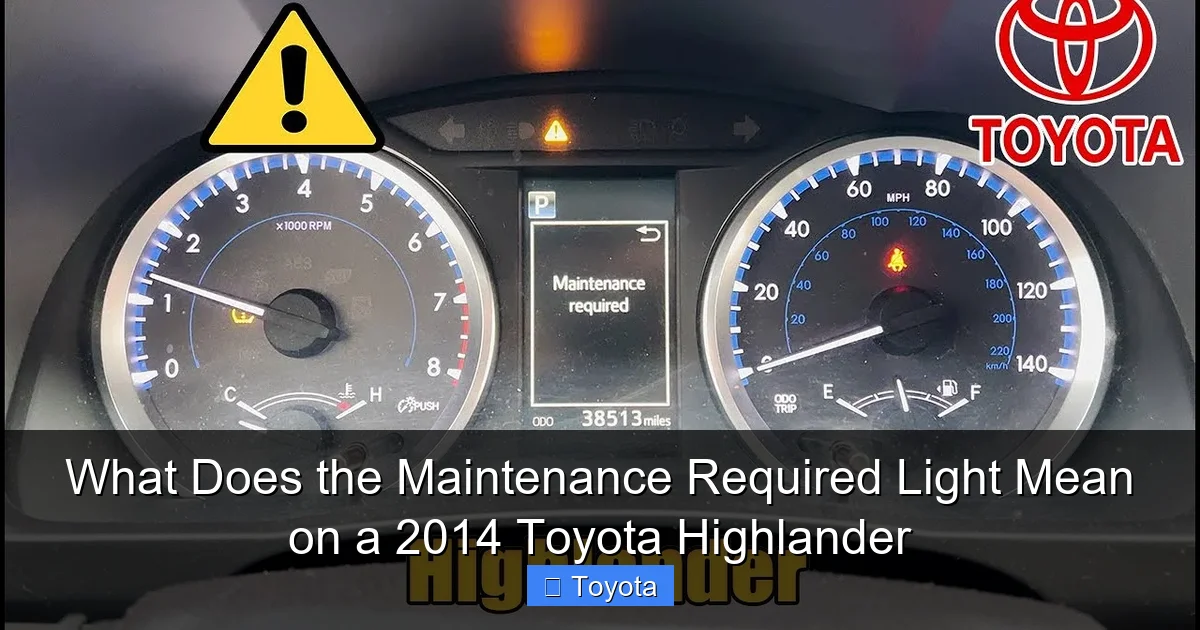
So, you’re driving your trusty 2014 Toyota Highlander, maybe running errands or on a family adventure, and you notice a small icon light up on your dashboard. It looks like a little wrench or sometimes says “MAINT REQD.” Your first thought might be, “Uh oh, what’s wrong now?” Take a deep breath. In the vast majority of cases for your Highlander, this light is not a cause for panic. It’s not the check engine light, which signals a potential problem. Instead, think of the maintenance required light as your car’s polite, digital nudge. It’s your Highlander’s way of saying, “Hey, friend! Based on how we’ve been driving together, it’s time for our check-up.”
Toyota designed this system as part of their Maintenance Minder technology. For the 2014 Highlander, it’s a sophisticated, computer-based reminder system. It doesn’t just count miles; it actually monitors engine operating conditions. Factors like engine revolutions, coolant temperature, and even your driving style (stop-and-go city traffic versus steady highway cruising) are factored into an algorithm that calculates the remaining life of your engine oil. When that calculated oil life drops to a certain threshold, typically around 15% or at a specific time/mileage interval, the light comes on. It’s a personalized maintenance schedule tailored to your actual use, not a one-size-fits-all calendar.
This system is a fantastic tool for owners who want to follow Toyota’s recommended service intervals precisely, which is the absolute best way to ensure your Highlander’s longevity, reliability, and performance. It takes the guesswork out of “when” you need service. But to use it effectively, you need to understand what it truly means and what your appropriate response should be. Let’s break it down.
What Exactly Triggers the Light?
The maintenance required light is a cumulative signal. It’s programmed to illuminate when your Highlander reaches a predetermined service interval. For a 2014 model, these intervals are typically either every 5,000 miles or every 6 months, whichever comes first, for standard oil changes. However, the Maintenance Minder system can adjust this based on severe driving conditions. For instance, if you frequently tow, drive in extremely hot or cold climates, or do a lot of short trips where the engine doesn’t fully warm up, the system may calculate oil life degradation faster and illuminate the light sooner.
Visual guide about What Does the Maintenance Required Light Mean on a 2014 Toyota Highlander
Image source: i.ytimg.com
The Primary Culprit: Oil Change
By far, the most common reason the “MAINT REQD” light appears is that your engine oil and filter have reached the end of their useful service life. Engine oil lubricates, cools, and cleans internal components. Over time, it breaks down, becomes contaminated with combustion byproducts, and loses its viscosity. Running your Highlander on degraded oil is like asking a marathon runner to perform while dehydrated—it causes excessive friction, heat, and wear. The light is your first and most important warning to change the oil and filter before this damage occurs.
Other Scheduled Services
While an oil change is the star of the show, the maintenance required light is also tied to a full suite of scheduled services outlined in your owner’s manual. When the light comes on, it means it’s time for the service corresponding to that specific mileage interval. This often includes:
- Tire Rotation: Essential for even tire wear, extending tire life, and maintaining proper handling and safety. Your Highlander’s AWD system particularly benefits from regular rotations.
- Multi-Point Inspection: A comprehensive check of critical components: brakes, fluid levels (coolant, brake, transmission, power steering), belts, hoses, battery, and suspension components.
- Air Filter Replacement: A clogged engine air filter reduces power and fuel economy. A cabin air filter change ensures clean air inside your SUV.
- Other Fluid Services: Depending on the interval, it may be time for transmission fluid, differential fluid (for AWD models), or coolant checks/replacements.
It’s crucial to understand that the light doesn’t specify *which* service is due. It simply signals that the current service interval has been reached. A trusted mechanic or your dealer will use the mileage and your vehicle’s maintenance history to determine the exact checklist for that visit. You can look up the “Maintenance Schedule” table in your owner’s manual to see what services are due at 30,000 miles, 60,000 miles, etc.
How to Reset the Maintenance Required Light Yourself
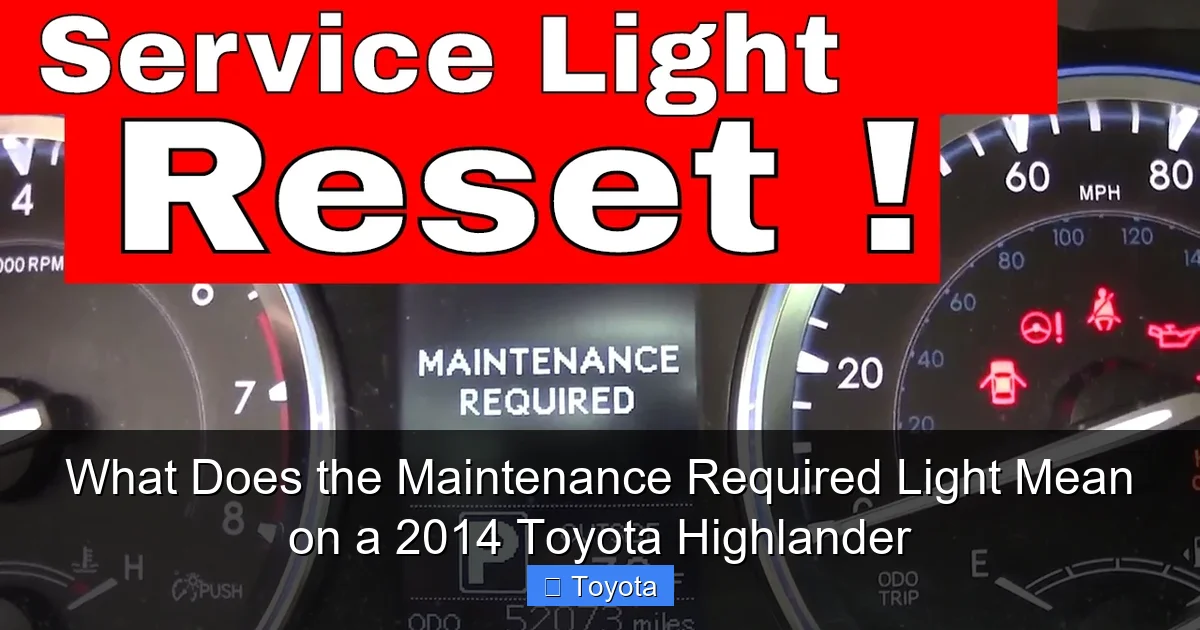
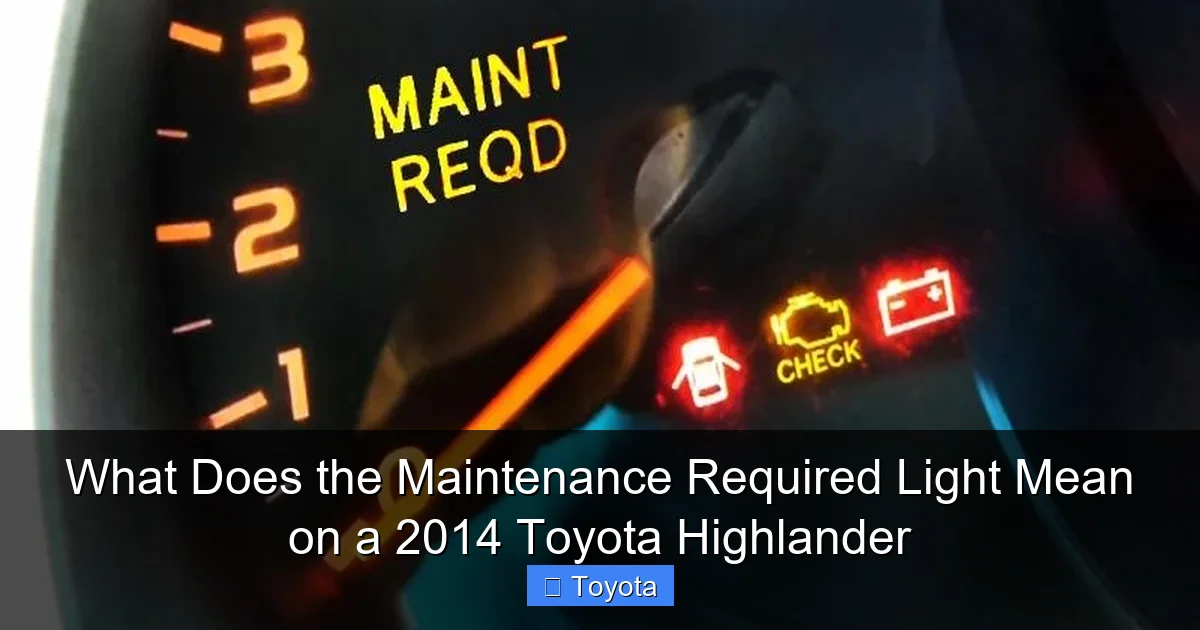
This is the part many Highlander owners are eager to learn. Resetting the light is a straightforward process you can do at home in less than 60 seconds, but only after you have completed the required maintenance. Resetting it without doing the work is like erasing a to-do list without doing the tasks—it doesn’t make the work go away; it just leaves you unprepared for the consequences.
Visual guide about What Does the Maintenance Required Light Mean on a 2014 Toyota Highlander
Image source: carfromjapan.com
For your 2014 Toyota Highlander, the procedure uses the odometer/trip meter reset button on your dashboard. Here is the standard method:
- Turn the ignition to the “ON” position. Do not start the engine. Simply press the start button twice (without your foot on the brake) or turn the key to the run position. All dashboard lights should illuminate.
- Use the “ODO/TRIP” button to switch the display to show the total odometer reading (not a trip meter). You may need to press the button multiple times until you see the total miles.
- Turn the ignition “OFF.” Now, press and hold the “ODO/TRIP” button.
- While still holding the button, turn the ignition back to the “ON” position (again, do not start the engine).
- Continue holding the button. The odometer display will change. It may show a series of dashes or the word “DONE” or “SET.” Keep holding the button until the maintenance required light blinks and then goes out, or until you see “DONE” appear on the screen. This can take 5-15 seconds.
- Release the button, turn the ignition off, and then start the engine to confirm the light is off.
Important Note: If this doesn’t work on the first try, consult your owner’s manual. The exact button sequence can sometimes vary slightly between trim levels or if the vehicle has a different instrument cluster. There are also model-specific guides available, such as our detailed article on how to reset the maintenance light on a Toyota Highlander, which covers variations for different model years. For the broader Toyota lineup, our guide on how to reset the maintenance required light on a Toyota provides additional context on the system’s logic.
Why You Should Never Ignore the Light
It’s tempting, especially if your Highlander seems to be running fine, to just put a piece of tape over the light and forget about it. This is a risky gamble with your multi-thousand-dollar investment. Ignoring the maintenance required light is essentially ignoring the factory-recommended service schedule that was engineered to keep your vehicle performing optimally for years.
Visual guide about What Does the Maintenance Required Light Mean on a 2014 Toyota Highlander
Image source: jbtools.com
The Domino Effect of Skipped Service
Let’s trace what happens if you ignore an oil change reminder. First, your oil becomes sludgy and ineffective. This increased friction causes your engine to work harder, reducing fuel economy—you’ll start paying more at the pump. The dirty oil also fails to properly lubricate and cool critical parts like piston rings, cylinder walls, and the camshaft. This leads to accelerated wear. What starts as an inexpensive oil change can cascade into a major engine repair costing thousands. The same principle applies to other services. Skipping a tire rotation leads to uneven tire wear, meaning you have to replace tires much sooner. Neglecting a multi-point inspection means a worn brake pad might grind down to the rotor, turning a $200 pad replacement into a $1,000 rotor and caliper job. Small problems ignored become big, expensive problems.
Impact on Warranty and Resale Value
If your 2014 Highlander is still under any remaining powertrain warranty, following the maintenance schedule is often a condition of that warranty. If a component fails and you have no records of the required maintenance, Toyota could deny your warranty claim. Furthermore, when it comes time to sell or trade-in your Highlander, a complete and verifiable service history is a huge selling point. It proves to the next owner that the vehicle has been cared for, and it typically increases the vehicle’s market value. A car with a history of ignored maintenance lights and spotty records will raise red flags for a buyer or dealership and lower your return on investment.
Common Misconceptions and Comparisons
Because dashboard lights can be confusing, several myths surround the maintenance required light. Clearing these up will help you respond correctly.
It’s Not the Check Engine Light
This is the most critical distinction. The check engine light (usually yellow and shaped like an engine) indicates an active fault or malfunction detected by the engine control module (ECM). It could be anything from a loose gas cap to a failing catalytic converter. It requires immediate diagnosis with a scan tool. The maintenance required light (usually amber and looks like a wrench or says “MAINT”) is a purely informational reminder based on a preset schedule. It has nothing to do with current faults. However, it’s worth noting that on some vehicles, a severely overdue service that leads to a problem (like low oil pressure) could eventually trigger a check engine light. For comparison, other brands use different symbols. For example, on many Honda Civics, a similar reminder is often indicated by a “wrench” light. You can learn more about what the wrench light means on a Honda Civic in our dedicated guide.
“Can I Just Keep Driving?”
Yes, but with a caveat. The light itself won’t cause any operational harm. You can drive for a few hundred miles after it comes on to schedule a convenient service appointment. However, you should not delay excessively. Think of it as a low-fuel warning; you have some range, but you need to refuel soon. The safe advice is to schedule service within one to two weeks or 200-300 miles of the light illuminating, whichever is sooner. If your driving conditions are “severe” (lots of short trips, towing, extreme temps), treat the light as a higher priority.
“Does It Mean I Need an Oil Change *Right Now*?”
Not necessarily “right now” in an emergency sense, but “right now” in a maintenance sense. The system is designed to give you adequate warning. It means your oil life is depleted and you should plan for an oil change at your earliest convenience. Don’t wait until the light is flashing or until you notice engine noises.
Professional Service vs. The DIY Reset
This brings us to a key decision point: what should you do when the light comes on? The answer has two parts: the service and the reset.
The service should almost always be performed by a professional, unless you are an experienced DIY mechanic with the proper tools, knowledge, and disposal methods for oil and filters. A professional service at a dealer or reputable independent shop provides immense value beyond just the parts replacement. They perform the full multi-point inspection, checking brakes, suspension, fluids, and belts. They have the expertise to spot early signs of wear that you might miss. They use the correct Toyota-spec fluids and filters. For your AWD Highlander, they will also check the differential fluid, which is critical for the system’s health. This is an investment in your vehicle’s health and safety. You can also refer to our article on what does check AWD system mean on Toyota Highlander to understand another critical dashboard warning related to your SUV’s all-wheel drive.
The reset, as detailed earlier, is a simple electronic procedure that merely tells the car’s computer you’ve acknowledged the reminder. It’s the final step after the physical work is done. If you have the service done at a shop, they will always reset it for you. If you do the oil change yourself, you must remember to reset the light manually. Forgetting to reset it doesn’t cause damage, but it means the system won’t accurately track your next interval, and the light will come back on prematurely, defeating the purpose of the system.
For those who prefer a visual guide, there are many helpful video tutorials specific to the 2014 Highlander. The process is identical across most 2014-2016 Highlanders, so a search for “2014 Toyota Highlander maintenance light reset” will yield step-by-step videos. Our text-based guide above is the universal method.
Conclusion: A Simple Tool for a Long-Lasting Highlander
The maintenance required light on your 2014 Toyota Highlander is one of the best features for conscientious ownership. It’s not an adversary; it’s an ally. It’s a direct line of communication from your vehicle’s sophisticated computer, telling you exactly when it needs attention based on how you actually use it. By respecting this signal, you are actively choosing to protect your engine, maintain your SUV’s performance and fuel efficiency, safeguard your warranty, and preserve its resale value. The process is simple: when the light comes on, schedule your service, have a professional perform the needed maintenance (or do it correctly yourself), and then reset the light. This creates a virtuous cycle of care that will reward you with many more years of reliable, safe, and enjoyable driving from your Highlander. Keep this guide handy, consult your owner’s manual for your specific schedule, and treat that little wrench icon as a helpful reminder from a friend, not a source of stress.
Frequently Asked Questions
Is the maintenance required light the same as the check engine light?
No, they are completely different. The maintenance required light is a scheduled service reminder based on mileage/time. The check engine light indicates an active engine or emissions system fault that needs diagnosis. They serve different purposes and require different actions.
Can I reset the maintenance light without changing the oil?
Yes, the reset procedure is electronic and can be performed at any time. However, you should never reset it without first completing the required service. Doing so will cause the system to lose track of your oil life and the light will come back on very quickly, providing no benefit and potentially leading to engine damage.
How many miles can I drive after the maintenance light comes on?
You typically have 200-500 miles of “grace” after the light illuminates, as it’s designed to give you warning. However, you should schedule service as soon as possible. Driving excessively beyond this point risks engine wear from degraded oil. The exact distance depends on your driving conditions and how the system calculated oil life.
Will the light turn off by itself after I get service?
No. The light is a manual reminder that must be explicitly reset via the dashboard procedure. Even after a mechanic changes your oil, they must manually perform the reset sequence for the light to go out. If you change the oil yourself, you must remember to do this step.
What if the maintenance light won’t reset after I’ve done the service?
First, double-check that you followed the reset procedure exactly (ignition on, hold trip button, ignition on while holding, wait for “DONE”). If it still fails, there might be an electrical issue or a fault in the system. Try the procedure again after cycling the ignition fully off and on. If it persists, consult your owner’s manual or a mechanic, as there may be an underlying issue with the dash or the maintenance minder system itself.
Does the maintenance required light affect my car’s performance or emissions?
The light itself has no effect on performance or emissions—it’s just an indicator. However, the underlying need for service (like old, sludgy oil or clogged air filters) absolutely can reduce performance, fuel economy, and increase emissions. Addressing the reminder resolves these potential issues.