What Does the Maintenance Required Light Mean on a 2013 Toyota Camry?

Contents
- 1 Key Takeaways
- 2 📑 Table of Contents
- 3 Decoding the Friendly Reminder: What the Light Actually Means
- 4 What Specific Maintenance is “Required”?
- 5 How to Reset the Maintenance Required Light Yourself
- 6 What Happens If You Ignore It? The Real Risks
- 7 Comparing the Maintenance Required Light to Other Dashboard Lights
- 8 Frequently Asked Questions (FAQs)
- 9 Frequently Asked Questions

Car Tire Inflator

Portable Work Light

Phone Mount for Bike
Reflective Safety Triangle
The “Maintenance Required” light on your 2013 Toyota Camry is not an emergency warning. It’s a friendly, scheduled reminder from your car’s computer that it’s time for regular, preventative maintenance based on your driving mileage or time since the last service. Ignoring it can lead to reduced performance, poor fuel economy, and costly repairs down the line. This light is triggered after a set interval (typically 5,000 miles) and signals that services like an oil change, tire rotation, and multi-point inspection are due.
Key Takeaways
- It’s a Reminder, Not a Crisis: The Maintenance Required light is a scheduled service alert, not an indication of immediate, dangerous trouble like a Check Engine light.
- It’s Mileage/Time-Based: The light illuminates after a preset interval (usually every 5,000 miles) from the last reset, regardless of your driving conditions.
- Standard Services Are Due: Its primary trigger is the need for an oil change, tire rotation, and a comprehensive multi-point inspection.
- You Must Reset It Manually: After a mechanic performs the required service, they (or you) must manually reset the light using a specific procedure. It will not turn off on its own.
- Ignoring It Has Consequences: Prolonged neglect can lead to engine sludge from old oil, uneven tire wear, and missed opportunities to catch small problems before they become big, expensive ones.
- It’s Separate from Other Warnings: This light is distinct from the “Check Engine” light, oil pressure light, or other urgent dashboard warnings that require immediate attention.
📑 Table of Contents
- Decoding the Friendly Reminder: What the Light Actually Means
- What Specific Maintenance is “Required”?
- How to Reset the Maintenance Required Light Yourself
- What Happens If You Ignore It? The Real Risks
- Comparing the Maintenance Required Light to Other Dashboard Lights
- Frequently Asked Questions (FAQs)
Decoding the Friendly Reminder: What the Light Actually Means
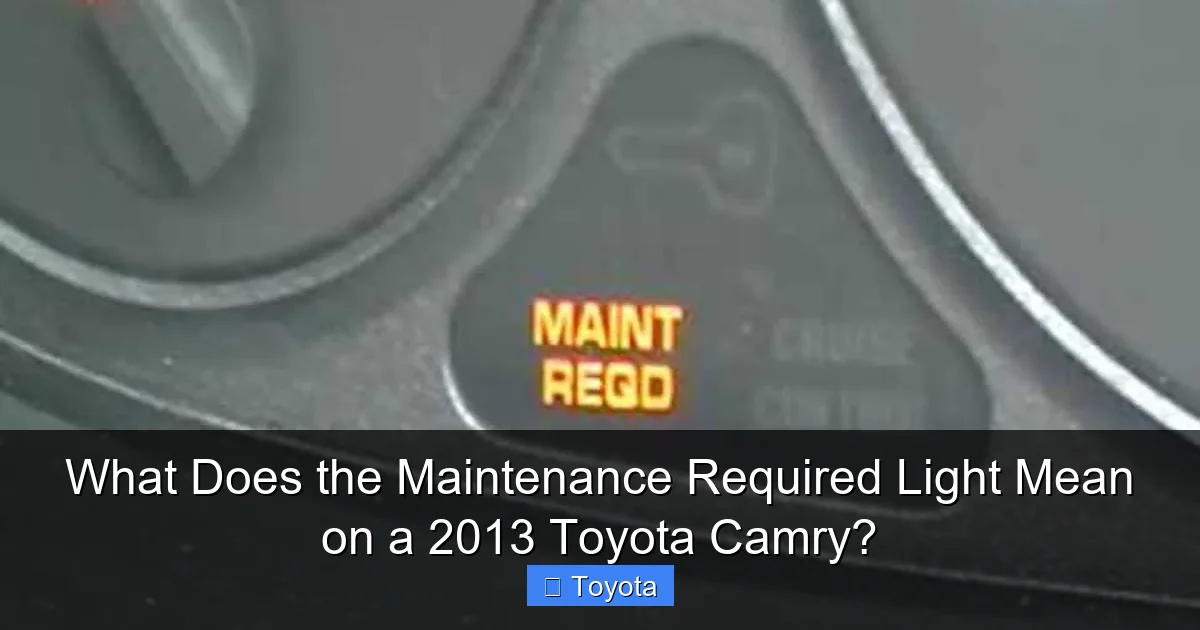
So, you’re driving your reliable 2013 Toyota Camry, and a small amber icon that looks like a little wrench or the words “MAINT REQD” suddenly appears on your dashboard. Your heart might skip a beat. Is it serious? Should you pull over? Take a deep breath. In the world of Toyota dashboard symbols, this one is one of the least alarming. It is not your Check Engine light. It is not your oil pressure light. It is, in essence, your car’s way of tapping you on the shoulder and saying, “Hey, it’s been about 5,000 miles (or 6 months) since my last tune-up. I’m feeling a bit thirsty for fresh oil and could use a check-up.”
This system is Toyota’s Maintenance Required (MR) indicator. It’s a sophisticated, computerized mileage counter that tracks your vehicle’s service intervals. Unlike older cars where you might have used a sticker on the windshield to remember your next oil change, your 2013 Camry does this digitally. It doesn’t “know” the condition of your oil or your tires; it simply counts down from the last reset point. When it hits zero (or the preset interval), the light comes on. Its sole purpose is to ensure you adhere to the factory-recommended service schedule, which is designed to keep your Camry running smoothly, efficiently, and reliably for years to come. Think of it as your car’s personal assistant for preventative care.
The “MR” System: How It Works Behind the Scenes
The system is elegantly simple. When your mechanic (or you) performs the required maintenance and resets the light, you are essentially telling the car’s computer, “Start counting from zero again.” The car’s internal computer then begins tallying your miles (and sometimes time) from that exact point. The 2013 Camry’s system is typically set to remind you every 5,000 miles for standard driving conditions. However, if your driving habits fall under Toyota’s definition of “severe” service—which includes frequent short trips, extreme temperatures, dusty conditions, or heavy loads—the recommended interval might be shorter.
The light doesn’t discriminate based on how you drive. Whether you’ve done 5,000 miles of perfect highway cruising or 5,000 miles of stop-and-go city traffic with a roof rack full of gear, the light will illuminate at the same mileage mark. This is why it’s crucial to understand that the light is a starting point for service, not an exact diagnostic tool. Your mechanic will use the light’s illumination as a cue to perform a full suite of checks and services tailored to your specific vehicle’s needs and history.
What Specific Maintenance is “Required”?
When that wrench illuminates, it’s calling for a standard service package. For a 2013 Toyota Camry, this almost always centers on the following critical tasks. Completing these items addresses the most common wear-and-tear items and ensures all vital systems are checked.
The Core: Oil and Filter Change
This is the heart of the service. Fresh engine oil is the lifeblood of your Camry’s engine. Over 5,000 miles, oil breaks down, loses its viscosity, and becomes contaminated with combustion byproducts and metal particles. Driving with degraded oil increases friction, causes excessive heat, and can lead to premature engine wear or catastrophic failure. The service includes draining the old oil, replacing the oil filter (a critical step often missed by DIYers), and refilling with the correct grade and quantity of Toyota-approved oil, typically 0W-20 for this model year.
Tire Rotation and Inspection
Front-wheel drive cars like the Camry put disproportionate stress on the front tires (steering, braking, acceleration). A tire rotation—typically moving the front tires to the rear and crossing them—promotes even tread wear across all four tires. This extends the life of your tire set, improves handling, and maintains fuel efficiency. During rotation, the technician will also measure tread depth, check for uneven wear patterns (which can indicate alignment or suspension issues), and verify proper tire pressure.
The Essential Multi-Point Inspection
This is where the real value of the service comes in. While your oil is being changed, a thorough inspection is performed. This checklist usually includes:
- Fluids: Checking and topping off coolant, brake fluid, power steering fluid, transmission fluid, and windshield washer fluid.
- Brakes: Inspecting brake pads/shoes for wear, rotors for thickness and scoring, and brake lines for leaks.
- Battery: Testing charge and checking terminals for corrosion.
- Belts and Hoses: Looking for cracks, fraying, or wear on the serpentine belt and critical engine hoses.
- Lights: Ensuring all exterior and interior lights function.
- Wipers: Checking blade condition.
- Suspension: A visual check of shocks/struts and steering components.
This inspection is your car’s annual physical. It catches small problems—a slightly low coolant level, a brake pad getting thin, a loose belt—before they strand you on the side of the road or cause expensive collateral damage.
How to Reset the Maintenance Required Light Yourself
Once the scheduled service is complete, the light will not turn off by itself. It must be manually reset. This is a simple procedure you can do at home with no tools, saving you a trip to the dealer. For a 2013 Toyota Camry, here is the standard method:
- Ensure the ignition is OFF.
- Press and hold the “ODO/TRIP” button on the instrument cluster.
- While still holding the button, turn the ignition key to the “ON” position (the position right before starting, where all dash lights come on). Do not start the engine.
- Continue holding the “ODO/TRIP” button. After about 5-10 seconds, the odometer display will change. It will show a series of zeros or may briefly show “DISP OFF” before returning to the normal odometer reading.
- The “MAINT REQD” light should now be extinguished. You can release the button and turn the ignition off.
If this doesn’t work, consult your owner’s manual for the exact procedure, as there can be slight variations. If the light comes back on after a short drive, the reset likely wasn’t successful and should be tried again. For more detailed guides on resetting maintenance lights across various Toyota models, you can refer to resources like this comprehensive Toyota reset guide.
What Happens If You Ignore It? The Real Risks
It’s tempting to think, “My car seems fine, I’ll just keep driving.” But ignoring the Maintenance Required light is a false economy with potentially serious consequences. The light is your cheapest insurance policy against major breakdowns.
Engine Damage from Neglected Oil Changes
This is the most significant risk. Oil is not just a lubricant; it’s a coolant, a cleaner, and a sealant. As it degrades, it loses its ability to perform these functions. Thick, sludgy oil can’t flow properly to lubricate tight engine clearances, leading to metal-on-metal contact, overheating, and accelerated wear. In extreme cases, it can cause a seized engine. The cost of an engine rebuild or replacement dwarfs the cost of a regular oil change by thousands of dollars.
Premature and Uneven Tire Wear
Skipping tire rotations means your front tires will wear out much faster than your rears. You’ll likely need to replace two tires far sooner than the other two, which is inefficient. More importantly, uneven wear can create a noisy, unstable ride and reduce traction, especially in wet conditions. It can also mask more serious problems like misalignment, which, if left unchecked, can damage suspension components and further degrade tires.
Missed Opportunities to Find Small Problems
The multi-point inspection is your safety net. A technician might notice a minor coolant leak, a fraying belt, or brake pads with 20% life left. Fixing these during a routine service is relatively inexpensive and quick. If you skip the service, you won’t get that expert eye on your car. That minor leak becomes a major overheating issue. That fraying belt snaps, leaving you stranded and potentially damaging other engine accessories. That brake pad wears to the metal, scoring your rotors and multiplying your repair bill.
Comparing the Maintenance Required Light to Other Dashboard Lights
Understanding the hierarchy of your dashboard is key to knowing how to respond. The Maintenance Required light sits in a specific category. It’s helpful to compare it to other common warnings.
- Maintenance Required Light (Amber Wrench/MAINT REQD): Action: Schedule service within the next few hundred miles. Non-urgent. It’s a mileage counter.
- Check Engine Light (Yellow Engine Icon): Action: Get the vehicle’s computer scanned for trouble codes as soon as possible. It indicates a problem with the emissions or engine management system that could affect performance, fuel economy, or cause damage if severe. It’s a diagnostic tool.
- Oil Pressure Light (Red Oil Can): Action: STOP THE CAR IMMEDIATELY in a safe place and turn off the engine. This indicates a loss of oil pressure, which can destroy an engine in minutes. It’s a critical failure warning.
- Battery/Charging Light (Red Battery Icon): Action: Drive cautiously to a safe location or a repair shop. This means your alternator isn’t charging the battery, and you’ll soon run out of electrical power. It’s a system failure warning.
The “MR” light is purely informational and preventative. Other manufacturers have similar systems. For instance, many Hondas use a “SERVICE” or wrench icon, which you can learn about in articles like What Does The Wrench Light Mean On A Honda Civic. The principle is universally the same: a scheduled reminder from the manufacturer.
Frequently Asked Questions (FAQs)
Can I keep driving my Camry with the Maintenance Required light on?
Yes, but only for a limited time and distance. The light means service is overdue. You should schedule an appointment within the next 100-300 miles. Driving long distances or ignoring it for months risks engine damage from old oil and misses vital safety inspections.
Do I have to go to a Toyota dealership to reset the light?
No. Any qualified mechanic at an independent shop or even a competent DIYer can perform the required service and reset the light using the simple button-press procedure outlined in your owner’s manual. You only need a dealership if you want specific recall work or warranty service.
What if the Maintenance Required light comes back on right after I reset it?
This indicates the reset procedure was not followed correctly. The system didn’t register the reset command. Carefully repeat the steps: turn ignition OFF, hold the trip/odo button, turn ignition to ON (not start), hold until display blinks/zeros, then release. If it persists, there may be a rare electrical fault.
Is the Maintenance Required light the same as the service light on a Subaru or Nissan?
Yes, in principle. Most modern cars from Toyota, Honda, Subaru, Nissan, and others have a similar mileage-based service reminder system. The iconography and exact reset procedure may differ slightly. For example, many Subarus use a small “i” inside a circle, which is explained in guides like What Does The I Light Mean On A Subaru Dashboard. The core function—reminding you of scheduled maintenance—is identical.
My 2013 Camry has 60,000 miles. Is there anything special besides an oil change?
At 60,000 miles, you are entering major service interval territory. Along with the standard oil change and rotation, the service should include replacing the engine air filter, cabin air filter, spark plugs (if not done at 30k), and a thorough check of all fluids. Your technician should also inspect the timing belt/chain (the 2.5L 4-cylinder has a timing chain, which is generally “lifetime,” but the 3.5L V6 has a timing belt that must be replaced around 60k-90k miles—know your engine!). This is a critical item to verify.
Can I just change the oil myself and reset the light, skipping the inspection?
Technically, yes. But you would be missing the most valuable part of the service: the professional multi-point inspection. The cost of a professional service includes the mechanic’s expertise to spot problems you might miss. Skipping the inspection to save a small fee is penny-wise and pound-foolish, as you risk a much costlier breakdown.
Frequently Asked Questions
How many miles can I drive after the Maintenance Required light comes on?
You should schedule service within 100-300 miles. The light illuminates at the exact service interval (e.g., 5,000 miles). While driving an extra 50 miles won’t ruin your engine, consistently delaying service by thousands of miles leads to oil degradation and missed inspections.
Will the light turn off by itself once I’ve driven enough miles after the service?
No. The light is a one-way switch. It turns ON at the service interval and will stay ON forever, even if you drive another 10,000 miles, until it is manually reset. This is why resetting it after service is a mandatory final step.
Does the Maintenance Required light mean my car is unsafe to drive?
No. It means your car is due
What is the average cost to turn off the Maintenance Required light on a 2013 Camry?
The cost is the cost of the required service itself, not a fee for “turning off the light.” A standard oil change and tire rotation with a multi-point inspection typically ranges from $60 to $120 at an independent shop, depending on oil type and your location. At a dealership, expect to pay $80 to $150+.
My Maintenance Required light is flashing. Is that different?
On most models, including the 2013 Camry, the Maintenance Required light illuminates solidly. A flashing light is typically reserved for the “Check Engine” or other critical warnings. If your MAINT REQD light is flashing, consult your owner’s manual immediately, as it could indicate a different, more urgent system issue.
Can severe driving conditions make the light come on sooner?
No. The Toyota Maintenance Required system on the 2013 Camry is primarily a fixed-mileage timer (5,000 miles). It does not adjust for “severe” driving conditions. However, if your owner’s manual defines your driving as severe, Toyota recommends servicing at shorter intervals (e.g., every 3,750 miles for oil changes). You must manually track this or have your mechanic advise you, as the car’s light won’t.