
What Does the Maintenance Light Mean on a Toyota Highlander?

The maintenance light on your Toyota Highlander is a scheduled service reminder, not an immediate danger signal. It illuminates based on mileage or time intervals to prompt for routine maintenance like oil changes and inspections. Ignoring it can lead to preventable engine wear and costly repairs, so you should address it promptly by checking your oil level and scheduling service with a trusted mechanic.
Key Takeaways
- It’s a reminder, not a warning: The maintenance light signals scheduled service is due, not a critical system failure like a check engine light.
- It’s based on oil life: The system calculates oil degradation using mileage, engine run time, and driving conditions, not just a simple timer.
- You must reset it manually: After a technician performs the required service, the light must be reset through a specific procedure; it does not turn off automatically.
- Don’t ignore it for long: While you can drive briefly with the light on, prolonged neglect risks engine damage and voids parts of your warranty.
- Severe driving shortens intervals: Frequent short trips, extreme temperatures, or dusty conditions can trigger the light sooner than the standard mileage interval.
- It covers more than just oil: The reminder often includes other scheduled tasks like tire rotation, fluid checks, and brake inspection per your owner’s manual.
- You can check the code: Some Highlander models allow you to see the specific maintenance item due by using the odometer button sequence.
📑 Table of Contents
- That Little Wrench Isn’t So Scary: Decoding Your Highlander’s Maintenance Light
- What the Maintenance Light Actually Means (And What It Doesn’t)
- How the Maintenance Reminder System Works: A Peek Under the Hood
- What to Do the Moment You See That Wrench
- How to Reset the Maintenance Light Yourself (If You DIY)
- Common Misconceptions and Myths Debunked
- Your Toyota Highlander’s Maintenance Schedule: What’s Actually Due?
- Conclusion: Your Partner in Prevention
That Little Wrench Isn’t So Scary: Decoding Your Highlander’s Maintenance Light
You’re cruising down the highway in your Toyota Highlander, the family is happy, the cargo space is full, and everything feels reliable. Then, you glance at the dashboard and see it: a small, amber icon that looks like a little wrench or a “MAINTENANCE REQUIRED” message. Your stomach might do a little flip. Is something seriously wrong? Should you pull over immediately?
Take a deep breath. That light is one of the least intimidating warnings on your dash, but it’s also one of the most important to understand. Unlike the urgent, blinking check engine light that screams “Stop Now!”, your Highlander’s maintenance light is a polite, persistent nudge. It’s your vehicle’s way of saying, “Hey, it’s been a while since my last check-up. Let’s schedule some routine love to keep me running smoothly for years to come.” Think of it as a calendar alert from your car, not a panic alarm.
In this complete guide, we’re going to demystify that wrench icon entirely. We’ll cover exactly what it means, how Toyota’s clever system calculates when it should come on, what you absolutely must do when you see it, and how to turn it off after service. We’ll also bust some common myths and walk through your Highlander’s actual maintenance schedule. By the end, you’ll look at that light with confidence, not concern.
What the Maintenance Light Actually Means (And What It Doesn’t)
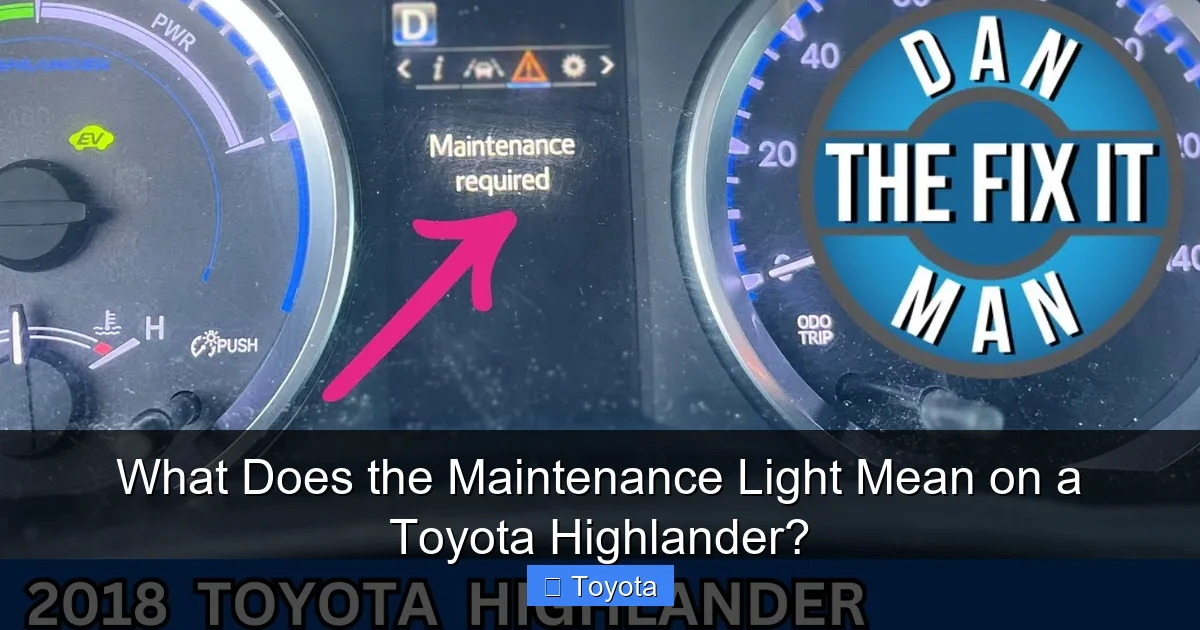
First, let’s clear the air. The maintenance required light on your Toyota Highlander is part of a system called the Maintenance Reminder System (MRS). It is not a diagnostic trouble code. It does not detect a specific fault like a bad sensor or a failing catalytic converter. Its sole job is to track elapsed time and mileage since your last maintenance service and remind you when the next one is due based on Toyota’s recommended schedule.
Visual guide about What Does the Maintenance Light Mean on a Toyota Highlander?
Image source: i.ytimg.com
A Smart System, Not a Simple Timer
Older cars used a simple mileage-based sticker on the windshield or a basic timer that would light up every 5,000 miles. Your Highlander’s system is smarter. It uses the Engine Control Module (ECM) to monitor several factors:
- Total Mileage: The primary driver.
- Engine Run Time: How many hours the engine has been operating.
- Driving Conditions: The system assesses “severe” vs. “normal” driving patterns. Lots of short trips where the engine doesn’t fully warm up? Stop-and-go city traffic? Towing? Extreme heat or cold? These “severe” conditions degrade oil and components faster, so the system will calculate a shorter service interval.
- Engine RPM and Temperature: How hard and how hot the engine is working.
This data is fed into an algorithm that estimates the remaining oil life percentage. When that percentage drops to a preset threshold (usually around 15-20% remaining), the wrench light illuminates. So, your light might come on at 4,500 miles if you only drive short trips, or it might wait until 7,500 miles if you’re consistently on the highway. It’s personalized to your driving.
This is NOT the Check Engine Light
This is the most crucial distinction. The check engine light (usually an engine-shaped icon) illuminates when the ECM detects a problem with the emissions system, ignition, fuel delivery, or another critical component. It’s a故障 (malfunction) indicator. The maintenance light is a service interval indicator. They are completely separate systems with different purposes. If your check engine light is on, you need a diagnostic scan immediately. If only the maintenance light is on, you have time to plan your service, but you shouldn’t delay indefinitely. You might also see other warning lights like the “Check AWD System” message, which is an entirely different issue related to the all-wheel-drive electronics and requires urgent attention.
How the Maintenance Reminder System Works: A Peek Under the Hood
Understanding the “why” behind the light helps you trust it. The system is essentially a software program that runs a constant calculation. Here’s a simplified version of what happens every time you start your Highlander:

Visual guide about What Does the Maintenance Light Mean on a Toyota Highlander?
Image source: i.ytimg.com
- Initialization: When you turn the key (or press the start button), the system performs a self-check. The maintenance light will illuminate briefly (2-3 seconds) along with all other dash lights as a bulb check.
- Data Collection: As you drive, the ECM collects data points about your trips: distance, duration, average RPM, engine coolant temperature, and ambient air temperature.
- Algorithm Processing: This data is fed into the oil life algorithm. The system knows that oil oxidizes and breaks down faster under high heat and shear stress (from short trips). It knows that a long highway run is gentle on oil. It assigns “degradation points” for each drive cycle.
- Percentage Calculation: The ECM continuously calculates the estimated oil life remaining, from 100% down to 0%.
- The Threshold: When the algorithm determines the oil life has reached the manufacturer’s predetermined “service due” threshold (often 15% or a specific mileage/time interval), it triggers the maintenance light.
For most modern Highlanders (2014+), this is an oil-change-centric system. However, the reminder is also tied to a broader maintenance schedule. When the light comes on, it’s prompting you for the full suite of services listed for that specific interval in your owner’s manual—which almost always includes an oil and filter change, but also tire rotation, fluid top-offs, and a comprehensive multi-point inspection.
What About Different Model Years?
The core principle is the same across all recent Highlander generations, but the interface can vary slightly:
- Pre-2014 Models: Often have a simpler “MAINTENANCE REQUIRED” light that comes on at a fixed mileage interval (e.g., 5,000 miles). You reset it via a button or odometer procedure.
- 2014-Present Models: Use the more advanced oil life calculation system. The light is typically a small wrench icon. Many models also allow you to view the remaining oil life percentage on the multi-information display by pressing the “Trip” or “Display” button on the steering wheel. This is a fantastic feature to monitor your oil life trend before the light even comes on.
- Hybrid Models: The system is integrated with the hybrid system’s computer but functions identically for maintenance reminders.
What to Do the Moment You See That Wrench
So, the light is on. Now what? Don’t panic, but don’t ignore it either. Here is your step-by-step action plan:

Visual guide about What Does the Maintenance Light Mean on a Toyota Highlander?
Image source: autovfix.com
Step 1: Perform a Quick Visual & Fluid Check
Before you even call the shop, do a basic assessment. Pop the hood and:
- Check the engine oil level. Use the dipstick. Is it low? Is it excessively dark or gritty? Low oil can trigger the light on some models and is an immediate concern.
- Check the coolant level. Look at the overflow reservoir. It should be between the “MIN” and “MAX” lines.
- Do a quick tire check. Are all tires properly inflated? Significant underinflation can be a separate issue, but it’s good to rule out.
If your oil is very low or you see any active leaks, top up cautiously and plan to get to a service center very soon. If fluids look normal, you have a bit more breathing room.
Step 2: Consult Your Owner’s Manual
Your manual is the ultimate authority. Look up the “Maintenance/Lubrication” or “Scheduled Maintenance” section. Find the table for your specific model year and engine (e.g., 3.5L V6). It will list exactly what services are due at “A”, “B”, or “1”, “2” service intervals. For example, a common “A” service is just an oil and filter change. A “B” service might include that plus cabin air filter, tire rotation, and multi-point inspection. The light coming on typically indicates an “A” or “B” service is due.
Step 3: Schedule Your Service
Call your preferred Toyota dealership service department or a trusted independent mechanic. Tell them: “My 2018 Toyota Highlander’s maintenance required light is on. I’d like to schedule a [A/B] service.” They will confirm what’s due based on your VIN and mileage. This is also a great time to ask about any model-specific service bulletins or common issues for your year model.
Step 4: Get the Service Done & Request a Reset
When you drop off the vehicle, explicitly remind the service advisor that the maintenance light is on and needs to be reset after the work is completed. A good technician will perform the required maintenance and reset the light before you pick up the car. Always verify the light is off before you leave the lot. If it’s still on, ask them to do it again. It’s a simple 30-second procedure, but it’s easy to forget.
How to Reset the Maintenance Light Yourself (If You DIY)
If you perform your own oil changes and maintenance, you’ll need to reset the light. The procedure varies slightly by year, but the most common method for Highlanders from 2014 onward is as follows:
- Turn the ignition ON. Do not start the engine. Press the “Start” button twice without touching the brake pedal (for push-button start) or turn the key to the “ON” position (for key ignition). All dash lights will come on.
- Use the odometer/trip meter button. On the instrument cluster, locate the button used to toggle between “Trip A”, “Trip B”, and “Odometer”. It’s usually on the dashboard near the speedometer or on the steering wheel stalk.
- Display the “Odometer” reading. Press the button until the full odometer (not trip meter) is displayed on the screen.
- Turn the ignition OFF. Press the start button to turn the car completely off.
- Press and hold the odometer button. While holding the button down, press the start button once (to turn the ignition back to “ON”). Keep holding the button.
- Watch for the reset. The maintenance light will blink a few times, then go out. The odometer display may show a series of dashes or “000000”. Release the button. The light should be off.
Important: This is a general guide. For the exact steps for your specific year, consult your owner’s manual under “Maintenance Reset” or search for “how to reset maintenance light on a [your year] Toyota Highlander”. Procedures for 2013, 2017, 2022, etc., can have minor differences. For example, some newer models might require using the steering wheel controls to enter a “Settings” menu. If the above doesn’t work, refer to a year-specific guide.
What If It Won’t Reset?
If you’ve followed the steps correctly and the light remains on, there are a few possibilities:
- You didn’t perform all the required services for that interval. The system is designed to only reset after the full service is complete.
- There is an electrical glitch or a blown fuse related to the instrument cluster.
- The system has a fault and needs to be scanned with a professional diagnostic tool (like a Techstream) to clear the code.
- You have a different issue that is causing the light to re-illuminate immediately after reset (rare, but possible).
In these cases, a professional diagnosis is necessary.
Common Misconceptions and Myths Debunked
This little light spawns a lot of misinformation. Let’s set the record straight.
Myth 1: “The Maintenance Light Means My Oil Is Low.”
False. The low oil pressure warning (usually an oil can icon) is a separate, critical light. The maintenance light is based on a calculated oil life degradation, not real-time oil pressure or level. You could have perfect oil level but still trigger the light because the oil has chemically broken down over time and miles.
Myth 2: “I Can Just Reset It Without Doing the Service to Make It Go Away.”
Technically, yes, you can often reset the light without performing maintenance. This is a terrible idea. You are essentially tricking your car’s computer. The purpose of the system is to protect your engine. By resetting it without changing the oil or performing inspections, you are driving with degraded oil and unchecked components, risking accelerated wear, sludge buildup, and eventual failure. It also voids the maintenance record, which can impact warranty claims and resale value. Think of it like erasing your calendar reminder without actually going to the doctor.
Myth 3: “It’s the Same as the ‘Service Engine Soon’ Light on Some Cars.”
Not really. While some manufacturers use “Service Engine Soon” for both maintenance reminders and check engine issues, Toyota keeps them distinct. The wrench icon is purely for scheduled maintenance. The check engine light (often a outline of an engine) is for emissions-related faults. Never confuse the two.
Myth 4: “If I Drive Mostly Highway Miles, I Can Ignore It Longer.”
Actually, the opposite might be true! The system is smart enough to account for highway driving being less severe, so your interval might extend slightly. But the light coming on means the system has calculated that, based on your specific driving pattern, the service is due. Don’t assume your highway commute gives you a free pass. The algorithm has already factored that in.
Your Toyota Highlander’s Maintenance Schedule: What’s Actually Due?
Let’s get practical. What does “service” mean when that light comes on? While your owner’s manual is the final word, here is a generalized breakdown for a typical Highlander (non-hybrid, 3.5L V6) under “normal” driving conditions. “Severe” driving (frequent short trips, extreme temps, dusty roads, heavy loads) means services are needed more often.
Every 5,000-7,500 Miles or 6 Months (The “A” Service)
- Oil and filter change (This is the primary trigger).
- Tire rotation (helps ensure even wear).
- Multi-point inspection (brakes, fluids, belts, hoses, etc.).
- Cabin air filter inspection (replace every 15k-30k miles).
- All fluid levels checked and topped off (coolant, brake, washer, power steering).
Every 10,000-15,000 Miles or 12 Months (The “B” Service)
This includes everything in the “A” service, plus:
- Inspect engine air filter (replace every 30k-45k miles).
- Inspect wiper blades.
- Inspect steering linkage and suspension components.
- Check and adjust valve clearance (if applicable on some models).
Major Services (30k, 60k, 90k Miles)
At these milestones, expect all the above plus:
- Replace engine air filter.
- Replace cabin air filter.
- Replace spark plugs (typically at 120k miles on many models, but check your manual).
- Replace timing belt/chain inspection (the Highlander’s timing chain is generally considered “lifetime,” but inspection is still part of the schedule).
- Differential fluid service (AWD models).
- Transmission fluid service (Toyota often says “lifetime” for the fill, but many technicians recommend changing it around 60k-100k miles for longevity, especially in severe service).
Pro Tip: Keep a small notebook or use your phone’s notes app to log your service dates, mileage, and what was done. It’s invaluable for your records and future resale.
Conclusion: Your Partner in Prevention
The maintenance light on your Toyota Highlander is one of your vehicle’s best features. It’s a sophisticated, personalized reminder system designed to take the guesswork out of upkeep. Unlike a sudden breakdown, it gives you the power to plan and budget for maintenance, ensuring your Highlander remains the reliable, safe, and versatile family hauler it was built to be.
When that wrench icon appears, see it as a helpful memo, not a harbinger of doom. Check your oil, consult your manual, and schedule your service promptly. If you’re a DIY enthusiast, learn the reset procedure for your specific model year, but never reset it without doing the actual work. By respecting this simple light and following the recommended schedule, you’re investing in the long-term health of your SUV, protecting its value, and ensuring it’s ready for every adventure—from the daily school run to the cross-country road trip. Your Highlander takes care of you; returning the favor with timely maintenance is the least you can do.
Frequently Asked Questions
Is it safe to drive my Toyota Highlander with the maintenance light on?
Yes, it is generally safe to drive for a short period (a few hundred miles) to reach your service appointment. However, you should not ignore it for months. The light indicates your oil is degraded, and continuing to drive with old oil increases engine wear and could lead to expensive damage.
How many miles can I typically drive after the maintenance light comes on before needing service?
The system is designed to give you a buffer. Most often, the light illuminates when there is about 15-20% oil life remaining, which translates to roughly 500-1,000 miles under normal driving conditions. Use this as a window to schedule your appointment, not as an extension of your service interval.
What’s the difference between the maintenance light and the check engine light on a Highlander?
The maintenance light (wrench icon) is a simple reminder for scheduled service like oil changes. The check engine light (engine-shaped icon) indicates a fault in the engine, emissions, or transmission system that needs immediate diagnostic attention. One is for prevention; the other is for correction of an active problem.
Can I reset the maintenance light without changing the oil?
Technically, yes, using the manual reset procedure. However, this is strongly discouraged. You would be driving with oil that has exceeded its service life, which can cause sludge, increased friction, and premature engine wear. Always perform the required maintenance before resetting the light.
Why did my maintenance light come on so soon after my last oil change?
This is likely due to “severe” driving conditions. If your trips are mostly short (under 10 minutes), you frequently tow, drive in extremely hot or cold weather, or operate in dusty environments, the system calculates faster oil degradation and will shorten the interval. Your driving style directly impacts the reminder.
Does the maintenance light always mean I need an oil change?
For most modern Highlanders, yes, the primary trigger is the oil life calculation. However, the light is tied to the overall maintenance schedule. When it comes on, it’s reminding you that a full service (which includes the oil change, tire rotation, and inspection) is due according to your owner’s manual. Always have the technician check the maintenance code (like “A” or “B”) to see the full list of required tasks.
