
How to Travel with a Car Seat on a Plane: A Complete Practical Guide

Preparing for a family vacation involves countless moving parts, but when you have a toddler or infant, traveling brings a unique set of logistical challenges. One of the most common dilemmas parents face is how to travel with a car seat on a plane without losing your sanity or damaging essential gear. Whether you are planning a cross-country trip or a family road-trip-turned-flight, keeping your child secure both in the air and at your destination is a top priority.
While airlines technically allow children under two to ride as lap infants, child passenger safety experts and government agencies strongly recommend securing young children in their own certified child restraint system (CRS). Navigating airline rules, checking your equipment, sizing restrictions, and actual cabin installation can feel overwhelming for non-expert travelers. This comprehensive guide breaks down everything you need to know to transport, install, and protect your child safety seat seamlessly from your front door to your final destination.
Quick Answer
To fly with a car seat, you must purchase a separate ticket for your child. Ensure your car seat features a label stating it is “certified for use in motor vehicles and aircraft.” Install the seat strictly in a window or center-row middle seat, never in an exit row, using the airplane’s lap belt. Alternatively, you can gate-check it for free.
Checking Airline Rules and Certification Requirements
Before you head to the airport, you need to verify that your gear complies with federal standards and individual carrier policies. Not all child restraint devices are allowed onboard commercial aircraft, and guessing wrong at the boarding gate can throw your travel plans into chaos.
Finding the FAA Approval Label
In the United States, the Federal Aviation Administration (FAA) regulates onboard child safety standards. To use a car seat in the cabin, look for a stamped or sewn-in label on your equipment that explicitly states: “This restraint is certified for use in motor vehicles and aircraft.”
If your seat is missing this label or the text has worn away, flight attendants have the right to deny its use in the cabin. For more details on regulatory expectations, you can consult official safety resources via the U.S. Department of Transportation.
Understanding What Is Allowed vs. Prohibited
- Allowed: Infant seats, convertible seats, and combination harness-boosters used strictly in their 5-point harness mode.
- Prohibited: Backless and high-back booster seats relying on vehicle shoulder-lap belts cannot be used during takeoff, landing, or taxiing because aircraft seats do not feature shoulder belts.
- Prohibited: Belly belts, vest harnesses that attach to an adult, and chest-mounted baby carriers are strictly barred during critical phases of flight.
Choosing Your Strategy: Bring Onboard vs. Check It
You generally have two primary pathways when traveling with a car seat: bringing it into the cabin to use as a seat, or checking it through the airline system. Each choice carries distinct pros and cons regarding safety, convenience, and equipment longevity.
| Strategy | Primary Benefits | Main Drawbacks |
| Bring Onboard | Maximum safety during turbulence; familiar environment for your child. | Bulky to carry through terminals; must fit airline seat width dimensions. |
| Gate-Check | Keeps your hands free through security and concourses; lightweight travel. | High risk of hidden structural damage or rough handling by baggage handlers. |
Why Bringing It Onboard Is Safer
According to the National Highway Traffic Safety Administration, unexpected severe turbulence is one of the leading causes of in-flight injuries for unsecured children. A certified car seat gives your child the same structural crash protection in the sky that they rely on during everyday drives. Furthermore, toddlers are often far more willing to nap or sit quietly in a familiar seat than in a slippery, oversized airline chair.
How Gate-Checking Works Safely
If you decide not to use the seat in flight, you can carry it through security and check it right at the boarding gate. This minimizes the distance the equipment travels through automated baggage sorters.
- Always pack the car seat inside a heavy-duty, padded travel bag to shield it from grease, moisture, and strap tears.
- Request a gate-check tag from the ticket counter or gate agent before boarding begins.
- Pick up the item planeside immediately upon deplaning.
Step-by-Step: Installing a Car Seat on an Airplane
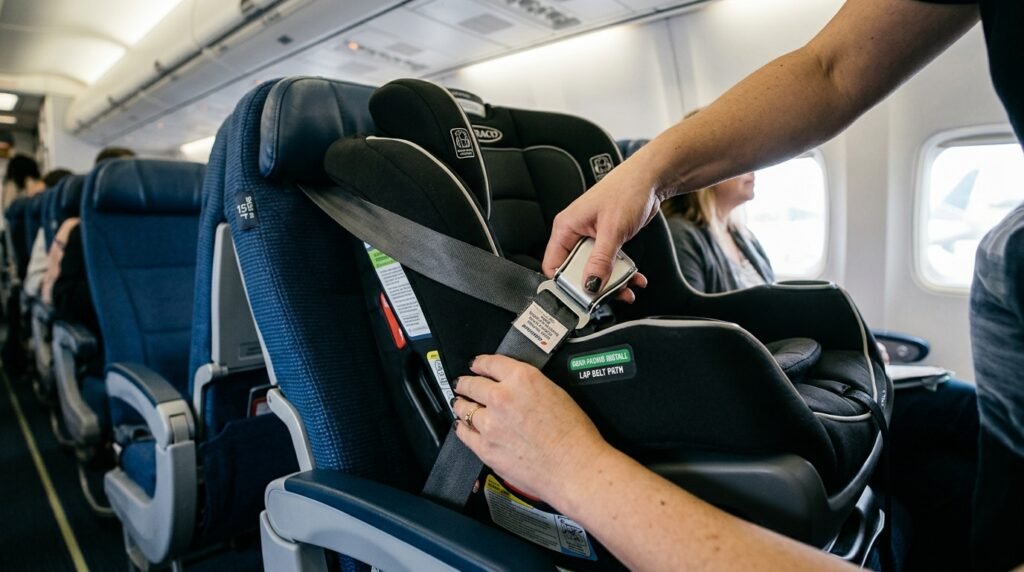
Installing a car seat on an aircraft is similar to a vehicle installation, but tighter space constraints and shorter belt lengths require a bit of finesse. Follow these step-by-step instructions to get it right:
- Board Early: Take advantage of family pre-boarding. Rushing to thread a belt while impatient passengers bump past you in the aisle is a recipe for frustration.
- Select the Right Location: Place the car seat in a window seat. This ensures it never blocks an evacuation path for neighboring passengers. If you are traveling with two children across a three-seat row, put the car seats in the window and middle positions. Exit rows are strictly forbidden.
- Flip the Armrest: Lift the aisle-side armrest out of the way to give yourself working room.
- Thread the Airplane Seatbelt: Route the aircraft seatbelt through the designated belt path channels on the car seat (the rear-facing or forward-facing path depending on your child’s setup). Ensure the belt is not twisted.
- Buckle and Tighten: Snap the metal buckle into place. Because aircraft buckles are bulky, they can sometimes land squarely in the middle of the belt path, making it hard to pull tight. If this happens, open the belt path and flip the buckle tongue before latching.
- Test for Movement: Pull firmly on the sides of the car seat near the belt path. It should not move more than an inch side-to-side.
- Adjust the Recline: Ensure rear-facing angle indicator lines are respected, though aircraft seat cushions often compress differently than vehicle benches.
Managing Logistics Through the Airport
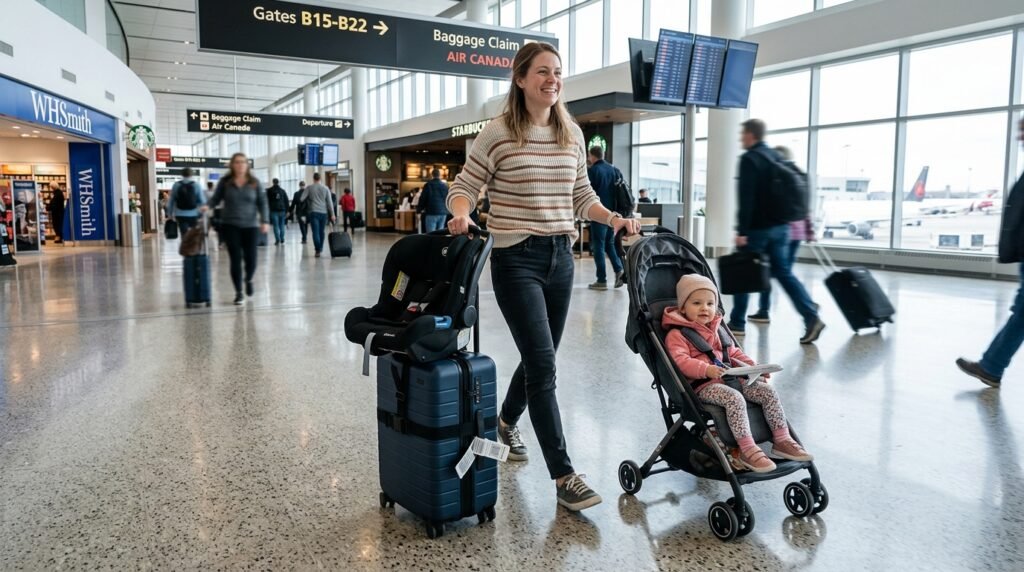
Dragging luggage, a stroller, a diaper bag, and a heavy car seat can test any parent’s patience. Smart planning simplifies airport navigation:
- Use a Travel Cart or Strap: Purchase a lightweight luggage strap or a folding travel cart that clips your car seat directly onto your rolling suitcase. This transforms your car seat into a makeshift stroller for hauling a toddler through long terminal corridors.
- Keep Documents Handy: Keep your child’s birth certificate or passport (if flying internationally) and printouts of airline policies easily accessible in an outer pocket.
- Mind the Width: Economy airplane seats typically range from 16 to 17.5 inches wide. Measure your car seat’s base width before leaving home to guarantee it won’t get wedged or rejected by narrow armrests.
Expert Tip
Expert Tip: Always practice installing your travel car seat using an online airline seat dimension map or a spare folding chair at home at least a week before your trip. Mastering the quick-release mechanism and belt length adjustment in your living room prevents stressful fumbling while blocking boarding passengers in a cramped aircraft aisle.
Common Mistakes Car Owners Should Avoid
- Assuming all foreign car seats are automatically cleared: Seats bought overseas must meet specific United Nations standards or carry equivalent foreign government endorsements; standard domestic stamps do not always transfer across international boundaries.
- Placing a car seat in an exit row: Flight crews will force you to relocate the seat immediately if it violates safety placement rules near emergency exits.
- Skipping the travel bag protection: Checking a bare car seat opens it up to severe strap grease, structural fractures, and missing components caused by rough conveyor belt systems.
- Leaving the top tether dangling (if applicable): While upper tethers used in cars are rarely anchorable on standard planes, always check if your specific model manual requires or permits alternative configurations in-flight.
- Forgetting to check destination car seat laws: If you plan on renting a car or taking taxis after landing, ensure your travel gear complies with local jurisdiction safety laws at your final stop.
When to Call a Professional Mechanic or Safety Technician
While airplane installations are managed by parents and monitored by flight crews, car seat safety extends directly to your vehicle usage once you touch ground. You should consult a Certified Child Passenger Safety Technician (CPST) or visit a local inspection station if:
- You experience rough baggage handling or a severe drop that causes visible stress marks, cracks, or deep scuffs on your checked car seat’s plastic shell.
- You are unsure whether your car seat has suffered hidden structural compromise during transit, as internal frame fractures are often invisible to the naked eye.
- You struggle to achieve a tight, secure fit when reinstalling the seat into your rental car or personal vehicle after arriving at your destination.
FAQs
Can I use any car seat on an airplane?
No. Your car seat must feature a clear manufacturer label stating that it is certified for use in motor vehicles and aircraft. Most standard U.S. car seats qualify, but booster seats and non-harnessed devices are prohibited.
Do I have to buy a ticket for my infant to use a car seat?
Yes. To secure a car seat in the cabin, you must purchase a dedicated adjacent passenger seat for your child. Airlines do not provide a free extra seat just to hold a car seat.
What happens if my car seat does not fit into the airplane seat?
Airlines are required by federal guidelines to make a reasonable attempt to accommodate your certified restraint system. If it physically cannot fit due to narrow cabin dimensions, flight staff will relocate you to an alternative seat or arrange for it to be gate-checked free of charge.
Can rear-facing car seats be used on planes?
Yes. Rear-facing car seats are fully permitted onboard as long as they fit within the row space without blocking emergency egress and meet the width requirements of the specific aircraft cabin.
Are CARES safety harnesses a good alternative to a car seat?
The Child Aviation Restraint System (CARES) is an FAA-approved harness device designed specifically for children weighing between 22 and 44 pounds who can sit upright independently. It is lightweight and easy to pack, though it only works in forward-facing applications and does not replace a car seat for post-flight vehicle travel.
Is it better to check my car seat or bring it on the plane?
Bringing it into the cabin maximizes your child’s safety during unexpected turbulence and protects the equipment from the rough handling typical of commercial baggage compartments.
Conclusion
Mastering how to travel with a car seat on a plane comes down to early preparation, verifying your equipment labels, and understanding airline seating rules. By choosing to bring your certified child restraint system onboard, you ensure peace of mind, protect your investment from baggage damage, and keep your child secure through every phase of travel. Double-check your airline’s guidelines, practice your installation routine ahead of time, and head to the airport equipped for a smooth, stress-free family journey.
