Toyota Smart Key Vs Keyless Entry: What’s the Difference?

Contents
- 1 Key Takeaways
- 2 📑 Table of Contents
- 3 Introduction: Unlocking the Confusion
- 4 What is Keyless Entry? The Foundational Concept
- 5 What is a Toyota Smart Key? The Proximity-Based Evolution
- 6 Head-to-Head: Toyota Smart Key vs. Standard Keyless Entry
- 7 Security: Which System is Safer?
- 8 Troubleshooting and Practical Tips
- 9 The Future: Where Is This Technology Headed?
- 10 Conclusion: Knowledge is Key (Pun Intended)
- 11 Frequently Asked Questions
Reflective Safety Triangle

Multipurpose Lubricant Spray

LED Emergency Road Flares

Car Wash Mitt
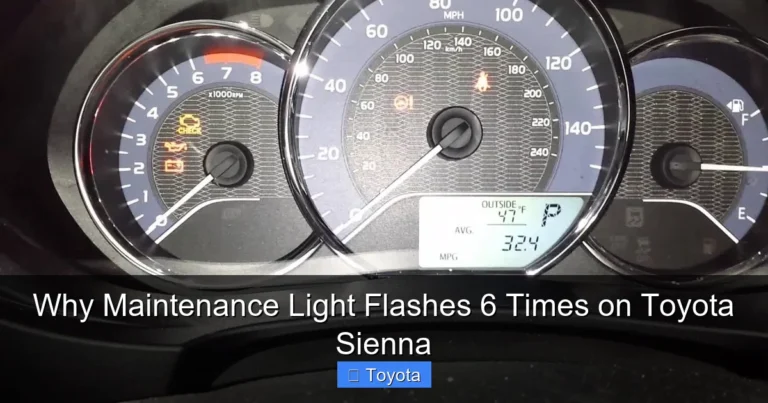
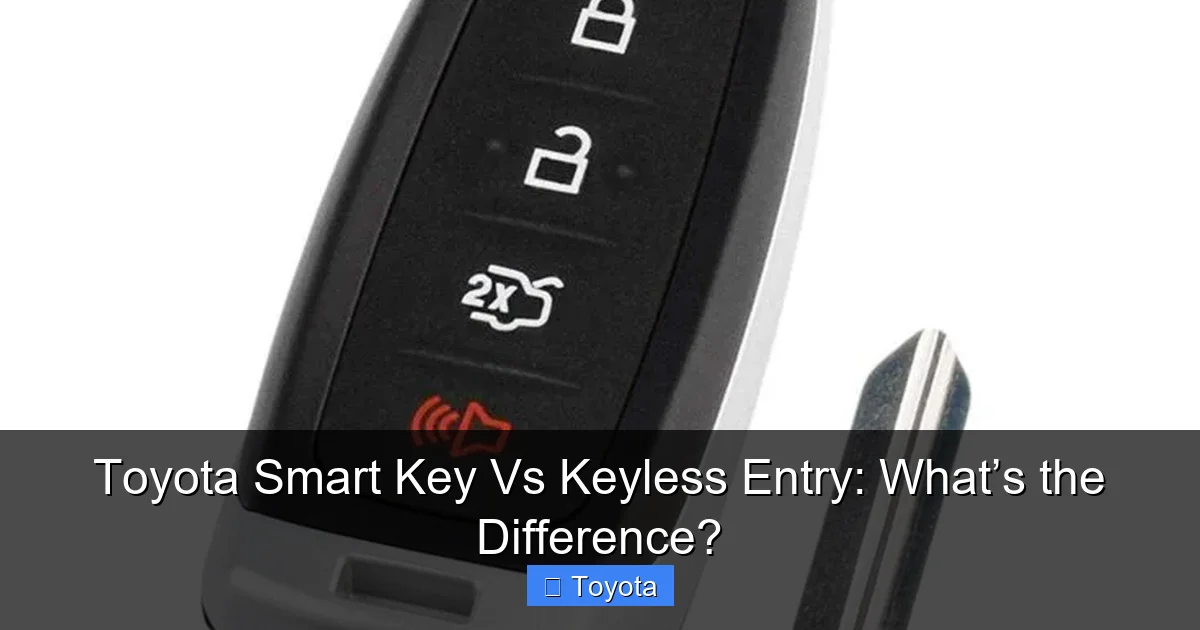
Many people use “Toyota Smart Key” and “keyless entry” interchangeably, but they are not the same thing. Keyless entry is a broader term for any system that lets you unlock a car without a physical key, often via a keypad or remote. A Toyota Smart Key is a specific, advanced type of keyless entry system that uses proximity sensors and a push-button start. All Toyota Smart Keys provide keyless entry, but not all keyless entry systems are Smart Keys. Understanding the difference helps you know your car’s capabilities and troubleshoot issues.
Key Takeaways
- Keyless Entry is the Umbrella Term: It describes any system for accessing a vehicle without inserting a traditional metal key, including basic remote fobs and keypad entry.
- Toyota Smart Key is a Specific, Advanced System: It combines passive keyless entry (unlocks as you approach) with push-button ignition, requiring the key fob to be inside the vehicle.
- Core Difference is in “Passive” Access: A standard keyless remote requires you to press a button. A Smart Key system works automatically when the fob is within range, often just by touching the door handle.
- Smart Key Systems Have More Components: They rely on multiple antennas in the car, a low-frequency radio in the fob, and a sophisticated engine immobilizer system.
- Security Approaches Differ: While both are secure, Smart Key systems face unique threats like relay attacks, requiring additional protections like signal-blocking storage.
- Troubleshooting Varies by System: A dead battery in a standard key fob simply stops the remote from working. A dead Smart Key battery can sometimes still allow driving if the fob is physically inserted or placed in a specific slot.
[FEATURED_IMAGE_PLACEHOLDER]
📑 Table of Contents
- Introduction: Unlocking the Confusion
- What is Keyless Entry? The Foundational Concept
- What is a Toyota Smart Key? The Proximity-Based Evolution
- Head-to-Head: Toyota Smart Key vs. Standard Keyless Entry
- Security: Which System is Safer?
- Troubleshooting and Practical Tips
- The Future: Where Is This Technology Headed?
- Conclusion: Knowledge is Key (Pun Intended)
Introduction: Unlocking the Confusion
You walk up to your Toyota, your hands full of groceries, and the doors unlock automatically. You press the brake, push a button, and the engine roars to life. No fumbling for keys. This seamless experience is the hallmark of modern automotive convenience. But what do you call it? Is it keyless entry? Is it a smart key? Are they the same thing? In the world of Toyota, this is a common point of confusion, and getting it straight is more than just semantics—it helps you understand your vehicle’s technology, use its features correctly, and solve problems when they arise.
Think of it like this: “Keyless entry” is a broad category, like “sedan.” A “Toyota Smart Key” is a specific model within that category, like a “Camry SE.” All Smart Keys provide keyless entry, but your Toyota might have a keyless entry system that isn’t a full Smart Key. The distinction lies in the level of automation and the specific technology used. This article will pull back the curtain on both systems, explaining exactly how they work, what sets them apart, and what it means for you as a Toyota owner. We’ll dive into the radio waves, the antennas hidden in your door handles, and the security protocols that keep your vehicle safe.
What is Keyless Entry? The Foundational Concept
Before we talk about the “smart” part, let’s establish the baseline. Keyless entry is any system that allows you to lock and unlock your car doors (and sometimes the trunk) without using a physical metal key to turn a cylinder. This technology has been around since the 1980s and has evolved significantly. The goal is simple: convenience and a bit of added security against lock-picking.

Visual guide about Toyota Smart Key Vs Keyless Entry: What’s the Difference?
Image source: images.91wheels.com
How Traditional Keyless Entry (Remote Fob) Works
The most common form you’ll encounter is the radio remote key fob. This is a small, battery-powered device with buttons for lock, unlock, and sometimes a panic alarm or trunk release. When you press the unlock button:
- The fob’s transmitter emits a coded radio frequency (RF) signal, typically in the 315 MHz or 433 MHz range.
- An antenna on your vehicle (often in the rear window or front dash) receives this signal.
- The vehicle’s receiver decodes the signal. If the code matches the one stored in its memory, it sends power to the door lock actuators, and the doors unlock.
This process requires a deliberate action from you: pressing the button. The system is not “aware” of the fob’s location; it just responds to the specific signal it receives. This is a one-way communication from fob to car.
Keypad Entry: The Original Hands-Free Option
Long before smart keys, some vehicles offered a keypad entry system mounted on the driver’s door or under the window. You’d enter a pre-programmed code, and the doors would unlock. This is also keyless entry—no key required—but it’s independent of any fob. It’s a great backup if you lose your fob, but it doesn’t offer the “walk-up” convenience of a remote or smart key. Some higher-trim Toyota models still offer this as a feature.
What is a Toyota Smart Key? The Proximity-Based Evolution
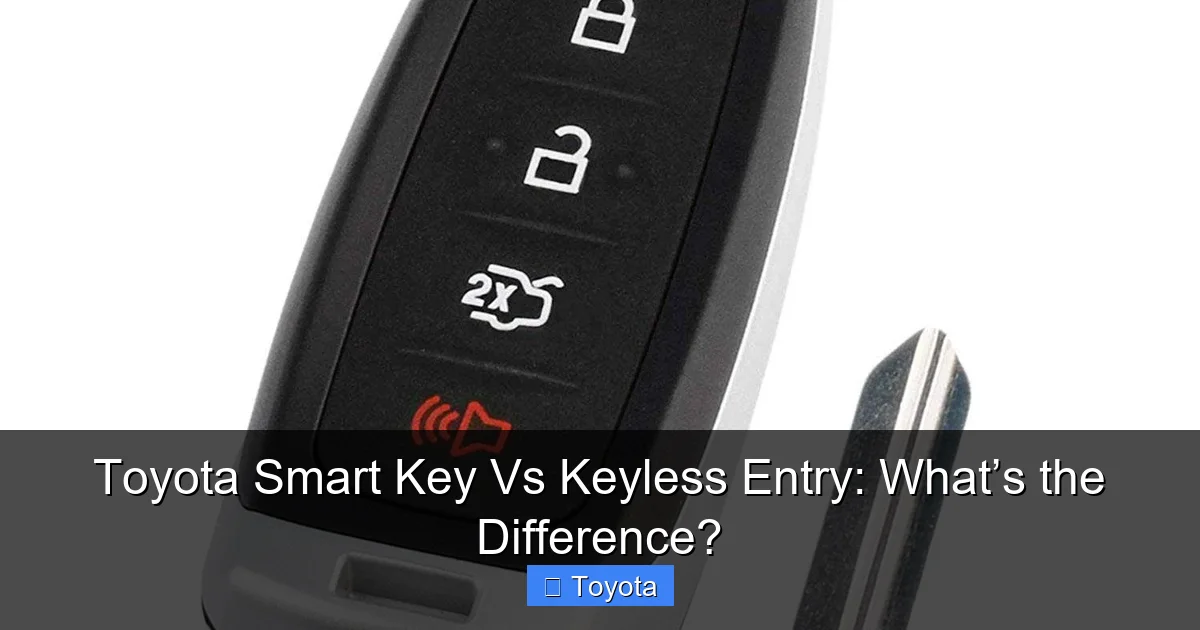
A Toyota Smart Key system (often marketed as Smart Key System with Push-Button Start) is a specific, integrated technology package that takes keyless entry to the next level. It’s not just about unlocking; it’s about creating a seamless, key-free experience from approach to departure. The core innovation is passive, proximity-based entry and push-button ignition.
Visual guide about Toyota Smart Key Vs Keyless Entry: What’s the Difference?
Image source: blog.probuscars.be
The Magic of Passive Entry
With a Smart Key system, you don’t need to press any buttons on the fob to unlock the car. Here’s how the magic happens:
- Low-Frequency Field: The car continuously emits a low-frequency (LF) radio field (around 125 kHz) from antennas hidden in the door handles and sometimes the rear bumper.
- Fob Activation: When your Smart Key fob, which has a low-power, passive RFID chip, enters this field (typically within 1-3 feet), the LF energy powers up the chip in the fob.
- Two-Way Communication: The now-active fob responds with its unique encrypted ID code via a higher-frequency (RF) signal.
- Verification & Action: The car’s control module receives this code, verifies it against its stored list, and if valid, unlocks the doors. You often just need to touch the inner handle sensor. The same process works for the trunk.
This is a two-way “conversation.” The car asks, “Who are you?” and the fob answers, “I’m authorized.” It’s all automatic.
Push-Button Start: The Final Piece
This is the other defining feature. Once inside, you don’t insert a key or even have a key slot. You simply press the brake pedal and push the engine start/stop button. For this to work:
- The system must confirm the Smart Key fob is inside the vehicle. It does this using the same LF antenna field within the cabin.
- It also verifies the brake pedal is depressed (a critical safety feature).
- Only then does it allow the engine to start and, importantly, allows you to turn the engine off and remove the fob from the car without locking the keys inside.
This integration means the car knows if the authorized fob is present or not, which is crucial for the immobilizer system that prevents hot-wiring.
Head-to-Head: Toyota Smart Key vs. Standard Keyless Entry
Now that we’ve defined both, let’s compare them side-by-side to highlight the practical differences you’ll notice in your daily driving.
Visual guide about Toyota Smart Key Vs Keyless Entry: What’s the Difference?
Image source: blog.probuscars.be
Feature Comparison Table
- Unlocking Mechanism:
Standard Keyless Entry: Requires manually pressing a button on the fob.
Toyota Smart Key: Fully passive. Touch the door handle when the fob is in range. - Starting the Engine:
Standard Keyless Entry: Requires inserting a physical key (even if it’s a “valet” key without remote buttons) or, in newer models, a separate push-button start that still requires a key fob with a physical key slot.
Toyota Smart Key: Push-button start only. No key slot. The fob can stay in your pocket or bag. - Fob Location Awareness:
Standard Keyless Entry: The car does not know where the fob is. It just responds to the signal.
Toyota Smart Key: The car knows if the fob is outside (near a door), inside the cabin, or not present at all. This prevents locking the fob inside and enables the “walk-away” auto-lock feature. - Physical Key Backup:
Standard Keyless Entry: The fob almost always contains a hidden physical key blade for emergencies.
Toyota Smart Key: The fob may or may not have a hidden key blade. Many modern Toyota Smart Key fobs do not. Instead, a separate mechanical emergency key is often provided, or there is a specific procedure using the start button. You must check your owner’s manual. For example, many Camry or RAV4 models with a Smart Key have a slot on the steering column where you can insert the fob if the battery is dead to start the car. - Typical Toyota Models/Trims:
Standard Keyless Entry: Often found on base and mid-level trims (e.g., Toyota Corolla L, LE; RAV4 LE, XLE).
Toyota Smart Key: Usually standard on higher trims (e.g., Camry XLE/XSE, RAV4 Limited/Platinum, Highlander Limited/Platinum, most Lexus models). It’s frequently part of a “convenience package” or “premium package.”
Real-World Scenario: A Day with Each System
With Standard Keyless Entry: You approach your Toyota Corolla. You press the unlock button on your fob, hear the doors click, and pull the handle. You insert the key fob into the slot (or use the hidden key) and turn to start the engine. When you leave, you must remember to press the lock button on the fob or use the door lock switch.
With a Toyota Smart Key: You approach your Toyota Highlander XSE, groceries in both arms. As you get within a few feet, you simply touch the rear of the front door handle. It unlocks. You get in, place your bag on the seat, press the brake, and push the start button. When you walk away, the car automatically locks after a few seconds (if you have the “walk-away” auto-lock feature enabled). The fob never leaves your pocket.
Security: Which System is Safer?
Both systems are vastly more secure than a simple metal key, which can be easily copied. However, they face different types of threats.
Threats to Standard Keyless Entry
The main vulnerability is code grabbing/replay attacks. An attacker with special equipment could capture the rolling code signal from your remote when you press it and later replay it to unlock your car. Modern systems use strong encryption and rolling codes that change with every use, making this very difficult. The bigger risk is simply physical theft of the fob, which would grant full access.
Threats to Toyota Smart Key Systems (Relay Attacks)
This is the modern concern. A relay attack is the primary threat to passive keyless entry and start (PKES) systems like the Smart Key. Thieves use two devices: one amplifies the LF signal from your car near your house (where the fob is likely on a nightstand) and relays it to a second device near the car. The car thinks the authorized fob is present, unlocks, and can even be started. The fob never leaves your home. This is why security experts recommend storing your Smart Key fob in a Faraday cage or signal-blocking pouch/box when not in use. Some Toyota models also allow you to deactivate the Smart Key system via a switch in the glove compartment, forcing you to use the physical emergency key.
Toyota’s Security Enhancements
Toyota has implemented several layers:
- Encryption: The communication between fob and car is heavily encrypted.
- Motion Detection: Some newer Smart Key fobs have motion sensors. If the fob is stationary for a long period (like on a nightstand), it may disable its LF receiver to prevent relay attacks.
- Ultra-Wideband (UWB): Starting in some 2023+ models (like the bZ4X and certain Tundras), Toyota is introducing UWB technology. This provides precise distance and direction measurement, making relay attacks virtually impossible because the car can tell the fob is centimeters away, not just in the general vicinity.
Troubleshooting and Practical Tips
Knowing the differences helps you diagnose problems.
“My Smart Key isn’t working!”
First, check the obvious: is the fob battery dead? A low battery can cause intermittent operation. For a Smart Key, if the battery is completely dead, you often can’t unlock via the handle sensor. However, you can usually:
- Use the hidden physical key (if your fob has one) to unlock the door.
- Some models have a designated spot (often near the start button or in the cup holder) where you can place the dead fob. The car’s LF antenna can still power it up enough to authenticate when you press the start button. Check your manual!
- The emergency mechanical key provided with the vehicle will work on the driver’s door.
If the fob works sometimes but not others, you might have a weak battery, physical damage to the fob, or interference from other electronic devices or metal objects. For programming a new Smart Key, you typically need a dealer or locksmith with specialized equipment due to the encryption.
Living with a Smart Key: Best Practices
- Use a Signal-Blocking Pouch: Store your fob in a Faraday pouch or metal box at home to prevent relay attacks.
- Don’t Mix Fobs: Keep your Toyota Smart Key separate from other key fobs (like your office access badge) to avoid signal interference.
- Know Your Backup: Locate the physical emergency key and know exactly how to use it for your specific model year. Practice opening the door with it once so you’re not fumbling in an emergency.
- Battery Replacement: Smart Key fobs use a specific coin cell battery (often CR2032). Replacement is usually simple—a small screw or a snap-open case. But be gentle; the internal components are sensitive.
The Future: Where Is This Technology Headed?
The industry is moving beyond physical fobs altogether. The next step is smartphone-based digital keys.
Smartphone as a Key
Using technologies like NFC (Near Field Communication) and Bluetooth Low Energy (BLE), your compatible smartphone can act as your Smart Key. You can lock, unlock, and start your car with your phone. This is already available on some Toyota and Lexus models via the Toyota app. The benefits are huge: no lost fob, no dead battery (until your phone dies!), and the ability to easily share digital keys with family members or rental services via an app.
Ultra-Wideband (UWB) for Precision
As mentioned, UWB is the gold standard for secure, precise keyless entry. It measures the time it takes for signals to travel, calculating distance with centimeter accuracy. This prevents the “relay” trick because the car knows the fob is right next to the door handle, not down the street. UWB also enables new features like automatically adjusting seats and mirrors based on which fob (or phone) is approaching. You’ll see this roll out across more Toyota models in the coming years.
Conclusion: Knowledge is Key (Pun Intended)
So, what’s the final word on Toyota Smart Key vs. keyless entry? Keyless entry is the general capability. A Toyota Smart Key is a premium, integrated system that delivers fully passive entry and push-button start, with the car actively sensing the fob’s presence. It represents the pinnacle of keyless convenience available in most Toyota lineups today. If your Toyota has a button you must press on the fob to unlock and a traditional key slot to start, you have keyless entry but not a Smart Key system. If you can walk up, touch the handle, and push a button to go, you have the Smart Key System.
Understanding this distinction empowers you. It helps you shop for a used Toyota with the right features, troubleshoot when something goes wrong, and adopt best practices to keep your vehicle secure. As technology marches on, the physical key fob itself may become a relic, replaced by the device we carry every day: our smartphones. But the core principle remains the same—convenience through seamless, secure authentication. Whether you have a basic remote or a full Smart Key, taking a moment to understand how it works and how to protect it is a simple step that pays off in peace of mind.
Frequently Asked Questions
Can I add a Toyota Smart Key system to a vehicle that didn’t come with one?
Generally, no. The Smart Key system requires extensive hardware—multiple antennas, a specific control module, and a compatible engine immobilizer—that is not present on base models. It’s not a simple plug-and-play upgrade and would be prohibitively expensive. It’s best to choose a trim level that includes it from the factory.
What should I do if my Toyota Smart Key fob gets wet or damaged?
Immediately replace the battery and dry the fob thoroughly (do not use heat). If it stops working, you’ll need to use the physical emergency key to enter and may need to place the fob in the designated backup slot to start the car. If it’s physically damaged, you’ll need to purchase a replacement fob from a Toyota dealer and have it programmed to your vehicle, which can be costly.
Is it possible to lock my Smart Key inside the car by accident?
With a properly functioning Smart Key system, it’s very difficult but not impossible. The system is designed to detect if the fob is inside the car when you lock the doors. If it detects the fob, it will usually prevent locking or will unlock the doors immediately. However, if the fob’s battery is extremely low or there’s interference, this safeguard might fail. Always do a quick pocket check before walking away.
Do I still need to press the lock button on the door handle with a Smart Key?
No, that’s the point. To lock the doors with a Smart Key system, you typically press the lock button on the door handle (the part you touch to unlock) or use the lock button on the remote fob. Many models also feature a “walk-away auto-lock” that engages a few seconds after you close all doors and walk away with the fob.
Will a standard keyless entry fob work in a Toyota that has a Smart Key system?
No. They are different systems with different protocols. A standard key fob will not communicate with a Smart Key vehicle’s antennas and control modules. The vehicle must be specifically equipped with the Smart Key System from the factory to accept and recognize a Smart Key fob.
How much does a replacement Toyota Smart Key fob cost?
Replacement is expensive because it’s a coded security device. From a Toyota dealer, expect to pay between $200 and $400 for the fob itself, plus programming fees which can be $50-$100. Aftermarket or online options may be cheaper but carry risks of poor quality or inability to be programmed correctly. Always verify compatibility before purchasing.