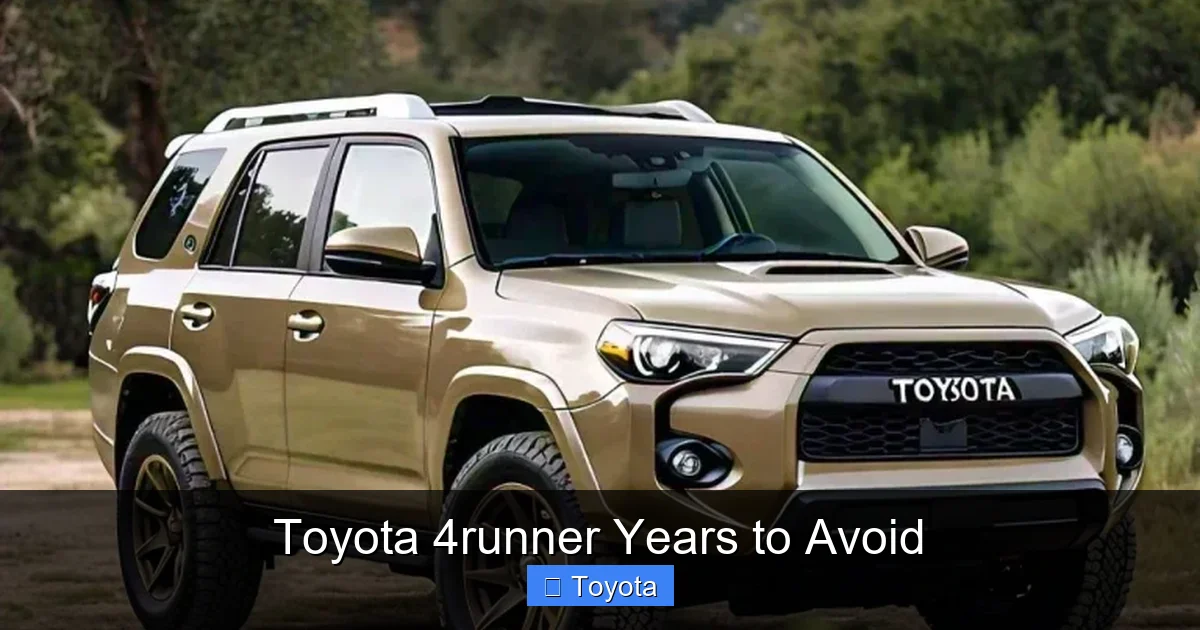
Toyota 4runner Years to Avoid

Contents
- 1 Key Takeaways
- 2 Introduction: The Toyota 4Runner’s Reputation for Toughness
- 3 Why Some Toyota 4Runner Years Are Riskier Than Others
- 4 The Worst Toyota 4Runner Years: A Detailed Breakdown
- 5 Better Alternatives: Toyota 4Runner Years to Consider
- 6 How to Avoid Buying a Problematic 4Runner
- 7 Conclusion: Make a Smart 4Runner Purchase
- 8 FAQs
- 9 Key Takeaways
- 10 Frequently Asked Questions

Car Tool Kit Set

Car Ambient Light Kit

Battery Terminal Cleaner

Tire Pressure Monitoring System (TPMS)
Not all Toyota 4Runners are created equal. While the 4Runner is known for reliability, certain model years have recurring problems that can lead to expensive repairs and headaches. This guide highlights the Toyota 4Runner years to avoid and helps you make a smarter, long-term investment.
Key Takeaways
- 2003–2009 4Runners have chronic frame rust issues: These models are notorious for severe corrosion, especially in snowy or coastal regions, leading to safety recalls and costly repairs.
- 2010–2013 models may suffer from transmission problems: Some owners report rough shifting, delayed engagement, and premature transmission failure, particularly in higher-mileage vehicles.
- 2005 and 2006 models often experience electrical gremlins: Faulty wiring, malfunctioning sensors, and dashboard warning lights are common complaints in these years.
- Early 2000s 4Runners (2000–2002) have weak rear suspension: The rear leaf springs tend to sag over time, affecting ride quality and towing capacity.
- 2014–2024 models are generally more reliable: These newer 4Runners benefit from improved engineering, better materials, and stronger warranties.
- Always get a pre-purchase inspection: Even in good model years, a thorough inspection can uncover hidden issues before you buy.
- Check for open recalls and service history: Use the VIN to verify if the vehicle has had necessary repairs, especially for rust or transmission concerns.
[FEATURED_IMAGE_PLACEHOLDER]
Introduction: The Toyota 4Runner’s Reputation for Toughness
The Toyota 4Runner has long been a favorite among off-road enthusiasts, families, and adventure seekers. Known for its rugged body-on-frame construction, powerful V6 engine, and go-anywhere capability, the 4Runner stands out in a market increasingly dominated by unibody crossovers. It’s a vehicle built to last—many owners proudly drive theirs for 200,000 miles or more with proper maintenance.
But here’s the catch: not every 4Runner model year is equally dependable. While Toyota has a stellar reputation for reliability, even the best automakers have had their missteps. Over the decades, certain 4Runner generations have developed recurring mechanical, electrical, or structural problems that can turn a dream SUV into a money pit. Whether you’re shopping for a used 4Runner or just curious about its history, knowing which Toyota 4Runner years to avoid can save you thousands in repairs and a lot of frustration.
Why Some Toyota 4Runner Years Are Riskier Than Others
When it comes to used vehicles, timing matters. A model that was cutting-edge in its day might now be outdated or prone to wear in specific components. The 4Runner, despite its durability, has seen several redesigns, engine updates, and manufacturing changes since its debut in the 1980s. Some of these changes introduced new problems, while others solved old ones.
One of the biggest factors in determining whether a 4Runner year is worth buying is manufacturing consistency. Toyota has generally maintained high build quality, but certain production runs—especially during model transitions—have had quality control lapses. Additionally, environmental factors like road salt in northern states or high humidity in coastal areas can accelerate wear on older models, particularly those with known vulnerabilities like rust or weak suspension components.
Common Issues Across Multiple Generations
Before diving into specific years, it’s helpful to understand the types of problems that have plagued the 4Runner over the years. These include:
- Frame and body rust: A major concern, especially in the third-generation models (1996–2002) and early fourth-gen (2003–2009) 4Runners. Rust can compromise structural integrity and lead to safety issues.
- Transmission troubles: Some 4Runners, particularly from 2010–2013, have experienced premature transmission wear, slipping, or failure.
- Electrical faults: Wiring harness issues, faulty sensors, and malfunctioning dashboard lights have been reported in several model years.
- Suspension wear: The rear leaf spring setup in older 4Runners tends to sag over time, reducing ride height and load capacity.
- Engine oil consumption: While not as severe as in some other Toyota models, a few 4Runner years have shown higher-than-normal oil usage.
Understanding these patterns helps you evaluate any used 4Runner more critically. Now, let’s break down the specific Toyota 4Runner years to avoid—and why.
The Worst Toyota 4Runner Years: A Detailed Breakdown
Not all 4Runners are created equal. While many model years are solid, a handful stand out for their recurring problems. Below are the Toyota 4Runner years to avoid, based on owner complaints, repair frequency, and expert analysis.
2003–2009: The Rust-Prone Fourth Generation
The fourth-generation 4Runner (2003–2009) is arguably the most problematic in the lineup. While it introduced a more modern design, a stronger V8 option, and improved interior features, it also brought with it a serious flaw: severe frame rust.
Toyota used thinner-gauge steel and less robust rust protection on these models, especially in the undercarriage and frame rails. In regions that use road salt in winter—like the Midwest, Northeast, and Canada—this led to widespread corrosion. Many owners reported rust holes forming in the frame within 8–10 years, sometimes even sooner. In extreme cases, the rust compromised the vehicle’s structural integrity, making it unsafe to drive.
In 2017, Toyota issued a voluntary recall for over 1 million vehicles, including 2003–2009 4Runners, due to frame rust. The company offered free frame replacements for affected vehicles, but only if the rust hadn’t already caused critical damage. Even with the recall, many owners missed the deadline or lived in areas where the repair wasn’t available.
Other issues with this generation include:
- Faulty airbag sensors: Some models had defective occupant detection systems, leading to airbags not deploying when needed.
- Power window failures: The window motors and regulators were prone to early failure, especially in colder climates.
- Excessive oil consumption: The 4.7L V8 engine in some models burned oil at a higher rate than expected.
If you’re considering a 2003–2009 4Runner, inspect the frame thoroughly. Look for bubbling paint, flaking metal, or soft spots under the vehicle. A professional inspection is strongly recommended.
2005–2006: Electrical Nightmares
While the entire 2003–2009 range has issues, the 2005 and 2006 model years are particularly notorious for electrical problems. Owners frequently report malfunctioning dashboard lights, erratic gauge behavior, and random warning chimes—even when nothing is wrong.
The root cause appears to be a faulty instrument cluster and wiring harness issues. Over time, the connectors degrade, leading to poor electrical contact. This can cause the check engine light to flash for no reason, the speedometer to stop working, or the 4WD system to fail to engage.
One owner from Michigan shared that their 2005 4Runner’s dashboard lit up like a Christmas tree during a snowstorm—ABS, brake, and check engine lights all came on simultaneously. A diagnostic scan revealed no actual faults, but the problem persisted until the instrument cluster was replaced.
These electrical gremlins are not only annoying—they can be dangerous. A malfunctioning 4WD system or brake warning light could lead to a serious accident if not addressed.
Tips for buyers:
- Test all dashboard functions before purchasing.
- Ask for a full diagnostic scan, including body control module checks.
- Check for any aftermarket electrical modifications, which can worsen the problem.
2010–2013: Transmission Troubles
The fifth-generation 4Runner launched in 2010 with a refreshed design, improved fuel economy, and a more refined ride. However, early models in this generation suffered from transmission issues that have plagued many owners.
The 5-speed automatic transmission used in these years was prone to rough shifting, delayed engagement when shifting from park to drive, and premature wear. Some drivers reported a “clunk” when accelerating from a stop, while others experienced slipping under heavy load—especially when towing or driving uphill.
Toyota eventually issued technical service bulletins (TSBs) addressing the issue, recommending software updates and, in some cases, transmission replacements. However, not all dealers performed the updates unless the problem became severe.
High-mileage examples (over 120,000 miles) are especially at risk. If you’re looking at a 2010–2013 4Runner, ask for maintenance records to see if the transmission has been serviced or updated. A test drive should include stop-and-go traffic, highway speeds, and a hill climb to check for smooth shifting.
2000–2002: Suspension Sag and Weak Rear End
The third-generation 4Runner (1996–2002) is generally reliable, but the 2000–2002 models have a well-known flaw: sagging rear suspension.
These 4Runners use a leaf spring rear suspension, which is durable but prone to sagging over time—especially if the vehicle has been used for towing or hauling heavy loads. The rear end can drop several inches, giving the SUV a “nose-up” appearance and reducing ground clearance.
This not only affects aesthetics but also handling and safety. A sagging rear suspension can cause uneven tire wear, reduced braking efficiency, and poor weight distribution. In extreme cases, the leaf springs can crack or break, leading to a sudden loss of control.
Many owners fix this with aftermarket lift kits or upgraded springs, but it’s an added expense. If you’re set on a 2000–2002 4Runner, inspect the rear suspension carefully. Look for uneven tire wear, cracked springs, or a noticeable dip in the rear.
2004: The “Lemon Year”
While not as universally problematic as the 2003–2009 range, the 2004 4Runner stands out as a particularly troublesome year. It combines many of the issues from its neighbors: frame rust, electrical faults, and early transmission wear.
Additionally, the 2004 model introduced a new navigation system that was widely criticized for being slow, outdated, and prone to freezing. Many owners ended up disabling it or replacing it with aftermarket units.
If you find a clean 2004 4Runner with low mileage and a strong service history, it might be worth considering—but proceed with caution. The odds of encountering at least one major issue are higher than in other years.
Better Alternatives: Toyota 4Runner Years to Consider
Now that we’ve covered the Toyota 4Runner years to avoid, let’s talk about the safer bets. If you’re shopping for a used 4Runner, these model years offer the best balance of reliability, features, and value.
2014–2024: The Modern, Reliable Generation
The current fifth-generation 4Runner (2014–present) is widely regarded as the most reliable in recent history. Toyota addressed many of the earlier issues with improved rust protection, better electrical systems, and a more durable transmission.
These models come with standard features like a backup camera, Bluetooth connectivity, and advanced safety systems (on higher trims). The 4.0L V6 engine is proven and efficient, delivering 270 horsepower and strong towing capacity (up to 5,000 lbs).
While no vehicle is perfect, the 2014–2024 4Runners have far fewer widespread complaints. Common issues are minor—like occasional infotainment glitches or tire wear—and are easily manageable with regular maintenance.
1996–1999: The Underrated Third Gen
Before the rust problems of the early 2000s, the late third-generation 4Runners (1996–1999) were solid, no-nonsense SUVs. They’re simpler, with fewer electronics to fail, and many have racked up over 250,000 miles with basic care.
These models are popular among off-roaders for their simplicity and ease of modification. The 3.4L V6 engine is reliable, and the part-time 4WD system is robust. Just be sure to check for rust—especially in the wheel wells and rocker panels—and inspect the suspension for wear.
2007–2009: The Improved Fourth Gen
While the entire 2003–2009 range has rust concerns, the 2007–2009 models received some updates that improved reliability. Toyota strengthened the frame slightly and improved undercoating in later production runs.
If you find a 2007–2009 4Runner that’s been garage-kept and well-maintained—especially in a dry climate—it can be a good buy. Just budget for a professional rust inspection and consider undercoating if you live in a snowy area.
How to Avoid Buying a Problematic 4Runner
Even if you steer clear of the worst years, any used vehicle can have hidden issues. Here’s how to protect yourself when shopping for a 4Runner.
Get a Pre-Purchase Inspection (PPI)
This is non-negotiable. A qualified mechanic—preferably one familiar with Toyotas or SUVs—can spot problems you might miss. They’ll check the frame for rust, test the transmission, inspect the suspension, and scan for error codes.
A PPI typically costs $100–$200, but it’s money well spent. It could save you thousands in repairs down the road.
Check the Vehicle History Report
Use services like Carfax or AutoCheck to review the vehicle’s history. Look for:
- Accident reports
- Title issues (salvage, flood damage)
- Service records
- Recall repairs
Pay special attention to whether the vehicle had frame rust repairs under Toyota’s recall program.
Test Drive Thoroughly
Don’t just drive around the block. Test the 4Runner in real-world conditions:
- Drive on highways to check for vibrations or noise.
- Test the 4WD system on a loose surface (gravel or dirt).
- Check for smooth shifting, especially from park to drive.
- Listen for unusual noises from the suspension or engine.
Research Common Issues for That Year
Before you buy, search online forums like Toyota Nation or 4Runner forums for common problems with that specific model year. Owners often share detailed repair logs and fixes.
Negotiate Based on Findings
If the inspection reveals issues—even minor ones—use them as leverage to negotiate a lower price. A vehicle with a sagging suspension or minor rust should cost less than a pristine example.
Conclusion: Make a Smart 4Runner Purchase
The Toyota 4Runner is a legendary SUV, but not every model year lives up to its reputation. While the brand is known for longevity and toughness, certain years—especially 2003–2009, 2005–2006, and 2010–2013—have recurring problems that can lead to expensive repairs and safety concerns.
By avoiding the Toyota 4Runner years to avoid and focusing on more reliable models like the 2014–2024 generation or well-maintained third-gen examples, you can enjoy all the benefits of this capable SUV without the headaches. Always do your homework, get a professional inspection, and don’t rush the process.
With the right knowledge and preparation, your 4Runner can be a trusted companion for decades—whether you’re cruising city streets or conquering mountain trails.
FAQs
Which Toyota 4Runner year has the worst rust problems?
The 2003–2009 4Runners are the most prone to frame rust, especially in snowy or coastal regions. Toyota issued a recall for these models due to severe corrosion that could compromise safety.
Are 2010–2013 4Runners reliable?
They’re generally reliable but have a higher incidence of transmission issues, including rough shifting and delayed engagement. Look for models with updated software and service records.
Can I fix a rusted 4Runner frame?
In mild cases, rust can be treated with undercoating or patch repairs. However, severe frame rust may require a full frame replacement, which is costly and often not worth the investment.
What’s the best year for a used Toyota 4Runner?
The 2014–2024 models are the best choice for reliability and modern features. The 1996–1999 models are also solid if you prefer a simpler, more rugged SUV.
Do 4Runners have transmission problems?
Some do—especially 2010–2013 models. Issues include slipping, harsh shifting, and premature wear. Regular maintenance and software updates can help prevent problems.
How can I check if a 4Runner had rust repairs?
Ask for service records and check the vehicle history report. You can also inspect the frame yourself or hire a mechanic to look for signs of welding, patching, or undercoating.
This is a comprehensive guide about Toyota 4Runner Years to Avoid.
Key Takeaways
- Understanding Toyota 4Runner Years to Avoid: Provides essential knowledge
Frequently Asked Questions
What is Toyota 4Runner Years to Avoid?
Toyota 4Runner Years to Avoid is an important topic with many practical applications.