
Is Tesla Mobile Charger Waterproof?

No, the standard Tesla mobile charger (the cable with the NACS connector) is not waterproof or officially rated for any level of water ingress (IP rating). While it can handle light rain or splashes momentarily, prolonged exposure to moisture can cause corrosion, connector damage, and safety hazards, potentially voiding your warranty. For reliable charging in wet conditions, invest in a dedicated Level 2 wall charger with a proper IP rating and always store your mobile cable dry.
Key Takeaways
- The Tesla mobile charger has no official IP rating: Tesla does not publish an Ingress Protection (IP) rating for its mobile connector, meaning it is not engineered or certified as waterproof or water-resistant.
- Light exposure is different from immersion: Brief contact with rain or snow is unlikely to cause immediate failure, but sustained moisture, heavy rain, or submersion is a serious risk for corrosion and short circuits.
- Water damage voids the warranty: Damage caused by liquid exposure is considered user misuse and is not covered under Tesla’s limited warranty for the mobile connector.
- Condensation is a hidden enemy: Temperature changes can cause internal condensation inside the connector, leading to slow, progressive corrosion of the electrical pins over time.
- Protection is your responsibility: Use a high-quality, sealed cable cover or bag when charging in damp conditions, and always store the connector in a dry place with the cap securely fastened.
- For frequent wet-weather charging, upgrade: If you regularly charge in rain, snow, or humid environments (like at a cabin or during adventure travel), a permanent Level 2 charger with a high IP rating (e.g., IP65 or IP66) is a safer, long-term investment.
- Safety first: Never force a wet connector into the vehicle port. Dry both the connector and the vehicle’s charge port thoroughly with a clean, lint-free cloth before connecting.
📑 Table of Contents
- The Burning Question: Is My Tesla Mobile Charger Waterproof?
- Decoding the “Not Waterproof” Verdict: What Tesla Says (And Doesn’t Say)
- The Real Enemy: How Water Damages Your Mobile Connector
- Practical Scenarios: When Is It At Risk?
- Protecting Your Investment: Smart Strategies for All Conditions
- The Ultimate Solution: A Permanent, Weatherproof Level 2 Charger
- Warranty Implications: What’s Covered and What Gets You in Trouble
- Conclusion: Respect the Tool for the Job
The Burning Question: Is My Tesla Mobile Charger Waterproof?
So, you’ve got your Tesla. Maybe it’s a sleek Model 3 for zipping around the city, a spacious Model Y for family adventures, or even a powerful Model S or X. You’ve got the mobile connector—that handy, flexible cable that lets you plug into almost any standard 120V or 240V outlet. It’s your freedom cord, your road trip lifeline. But then you look at it. You see the plastic shell, the exposed metal pins on the connector head. A big, nagging question pops into your head, especially if you live in a rainy climate, love camping, or just worry about the unexpected: Is this thing waterproof?
Let’s cut to the chase right away. No, the Tesla mobile connector (often called the “UMC” or Universal Mobile Connector) is not waterproof. Tesla does not assign it an Ingress Protection (IP) rating, which is the international standard for judging how well a device is sealed against solid particles and liquids. Without that rating, you have to assume it has little to no protection against water. This isn’t a secret Tesla is hiding; it’s simply a design reality for a portable, low-cost accessory meant for convenient, occasional use in dry or sheltered conditions.
Understanding this limitation is crucial for every Tesla owner. Misunderstanding it can lead to corroded connectors, charging errors, expensive repairs, and even safety risks. This article will dive deep into exactly why the mobile connector isn’t waterproof, what real-world water exposure can do, and—most importantly—what you can and should do to protect your charging equipment, especially if your lifestyle involves more than just plugging into a nice, dry garage every night.
Decoding the “Not Waterproof” Verdict: What Tesla Says (And Doesn’t Say)
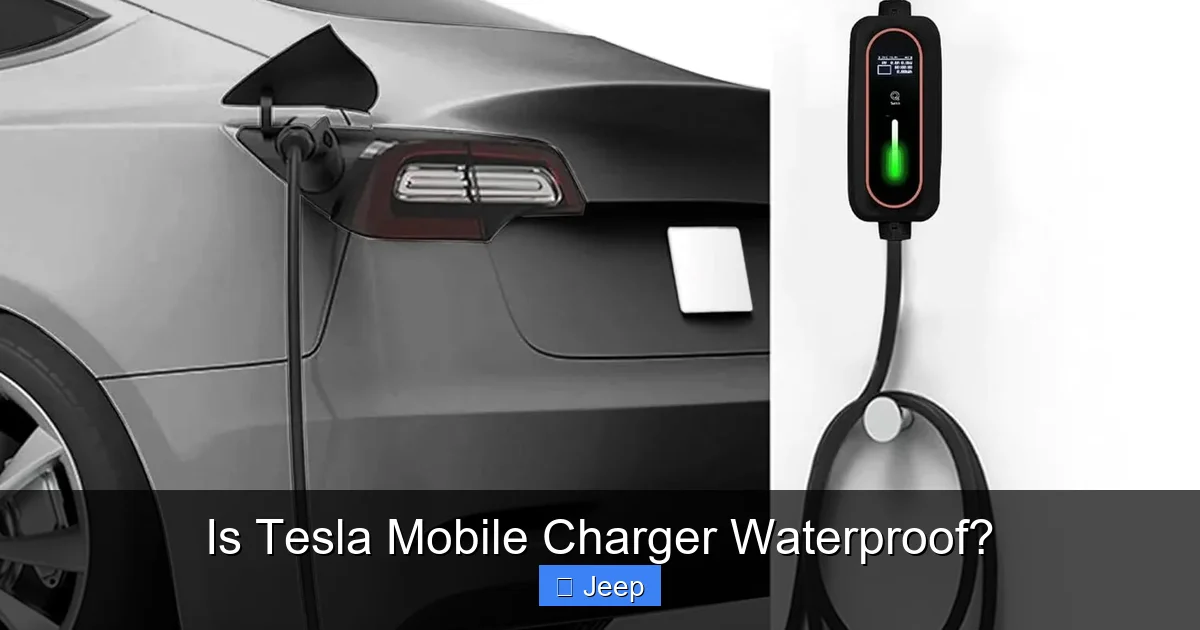
To understand the waterproof question, we need to look at the official word from Tesla and the technical reality of the product. The mobile connector is designed as a cost-effective, ultra-portable solution. It’s the cable that comes in the trunk with your car. Its primary job is to get you from a standard household outlet to a charging state reliably and safely under ideal conditions.
Visual guide about Is Tesla Mobile Charger Waterproof?
Image source: teslamusthavereviews.com
The Official Stance and the Missing IP Rating
If you search Tesla’s official support pages or the product documentation for the mobile connector, you will not find any mention of an IP rating like IP54, IP65, or IP67. This silence is deafening in the world of consumer electronics and electrical accessories. An IP rating is a clear, standardized promise. For example, IP65 means “dust-tight” and protected against “water jets.” IP67 means it can be submerged in up to 1 meter of water for 30 minutes.
The absence of this rating means the mobile connector has not been engineered, tested, or certified to withstand any specific level of water exposure. Its internal components and the seal where the cable meets the connector head are designed for mechanical stress and electrical load, not for creating a hermetic seal against moisture. The rubber boot that covers the connector pins when not in use offers minimal protection against light drips or dust, but it is not a waterproof cap.
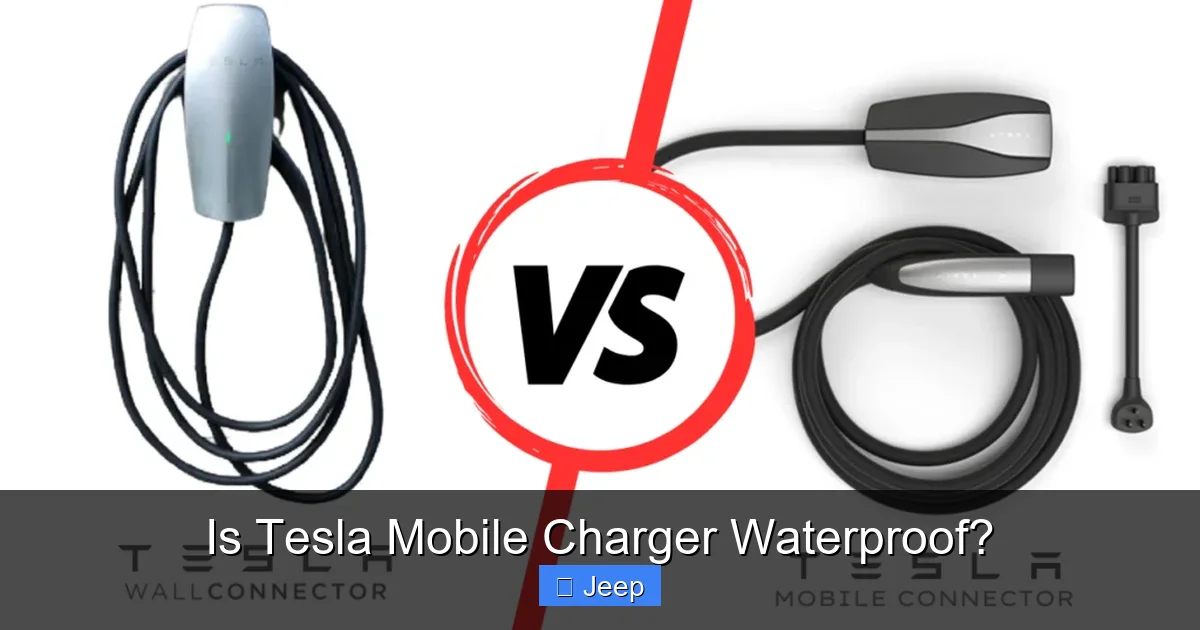
Contrast this with Tesla’s Wall Connector, which is typically rated at least IP65. This makes perfect sense because a wall connector is a permanent installation, often mounted on the outside of a house or in a carport. It needs to be weatherproof. The mobile connector, by design, is meant to be brought inside, stored in the trunk, and used in locations where you’d reasonably expect to find a dry outlet.
What “Water-Resistant” vs. “Waterproof” Really Means
This is a critical distinction. “Water-resistant” might mean it can survive an accidental splash or a brief shower while you’re fumbling to plug it in. “Waterproof” means it can function correctly after being exposed to a defined amount of water pressure or submersion. The Tesla mobile connector falls firmly into the first, very vague category, if at all. Think of it like your smartphone. Most modern phones are water-resistant (IP67/68). You can drop it in a puddle. The Tesla mobile connector is nowhere near that level of protection. A heavy dew, a sudden downpour while you’re setting up, or a melted snowbank dripping on it could introduce moisture into areas it wasn’t designed to keep out.
So, when we say it’s “not waterproof,” we mean it lacks the engineered seals, gaskets, and pressure equalization membranes that true waterproof devices have. Water can—and will—find its way into microscopic gaps, especially over time as seals degrade from heat cycles and general use.
The Real Enemy: How Water Damages Your Mobile Connector
Okay, so it’s not waterproof. But what’s the worst that can happen? A little water, a quick wipe, and you’re good, right? Not necessarily. Water damage is often slow, insidious, and can lead to catastrophic failure. Let’s break down the attack vectors.
Visual guide about Is Tesla Mobile Charger Waterproof?
Image source: cdn.pixabay.com
Corrosion: The Silent Killer of Electrical Connections
The most common and damaging effect of water on your mobile connector is corrosion. The connector head contains several metal pins: the large DC+ and DC- pins for high-voltage power, and smaller pins for communication and grounding. These pins are typically made of a conductive metal like brass or copper, often with a thin plating of tin or nickel to resist corrosion.
When water (especially water containing dissolved salts or minerals from rain or snow) gets into the connector and sits there, it begins an electrochemical process. It eats away at the metal plating and then the base metal itself. You’ll see it as greenish fuzz, white crust, or general pitting on the pins. This corrosion increases electrical resistance. Higher resistance means more heat during charging. Heat can melt plastic housings, degrade insulation, and in the worst case, cause a fire. Even if it doesn’t get that far, a corroded pin will cause poor connection errors (like the dreaded “Charging Fault” or “Check Connection” message on your Tesla screen), leading to interrupted charging sessions and frustration.
Corrosion can also occur inside the cable itself if water wicks its way down between the inner conductors and the outer insulation. This is harder to see but equally damaging over time.
Short Circuits and Safety Hazards
If enough water bridges the gap between the high-voltage DC pins (the two largest ones) or between a DC pin and ground, it can create a short circuit. The mobile connector and the vehicle’s charging system have safety protocols to detect this and shut down charging immediately. That’s the good news—the system is designed to fail safely. The bad news is that a short circuit event can physically damage components, blow internal fuses (which require a service visit to replace), and in rare, extreme cases of sustained arcing, could potentially cause damage to the vehicle’s charge port or onboard charger.
Beyond just pins, water getting into the body of the connector where the circuit board and electronics live can cause immediate failure. You might plug it in, see no charging icon, and get an error. The connector has essentially been fried.
The Condensation Conundrum
Here’s a sneaky one that many people don’t consider: condensation. Imagine you’re charging your Tesla at a remote cabin in the mountains. The air is cold and damp at night. You plug in the mobile connector, which is at ambient temperature. As the car’s battery charges, it generates a small amount of heat, which can warm the connector slightly. When you unplug in the morning and put the still-warm (or at least temperature-different) connector back into its plastic bag or trunk, it can cool down rapidly in the cold mountain air. This temperature swing can cause moisture from the air to condense inside the sealed connector head or along the cable. That condensation then sits there, setting the stage for the corrosion we just discussed. This is why simply wiping off visible water isn’t always enough; you need to ensure the connector is truly dry before sealing it away in a non-breathable bag.
Practical Scenarios: When Is It At Risk?
Theoretical risks are one thing, but let’s map this to real life. When are you most likely to expose your mobile connector to conditions it’s not happy with?
Visual guide about Is Tesla Mobile Charger Waterproof?
Image source: traditionalelectric.ca
Rain, Snow, and Sleet During Setup
This is the most common scenario. You’re at a hotel, a friend’s house, or a public RV park. It’s drizzling or snowing. You have to uncoil the cable, plug it into the outlet (which might be under a minimal eave), and then plug the heavy connector into your car’s port. During those 60-90 seconds of fiddling, the connector head and the cable near it are getting wet. If you then leave it plugged in for hours, that moisture is trapped against the vehicle’s charge port and inside the connector itself. The vehicle’s port has some drainage, but it’s not a sealed unit either. This is a high-risk activity.
Puddles, Mud, and Wet Surfaces
You’re charging in a driveway after a rainstorm. The cable gets draped over a puddle. You accidentally drop the connector in a shallow puddle or muddy slush. You roll it up and toss it in the trunk, where it’s sitting on wet floor mats. All of these introduce liquid directly to the connector and the cable jacket. The cable jacket itself is somewhat water-resistant, but it’s not a submarine cable. Prolonged saturation can allow water to migrate.
Humidity and Coastal Environments
Even without direct rain, high humidity—especially salty, coastal air—accelerates corrosion. The microscopic salt particles in the air are excellent electrolytes. Leaving a connector in a garage that isn’t climate-controlled in a beach town can still lead to corrosion over months and years. The same goes for using it in very humid, tropical climates.
The “It Was Fine Before” Fallacy
Many owners say, “I’ve used mine in the rain dozens of times and it’s fine!” This is the most dangerous mindset. Corrosion is cumulative. That first light rain might have left a few microscopic salt residues. The second rain added more. The third, a tiny bit of internal moisture that didn’t fully dry. Each event degrades the connector a little more. It might take two years, or five, but the failure often comes suddenly when you least expect it—during a critical road trip charging stop. It’s a ticking time bomb of galvanic corrosion.
Protecting Your Investment: Smart Strategies for All Conditions
Knowing it’s not waterproof is step one. Step two is taking proactive steps to keep it dry, because let’s face it, you’re still going to use it in less-than-ideal conditions sometimes. Here is your defense-in-depth strategy.
The Golden Rule: Store It Dry, Always
The single most important habit is to never store the mobile connector while it’s damp or wet. When you’re done charging, unplug from the car first, then from the outlet. Give the connector head a thorough inspection. Use a clean, dry, lint-free microfiber cloth to wipe down every surface, especially the metal pins. Get into the crevices. Then, with the protective cap securely fastened over the pins, coil the cable loosely (don’t create sharp kinks) and store it in a dedicated, dry bag or compartment in your trunk. Many owners use large Ziploc-style bags, but these can trap condensation. A better option is a breathable mesh bag or a small, dedicated dry bag like those used for electronics. The key is to keep it away from wet floor mats, snow, or any source of ambient moisture.
Active Protection During Use: Covers and Canopies
When you must charge in the rain, you need to create a mini-shelter for the connection point.
- Simple DIY Cover: A large gallon-sized Ziploc bag or a piece of heavy-duty plastic sheeting can be draped over the connector and the cable entry point to the vehicle’s charge port, secured with a rubber band or tape. This won’t make it waterproof, but it deflects the bulk of direct rainfall.
- Commercial Connector Covers: Companies like EVSE Safety and others sell specifically designed, sealed covers that fit over the Tesla connector. These are made of flexible rubber or silicone with a tight seal around the cable. They are the best off-the-shelf solution for keeping the connection point dry during a downpour.
- The Umbrella Trick: Have a travel umbrella? Clip it to the side of the charge port (carefully) or have a friend hold it over the connection area while you plug/unplug. It’s low-tech but highly effective.
- Seek Shelter: Always, always look for the outlet that’s under the deepest eave, inside a garage, or under a permanent canopy. The extra 20 feet of walking to a drier outlet is worth it.
Pre-Charging Preparation: A Dry Start is Half the Battle
Before you even think about plugging in, check both ends.
- Inspect the Vehicle’s Charge Port: Look inside the Tesla’s charge port. Is there any water, ice, or debris? Use a dry cloth or a can of compressed air (held upright) to gently clear it out. Never insert anything metallic.
- Dry the Connector Pins: Even if you think the mobile connector is dry, give the pins a quick wipe with your dry cloth. It takes two seconds.
- Check the Outlet: Is the outdoor outlet you’re using covered? Does it have a proper in-use cover (the kind with a gasket that closes around the plug)? If not, that outlet is a water hazard for the plug itself.
Consider a Dedicated, Weatherproof Travel Charger
If your lifestyle frequently involves charging in unpredictable weather—think skiing, beach trips, or rural camping—consider purchasing a second, more rugged mobile connector from a third party. Companies like Lectron and J1772 to Tesla adapters with robust housings sometimes offer better sealing and more durable boots. While still not “waterproof” in the certified sense, they often have improved designs over the stock Tesla unit. Alternatively, you could keep your stock connector pristine in the trunk for “nice weather” and use a hardier, dedicated travel unit for adventures. Just ensure any third-party adapter is properly UL-listed and compatible with your vehicle’s charging protocols.
The Ultimate Solution: A Permanent, Weatherproof Level 2 Charger
If you find yourself constantly worrying about your mobile connector’s exposure, it’s a sign you’ve outgrown its intended use case. The most reliable, safe, and convenient solution for any Tesla owner who wants to charge at home or at a secondary location (like a vacation home) is a dedicated Level 2 charging station.
Why a Wall Connector or Hardwired EVSE is the Answer
A permanently mounted Level 2 charger (like the Tesla Wall Connector or excellent third-party options from Grizzl-E, JuiceBox, or ChargePoint) is built from the ground up for outdoor installation. They carry high IP ratings (commonly IP65 or IP66). This means they are completely dust-tight and can withstand powerful water jets from any direction. You can mount them on the side of your house, on a post in the driveway, or in a carport with complete confidence that a rainstorm or snowstorm will not harm them.
The connector on these units is also much more substantial. It has a heavy-duty, sealed cable and a connector with a built-in, secure, weatherproof cap that automatically covers the pins when not in use. The cable itself is often thicker and more resistant to UV degradation and physical abrasion.
For Jeep owners or those with an adventurous spirit who charge at a cabin, a permanent Level 2 charger at that location eliminates the entire mobile connector problem. You arrive, plug into a known-safe, weatherproof station, and never have to worry about dragging a delicate cable out of the trunk in a storm. The cost of installation is an investment in convenience, safety, and the longevity of your charging equipment. You can learn more about the typical costs to install a Tesla charger to budget for this upgrade.
Cross-Compatibility and Future-Proofing
Many modern Level 2 chargers, including the Tesla Wall Connector, can be configured to supply power to other EVs using a J1772 plug. This is useful if you have multiple electric vehicles in the household, like a Nissan Ariya or a Ford Mustang Mach-E. A weatherproof, high-amperage station serves all of them safely. A mobile connector, by contrast, is a single-point solution that is inherently vulnerable.
Warranty Implications: What’s Covered and What Gets You in Trouble
This is the part that makes people’s stomachs drop. Tesla’s warranty for the mobile connector is limited, and it explicitly excludes damage from “misuse, neglect, accident, or unauthorized modification.” Liquid damage is almost always classified as misuse or neglect. If you take your mobile connector to a Tesla Service Center with corroded pins and claim it’s defective, they will very likely inspect it and determine the cause is water exposure. The result? You will be billed for a replacement connector (currently around $275-$325) and any associated labor. It will not be a warranty repair.
This policy is standard across the electronics and automotive accessory industry. It’s not a Tesla-specific “gotcha.” It’s a clear delineation of intended use. The mobile connector is for dry, indoor, or protected outlets. Using it as a rugged, all-weather charging tool is outside its design parameters, and the warranty reflects that.
Therefore, protecting your connector isn’t just about preventing a breakdown; it’s about protecting your wallet. The small cost of a good connector cover or a dedicated dry bag is trivial compared to the price of a new, warranty-voided connector.
Conclusion: Respect the Tool for the Job
So, is the Tesla mobile charger waterproof? The definitive, practical answer is no. It is a fantastic piece of kit for its intended purpose: convenient, portable charging from standard outlets in dry, controlled environments. It gives you incredible flexibility for travel and overnight stays. But it is not a ruggedized, outdoor power hose. Treating it as such guarantees a future of charging errors, corroded connectors, and unexpected costs.
Your action plan is simple: acknowledge its limitation, adopt rigorous drying and storage habits, use simple protective covers when caught in the rain, and for any situation where you’ll be charging regularly in wet or humid conditions, make the strategic upgrade to a dedicated, IP-rated Level 2 charging station. This approach protects your equipment, ensures your safety, keeps your Tesla charging reliably, and respects the tool for the job it was actually designed to do. Your Tesla’s battery and your peace of mind will thank you for it.
Frequently Asked Questions
Can I use my Tesla mobile charger in light rain?
While a brief, light drizzle during the few seconds you’re plugging in is unlikely to cause instant failure, it is not recommended. Any moisture that gets trapped in the connector or on the vehicle’s charge port can lead to corrosion over time. If you must charge in light rain, use a plastic bag or commercial cover to shield the connection point.
What happens if my Tesla mobile connector gets wet?
If it gets wet, you must dry it thoroughly before storing or using it. Wipe the connector pins and cable with a dry cloth. Do not plug a visibly wet connector into your car, as this risks short circuits and corrosion. If water has been left inside, corrosion will likely start, leading to charging errors and eventual failure, which is not warranty-covered.
Does Tesla warranty cover water damage on the mobile connector?
No. Tesla’s limited warranty for the mobile connector excludes damage from misuse, neglect, or accident. Liquid damage is considered neglect. If you submit a water-damaged connector for warranty, it will be denied, and you will have to pay for a replacement.
Should I buy a protective cover for my Tesla mobile connector?
Yes, especially if you frequently charge outdoors or in unpredictable weather. A simple silicone or rubber cover that seals over the connector pins provides excellent protection against rain and snow when the connector is not in use and during transport. It’s a low-cost safeguard against a high-cost replacement.
Is the Tesla mobile connector safe to use if it’s been stored in a damp trunk?
Before using it, you must inspect and dry it completely. Check the connector pins for any signs of moisture or corrosion. Wipe everything down with a dry microfiber cloth. If you store it in a trunk that gets damp (e.g., from snow boots or wet gear), consider storing it in an additional sealed, dry bag to prevent ambient humidity from affecting it.
What’s the best way to store my Tesla mobile connector long-term?
Always store it with the protective cap firmly attached to the connector. Coil the cable loosely to avoid stress. Place it in a dedicated, dry, breathable bag or compartment away from direct sunlight, extreme temperatures, and any source of moisture. For maximum protection in humid climates, a small desiccant packet in the storage bag can help absorb any residual humidity.
