
Is a Toyota Tundra a 3/4-ton Truck?

The Toyota Tundra is not a 3/4-ton truck—it’s a full-size 1/2-ton pickup. While it offers impressive towing and payload capabilities, it falls short of the 3/4-ton class in both design and capacity, making it ideal for everyday hauling and moderate work tasks.
Key Takeaways
- Truck Classifications Explained: Pickup trucks are categorized by weight classes—1/2-ton, 3/4-ton, and 1-ton—based on payload capacity and chassis strength.
- Toyota Tundra Is a 1/2-Ton Truck: Despite its rugged appearance and powerful engine options, the Tundra is engineered as a half-ton pickup, not a 3/4-ton.
- Payload and Towing Limits: The Tundra’s max payload is around 1,940 lbs and towing up to 12,000 lbs, which is strong for a half-ton but below 3/4-ton standards.
- Chassis and Suspension Differences: 3/4-ton trucks use heavier-duty frames, axles, and suspension systems—features the Tundra doesn’t fully match.
- Best for Everyday and Light Work Use: The Tundra excels in daily driving, light towing, and moderate hauling, making it a great family-friendly workhorse.
- Competitors in the 3/4-Ton Space: Trucks like the Ford F-250, Ram 2500, and Chevrolet Silverado 2500 are true 3/4-ton models with higher capacities.
- Future Upgrades May Bridge the Gap: With the introduction of the i-FORCE MAX hybrid powertrain, the Tundra is closing the performance gap, but it still isn’t classified as a 3/4-ton.
📑 Table of Contents
- Is a Toyota Tundra a 3/4-Ton Truck? The Straight Answer
- Understanding Truck Weight Classes: 1/2-Ton, 3/4-Ton, and 1-Ton
- Toyota Tundra Specs: Payload, Towing, and Capability
- Chassis and Build: Why the Tundra Isn’t a 3/4-Ton
- Who Should Buy a Toyota Tundra?
- The Future of the Tundra: Could It Become a 3/4-Ton?
- Conclusion: The Tundra Is a Half-Ton Hero
Is a Toyota Tundra a 3/4-Ton Truck? The Straight Answer
If you’re shopping for a pickup truck and you’ve been eyeing the Toyota Tundra, you might be wondering: Is this a 3/4-ton truck? It’s a fair question. The Tundra looks tough, sounds powerful, and has a reputation for reliability that few trucks can match. But when it comes to official truck classifications, things aren’t always as they seem.
The short answer? No, the Toyota Tundra is not a 3/4-ton truck. It’s officially classified as a full-size 1/2-ton pickup. That might surprise some people, especially since the Tundra has evolved significantly over the years, growing in size, power, and capability. But despite its impressive specs, it still falls short of the engineering and capacity standards that define 3/4-ton trucks.
So why does this matter? Truck classifications aren’t just marketing labels—they reflect real differences in design, durability, and intended use. Whether you’re towing a camper, hauling construction materials, or just need a dependable daily driver, knowing your truck’s class helps you make the right choice. In this article, we’ll break down what it means to be a 3/4-ton truck, how the Tundra stacks up, and why it’s still a fantastic option—even if it’s not in the heavy-duty league.
Understanding Truck Weight Classes: 1/2-Ton, 3/4-Ton, and 1-Ton
Visual guide about Is a Toyota Tundra a 3/4-ton Truck?
Image source: motortrend.com
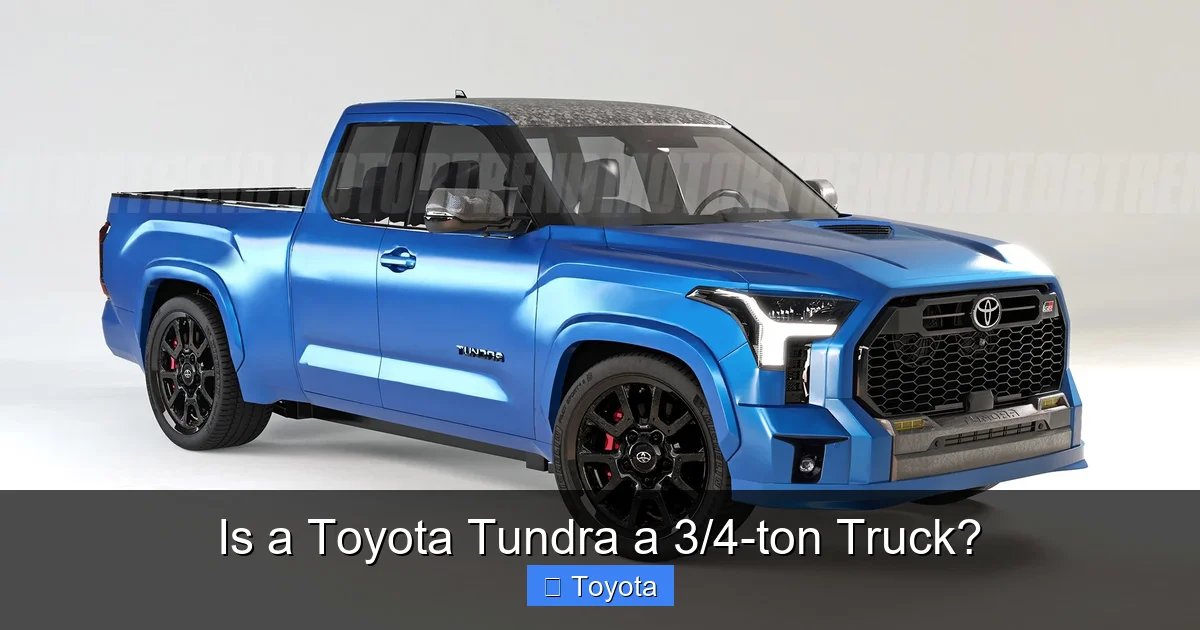
Before we dive deeper into the Tundra’s specs, let’s clear up a common source of confusion: truck weight classes. These terms—1/2-ton, 3/4-ton, and 1-ton—have been around for decades, but they don’t actually refer to the truck’s total weight. Instead, they describe the vehicle’s payload capacity, or how much weight it can safely carry in the bed and cabin.
Origins of the Terminology
The “ton” classification dates back to the early 20th century when trucks were rated by how much cargo they could carry. A 1/2-ton truck could haul 1,000 pounds, a 3/4-ton could handle 1,500 pounds, and a 1-ton truck could carry 2,000 pounds. While modern trucks far exceed these numbers, the labels stuck—even though they’re now more about tradition and marketing than actual capacity.
Today, these classes help buyers quickly understand a truck’s intended use:
– 1/2-ton trucks (like the Ford F-150, Chevrolet Silverado 1500, and Toyota Tundra) are ideal for everyday driving, light towing, and moderate hauling.
– 3/4-ton trucks (such as the Ford F-250, Ram 2500, and GMC Sierra 2500) are built for heavier workloads, including large trailers, equipment, and frequent towing.
– 1-ton trucks (like the Ford F-350 or Ram 3500) are the heavyweights, designed for commercial use, massive payloads, and extreme towing.
How Classes Are Determined
Truck classes are based on several engineering factors:
– Frame strength: Heavier-duty trucks use thicker, reinforced frames.
– Suspension system: 3/4-ton and 1-ton trucks have sturdier springs, shocks, and axles.
– Axle ratings: The rear axle on a 3/4-ton truck is built to handle more weight.
– Braking system: Larger trucks need more robust brakes to stop safely under heavy loads.
– GVWR (Gross Vehicle Weight Rating): This is the maximum total weight the truck can safely carry, including fuel, passengers, cargo, and the vehicle itself.
For example, a typical 1/2-ton truck has a GVWR between 6,000 and 7,000 pounds. A 3/4-ton truck usually ranges from 8,000 to 10,000 pounds. The higher the GVWR, the more capable the truck.
Why the Confusion?
So why do some people think the Tundra is a 3/4-ton truck? Part of it comes from its size and appearance. The Tundra is a large, muscular pickup with a bold grille, aggressive stance, and a powerful V8 or hybrid engine. It looks like it could handle heavy-duty work—and in many ways, it can. But looks can be deceiving.
Another reason is that Toyota has consistently pushed the Tundra’s capabilities. With the 2022 redesign, the Tundra gained a new twin-turbo V6 engine, a stronger frame, and improved towing. The introduction of the i-FORCE MAX hybrid system boosted torque and efficiency, making the Tundra feel more powerful than ever. But even with these upgrades, it’s still built on a 1/2-ton platform.
Toyota Tundra Specs: Payload, Towing, and Capability
Visual guide about Is a Toyota Tundra a 3/4-ton Truck?
Image source: noorcars.com
Now let’s look at the numbers. How does the Toyota Tundra actually perform when it comes to payload and towing? And how do those numbers compare to true 3/4-ton trucks?
Payload Capacity
Payload is the total weight the truck can carry in the cab and bed. This includes passengers, gear, tools, and anything else you’re hauling. For the 2024 Toyota Tundra, the maximum payload varies by configuration, but it typically ranges from 1,500 to 1,940 pounds.
That’s solid for a half-ton truck. For comparison:
– Ford F-150: Up to 3,325 lbs (with heavy-duty payload package)
– Chevrolet Silverado 1500: Up to 2,280 lbs
– Ram 1500: Up to 2,300 lbs
So while the Tundra isn’t the payload leader in the 1/2-ton class, it’s competitive—especially in its higher trims like the TRD Pro or Capstone.
Towing Capacity
Towing is where the Tundra really shines. With the available i-FORCE MAX hybrid powertrain, the Tundra can tow up to 12,000 pounds when properly equipped. That’s impressive for a half-ton truck and puts it on par with some older 3/4-ton models.
Here’s how it stacks up:
– Ford F-150: Up to 14,000 lbs (with Max Trailer Tow Package)
– Chevrolet Silverado 1500: Up to 13,300 lbs
– Ram 1500: Up to 12,750 lbs
So the Tundra’s towing is strong—but again, it’s still within the 1/2-ton range. True 3/4-ton trucks like the Ford F-250 can tow up to 20,000 pounds, and the Ram 2500 can handle over 19,000 pounds.
Engine Options and Performance
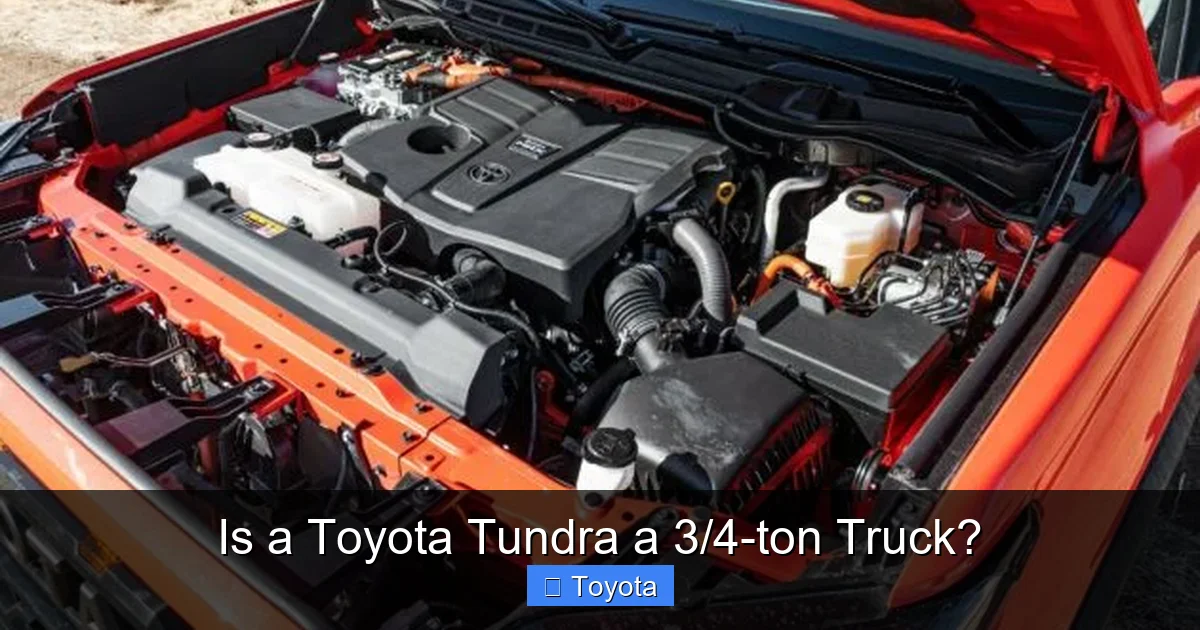
The 2024 Tundra comes with two engine choices:
1. i-FORCE 3.4L Twin-Turbo V6: 389 horsepower, 479 lb-ft of torque
2. i-FORCE MAX 3.4L Twin-Turbo V6 Hybrid: 437 horsepower, 583 lb-ft of torque
The hybrid version, in particular, delivers instant torque and smooth power delivery, making it feel more capable than its half-ton classification suggests. It’s great for towing up steep hills or accelerating with a heavy load.
But here’s the catch: even with all that power, the Tundra’s chassis, suspension, and axle ratings aren’t built to handle the sustained heavy loads that 3/4-ton trucks are designed for. It’s like putting a sports car engine in a compact car—it’s fast, but the frame might not handle extreme stress over time.
Real-World Examples
Let’s say you’re planning a cross-country trip with a 10,000-pound travel trailer. The Tundra can handle it—no problem. But if you’re towing that same trailer every weekend for work, or hauling 2,000 pounds of gravel regularly, a 3/4-ton truck would be a better long-term choice.
Similarly, if you’re using your truck for daily commuting, weekend camping, and occasional boat towing, the Tundra is more than capable. But if your work involves frequent heavy hauling—like construction, farming, or landscaping—you’ll want the extra durability of a 3/4-ton.
Chassis and Build: Why the Tundra Isn’t a 3/4-Ton
Visual guide about Is a Toyota Tundra a 3/4-ton Truck?
Image source: bringatrailer.com
Now let’s get technical. What makes a 3/4-ton truck different from a 1/2-ton? It’s not just about engine power or towing specs. It’s about the entire vehicle architecture.
Frame Design
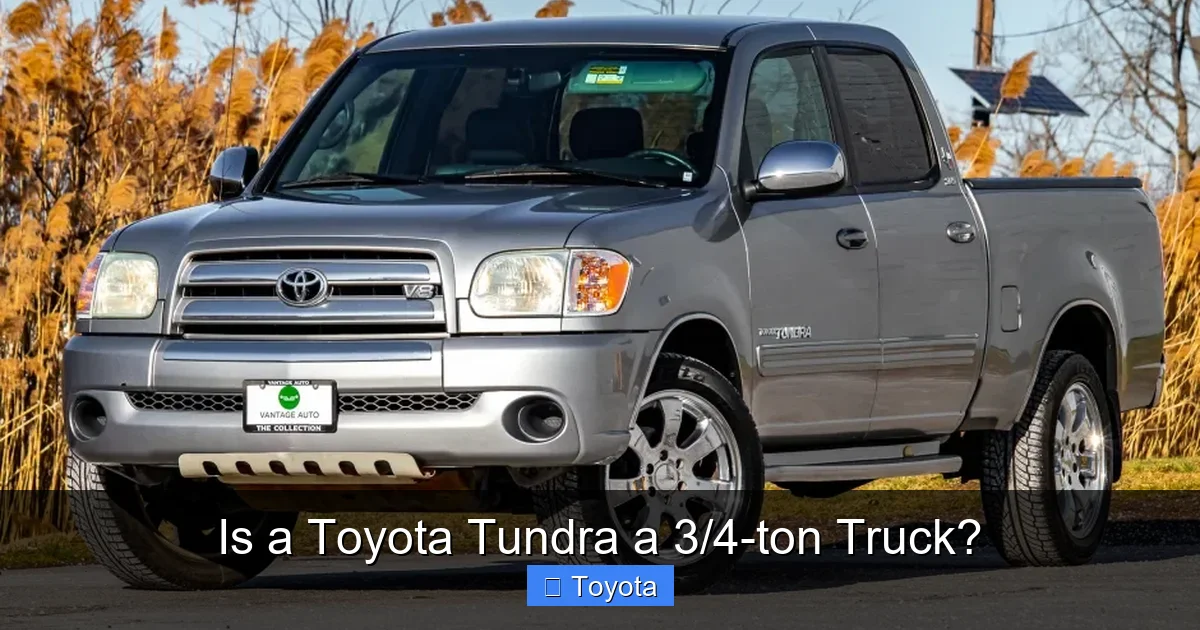
The Tundra uses a fully boxed, high-strength steel frame—impressive for a half-ton truck. But 3/4-ton trucks go further. They often use thicker steel, additional crossmembers, and reinforced sections to handle heavier loads. For example, the Ford F-250 has a frame that’s 50% stronger than the F-150’s in key areas.
The Tundra’s frame is strong, but it’s not overbuilt like a heavy-duty truck. It’s designed for durability and off-road capability, not maximum payload.
Suspension System
Suspension is critical for handling weight. The Tundra comes with a coil-spring rear suspension (a rarity among full-size trucks), which improves ride comfort and off-road performance. But it’s not as robust as the leaf-spring setups found on most 3/4-ton trucks.
Leaf springs are heavier and less comfortable, but they’re better at handling constant heavy loads. The Tundra’s suspension is tuned for balance—comfortable for daily driving, capable for light work, but not optimized for maximum hauling.
Axle and Drivetrain
The Tundra uses a solid rear axle with a 9.5-inch ring gear—solid, but not heavy-duty. In contrast, 3/4-ton trucks often have 10.5-inch or larger axles with higher gear ratios and stronger differentials.
Additionally, 3/4-ton trucks typically offer options like dual rear wheels (DRW), which spread the load and improve stability under heavy towing. The Tundra doesn’t offer DRW, another sign it’s not built for extreme duty.
Brake System
Braking is another area where 3/4-ton trucks have an edge. They use larger rotors, more powerful calipers, and sometimes even exhaust brakes or integrated trailer brakes. The Tundra has strong brakes for a half-ton, but they’re not designed for repeated heavy stops with massive loads.
Real-World Implications
All of this means the Tundra is built for versatility, not brute strength. It’s great for someone who wants a tough, reliable truck that can handle most tasks without sacrificing ride quality. But if you’re regularly pushing the limits of payload and towing, a 3/4-ton truck will last longer and perform better under stress.
Who Should Buy a Toyota Tundra?
So if the Tundra isn’t a 3/4-ton truck, who is it for? The answer might surprise you: it’s for a lot of people.
Daily Drivers Who Want Capability
If you want a truck that’s comfortable on the highway, easy to park, and still capable of towing a boat or hauling a load of mulch, the Tundra is a great choice. Its refined interior, advanced tech, and smooth ride make it one of the most comfortable full-size trucks on the market.
Off-Road Enthusiasts
The Tundra TRD Pro is a beast off-road. With Fox shocks, skid plates, and aggressive tires, it can tackle trails that would challenge many SUVs. For overlanding, camping, or weekend adventures, the Tundra is a top pick.
Families Who Need Space
With seating for up to five and a spacious cabin, the Tundra is a great family truck. It’s safe, reliable, and packed with features like Toyota Safety Sense 2.5, Apple CarPlay, and available rear-seat entertainment.
Light Commercial Users
Contractors, landscapers, and small business owners who don’t need extreme hauling can benefit from the Tundra’s durability and low maintenance costs. It’s tough enough for job sites but not overkill for occasional use.
When to Consider a 3/4-Ton Instead
You should look at a 3/4-ton truck if:
– You regularly tow over 12,000 pounds
– You frequently haul payloads over 2,000 pounds
– You need dual rear wheels for stability
– You use your truck for heavy-duty work daily
– You want maximum long-term durability under stress
In those cases, trucks like the Ford F-250, Ram 2500, or Chevrolet Silverado 2500 are better suited.
The Future of the Tundra: Could It Become a 3/4-Ton?
With the rise of hybrid powertrains and evolving consumer demands, could Toyota ever build a true 3/4-ton Tundra? It’s possible—but unlikely in the near term.
Hybrid Power and Efficiency
The i-FORCE MAX hybrid system shows Toyota is serious about performance and efficiency. It delivers V8-like torque with better fuel economy, making the Tundra more capable than ever. But hybrid tech alone doesn’t make a truck heavy-duty.
Market Positioning
Toyota has always positioned the Tundra as a reliable, no-nonsense full-size truck—not a workhorse. The brand’s strength is in durability and resale value, not maximum capability. Building a 3/4-ton Tundra would require a new platform, higher costs, and a different marketing strategy.
Competition and Demand
The 3/4-ton market is dominated by Ford, GM, and Ram. Toyota would need a compelling reason to enter that space. Right now, the Tundra sells well as a premium half-ton. There’s no urgent need to change.
That said, if demand grows for a hybrid 3/4-ton truck, Toyota could respond. But for now, the Tundra remains a 1/2-ton champion.
Conclusion: The Tundra Is a Half-Ton Hero
So, is a Toyota Tundra a 3/4-ton truck? The answer is clear: no. It’s a full-size 1/2-ton pickup with impressive capabilities, but it doesn’t meet the engineering standards of a heavy-duty truck.
That doesn’t make it any less valuable. The Tundra is one of the most reliable, comfortable, and capable half-ton trucks on the market. It’s perfect for daily driving, light towing, off-roading, and family life. And with the i-FORCE MAX hybrid, it’s more powerful than ever.
If you need a truck for serious heavy-duty work, look at the 3/4-ton options. But if you want a tough, dependable, and versatile pickup that can handle most tasks with ease, the Toyota Tundra is an excellent choice—just don’t expect it to wear the 3/4-ton badge.
Frequently Asked Questions
Is the Toyota Tundra a 3/4-ton truck?
No, the Toyota Tundra is classified as a full-size 1/2-ton pickup truck. While it has strong towing and payload capabilities, it does not meet the engineering standards of a 3/4-ton truck.
What is the maximum towing capacity of a Toyota Tundra?
The 2024 Toyota Tundra can tow up to 12,000 pounds when equipped with the i-FORCE MAX hybrid powertrain and proper towing package. This is impressive for a half-ton truck but below 3/4-ton levels.
Can the Tundra handle heavy loads like a 3/4-ton truck?
The Tundra can handle moderate to heavy loads, but it’s not built for sustained heavy-duty use. For frequent hauling over 2,000 pounds or towing above 12,000 lbs, a 3/4-ton truck is a better choice.
What makes a truck a 3/4-ton?
A 3/4-ton truck has a stronger frame, heavier-duty suspension, larger axles, and higher GVWR (usually 8,000–10,000 lbs). These features allow it to handle greater payloads and towing than 1/2-ton trucks.
Is the Tundra good for daily driving?
Yes, the Tundra is excellent for daily driving. It offers a comfortable ride, modern tech, and strong reliability, making it a great choice for families and commuters.
Should I buy a Tundra or a 3/4-ton truck?
Choose the Tundra if you need a capable, comfortable truck for everyday use and light to moderate work. Go with a 3/4-ton truck if you regularly tow heavy trailers or haul large payloads.
