
Is a Toyota Tundra a 3/4 Ton Truck

The Toyota Tundra is not officially classified as a 3/4 ton truck. While it offers impressive towing and payload capabilities, it falls into the half-ton pickup category. Understanding truck classifications helps buyers choose the right vehicle for their needs.
Key Takeaways
- Truck Classifications Matter: Trucks are grouped by weight capacity—half-ton, 3/4-ton, and one-ton—based on their Gross Vehicle Weight Rating (GVWR).
- Toyota Tundra Is a Half-Ton Truck: Despite its rugged build and strong performance, the Tundra is designed and rated as a half-ton pickup.
- Payload and Towing Are Impressive: The Tundra can tow up to 12,000 pounds and carry over 1,900 pounds, rivaling some 3/4-ton trucks.
- Engine and Chassis Design Influence Class: The Tundra’s frame, suspension, and drivetrain are built for heavy-duty use but don’t meet 3/4-ton standards.
- Real-World Use vs. Official Ratings: Many owners use the Tundra for tasks typically reserved for heavier trucks, but it’s not built for extreme commercial workloads.
- Compare with True 3/4-Ton Trucks: Models like the Ford F-250, Chevy Silverado 2500, and Ram 2500 are true 3/4-ton trucks with higher GVWR and reinforced components.
- Choose Based on Needs: If you need maximum towing and hauling, consider a 3/4-ton. For everyday heavy use, the Tundra is a strong half-ton option.
📑 Table of Contents
- Is a Toyota Tundra a 3/4 Ton Truck? The Straight Answer
- Understanding Truck Weight Classes: Half-Ton, 3/4-Ton, and One-Ton
- Toyota Tundra: Payload and Towing Capacity Breakdown
- How the Tundra Compares to True 3/4-Ton Trucks
- Who Should Choose the Toyota Tundra?
- The Bottom Line: Tundra’s Strengths and Limitations
- Final Thoughts: Choose the Right Tool for the Job
Is a Toyota Tundra a 3/4 Ton Truck? The Straight Answer
If you’re shopping for a full-size pickup and have your eye on the Toyota Tundra, you might be wondering: Is this truck tough enough to handle heavy loads like a 3/4-ton? It’s a fair question. The Tundra looks the part—rugged, muscular, and built with Toyota’s reputation for reliability. But when it comes to official truck classifications, the answer is clear: the Toyota Tundra is not a 3/4-ton truck. It’s classified as a half-ton pickup.
Now, don’t let that fool you into thinking it’s weak. The Tundra punches well above its weight class. With strong towing capacity, a durable frame, and a powerful V8 engine (and now a hybrid option), it’s one of the most capable half-ton trucks on the market. But understanding the difference between half-ton and 3/4-ton trucks is key to making the right choice for your lifestyle, work, or recreational needs.
Truck classifications aren’t just marketing labels—they reflect real engineering differences. These categories are based on the truck’s Gross Vehicle Weight Rating (GVWR), which is the maximum weight the vehicle can safely carry, including passengers, cargo, fuel, and accessories. Half-ton trucks typically have a GVWR under 8,500 pounds, while 3/4-ton trucks range from 8,500 to 10,000 pounds. One-ton trucks go even higher.
So while the Tundra can tow a boat, haul a trailer, or carry a full load of firewood, it’s not built to the same industrial standards as a Ford F-250 or Chevy Silverado 2500. That doesn’t make it inferior—just different. It’s designed for people who want serious capability without stepping into commercial-grade territory.
Understanding Truck Weight Classes: Half-Ton, 3/4-Ton, and One-Ton
Visual guide about Is a Toyota Tundra a 3/4 Ton Truck
Image source: motortrend.com
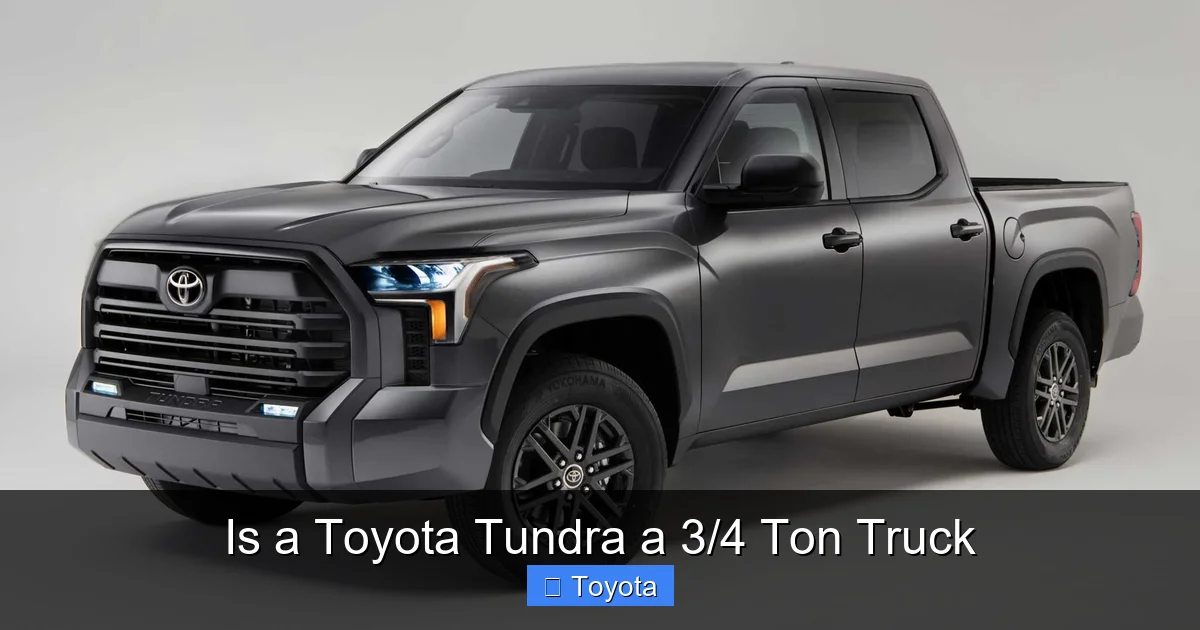
To really answer whether the Toyota Tundra is a 3/4-ton truck, we need to break down what these classifications actually mean. These terms—half-ton, 3/4-ton, one-ton—date back to the early days of pickup trucks when they were rated by how much weight they could carry in the bed. A “half-ton” truck could carry 1,000 pounds (half a ton), a “3/4-ton” could carry 1,500 pounds, and a “one-ton” could carry 2,000 pounds.
Today, those numbers are outdated, but the names stuck. Modern classifications are based on GVWR, not payload alone. Here’s a quick breakdown:
– Half-ton trucks (Class 2): GVWR under 8,500 lbs. Examples: Toyota Tundra, Ford F-150, Chevy Silverado 1500, Ram 1500.
– 3/4-ton trucks (Class 2/3): GVWR between 8,500 and 10,000 lbs. Examples: Ford F-250, Chevy Silverado 2500, Ram 2500.
– One-ton trucks (Class 3): GVWR over 10,000 lbs. Examples: Ford F-350, Chevy Silverado 3500, Ram 3500.
The Tundra’s GVWR typically ranges from 7,000 to 7,800 pounds, depending on the cab configuration, bed length, and drivetrain. That firmly places it in the half-ton category. Even the heaviest Tundra models don’t cross the 8,500-pound threshold required for 3/4-ton classification.
But here’s where it gets interesting: payload and towing capacity don’t always align perfectly with GVWR. A half-ton truck can sometimes tow more than a lighter 3/4-ton model, depending on engine, transmission, and rear axle ratio. That’s why the Tundra can feel like a 3/4-ton truck in everyday use—it’s built to handle serious work.
Why the Confusion Exists
So why do so many people think the Tundra is a 3/4-ton truck? Part of it comes from Toyota’s marketing and the truck’s bold, aggressive styling. The Tundra looks like it could dominate a construction site—and in many ways, it can. It also helps that Toyota has consistently offered a robust V8 engine and a sturdy frame, giving the Tundra a reputation for durability.
Another reason is real-world performance. Many Tundra owners use their trucks to tow large travel trailers, haul heavy equipment, or work on farms and job sites. In practice, the Tundra can handle tasks that overlap with 3/4-ton territory. But that doesn’t change its official classification.
It’s also worth noting that Toyota has never claimed the Tundra is a 3/4-ton truck. The company positions it as a full-size half-ton pickup with best-in-class capability for its class. And in many ways, it delivers.
Toyota Tundra: Payload and Towing Capacity Breakdown
Visual guide about Is a Toyota Tundra a 3/4 Ton Truck
Image source: towengine.com
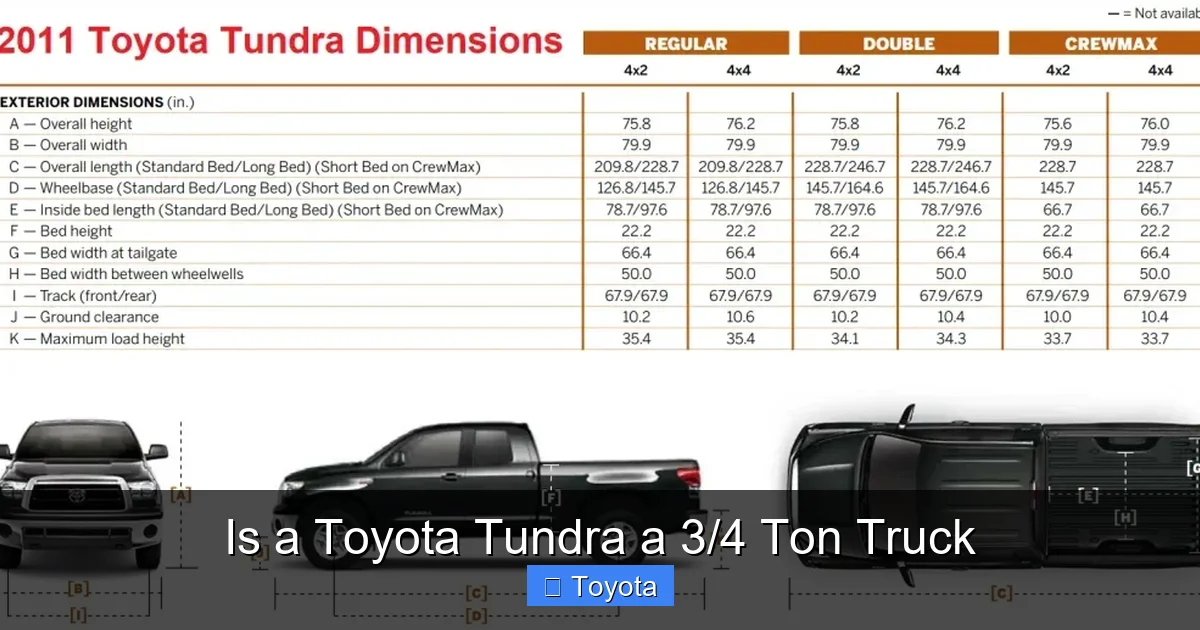
Let’s look at the numbers. The Toyota Tundra’s payload and towing capacity are where it really shines—and where the “is it a 3/4-ton?” debate heats up.
As of the latest 2024 model, the Tundra offers two engine options: a 3.5-liter twin-turbo V6 (i-FORCE) and a hybrid version of that engine (i-FORCE MAX). Both are powerful, but the hybrid delivers the best towing performance.
Here’s a quick look at what the Tundra can do:
– Maximum Towing Capacity: Up to 12,000 pounds (with the i-FORCE MAX hybrid and proper equipment).
– Maximum Payload Capacity: Up to 1,940 pounds (depending on configuration).
To put that in perspective, many 3/4-ton trucks start around 12,000 to 14,000 pounds of towing capacity. So the Tundra is right at the lower end of 3/4-ton towing—but remember, it’s still a half-ton truck.
Real-World Towing Examples
What can you actually tow with a Tundra? A lot. Here are some practical examples:
– A 25-foot travel trailer (average weight: 6,000–8,000 lbs)
– A mid-size fishing boat with trailer (3,000–5,000 lbs)
– A small horse trailer (5,000–7,000 lbs)
– A utility trailer loaded with ATVs or lawn equipment (2,000–4,000 lbs)
With the right hitch, brake controller, and trailer setup, the Tundra can handle these loads comfortably. In fact, many RVers and outdoor enthusiasts choose the Tundra for its reliability and smooth ride—even over longer distances.
But if you’re towing a 30-foot fifth-wheel trailer or a heavy equipment hauler, you might want to step up to a 3/4-ton or one-ton truck. Those vehicles have heavier-duty suspensions, stronger axles, and often dual rear wheels (DRW) for added stability.
Payload: What Can You Haul in the Bed?
Payload is just as important as towing. It’s the total weight the truck can carry in the cab and bed. The Tundra’s max payload of nearly 2,000 pounds means you can load up with:
– A full pallet of concrete bags (about 1,500–2,000 lbs)
– Several bags of mulch, soil, or gravel
– Tools and materials for a weekend project
– A motorcycle or two on a ramp
Again, this is impressive for a half-ton truck. Some competitors, like the Ford F-150, can match or exceed this, but the Tundra holds its own.
Keep in mind that payload decreases as you add options. A crew cab with four passengers, a tonneau cover, and a bed liner will reduce your available payload. Always check the door jamb sticker for your truck’s exact rating.
How the Tundra Compares to True 3/4-Ton Trucks
Visual guide about Is a Toyota Tundra a 3/4 Ton Truck
Image source: tnstatic.net
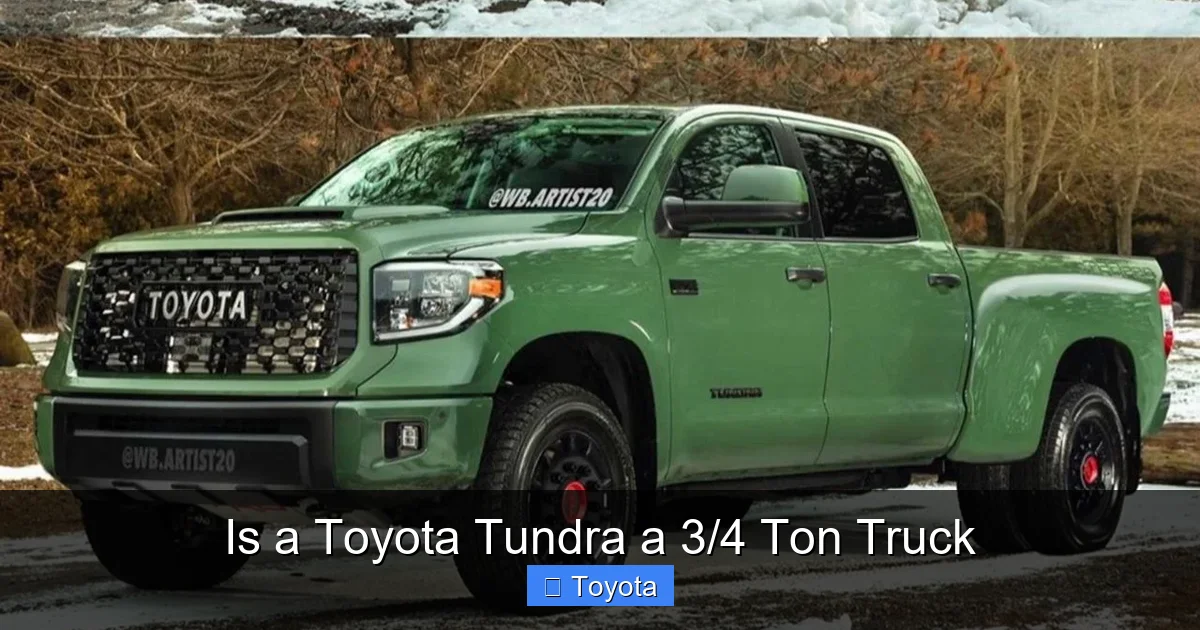
Now let’s put the Tundra head-to-head with actual 3/4-ton trucks. We’ll look at three major competitors: the Ford F-250, Chevy Silverado 2500, and Ram 2500.
Ford F-250 Super Duty
– GVWR: Up to 10,000 lbs
– Max Towing: Up to 22,800 lbs (with gooseneck/fifth-wheel)
– Max Payload: Up to 4,270 lbs
– Engine Options: 7.3L V8 gas, 6.7L Power Stroke diesel
The F-250 is a true workhorse. It’s built with a heavier frame, larger brakes, and a more robust suspension. It’s designed for commercial use, heavy trailers, and extreme conditions.
Compared to the Tundra, the F-250 can tow nearly twice as much and carry more than double the payload. It’s also significantly heavier and less fuel-efficient.
Chevy Silverado 2500HD
– GVWR: Up to 10,000 lbs
– Max Towing: Up to 20,000 lbs
– Max Payload: Up to 3,979 lbs
– Engine Options: 6.6L V8 gas, 6.6L Duramax diesel
Like the F-250, the Silverado 2500 is built for serious hauling. It has a reinforced frame, heavy-duty rear axle, and optional dual rear wheels. It’s a favorite among contractors and farmers.
The Tundra can’t match the Silverado 2500’s towing or payload, but it’s more than capable for most personal and light commercial use.
Ram 2500
– GVWR: Up to 10,000 lbs
– Max Towing: Up to 19,680 lbs
– Max Payload: Up to 4,012 lbs
– Engine Options: 6.4L HEMI V8, 6.7L Cummins diesel
The Ram 2500 is known for its smooth ride and luxurious interior—even in work trim. It’s a great blend of comfort and capability.
Again, the Tundra doesn’t compete in raw numbers, but it offers a more car-like driving experience and legendary Toyota reliability.
Key Differences in Build and Design
So what makes a 3/4-ton truck different from a half-ton like the Tundra? It comes down to engineering:
– Frame: 3/4-ton trucks have thicker, heavier frames with more crossmembers.
– Suspension: They use heavier leaf springs, larger shocks, and often dual rear wheels.
– Axles: Rear axles are larger and rated for higher torque and load.
– Brakes: Bigger rotors and calipers for stopping heavy loads.
– Transmission and Cooling: Enhanced cooling systems to handle sustained towing.
The Tundra has a strong frame and good suspension, but it’s not built to the same industrial standards. It’s designed for durability and comfort, not extreme commercial use.
Who Should Choose the Toyota Tundra?
So if the Tundra isn’t a 3/4-ton truck, who is it for? The answer: a lot of people.
The Tundra is ideal for buyers who want:
– A full-size truck with serious towing and hauling ability
– A vehicle that’s reliable and built to last
– A comfortable daily driver that can also work hard
– A truck that doesn’t require commercial-grade maintenance
Think weekend warriors, outdoor enthusiasts, small business owners, and families who need a versatile vehicle. If you tow a camper a few times a year, haul tools for home projects, or need a dependable truck for daily driving, the Tundra is a great fit.
It’s also a smart choice if you want Toyota’s reputation for longevity. Many Tundras are known to hit 200,000, 300,000, or even 500,000 miles with proper maintenance. That’s a big selling point for anyone looking to keep a truck for decades.
When to Consider a 3/4-Ton Instead
There are times when a 3/4-ton truck makes more sense:
– You tow a fifth-wheel or gooseneck trailer regularly
– You haul heavy equipment or materials for work
– You need maximum payload for tools or cargo
– You drive in extreme conditions (mountains, snow, off-road)
If your needs go beyond what a half-ton can handle, stepping up to a Ford F-250, Chevy 2500, or Ram 2500 is the right move. These trucks are built for the long haul—literally.
The Bottom Line: Tundra’s Strengths and Limitations
Let’s wrap this up with a clear summary.
The Toyota Tundra is not a 3/4-ton truck. It’s a half-ton pickup with impressive capabilities, but it doesn’t meet the GVWR or structural standards of heavier-duty trucks.
That said, it’s one of the most capable half-ton trucks available. With up to 12,000 pounds of towing and nearly 2,000 pounds of payload, it can handle most personal and light commercial tasks with ease.
Its strengths include:
– Strong V6 and hybrid engine options
– Durable frame and suspension
– Comfortable, well-equipped interior
– Toyota’s reputation for reliability and resale value
Its limitations include:
– Lower GVWR than 3/4-ton trucks
– No diesel engine option (as of 2024)
– Less towing and payload than true heavy-duty pickups
If you’re debating between a Tundra and a 3/4-ton truck, ask yourself: What will I actually use it for? If you’re towing under 10,000 pounds and don’t need extreme payload, the Tundra is a fantastic choice. If you’re regularly pushing the limits of a half-ton, it’s time to step up.
Final Thoughts: Choose the Right Tool for the Job
At the end of the day, truck classifications exist for a reason. They help buyers understand what a vehicle is designed to do. The Toyota Tundra is built to be a tough, reliable, and capable half-ton truck—not a commercial-grade 3/4-ton.
But that doesn’t make it any less impressive. In fact, its blend of power, comfort, and durability makes it a standout in its class. Whether you’re towing a trailer, hauling gear, or just cruising down the highway, the Tundra delivers.
So, is a Toyota Tundra a 3/4-ton truck? No. But is it a great truck? Absolutely.
If you value Toyota’s legacy of quality and want a full-size pickup that can handle real work without the bulk and complexity of a heavy-duty truck, the Tundra deserves a serious look. Just know what you’re getting—and what you’re not.
And remember: the best truck isn’t always the biggest or strongest. It’s the one that fits your life.
Frequently Asked Questions
Is the Toyota Tundra classified as a 3/4-ton truck?
No, the Toyota Tundra is officially classified as a half-ton truck. Its Gross Vehicle Weight Rating (GVWR) ranges from 7,000 to 7,800 pounds, which falls well below the 8,500-pound threshold for 3/4-ton classification.
Can the Toyota Tundra tow as much as a 3/4-ton truck?
The Tundra can tow up to 12,000 pounds with the i-FORCE MAX hybrid engine, which is close to the lower end of 3/4-ton towing capacity. However, most 3/4-ton trucks can tow significantly more, especially with diesel engines.
What’s the difference between half-ton and 3/4-ton trucks?
Half-ton trucks have a GVWR under 8,500 pounds and are designed for everyday use with moderate towing and payload. 3/4-ton trucks have a GVWR of 8,500–10,000 pounds, with heavier frames, suspensions, and axles for commercial-grade work.
Can I use a Toyota Tundra for heavy-duty work?
Yes, the Tundra is capable of handling heavy-duty tasks like towing large trailers and hauling equipment. However, for extreme or frequent commercial use, a 3/4-ton or one-ton truck is better suited.
Does the Toyota Tundra have a diesel engine?
As of 2024, the Tundra does not offer a diesel engine. It comes with a 3.5-liter twin-turbo V6 (i-FORCE) or a hybrid version (i-FORCE MAX). Diesel engines are common in 3/4-ton trucks for increased torque and towing.
Is the Toyota Tundra reliable compared to 3/4-ton trucks?
Yes, the Tundra is known for exceptional reliability and longevity, often exceeding 200,000 miles with proper maintenance. While 3/4-ton trucks are built for heavy use, they may require more frequent repairs due to their rugged design.
