How to Turn on Rab in Subaru

Contents
- 1 Key Takeaways
- 2 📑 Table of Contents
- 3 Understanding RAB in Subaru: What It Is and Why It Matters
- 4 Which Subaru Models Come with RAB?
- 5 Step-by-Step Guide: How to Turn On RAB in Your Subaru
- 6 Common Issues and Troubleshooting Tips
- 7 Best Practices for Using RAB Safely
- 8 RAB vs. Other Subaru Safety Features: How They Work Together
- 9 Conclusion: Make RAB Work for You
- 10 Frequently Asked Questions


Turning on RAB (Reverse Automatic Braking) in your Subaru is simple but requires knowing the right steps and safety precautions. This guide walks you through the process, explains how the system works, and helps you avoid common mistakes—so you can use this smart safety feature with confidence.
Key Takeaways
- What RAB Is: RAB (Reverse Automatic Braking) is a safety feature that automatically applies the brakes when it detects an obstacle behind your Subaru while reversing.
- How to Activate: Press the RAB button on the center console or dashboard—usually marked with a rearview camera icon or “RAB” label—while the vehicle is in reverse.
- System Requirements: Ensure your Subaru model supports RAB (common in Outback, Forester, Ascent, and Crosstrek trims from 2019 onward) and that sensors are clean and unobstructed.
- Safety First: Always perform a visual check before reversing—RAB is an assist, not a replacement for driver awareness.
- Troubleshooting Tips: If RAB doesn’t activate, check for warning lights, sensor blockages, or system deactivation in vehicle settings.
- Maintenance Matters: Keep rear sensors and cameras clean; dirt, snow, or ice can disable RAB functionality.
- Driver Responsibility: RAB works best as a backup—never rely on it solely to avoid collisions.
📑 Table of Contents
- Understanding RAB in Subaru: What It Is and Why It Matters
- Which Subaru Models Come with RAB?
- Step-by-Step Guide: How to Turn On RAB in Your Subaru
- Common Issues and Troubleshooting Tips
- Best Practices for Using RAB Safely
- RAB vs. Other Subaru Safety Features: How They Work Together
- Conclusion: Make RAB Work for You
Understanding RAB in Subaru: What It Is and Why It Matters
If you’ve ever backed out of a tight parking spot only to hear that dreaded “thud”—or worse, seen a shopping cart mysteriously appear behind your car—you’ll appreciate Subaru’s Reverse Automatic Braking (RAB) system. This intelligent safety feature is designed to prevent low-speed rear collisions by automatically applying the brakes when it senses an obstacle behind your vehicle while you’re in reverse.
RAB isn’t just another gimmick—it’s part of Subaru’s broader EyeSight® Driver Assist Technology suite, which has earned the brand top safety ratings year after year. But unlike some advanced driver aids that work seamlessly in the background, RAB requires a bit of user interaction to activate properly. That’s why knowing how to turn on RAB in Subaru vehicles is essential for getting the most out of this life-saving tech.
Think of RAB as your co-pilot when backing up. Whether you’re navigating a crowded mall parking lot, pulling out of a narrow driveway, or trying to avoid a child’s bike left behind the car, RAB adds an extra layer of protection. It uses a combination of rearview camera input and ultrasonic sensors mounted in the bumper to detect objects within a few feet behind your vehicle. When the system determines a collision is imminent, it sends a warning—and if you don’t react in time, it hits the brakes for you.
But here’s the catch: RAB won’t always be active by default. Depending on your Subaru model, trim level, and settings, you may need to manually enable it each time you shift into reverse—or configure it to stay on. That’s where many drivers get confused. Don’t worry—we’ll walk you through everything step by step.
Which Subaru Models Come with RAB?
Before you start hunting for the RAB button, it’s important to confirm whether your Subaru actually has this feature. Not all trims or model years include Reverse Automatic Braking, so let’s clear up any confusion.
RAB was introduced in select Subaru models around 2019 and has since become more widely available across the lineup. Here’s a quick breakdown:
– **Subaru Outback**: Available on Premium, Limited, Touring, and Wilderness trims (2019–present).
– **Subaru Forester**: Found on Premium, Sport, Limited, and Touring trims (2019–present).
– **Subaru Ascent**: Standard on all trims from 2020 onward.
– **Subaru Crosstrek**: Available on Premium and Limited trims (2020–present).
– **Subaru Legacy**: Offered on Premium, Limited, and Touring trims (2020–present).
If your vehicle was manufactured before 2019 or is a base trim (like the Subaru Impreza L or Forester Base), it likely doesn’t have RAB. You can double-check by looking for a rear bumper with small circular sensors (usually four of them) or consulting your owner’s manual under “Driver Assistance Systems.”
Pro tip: Even if your Subaru has RAB, it may be bundled with other features like Rear Cross-Traffic Alert (RCTA) and Blind Spot Detection (BSD). These systems often share sensors, so if one isn’t working, the others might be affected too.
Step-by-Step Guide: How to Turn On RAB in Your Subaru
Now for the main event—how to actually turn on RAB. The process is straightforward, but it varies slightly depending on your Subaru model and infotainment system. Follow these steps to activate RAB safely and correctly.
Step 1: Start Your Vehicle and Shift Into Reverse
First, make sure your Subaru is running (or in accessory mode if you’re just testing). Then, shift into reverse gear. This is crucial—RAB only activates when the transmission is in “R.” You won’t be able to turn it on while driving forward or parked in drive.
As soon as you shift into reverse, your rearview camera should automatically display on the infotainment screen. This is your first clue that the system is awake and ready.
Step 2: Locate the RAB Button
Next, look for the RAB button. It’s typically located on the center console, near the gear shifter, or on the dashboard above the climate controls. The button usually has one of these symbols:
– A rearview camera icon with radiating waves
– The letters “RAB” inside a circle or rectangle
– A graphic showing a car reversing toward an object
On newer models (2022+), the button may be integrated into the touchscreen under “Settings” > “Driver Assistance” > “Reverse Automatic Braking.”
If you can’t find it, check your owner’s manual—Subaru sometimes changes button placement between model years.
Step 3: Press the RAB Button
Once you’ve found the button, press it once. You should see a confirmation message on the screen (e.g., “RAB ON”) and possibly hear a chime. Some models also illuminate an indicator light on the button itself.
If nothing happens, don’t panic. Try pressing the button again—or check if the system is already active. On many Subarus, RAB turns on automatically when you shift into reverse, so you might not need to press anything at all.
Step 4: Test the System (Safely!)
To verify RAB is working, find a safe, open area—like an empty parking lot. Place a cardboard box or traffic cone about 2–3 feet behind your vehicle. Slowly reverse toward it while watching the screen and listening for alerts.
You should see visual warnings (flashing icons, red zones) and hear audible beeps as you get closer. If you don’t stop in time, the car should brake automatically—but only if the obstacle is within the detection range and moving at a low speed (typically under 9 mph).
⚠️ Important: Never test RAB with people, pets, or real vehicles nearby. Use soft, non-damaging objects only.
Step 5: Adjust Settings (Optional)
Some Subaru models let you customize RAB behavior through the vehicle settings menu. For example, you can:
– Set RAB to stay on permanently (instead of turning off after each drive)
– Adjust sensitivity levels (high/medium/low)
– Disable RAB temporarily (e.g., when towing a trailer)
To access these options, go to the main menu > Settings > Driver Assistance > Reverse Automatic Braking. Use the steering wheel controls or touchscreen to navigate.
Common Issues and Troubleshooting Tips
Even the best technology can hiccup. If you’re having trouble turning on RAB or it’s not working as expected, here are some common causes and fixes.
RAB Won’t Turn On
– **Cause**: Dirty or blocked sensors.
**Fix**: Clean the rear bumper thoroughly, especially the four small ultrasonic sensors. Use a soft cloth and mild soap—avoid pressure washers or abrasive cleaners.
– **Cause**: System disabled in settings.
**Fix**: Go to your vehicle settings and ensure RAB is enabled. Some drivers accidentally turn it off and forget.
– **Cause**: Faulty fuse or electrical issue.
**Fix**: Check the fuse box (usually under the dashboard or hood) for blown fuses related to the rear camera or driver assist systems. If unsure, visit a Subaru dealer.
RAB Activates Too Easily (False Alerts)
– **Cause**: Sensors detecting harmless objects (e.g., curbs, snowbanks, low-hanging branches).
**Fix**: Adjust sensitivity to “Low” in settings, or clean sensors if debris is causing interference.
– **Cause**: Sensor misalignment after bumper repair.
**Fix**: Have a technician recalibrate the sensors—this often requires specialized tools.
RAB Light Stays On or Flashes
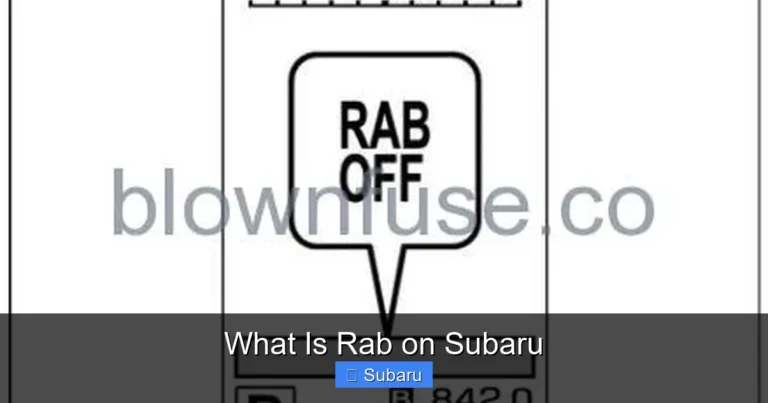
A persistent warning light on your dashboard (often labeled “RAB OFF” or with a camera icon) means the system is disabled or malfunctioning.
– **Cause**: Temporary deactivation (e.g., after turning off the engine).
**Fix**: Simply press the RAB button again after restarting.
– **Cause**: Software glitch.
**Fix**: Turn the car off, wait 30 seconds, then restart. This resets the system.
– **Cause**: Hardware failure.
**Fix**: Schedule service at a Subaru dealership—RAB relies on precise calibration and may need professional diagnosis.
RAB Doesn’t Brake When It Should
– **Cause**: Object outside detection range. RAB typically only works within 1–3 feet and at speeds below 9 mph.
**Fix**: Drive slower when reversing and stay within the system’s effective zone.
– **Cause**: Wet, icy, or muddy conditions reducing sensor accuracy.
**Fix**: Clean sensors and avoid relying solely on RAB in poor weather.
Remember: RAB is not designed to stop high-speed collisions or detect fast-moving objects (like a bike suddenly rolling behind you). It’s a last-resort safety net—not a substitute for careful driving.
Best Practices for Using RAB Safely
Now that you know how to turn on RAB, let’s talk about using it wisely. Like any driver assist feature, RAB works best when paired with good habits.
Always Do a Visual Check First
Before shifting into reverse, walk around your vehicle (if safe) or use your mirrors and camera to scan for obstacles. RAB can’t see everything—especially small children, pets, or objects below bumper height.
Keep Sensors Clean
Dirt, snow, ice, or even bug splatter can block ultrasonic sensors. Make it a habit to wipe down the rear bumper weekly, especially in winter or after off-road trips.
Don’t Rely on RAB Alone
Subaru explicitly states that RAB is a “driver support system,” not an autonomous feature. Always keep your foot near the brake pedal and be ready to stop manually.
Understand Its Limits
RAB may not detect:
– Objects moving quickly toward the vehicle
– Very low or very high obstacles (e.g., parking blocks, tree branches)
– Soft or sound-absorbing materials (like foam or fabric)
Educate Your Passengers
If you have kids or frequent passengers, teach them not to play behind the car—even if RAB is on. Better safe than sorry.
Update Your Software
Subaru occasionally releases over-the-air updates that improve RAB performance. Check for updates through your infotainment system or visit a dealer.
RAB vs. Other Subaru Safety Features: How They Work Together
RAB doesn’t operate in isolation. It’s part of a network of safety systems that complement each other. Understanding how they interact can help you use your Subaru more confidently.
– **Rear Cross-Traffic Alert (RCTA)**: Warns you of vehicles approaching from the sides while reversing. Works alongside RAB but doesn’t brake automatically.
– **Blind Spot Detection (BSD)**: Alerts you to cars in your blind spots—useful when changing lanes, not reversing.
– **EyeSight®**: Monitors forward traffic for collision prevention, adaptive cruise control, and lane departure warnings. Doesn’t affect RAB directly but shares sensor data in some models.
– **Automatic Emergency Braking (AEB)**: Stops the car if you’re about to hit something ahead. RAB is the rear-facing version of this.
Think of RAB as your rear bumper’s guardian angel—while EyeSight watches the road ahead, RAB keeps an eye on what’s behind you.
Conclusion: Make RAB Work for You
Learning how to turn on RAB in Subaru vehicles is more than just a technical skill—it’s about taking control of your safety. This feature can prevent fender benders, protect pedestrians, and give you peace of mind in tricky parking situations. But like any tool, it’s only effective when used correctly.
Remember: RAB is there to assist, not replace, your judgment. Keep those sensors clean, stay alert, and never assume the car will stop for you. With the right knowledge and habits, you’ll get the most out of this smart Subaru innovation—and maybe even avoid a costly repair (or worse) down the road.
So the next time you slide into your driver’s seat, take a moment to check that RAB is ready to go. Press that button, trust the tech—but always keep your eyes on the road (or in this case, the rearview screen). Your Subaru, your passengers, and that innocent shopping cart will thank you.
Frequently Asked Questions
How do I know if my Subaru has RAB?
Check your owner’s manual or look for four small sensors in the rear bumper. RAB is typically available on Premium, Limited, and Touring trims of Outback, Forester, Ascent, Crosstrek, and Legacy models from 2019 onward.
Can I turn RAB on permanently?
Yes, on most newer Subaru models, you can set RAB to stay on by going to Settings > Driver Assistance > Reverse Automatic Braking and selecting “Always On.” This prevents you from having to press the button every time.
Why won’t my RAB turn on even after pressing the button?
Common reasons include dirty sensors, the vehicle not being in reverse, or the system being disabled in settings. Clean the rear bumper and check your driver assistance menu.
Does RAB work in the rain or snow?
RAB can be less effective in heavy rain, snow, or mud because these conditions may block or interfere with the ultrasonic sensors. Always clean sensors after恶劣 weather and use extra caution.
Can RAB damage my brakes?
No, RAB uses the same braking system as normal stops and is designed to apply gentle, controlled pressure. It won’t cause wear or damage when functioning properly.
What should I do if RAB activates unexpectedly?
First, check for actual obstacles. If it was a false alert (e.g., due to a curb or debris), clean the sensors and consider lowering sensitivity in settings. If it happens frequently, have the system inspected.