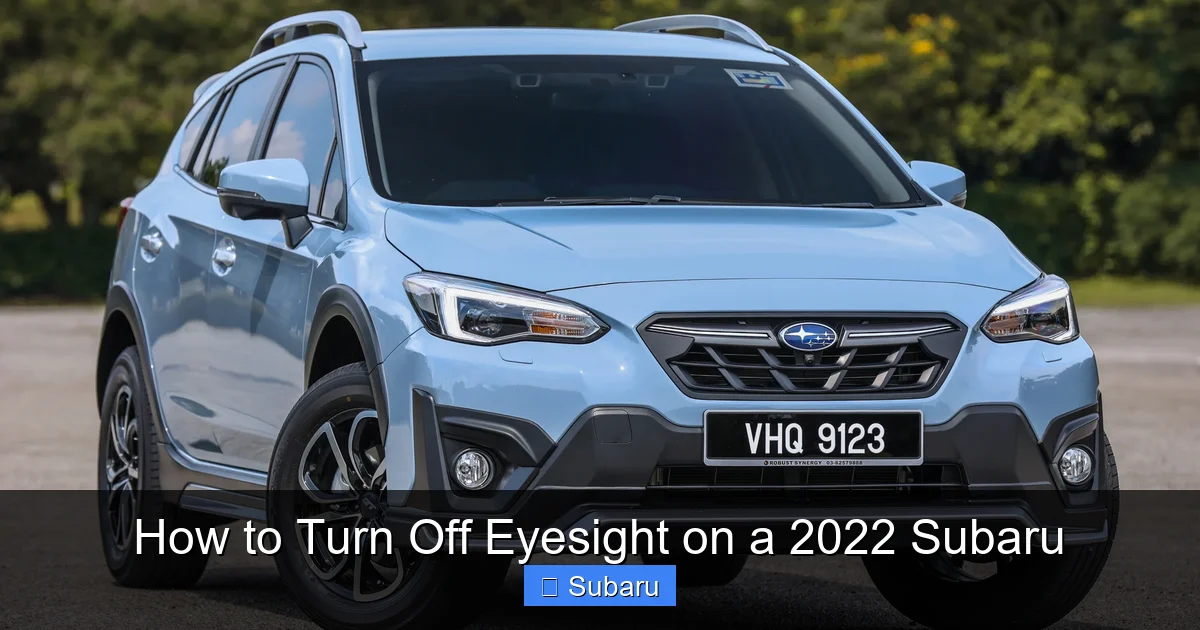
How to Turn Off Eyesight on a 2022 Subaru

Contents
- 1 Key Takeaways
- 2 Understanding Subaru EyeSight: What It Is and Why It Matters
- 3 When Should You Consider Turning Off EyeSight?
- 4 Step-by-Step: How to Turn Off EyeSight on a 2022 Subaru
- 5 Important Warnings and Safety Considerations
- 6 Troubleshooting Common EyeSight Issues
- 7 Best Practices for Managing EyeSight in Daily Driving
- 8 Conclusion: Use EyeSight as Intended—For Safety
- 9 Frequently Asked Questions


Turning off EyeSight on a 2022 Subaru is simple but should only be done temporarily. This guide walks you through the process, explains when it’s appropriate, and highlights important safety considerations to keep in mind.
This is a comprehensive guide about How to Turn Off EyeSight on a 2022 Subaru.
Key Takeaways
- EyeSight can be turned off using the master switch on the dashboard. This disables all active safety features like adaptive cruise control and lane departure warning.
- Disabling EyeSight is not recommended for regular driving. The system enhances safety by preventing collisions and keeping you in your lane.
- You can temporarily disable specific features like lane keep assist. Use the steering wheel controls to turn off individual functions without shutting down the entire system.
- EyeSight automatically reactivates when you restart the car. There’s no need to manually turn it back on after each drive.
- Calibration may be required after windshield replacement. If EyeSight behaves oddly, a professional recalibration might be necessary.
- Always re-enable EyeSight before normal driving. Keeping it off increases the risk of accidents, especially on highways or in heavy traffic.
- Consult your owner’s manual for model-specific instructions. Trim levels and options can affect how EyeSight operates and how it’s controlled.
[FEATURED_IMAGE_PLACEHOLDER]
Understanding Subaru EyeSight: What It Is and Why It Matters
If you’ve recently driven a 2022 Subaru—or even just ridden in one—you’ve likely noticed something different about the way the car behaves on the road. Maybe it gently tugged the steering wheel back when you drifted out of your lane. Or perhaps it slowed down automatically when traffic ahead came to a stop. That’s EyeSight in action.
EyeSight is Subaru’s advanced driver-assistance system (ADAS), introduced over a decade ago and now standard on nearly all 2022 Subaru models, including the Outback, Forester, Crosstrek, and Legacy. It uses a stereo camera system mounted near the rearview mirror to monitor the road ahead, detecting vehicles, pedestrians, lane markings, and potential hazards. Based on this data, EyeSight can intervene to help prevent accidents or reduce their severity.
The system includes several key features: Adaptive Cruise Control (ACC), Pre-Collision Braking, Lane Departure and Sway Warning, Lane Keep Assist, and Lead Vehicle Start Alert. Together, these technologies form one of the most comprehensive safety suites available in non-luxury vehicles. In fact, studies by the Insurance Institute for Highway Safety (IIHS) have shown that vehicles equipped with EyeSight experience significantly fewer front-to-rear crashes and pedestrian-related incidents.
But despite its benefits, some drivers find EyeSight overly sensitive or intrusive—especially in certain driving conditions. For example, lane keep assist might feel too aggressive on winding rural roads, or adaptive cruise control could disengage unexpectedly in heavy rain. That’s why Subaru gives you the option to turn off EyeSight—but with important caveats.
It’s crucial to understand that disabling EyeSight removes a critical layer of protection. While it’s technically possible to turn it off, doing so permanently or without good reason undermines the very purpose of having such advanced safety tech in the first place. Think of it like removing your seatbelt because it’s uncomfortable—it might feel freeing in the moment, but it dramatically increases your risk in an emergency.
So why would anyone want to turn it off? Legitimate reasons include driving on poorly marked roads, towing a trailer (which can interfere with camera visibility), or performing maintenance that requires the system to be inactive. In these cases, temporary deactivation makes sense. But for everyday driving, keeping EyeSight active is strongly advised.
When Should You Consider Turning Off EyeSight?
Before diving into the “how,” let’s address the “when.” Knowing when—and when not—to disable EyeSight is just as important as knowing the steps to do it.
One common scenario is driving on roads with faded or missing lane markings. EyeSight relies heavily on clear lane lines to function properly. If you’re traveling through construction zones, rural areas with worn pavement, or snow-covered streets, the system may struggle to detect lanes accurately. In these cases, lane keep assist might repeatedly tug the steering wheel or issue false warnings, which can be distracting or even dangerous if it causes overcorrection.
Another valid reason is towing. When you attach a trailer or haul a heavy load, the added weight and altered aerodynamics can affect how your Subaru handles. More importantly, the trailer might block the EyeSight cameras’ view of the road ahead. Subaru explicitly recommends disabling EyeSight when towing to prevent erratic behavior from adaptive cruise control or pre-collision braking.
Mechanical work or windshield replacement also warrants temporary deactivation. If you’re replacing the windshield—which houses the EyeSight cameras—the system must be recalibrated afterward by a certified technician. Until that’s done, it’s safer to keep EyeSight off. Similarly, if you’re performing diagnostics or repairs that involve the electrical system, turning off EyeSight prevents unintended activations.
Some drivers also turn it off during off-road adventures. While Subarus are known for their all-wheel-drive capability, trails and rugged terrain often lack lane markings and have unpredictable obstacles. EyeSight isn’t designed for such environments, and its interventions could interfere with skilled off-road driving.
Lastly, personal preference plays a role. A small number of drivers simply don’t like the feel of automated assistance—they prefer full manual control. While this is understandable, it’s worth noting that disabling safety features for comfort or habit significantly reduces the vehicle’s protective capabilities.
In all these cases, the key word is *temporary*. EyeSight should only be off for the duration of the specific situation. Once you return to normal driving conditions—clear roads, no trailer, calibrated cameras—you should reactivate the system immediately.
Step-by-Step: How to Turn Off EyeSight on a 2022 Subaru
Now that we’ve covered the “why,” let’s get into the “how.” Turning off EyeSight on a 2022 Subaru is straightforward, but the exact method depends on your model and trim level. Most 2022 Subarus use a combination of physical buttons and steering wheel controls.
The primary way to disable EyeSight is through the master switch located on the lower left side of the dashboard, near the steering column. Look for a button labeled “EyeSight” or marked with an icon resembling two eyes or a camera. Pressing this button once will turn off the entire system. You’ll know it’s off when the EyeSight indicator light on the instrument cluster turns amber (or stays lit instead of turning green).
Here’s a step-by-step breakdown:
1. Start your vehicle – Make sure the engine is running or the ignition is in the “ON” position. EyeSight controls won’t respond if the car is off.
2. Locate the EyeSight button – It’s typically found on the dashboard, left of the steering wheel. On some models, it may be integrated into the climate control panel or near the hazard lights.
3. Press and hold the button – A single press usually toggles the system on or off. However, on certain trims, you may need to hold it for a few seconds until you see a confirmation message on the dashboard display.
4. Check the instrument cluster – Once disabled, the EyeSight icon will appear amber or grayed out. If it’s green, the system is still active.
5. Confirm functionality – Test by gently drifting toward a lane line (in a safe, legal environment). If the car doesn’t alert you or correct your steering, EyeSight is off.
It’s important to note that turning off the master switch disables *all* EyeSight features at once. You won’t have adaptive cruise control, lane keep assist, or pre-collision braking until you turn it back on.
Alternatively, you can disable individual features without shutting down the whole system. For example, if you only want to turn off lane keep assist but keep adaptive cruise control active, use the steering wheel controls:
– Press the “INFO” or “DISP” button to access the driver assistance menu.
– Navigate to “Lane Keep Assist” using the arrow keys.
– Toggle it off. The change will be reflected in the instrument cluster.
This granular control is useful if you find one feature annoying but still want the benefits of others. For instance, some drivers dislike the constant steering corrections from lane keep assist but appreciate the peace of mind from pre-collision braking.
Remember: EyeSight automatically reactivates every time you restart the vehicle. There’s no permanent “off” setting. So even if you turn it off during your drive, it will be back on the next time you start the car—unless you disable it again.
Important Warnings and Safety Considerations
While turning off EyeSight is easy, doing so comes with real risks. This isn’t like disabling a radio or turning off interior lights—it directly impacts your safety and the safety of others on the road.
First and foremost, EyeSight is designed to prevent accidents. According to Subaru, vehicles equipped with EyeSight have up to a 40% lower rate of property-damage claims and a 60% lower rate of bodily injury claims compared to non-equipped models. Disabling it removes a proven layer of protection.
One major concern is overreliance followed by sudden disengagement. If you’ve grown accustomed to EyeSight handling braking or lane corrections, your reaction time may slow when the system is off. You might not notice a stopped car ahead or drift out of your lane without warning. This is especially dangerous on highways, where speeds are higher and margins for error are smaller.
Another issue is weather and lighting conditions. EyeSight performs best in daylight and clear weather. But even in rain, fog, or dusk, it often still provides valuable assistance—like alerting you to a pedestrian stepping into the road. Turning it off in these conditions leaves you fully responsible for spotting hazards that the system could have caught.
There’s also the legal and insurance angle. While there’s no law requiring you to keep EyeSight on, insurers may consider disabling safety features when assessing claims. If an accident occurs while EyeSight was intentionally turned off, your claim could be scrutinized more closely—even if the system wouldn’t have prevented the crash.
Additionally, frequent toggling can lead to confusion. You might forget whether EyeSight is on or off, especially if you share the car with family members. A simple check of the dashboard icon before driving can prevent this, but it’s easy to overlook.
Finally, be aware that some advanced features—like Highway Driving Assist (available on higher trims)—depend entirely on EyeSight. Disabling the system means losing semi-autonomous driving capabilities, which can be a significant downgrade in convenience and fatigue reduction on long trips.
In short: only turn off EyeSight when absolutely necessary, and always re-enable it as soon as the reason for disabling it no longer applies.
Troubleshooting Common EyeSight Issues
Even when EyeSight is on, it doesn’t always work perfectly. If you’re experiencing glitches, it might tempt you to turn it off permanently—but often, the issue can be resolved without disabling the entire system.
One common problem is the “EyeSight Unavailable” message. This usually appears when the cameras are obstructed—by dirt, snow, ice, or even a poorly placed dash cam. The fix? Clean the windshield thoroughly, especially the area around the rearview mirror. Use a microfiber cloth and glass cleaner, and avoid abrasive materials that could scratch the lens.
Another frequent issue is erratic behavior in certain lighting conditions. Direct sunlight hitting the cameras can cause temporary blindness, leading to false warnings or disengagement. Similarly, driving toward a bright sunset or under intense streetlights at night can confuse the system. In these cases, the best solution is patience—EyeSight typically recalibrates once lighting normalizes.
If the system fails to recognize lanes consistently, check for worn or faded road markings. EyeSight needs clear contrast between the road and lane lines. On roads with poor maintenance, the system may struggle. Unfortunately, there’s no software fix for this—only improved infrastructure.
Software glitches can also occur. Subaru periodically releases updates to improve EyeSight performance. If your system seems buggy or unresponsive, visit a dealership to check for available updates. These are often free and can resolve issues like delayed braking or overly sensitive lane alerts.
In rare cases, the problem may be hardware-related. If the cameras are misaligned—due to an accident or improper windshield installation—the system won’t function correctly. This requires professional recalibration, which involves driving the car on a calibrated route while specialized equipment adjusts the camera angles. Never attempt this yourself; only certified technicians should perform recalibration.
Lastly, if you’ve recently replaced the windshield, assume EyeSight needs recalibration—even if it seems to be working. Subaru mandates this step to ensure accuracy. Driving with uncalibrated cameras is risky and could lead to malfunction during critical moments.
Best Practices for Managing EyeSight in Daily Driving
Rather than turning EyeSight on and off constantly, consider adopting habits that maximize its benefits while minimizing annoyances.
First, customize the settings to suit your driving style. Most 2022 Subarus allow you to adjust sensitivity levels for features like pre-collision braking and lane departure warnings. Go into the vehicle settings menu (usually accessed via the steering wheel or infotainment screen) and experiment with different levels. You might find a middle ground that’s helpful without being intrusive.
Second, keep the windshield clean. A dirty or streaked windshield is the number one cause of EyeSight malfunctions. Make it a habit to clean the glass regularly, especially before long trips or in winter months when road salt and grime accumulate quickly.
Third, use adaptive cruise control wisely. On highways, ACC can reduce driver fatigue by maintaining a set speed and distance from the car ahead. But in stop-and-go city traffic, it may react too slowly or too abruptly. In dense urban areas, it’s often better to drive manually—but keep other EyeSight features active for collision protection.
Fourth, educate all drivers who use your Subaru. If your teen, spouse, or friend borrows the car, make sure they understand how EyeSight works and why it should generally remain on. A quick demo of the dashboard icons and basic functions can prevent confusion and unsafe driving.
Finally, schedule regular maintenance checks. Include EyeSight in your routine service visits. Technicians can verify camera alignment, check for software updates, and ensure all sensors are functioning properly. This proactive approach helps catch issues early and keeps the system reliable.
Conclusion: Use EyeSight as Intended—For Safety
The ability to turn off EyeSight on a 2022 Subaru is a useful feature—but it should be treated as an exception, not the rule. This advanced safety system was engineered to protect you, your passengers, and others on the road. While it’s not perfect, its benefits far outweigh its occasional quirks.
Disabling EyeSight should only be done temporarily and for specific, justified reasons—like towing, off-roading, or driving on poorly marked roads. Even then, always re-enable it as soon as conditions allow. Remember, the system resets to “on” every time you start the car, so there’s no need to worry about accidentally leaving it off long-term.
If you find certain features annoying, try adjusting the settings or disabling individual functions instead of turning off the entire system. And if EyeSight isn’t working properly, don’t assume it’s broken—often, a simple cleaning or software update is all it takes.
Ultimately, EyeSight is one of the reasons Subarus consistently earn top safety ratings. By using it as intended, you’re not just following the manufacturer’s advice—you’re making a smart choice for your safety and peace of mind. So the next time you’re tempted to hit that EyeSight button, ask yourself: is this really necessary? In most cases, the answer will be no.
Frequently Asked Questions
Can I permanently turn off EyeSight on my 2022 Subaru?
No, EyeSight cannot be permanently disabled. It automatically reactivates every time you restart the vehicle. You must manually turn it off each time if desired.
Will turning off EyeSight affect my warranty or insurance?
Disabling EyeSight doesn’t void your warranty, but insurers may consider it when processing claims. Always re-enable the system for normal driving to maintain safety and coverage integrity.
Why does EyeSight turn off in the rain or snow?
Heavy rain, snow, or fog can obstruct the cameras, causing EyeSight to temporarily disable itself. Keep the windshield clean and dry to minimize disruptions.
Can I turn off only lane keep assist without disabling all of EyeSight?
Yes. Use the steering wheel controls to access the driver assistance menu and toggle lane keep assist off individually while keeping other features active.
Do I need to recalibrate EyeSight after a windshield replacement?
Yes. Subaru requires professional recalibration after any windshield replacement to ensure the cameras are properly aligned and functioning correctly.
Is it safe to drive with EyeSight turned off on the highway?
Driving without EyeSight on highways increases accident risk, especially at high speeds. Only disable it temporarily and re-enable it as soon as possible for maximum safety.