How to Turn Off Avh on Subaru Forester

Contents
- 1 Key Takeaways
- 2 What Is AVH and Why Does It Matter in Your Subaru Forester?
- 3 How to Turn Off AVH on Subaru Forester: Step-by-Step Instructions
- 4 When Should You Turn Off AVH? Practical Scenarios
- 5 Troubleshooting Common AVH Issues
- 6 Safety Considerations and Best Practices
- 7 Model Year Differences: What You Need to Know
- 8 Conclusion: Master Your Subaru Forester’s AVH System
- 9 Frequently Asked Questions

Car GPS Navigator

Car Windshield Wiper Blades
Car Emergency Roadside Kit

Torque Wrench Set
Turning off Auto Vehicle Hold (AVH) on your Subaru Forester is simple but often misunderstood. This guide walks you through the process for every model year, explains when it’s safe to disable, and offers troubleshooting tips for stubborn systems.
This is a comprehensive guide about How to Turn Off AVH on Subaru Forester.
Key Takeaways
- AVH stands for Auto Vehicle Hold, a safety feature that keeps your Forester stationary after stopping, even without pressing the brake pedal.
- You can temporarily disable AVH using the dashboard button, but it reactivates each time you restart the vehicle.
- Some newer Forester models allow permanent deactivation through the infotainment menu—check your owner’s manual for compatibility.
- Disabling AVH is useful on steep hills or during towing, but it reduces safety in stop-and-go traffic.
- Always re-enable AVH after use to maintain optimal safety and prevent rollback on inclines.
- If the AVH light stays on or won’t turn off, it may indicate a system fault—consult a Subaru technician.
- Understanding your Forester’s specific model year and trim is key to knowing which method works for your vehicle.
[FEATURED_IMAGE_PLACEHOLDER]
What Is AVH and Why Does It Matter in Your Subaru Forester?
If you’ve ever driven a modern Subaru Forester, chances are you’ve noticed a small green light on your dashboard that says “AVH” or “AUTO VEHICLE HOLD.” You might have wondered what it does—or even how to turn it off. Don’t worry, you’re not alone. Many Forester owners find this feature helpful at first, then frustrating when they don’t understand how to control it.
Auto Vehicle Hold, or AVH, is a driver-assist technology designed to make driving safer and more convenient, especially in heavy traffic or on hilly roads. When activated, AVH automatically holds your vehicle in place after you come to a complete stop and release the brake pedal. This means you don’t have to keep your foot on the brake or shift into Park—your Forester stays put until you press the accelerator.
This feature is particularly useful in stop-and-go traffic, at stop signs, or when waiting at traffic lights. It reduces driver fatigue and helps prevent accidental rollback on inclines, which is a common concern for manual transmission drivers—though most Foresters today are equipped with automatic transmissions.
But here’s the catch: AVH is always on by default. Every time you start your Forester, the system activates automatically. While this is great for safety, it can be annoying if you prefer more traditional driving dynamics or if you’re parking on a steep hill and want full control over your vehicle’s movement.
That’s why knowing how to turn off AVH on your Subaru Forester is such a valuable skill. Whether you’re a new owner or have been driving your Forester for years, understanding this feature—and how to manage it—can improve your driving experience and give you greater control behind the wheel.
How to Turn Off AVH on Subaru Forester: Step-by-Step Instructions
Turning off AVH on your Subaru Forester is surprisingly simple, but the exact steps depend on your model year and trim level. Most Foresters from 2014 onward come equipped with AVH, but the method to disable it varies slightly. Below, we’ll walk you through the most common ways to turn it off—temporarily and, in some cases, permanently.
Method 1: Using the AVH Button (Temporary Disable)
The easiest and most common way to turn off AVH is by pressing the dedicated AVH button on your dashboard. Here’s how:
1. Start your Subaru Forester and ensure the vehicle is in Park (P).
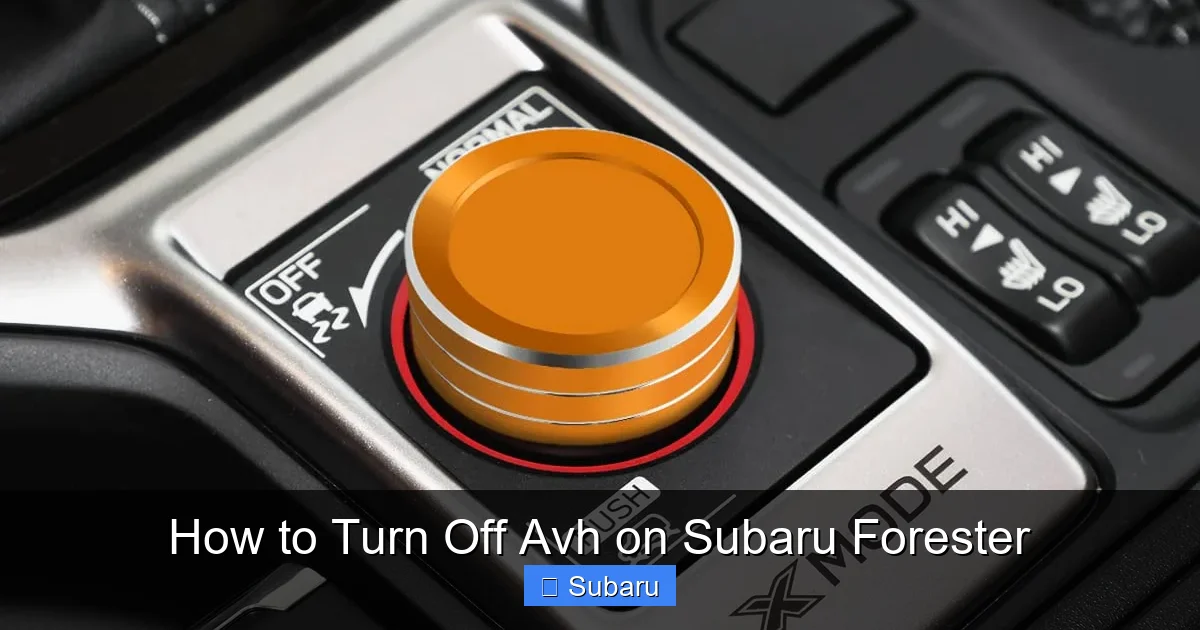
2. Look for a button labeled “AVH” or “AUTO VEHICLE HOLD” near the gear shifter or center console. It’s usually a small, round button with a green light.
3. Press and hold the AVH button for about 2–3 seconds.
4. The green AVH light on your dashboard will turn off, indicating the system is disabled.
5. You can now drive without the vehicle automatically holding after stops.
Important note: This only disables AVH temporarily. The system will reactivate the next time you start the car. If you want to keep it off, you’ll need to repeat this process each time.
Method 2: Using the Infotainment Menu (Permanent Disable on Select Models)
Some newer Subaru Foresters—particularly those from 2019 onward with the updated Starlink infotainment system—allow you to permanently disable AVH through the vehicle settings menu. This is a game-changer for drivers who never want to use the feature.
Here’s how to do it:
1. Turn on your Forester and wait for the infotainment screen to fully load.
2. Tap the “Settings” icon (usually a gear or wrench symbol).
3. Navigate to “Vehicle Settings” or “Driver Assistance.”
4. Look for an option labeled “Auto Vehicle Hold” or “AVH.”
5. Toggle the setting to “Off.”
6. Confirm your selection.
Once disabled this way, AVH will remain off even after restarting the vehicle—unless you manually re-enable it.
Tip: Not all Forester trims support this feature. If you don’t see the option in your menu, your vehicle likely only allows temporary disablement via the button.
Method 3: Disabling via EyeSight System (If Equipped)
If your Forester comes with Subaru’s EyeSight driver-assist suite (common on higher trims like Limited, Touring, or Wilderness), AVH may be linked to the system’s settings. In some cases, adjusting EyeSight preferences can indirectly affect AVH behavior.
To check:
1. Press the “EyeSight” button on the dashboard (if available).
2. Use the steering wheel controls to navigate to “Vehicle Settings.”
3. Look for “Auto Vehicle Hold” or similar.
4. Toggle it off.
This method is less common but worth trying if the standard button or menu options don’t work.
When Should You Turn Off AVH? Practical Scenarios
Now that you know how to turn off AVH, the next question is: when should you actually do it? While AVH is a helpful safety feature, there are certain driving situations where disabling it makes sense.
Driving on Steep Hills or Mountain Roads
If you frequently drive on steep inclines—like mountain passes or hilly neighborhoods—you might find AVH interfering with your control. The system holds the vehicle for a few seconds after you release the brake, which can feel sluggish or unpredictable when you’re trying to accelerate smoothly uphill.
By turning off AVH, you regain full control over your braking and acceleration. This is especially useful if you’re used to using the handbrake or heel-toe techniques on hills. Just remember to re-engage the brake manually to prevent rollback.
Towing or Using a Car Trailer
When towing a trailer or carrying heavy loads, AVH can sometimes cause jerky stops or unnecessary strain on the braking system. Disabling it allows for smoother control, especially when backing up or maneuvering in tight spaces.
Additionally, some drivers report that AVH can interfere with trailer brake controllers or stability systems. Turning it off ensures all systems work in harmony.
Off-Roading or Rough Terrain
If you take your Forester off the beaten path—whether on dirt trails, gravel roads, or muddy terrain—AVH might not respond well to uneven surfaces. The system is designed for paved roads and can misinterpret stops on loose or bumpy ground.
Disabling AVH gives you more predictable handling and reduces the risk of unintended braking or stalling.
Parallel Parking or Tight Maneuvers
In crowded urban areas, AVH can make parallel parking or tight turns feel awkward. The system holds the car after each micro-stop, which can slow down your progress and make it harder to judge distances.
Turning it off allows for quicker, more responsive movements—ideal for city driving.
Personal Preference and Driving Style
Let’s be honest: some drivers just don’t like electronic aids. If you prefer a more analog, hands-on driving experience, disabling AVH might simply feel better to you. There’s nothing wrong with that—as long as you understand the trade-offs.
Just remember: AVH is there for a reason. It enhances safety, especially for new drivers or those unfamiliar with hill starts. Use your judgment and re-enable it when safety is a priority.
Troubleshooting Common AVH Issues
Even with the right steps, you might run into problems when trying to turn off AVH on your Subaru Forester. Here are some common issues and how to fix them.
AVH Light Won’t Turn Off
If you press the AVH button but the green light stays on, there could be a few reasons:
– The vehicle isn’t in Park: AVH can only be disabled when the car is fully stopped and in Park. Make sure you’ve shifted correctly.
– The button is stuck or faulty: Try pressing it multiple times or cleaning around the button. If it’s physically damaged, a dealership visit may be needed.
– System error: A malfunction in the brake system, ABS, or EyeSight could prevent AVH from responding. Check for warning lights on the dashboard.
AVH Reactivates After Restarting
This is normal behavior for most Forester models. AVH is designed to reset to “on” every time you start the car. The only way to avoid this is if your vehicle supports permanent disablement via the infotainment menu (see Method 2 above).
If you don’t have that option, you’ll need to press the AVH button each time you drive.
AVH Doesn’t Work at All
If AVH won’t activate—even when you want it on—there may be an underlying issue:
– Low brake fluid: Check your brake fluid level and top it off if needed.
– Faulty brake switch: The sensor that detects brake pedal movement may be broken.
– Software glitch: A quick restart (turn the car off, wait 30 seconds, then restart) can often reset the system.
– EyeSight calibration needed: If your Forester has EyeSight, improper calibration can affect AVH. Visit a Subaru service center for a check.
AVH Engages Unexpectedly
Sometimes, AVH might activate when you don’t expect it—like when rolling slowly in traffic. This can be jarring.
To prevent this, avoid releasing the brake pedal completely during slow maneuvers. Keep light pressure on the brake until you’re ready to stop fully.
Safety Considerations and Best Practices
While turning off AVH can improve control in certain situations, it’s important to use this feature responsibly. Disabling safety systems always comes with trade-offs.
Always Re-Enable AVH When Appropriate
If you disable AVH for a specific task—like towing or off-roading—make sure to turn it back on afterward. Leaving it off permanently increases the risk of rollback on hills or accidental movement in traffic.
Use the Handbrake on Steep Hills
When AVH is off, rely on your parking brake (handbrake or electronic parking brake) when stopping on inclines. This gives you the same hold without relying on the brake pedal.
Stay Alert in Stop-and-Go Traffic
Without AVH, you’ll need to keep your foot on the brake during long stops. This can lead to fatigue, so take breaks during heavy traffic.
Educate Passengers and New Drivers
If others drive your Forester, make sure they understand how AVH works—and whether it’s currently on or off. A sudden change in behavior can be confusing or dangerous.
Regular Maintenance Matters
AVH relies on several systems: brakes, sensors, and software. Keep up with regular maintenance, including brake inspections and software updates, to ensure everything works smoothly.
Model Year Differences: What You Need to Know
Not all Subaru Foresters are created equal when it comes to AVH. The feature has evolved over the years, and the method to disable it varies by generation.
2014–2018 Subaru Forester
These models typically have a basic AVH system with a physical button near the gear shifter. You can only disable it temporarily—pressing the button turns it off until the next restart.
2019–2024 Subaru Forester
Starting with the 2019 redesign, many Foresters gained access to the Starlink infotainment system, which allows permanent AVH disablement via the settings menu. Higher trims (Limited, Touring, Wilderness) are more likely to have this feature.
2025 and Beyond
As Subaru continues to integrate more advanced driver-assist technologies, future models may offer even more customization. Keep an eye on software updates, as Subaru sometimes adds new features via over-the-air updates.
Trim Level Matters
Even within the same model year, AVH functionality can vary. Base trims (like the Forester Base or Premium) may only offer temporary disablement, while higher trims include menu-based controls.
Always consult your owner’s manual or visit a Subaru dealership to confirm your vehicle’s capabilities.
Conclusion: Master Your Subaru Forester’s AVH System
Knowing how to turn off AVH on your Subaru Forester isn’t just about convenience—it’s about understanding your vehicle and using its features wisely. Whether you’re navigating steep hills, towing a trailer, or simply prefer a more hands-on driving experience, being able to control AVH puts you in the driver’s seat—literally.
Remember, AVH is a safety feature designed to help, not hinder. Use it when it makes sense, and disable it when you need more control. With the right knowledge, you can enjoy the best of both worlds: modern technology and classic driving feel.
Keep this guide handy, share it with fellow Forester owners, and drive safe. Your Subaru is built for adventure—make sure you’re in full control every step of the way.
Frequently Asked Questions
Can I permanently turn off AVH on my Subaru Forester?
Yes, but only on select models from 2019 onward with the Starlink infotainment system. Use the vehicle settings menu to disable it permanently. Older models only allow temporary disablement via the dashboard button.
Why does AVH turn back on after I restart my car?
This is normal. AVH is designed to reset to “on” every time the vehicle is started for safety reasons. Only newer Foresters with menu-based settings can keep it off permanently.
Is it safe to drive with AVH turned off?
Yes, as long as you’re aware of the risks. Without AVH, you must manually hold the brake on stops and use the parking brake on hills. It’s safe for experienced drivers but less ideal for beginners.
What does the AVH light mean when it’s blinking?
A blinking AVH light usually indicates a system malfunction. Check for other warning lights, ensure the brake fluid is full, and visit a Subaru service center if the issue persists.
Can AVH be disabled while driving?
No. AVH can only be turned off when the vehicle is in Park. Attempting to disable it while moving will not work and could be unsafe.
Does AVH affect fuel efficiency?
Not significantly. AVH uses minimal energy and doesn’t impact engine performance or fuel economy. The benefit in safety and convenience far outweighs any negligible effect.