
How to Stop a Car Cover From Blowing Off in Wind

Quick Answer
To stop a car cover from blowing off, center it correctly, seat the elastic hems beneath both bumpers, and fasten every manufacturer-provided strap or buckle. If wind still makes the fabric balloon, the cover may be too large or poorly shaped for your vehicle; recent Car and Driver car cover testing also highlights fit and secure clasps as important outdoor-cover features.
5 quick steps to keep the cover secure
- Step 1 — Center it: Find the front label and align the cover evenly over the roof, mirrors, hood, and trunk.
- Step 2 — Seat the hems: Pull the front and rear elastic fully around their intended bumper edges.
- Step 3 — Use every strap: Fasten the supplied belly straps, buckles, or other approved retention points.
- Step 4 — Remove slack: Look for large loose panels that can fill with air and act like a sail.
- Step 5 — Respect strong wind: Follow your cover maker’s wind limits instead of simply tightening straps harder.
Fast diagnostic check
- If the cover still balloons after correct installation and fastening, check the size, worn elastic, damaged straps, and vehicle-to-cover shape match.
A car cover that keeps lifting in the wind is more than an annoyance. Repeated flapping can wear the fabric, stress seams, and move dirt across your vehicle’s paint.
My first check is always fit before adding more hardware. This 2026 guide explains how to secure a car cover properly, what tie-down methods make sense, and when taking the cover off is safer than fighting the wind.
In This Guide
Why Does a Car Cover Keep Blowing Off?
A car cover usually blows off because wind can get underneath loose fabric. Poor sizing, weak elastic, incorrect installation, or unused straps make that easier.
Definition: Car-cover wind lift happens when moving air enters beneath an exposed edge and creates enough pressure to raise, balloon, or shift the fabric.
Is the cover too large?
Oversizing is one of the first problems I check. Extra fabric creates large panels that can inflate whenever a gust reaches underneath the hem.
- Loose sides: Large folds hang beside the doors or rocker panels.
- Loose ends: The front or rear hem does not stay beneath the bumper.
- Ballooning: The roof or hood area rises noticeably during gusts.
- Constant shifting: The cover moves off-center even with its normal straps secured.
A universal car cover can work outdoors, but its dimensions still need to match the vehicle closely. A sedan, hatchback, SUV, pickup, and coupe have different shapes even at similar overall lengths.
Could the cover simply be installed incorrectly?
Yes. A correct-size cover can feel loose when it sits several inches too far forward, backward, or sideways.
Locate the front marking before tightening anything. Align mirror pockets first when the cover has them, then seat both ends around the bumpers.
- Confirm the cover is not backwards.
- Center the roof panel.
- Seat both mirror pockets evenly.
- Pull the elastic hem into its intended position.
- Fasten all supplied straps after alignment.
Are worn elastic and broken straps the problem?
Elastic hems lose holding power as they age. Strap stitching, buckles, and grommets can also deteriorate after repeated outdoor exposure.
Inspect every retention point before trusting the cover during windy weather. A single failed front or rear attachment can give wind an entry point.
Section Takeaway: A car cover usually blows off because it has too much uncontrolled fabric or too little effective retention. Correct the fit and installation before adding stronger tie-downs.
How Do You Secure a Car Cover So It Stays On?
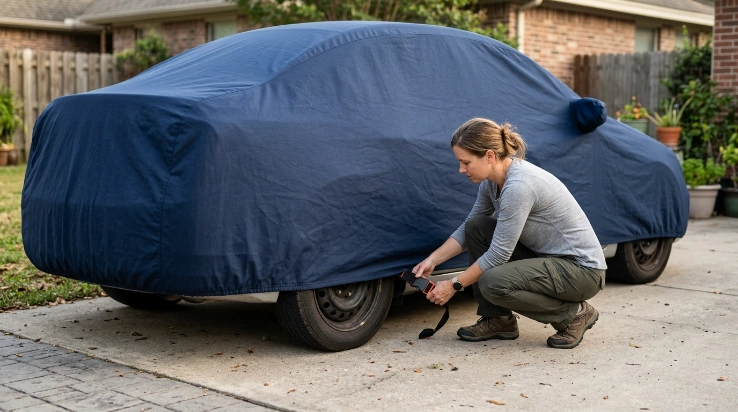
The safest method is to use the retention system designed for the cover. That usually means elastic hems plus manufacturer-provided underbody straps, buckles, grommets, or a compatible cable system.
1. Start with a clean, dry vehicle
Wind can move even a properly fitted cover slightly. Dust, sand, or grit underneath can then rub against the clear coat.
Keep the vehicle reasonably clean before covering it. General car-care resources from Kelley Blue Book can help with routine exterior upkeep.
2. Find the front and rear of the cover
Do not guess from the shape alone. Look for a sewn label or manufacturer marking that identifies the front.
Place the cover across the centerline of the vehicle. If it has mirror pockets, fit those before stretching the ends around the bumpers.
3. Seat the elastic hems completely
The front and rear hems should reach their intended positions without extreme stretching. Check for trapped or folded fabric around corners.
If one end barely reaches while the other hangs loose, stop. The cover may be off-center or incorrectly sized.
4. Fasten every built-in strap
Use every supplied strap when outdoor conditions call for it. Leaving one disconnected can allow a large section of fabric to move.
- Keep buckles away from painted panels.
- Keep straps away from hot exhaust parts.
- Avoid sharp brackets and unfinished metal edges.
- Pull straps snug rather than excessively tight.
- Recheck the cover after it settles into position.
Mechanic Alert: Do not crawl beneath a vehicle supported only by a jack to retrieve or route a car-cover strap. Use a safe method from beside the vehicle or get qualified help.
5. Check for ballooning before walking away
Stand back and inspect all four sides. Large hanging panels indicate that wind still has material to grab.
A stable cover should follow the basic shape of the vehicle without being stretched like a drum. If normal adjustment cannot achieve that, reconsider the size or cover style.
Section Takeaway: The best wind protection starts with correct installation, not improvised anchors. Center the cover, seat the hems, use its intended straps, and eliminate large areas of slack.
Which Car Cover Tie-Down Method Works Best?
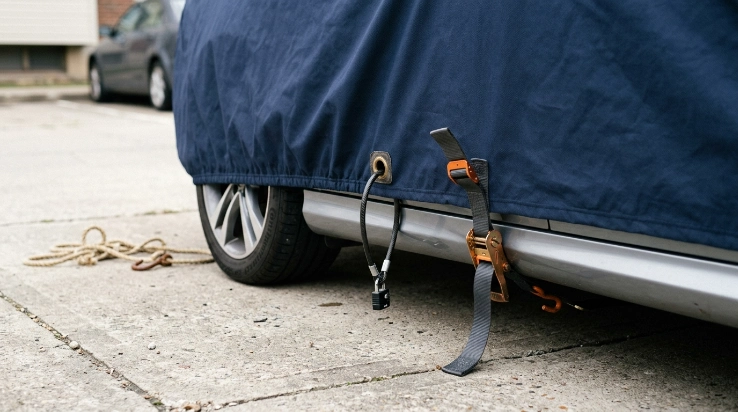
Manufacturer-supplied underbody straps are usually the best first choice because they were designed around that cover. Other options can help, but they should not damage the fabric or vehicle.
| Method | Best Use | Main Advantage | Main Caution |
|---|---|---|---|
| Built-in underbody straps | Normal outdoor parking | Designed for the cover | Do not overtighten |
| Approved gust straps | Extra wind control | Controls large loose panels | Use paint-safe hardware |
| Coated cable through grommets | Security plus retention | Adds a secondary restraint | Use only compatible grommets |
| Elastic hem alone | Calm conditions | Simple and quick | May be inadequate in wind |
| Random ropes or metal hooks | Not recommended | None worth the added risk | Can damage paint or fabric |
Are bungee cords safe for a car cover?
Only use them when your cover maker permits that setup and the attachment points are appropriate. Exposed hooks can strike paint, glass, wheels, or trim when wind moves them.
I prefer wide, purpose-built straps over thin cords whenever the manufacturer supports them. Wider straps spread load across a larger area.
Does a cable lock stop a cover from blowing away?
A coated cable can add retention when the cover includes reinforced security grommets. Its main purpose may still be theft deterrence rather than wind control.
Never punch your own holes into fabric unless the manufacturer provides instructions. An unreinforced hole can tear when wind loads it.
Should you weigh the cover down?
I would avoid placing hard household objects on the cover. Bricks, tools, metal weights, and similar items can shift or fall against the vehicle.
Use equipment made for the specific cover instead. A retention system should control fabric without creating a new source of scratches or dents.
Section Takeaway: Built-in straps and cover-specific accessories are preferable to improvised ropes, hooks, or weights. Any extra restraint should remain clear of paint, exhaust parts, and sharp edges.
How Do You Stop a Car Cover From Flapping Without Damaging Paint?
Reduce the loose fabric that wind can move, but do not overtighten the cover. The goal is controlled movement rather than maximum tension.
Keep dirt out from underneath
Wind-driven flapping becomes more concerning when grit sits between the cover and the clear coat. Movement can drag those particles across raised body areas.
- Remove loose dust, sand, and leaves before installation.
- Keep the inside surface of the cover clean.
- Do not drag a dirty cover across the ground.
- Store the cover in a clean, dry bag when removed.
Car and Driver’s testing process cleaned vehicles before installing covers so dirt would not interfere with the evaluation. That is a useful habit for everyday owners too.
Pay attention to high-contact areas
Mirrors, fender peaks, roof edges, spoilers, and bumper corners often contact the fabric more firmly than flat panels. Those areas deserve extra inspection after windy weather.
If you repeatedly see the same panel fluttering against one spot, solve the movement problem. Do not assume a soft lining makes uncontrolled rubbing harmless.
Do not tighten until seams are under heavy stress
A tighter strap is not automatically a safer strap. Excessive tension can load seams, grommets, buckles, and mirror pockets.
The cover should remain snug while still sitting naturally over the vehicle. If correct tension cannot control a large loose panel, the fit may be wrong.
Section Takeaway: Preventing wind-related paint damage requires three things: clean surfaces, a close fit, and controlled fabric movement. More tension cannot compensate for a poorly sized cover.
Should You Leave a Car Cover On During Strong Wind?
Not always. In severe wind, removing and safely storing the cover can be better than adding more straps.
Check your cover manufacturer’s wind instructions
Wind limits are product-specific. Do not assume every outdoor cover can remain installed through the same conditions.
For example, Coverking’s vehicle-cover instructions say not to rely only on the elastic bottom in moderate wind and advise removing its cover when high-wind conditions reach 30 mph or more.
That number applies to Coverking’s guidance, not every brand. Check the instructions for your exact cover before a storm arrives.
What should you do before a windstorm?
Make the decision while conditions are still safe. Do not struggle with a large sheet of fabric beside traffic, trees, or flying debris once strong gusts are underway.
- Check the weather forecast and alerts.
- Read the cover maker’s wind precautions.
- Move the vehicle into a garage when possible.
- Use a sheltered parking location if appropriate.
- Remove and store the cover when its instructions call for removal.
The National Weather Service wind-safety guidance warns that loose outdoor objects can become airborne during high winds. It also recommends staying clear of trees and other wind hazards.
Can parking position help?
A wall, garage, or other suitable structure may reduce direct exposure when parking is permitted and safe. Avoid parking beneath questionable branches merely to gain shelter from wind.
Do not rely on parking direction as your primary retention system. Wind direction can shift, especially around buildings and during storms.
What if the cover repeatedly comes loose?
Stop treating repeated failure as normal. A cover that continually lifts after proper installation needs closer inspection.
- Confirm the exact vehicle size.
- Inspect elastic for loss of tension.
- Inspect straps and anchor stitching.
- Look for stretched or distorted fabric.
- Check whether accessories changed the vehicle’s shape.
- Replace the cover when its retention system has failed.
Section Takeaway: Car-cover straps have limits. Follow the manufacturer’s wind instructions and remove the cover when conditions exceed what the product is designed to handle.
Frequently Asked Questions
How do I keep a car cover from blowing away?
Center the cover, pull the front and rear elastic hems into place, then secure every manufacturer-provided strap or buckle. If large sections still balloon, check sizing and worn elastic rather than simply tightening the cover harder.
Can I tie a car cover to the wheels?
Use only attachment methods approved by the cover manufacturer. Randomly tying fabric to wheels can create uneven tension, rubbing, or interference around wheel and brake areas, so purpose-built underbody straps are usually the safer choice.
Can I use bungee cords to secure my car cover?
You can use bungee cords only when the cover manufacturer permits them and suitable attachment points exist. Avoid exposed metal hooks near paint, trim, glass, and wheels because moving hardware can cause damage.
Why does my car cover keep ballooning?
Ballooning means wind is getting beneath the cover and filling loose areas with air. Common causes include an oversized cover, loose hems, missing straps, poor alignment, or fabric that does not closely match the vehicle’s shape.
Should a car cover be tight?
A car cover should be snug, not stretched excessively. It should follow the vehicle’s shape with limited loose fabric while avoiding heavy tension around mirrors, spoilers, antennas, seams, and bumper corners.
Can a loose car cover scratch paint?
It can contribute to paint marring when wind moves contaminated fabric across the vehicle. Keep both the car and inner cover surface clean, control excessive flapping, and inspect repeated contact areas after windy conditions.
Should I remove my car cover during a storm?
Follow the instructions for your exact cover. Some manufacturers specify wind conditions where removal is recommended, so do not assume extra straps make every car cover suitable for severe winds.
Final Takeaway: If your car cover keeps blowing off, start with fit, alignment, elastic condition, and the supplied retention system. A correctly sized cover with controlled fabric movement is more dependable than an oversized cover held down with improvised hardware.
Before the next windy day, inspect the cover while conditions are calm. Fix worn straps or poor fit now, and you’ll have a much easier decision when the forecast changes.