How to Sell a Car Privately in Mn

Contents
- 1 Key Takeaways
- 2 📑 Table of Contents
- 3 Step 1: Research and Price Your Car Accurately
- 4 Step 2: Gather and Prepare Required Documents
- 5 Step 3: Clean, Repair, and Detail Your Car
- 6 Step 4: Create an Effective Online Listing
- 7 Step 5: Handle Buyer Inquiries and Test Drives Safely
- 8 Step 6: Complete the Sale and Transfer Ownership
- 9 Bonus Tips for a Smooth Sale in Minnesota
- 10 Frequently Asked Questions

Jack Stands

Car Battery Tester

Anti Rust Spray
Fuel Injector Cleaner
Selling your car privately in Minnesota can get you more money than trading it in—if you do it right. This guide walks you through every step, from pricing and paperwork to advertising and closing the deal safely.
Thinking about selling your car privately in Minnesota? You’re making a smart move. Unlike trading in your vehicle at a dealership—where you might get thousands less—selling privately puts you in control. You set the price, choose your buyer, and keep more of the profit. But it’s not as simple as slapping a “For Sale” sign on the windshield and waiting for calls. Selling a car privately in MN requires planning, preparation, and attention to detail.
Minnesota has specific rules and paperwork requirements that differ from other states. From titling and registration to safety inspections and emissions testing, there’s a process to follow. And while it might seem overwhelming at first, breaking it down into manageable steps makes it much easier. Whether you’re selling a used sedan, an SUV, or even a classic car, this guide will walk you through everything you need to know to sell your car quickly, safely, and for the best possible price.
In this article, we’ll cover how to price your car fairly, prepare it for sale, create an effective listing, handle buyer inquiries, complete the legal transfer, and protect yourself from scams. We’ll also share insider tips from Minnesota sellers who’ve successfully navigated the process. By the end, you’ll feel confident and ready to sell your car privately in MN—no dealer markup, no hassle.
Key Takeaways
- Research your car’s value: Use tools like Kelley Blue Book or Edmunds to price your vehicle competitively based on condition, mileage, and local demand.
- Prepare all required documents: You’ll need the title, bill of sale, odometer disclosure, and a completed Minnesota Motor Vehicle Certificate of Title application.
- Clean and detail your car: A clean, well-maintained vehicle makes a strong first impression and can increase its perceived value.
- Advertise effectively: Use high-quality photos, write a clear description, and list on popular platforms like Craigslist, Facebook Marketplace, and Autotrader.
- Meet buyers safely: Always meet in public places, bring a friend, and verify payment before handing over the keys.
- Complete the transfer correctly: Sign the title properly, submit the Notice of Sale online, and keep copies of all paperwork for your records.
- Avoid scams and red flags: Be wary of overpaying checks, wire transfers, or buyers who refuse to inspect the car in person.
📑 Table of Contents
- Step 1: Research and Price Your Car Accurately
- Step 2: Gather and Prepare Required Documents
- Step 3: Clean, Repair, and Detail Your Car
- Step 4: Create an Effective Online Listing
- Step 5: Handle Buyer Inquiries and Test Drives Safely
- Step 6: Complete the Sale and Transfer Ownership
- Bonus Tips for a Smooth Sale in Minnesota
Step 1: Research and Price Your Car Accurately
One of the most important steps in selling your car privately is setting the right price. If you price it too high, it’ll sit on the market for weeks. Too low, and you leave money on the table. The key is finding that sweet spot where your car is competitively priced but still reflects its true value.
Start by researching similar vehicles in your area. Use trusted online tools like Kelley Blue Book (KBB), Edmunds, or NADA Guides. These platforms let you input your car’s make, model, year, mileage, condition, and features to get a fair market value. For example, a 2018 Honda CR-V with 60,000 miles in good condition might be valued at $18,500 in the Twin Cities, but only $17,200 in a smaller town like Duluth due to lower demand.
Don’t forget to check local listings. Browse Craigslist, Facebook Marketplace, and Autotrader to see what similar cars are selling for in Minnesota. Pay attention to how long they’ve been listed—cars that have been up for over 30 days may be overpriced. Also, note any upgrades or extras (like new tires, a backup camera, or a premium sound system) that could justify a higher price.
Once you have a range, adjust based on your car’s condition. Is it in excellent shape with full service records? You can price it at the higher end. Does it have minor dents, worn upholstery, or a check engine light? Be honest and price accordingly. Buyers will notice, and overpricing can kill a deal fast.
A good rule of thumb: aim for 5–10% below the average asking price to attract serious buyers quickly. For instance, if similar cars are listed at $18,000, list yours at $16,995. This creates urgency and makes your car stand out as a great deal.
Example: Pricing a 2016 Toyota Camry in Minneapolis
Let’s say you’re selling a 2016 Toyota Camry LE with 75,000 miles. According to KBB, the private party value is around $14,200 in good condition. You check local listings and see three similar Camrys priced at $14,500, $15,000, and $13,999. The $13,999 one sold in just 10 days. Based on this, you decide to list yours at $13,799 to move it fast. You also mention in the ad that it has new brakes and a recent oil change—small details that add value.
Step 2: Gather and Prepare Required Documents

Visual guide about How to Sell a Car Privately in Mn
Image source: sahilpopli.com
Before you even think about showing your car to buyers, make sure you have all the necessary paperwork. In Minnesota, selling a car privately involves more than just handing over the keys. You’ll need to complete several forms and provide documentation to legally transfer ownership.
The most important document is the **vehicle title**. This proves you own the car and have the right to sell it. Make sure the title is in your name and that there are no liens (loans) against it. If there’s a lien, you’ll need to pay it off before selling. Contact your lender to get a lien release once the loan is satisfied.
Next, you’ll need a **bill of sale**. While Minnesota doesn’t require a specific form, it’s a good idea to use one for your protection. The bill of sale should include:
– Seller and buyer names and addresses
– Vehicle make, model, year, and VIN
– Sale price
– Date of sale
– Odometer reading
– Signatures of both parties
You can find free bill of sale templates online or use the one provided by the Minnesota Department of Public Safety (DPS).
You’ll also need to complete the **odometer disclosure** section on the title. Federal law requires this for vehicles under 10 years old. Simply fill in the current mileage and sign it. If the odometer is broken or has been replaced, note that clearly.
Another key document is the **Minnesota Motor Vehicle Certificate of Title application (Form PS2000)**. The buyer will need this to register the car in their name. You don’t fill it out completely—just sign the back of the title where it says “Seller’s Signature.” The buyer handles the rest.
Finally, don’t forget the **Notice of Sale**. Within 10 days of selling your car, you must notify the Minnesota DPS that you’ve transferred ownership. This protects you from liability if the new owner gets a ticket or causes an accident. You can submit the notice online at the DPS website or by mailing Form PS2027. It’s free and takes just a few minutes.
Pro Tip: Keep Copies of Everything
After the sale, make photocopies or digital scans of the signed title, bill of sale, and Notice of Sale confirmation. Store them in a safe place for at least a year. If there’s ever a dispute or paperwork issue, you’ll have proof that the sale was completed properly.
Step 3: Clean, Repair, and Detail Your Car
Visual guide about How to Sell a Car Privately in Mn
Image source: images.cars.com
First impressions matter—especially when selling a car. A clean, well-maintained vehicle tells buyers you’ve taken care of it. It also helps justify your asking price and can speed up the sale.
Start with a thorough cleaning. Wash the exterior, wax it if possible, and clean the windows inside and out. Don’t skip the wheels and tires—grime and brake dust can make a car look neglected. Use a tire shine product to give them a fresh, like-new appearance.
Inside, vacuum every surface, including under the seats and in the trunk. Wipe down the dashboard, console, and door panels with a gentle cleaner. Remove any personal items, trash, or clutter. If there are odors (from pets, smoking, or food), use an odor eliminator or place an open box of baking soda in the car for a few days.
Consider minor repairs that can boost value. Fixing a cracked windshield, replacing burnt-out bulbs, or repairing small dents can make a big difference. Even something as simple as replacing worn floor mats or cleaning the upholstery can impress buyers.
If your car has mechanical issues, be honest. Disclose them in your ad and price the car accordingly. Trying to hide problems can lead to failed inspections or angry buyers. However, if a repair is inexpensive and adds value—like replacing a timing belt or fixing a squeaky belt—it’s worth doing.
Example: The $50 Detail That Sold a Car in 3 Days
Sarah from Rochester was selling her 2014 Ford Escape. She spent $50 on a professional interior detail and $20 on a car wash and wax. She also replaced a cracked side mirror for $80. Her ad highlighted the “freshly detailed interior” and “new mirror.” The car sold in three days for $1,200 more than she originally planned.
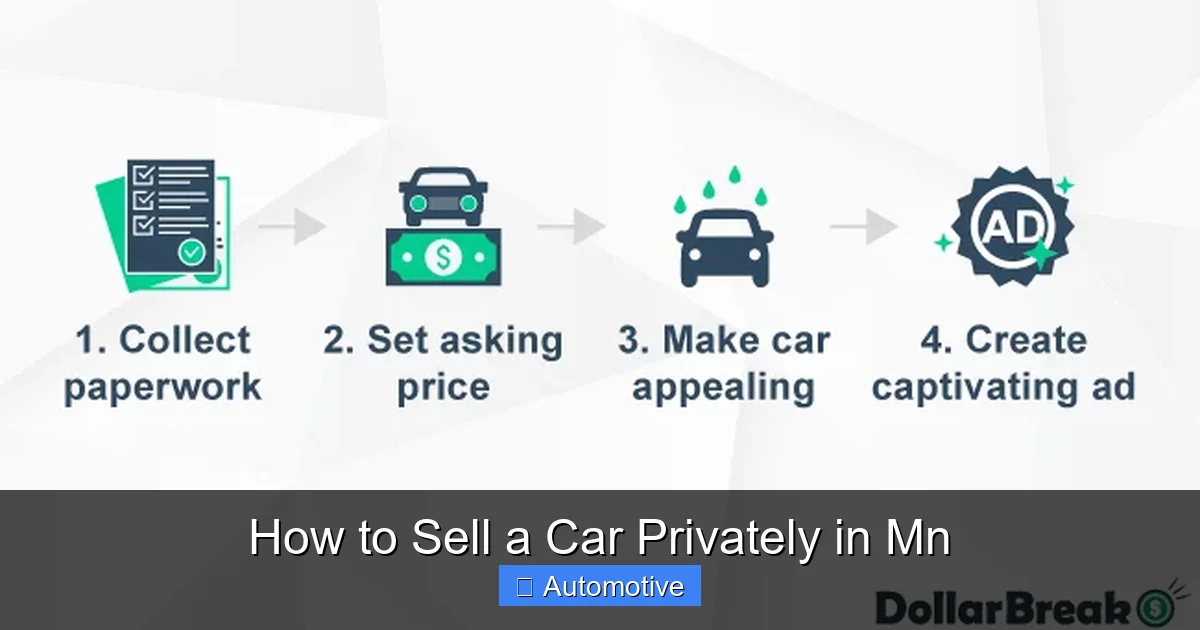
Step 4: Create an Effective Online Listing
Visual guide about How to Sell a Car Privately in Mn
Image source: dollarbreak.com
Once your car is clean and ready, it’s time to create a listing that grabs attention. Most private car sales in Minnesota happen online, so your ad needs to stand out.
Start with a clear, descriptive title. Include the year, make, model, and key features. For example: “2017 Subaru Outback – AWD, Low Miles, Excellent Condition – $16,500.” Avoid vague titles like “Car for Sale” or “Nice SUV.”
Write a detailed description that highlights the car’s best features. Mention:
– Mileage and condition
– Maintenance history (e.g., “Oil changed every 5,000 miles”)
– Recent repairs or upgrades
– Fuel efficiency
– Safety features (like blind-spot monitoring or automatic emergency braking)
– Any extras (roof rack, winter tires, etc.)
Be honest about flaws. Saying “minor scratch on rear bumper” builds trust. Buyers appreciate transparency.
Use high-quality photos. Take pictures in natural daylight, from multiple angles. Include:
– Front, back, and both sides
– Interior (driver’s seat, dashboard, back seat, trunk)
– Engine bay
– Tires and wheels
– Any damage (so buyers know what to expect)
Avoid filters or editing that makes the car look better than it is. Honesty builds credibility.
Choose the right platforms. In Minnesota, the most popular sites are:
– **Craigslist** – Free, local, and widely used
– **Facebook Marketplace** – Easy to use, integrates with your profile
– **Autotrader** – Great for serious buyers, but may charge a fee
– **OfferUp** – Mobile-friendly and popular in the Twin Cities
Post your ad in the evening or on weekends when more people are browsing. Refresh it every few days to keep it near the top of search results.
Pro Tip: Use Keywords in Your Ad
Include terms buyers might search for, like “reliable,” “low mileage,” “clean title,” or “no accidents.” This helps your listing appear in more searches.
Step 5: Handle Buyer Inquiries and Test Drives Safely
Once your ad is live, you’ll start getting messages and calls. Be responsive but cautious. Here’s how to handle inquiries like a pro.
Respond quickly—within a few hours if possible. A fast reply shows you’re serious and helps you beat competitors. Keep your answers polite and informative. Ask buyers about their budget, timeline, and what they’re looking for. This helps you filter out tire kickers.
When scheduling a test drive, always meet in a public place. Good options include:
– A police station parking lot (many have designated safe exchange zones)
– A busy shopping center
– A bank or library parking lot
Never meet at your home or a remote location. Bring a friend or family member with you. Let someone know where you’re going and when you expect to return.
Before the test drive, ask to see the buyer’s driver’s license and verify it matches their name. Keep a copy or photo of it for your records. Also, make sure they have valid insurance—some buyers may not realize they need it to drive your car.
During the test drive, stay in well-lit, populated areas. Avoid highways or back roads. Let the buyer drive, but stay alert. If something feels off, end the drive early.
After the test drive, be ready to answer questions about the car’s history, maintenance, and any issues. Have your service records handy. If the buyer is serious, they’ll want to know everything.
Red Flags to Watch For
– Buyers who refuse to meet in person
– Requests to wire money or use untraceable payment methods
– Offers significantly above your asking price
– Buyers who pressure you to sell quickly
– Requests to ship the car or meet in another state
If anything feels suspicious, trust your gut and walk away.
Step 6: Complete the Sale and Transfer Ownership
When a buyer agrees to purchase your car, it’s time to finalize the deal. This step is crucial—do it wrong, and you could face legal or financial trouble.
First, agree on the final price and payment method. **Cash is safest**, but cashier’s checks from a local bank are also acceptable. Avoid personal checks—they can bounce. If the buyer wants to pay with a cashier’s check, go to the bank with them to verify it’s real.
Once payment is confirmed, complete the paperwork:
1. Sign the title on the back in the “Seller” section. Print your name and sign it. Include the sale price and odometer reading.
2. Fill out the bill of sale with all required details. Both you and the buyer should sign it.
3. Give the buyer the signed title, bill of sale, and any maintenance records.
4. Remove your license plates. In Minnesota, plates stay with the seller, not the car. You can transfer them to a new vehicle or return them to the DPS.
5. Cancel your insurance on the car once the sale is complete.
Within 10 days, submit the **Notice of Sale** to the Minnesota DPS. This releases you from liability. You can do this online at the DPS website using your driver’s license number and the car’s VIN.
What the Buyer Needs to Do
The buyer must:
– Register the car in their name within 30 days
– Get new license plates (unless transferring yours)
– Pass a vehicle inspection if required (e.g., for out-of-state titles)
– Pay sales tax and registration fees
Make sure the buyer understands these steps. You can provide them with a copy of the DPS’s “Buying a Vehicle” guide for reference.
Bonus Tips for a Smooth Sale in Minnesota
– **Winter Selling:** If you’re selling in winter, highlight features like AWD, heated seats, or a block heater. These are big selling points in MN.
– **Emissions Testing:** Minnesota doesn’t require emissions testing for most vehicles, but some areas (like the Twin Cities) may have specific rules. Check with your local DPS office.
– **Safety Inspections:** While not required for private sales, a pre-sale inspection from a trusted mechanic can reassure buyers and justify your price.
– **Negotiation:** Be prepared to negotiate. Most buyers will try to haggle. Know your bottom line and stick to it.
– **Timing:** Spring and summer are the best times to sell. More buyers are out, and convertibles or trucks move faster.
Selling your car privately in Minnesota doesn’t have to be stressful. With the right preparation, pricing, and safety precautions, you can sell quickly and for a great price. Remember: honesty, transparency, and attention to detail go a long way.
Whether you’re upgrading to a new vehicle or just need the cash, selling privately puts more money in your pocket. Follow these steps, stay safe, and you’ll be driving away (or cashing that check) in no time.
Frequently Asked Questions
Do I need a safety inspection to sell a car privately in Minnesota?
No, Minnesota does not require a safety inspection for private car sales. However, if the buyer is registering the car from out of state, they may need to pass an inspection in their home state.
Can I sell my car if I still owe money on it?
No, you cannot sell a car with an outstanding loan unless the lien is released. Contact your lender to pay off the balance and obtain a lien release before selling.
How long does it take to sell a car privately in MN?
Most cars sell within 2–6 weeks, depending on price, condition, and market demand. Well-priced, clean vehicles with good photos often sell in under two weeks.
What happens if the buyer doesn’t register the car?
Once you submit the Notice of Sale to the DPS, you’re no longer liable for the vehicle. However, it’s wise to follow up with the buyer to confirm registration.
Can I sell my car without a title?
No, you must have a valid title to sell a car in Minnesota. If your title is lost, apply for a duplicate through the DPS before listing the vehicle.
Is it safe to sell a car online in Minnesota?
Yes, as long as you follow safety guidelines: meet in public, verify payment, and avoid suspicious buyers. Using trusted platforms and bringing a friend adds extra protection.