How to Reset the Check Engine Light on a 2007 Toyota 4runner

Contents
- 1 Key Takeaways
- 2 📑 Table of Contents
- 3 That Glowing Annoyance: Understanding Your 4Runner’s Check Engine Light
- 4 Why You Must Diagnose, Not Just Reset: The “Why” Behind the Light
- 5 Method 1: The Professional Way – Using an OBD2 Scanner
- 6 Method 2: The Manual Reset – Disconnecting the Battery
- 7 What to Do After You’ve Reset the Light
- 8 When to Absolutely Seek Professional Help
- 9 Conclusion: A Light Reset is a Temporary Fix, Not a Solution
- 10 Frequently Asked Questions

Octane Booster

Engine Flush Cleaner

Battery Terminal Cleaner

Torque Wrench Set
Resetting the check engine light on your 2007 Toyota 4Runner is a simple process, but it’s critical to diagnose and fix the underlying issue first. You can clear the light using an OBD2 scanner, which is the recommended and most reliable method. A less precise alternative is temporarily disconnecting the battery. Never ignore a check engine light, as resetting it without repair only masks a problem that could cause serious engine damage.
Key Takeaways
- Diagnosis Before Reset: Always read and address the diagnostic trouble code (DTC) causing the light before clearing it. The light is a warning, not a routine reminder.
- OBD2 Scanner is Best: Using a professional or basic OBD2 scanner is the only proper way to reset the light. It communicates directly with the 4Runner’s computer.
- Battery Disconnect is a Last Resort: Disconnecting the battery can clear the code but also resets other vehicle electronics (radio, clock, transmission adaptations). It may not work on all models.
- Light Will Return if Problem Persists: If the original issue isn’t fixed, the check engine light will illuminate again, often after just a few drive cycles.
- Safety First: Some codes indicate serious issues (like misfires or overheating). Driving with these active can destroy your catalytic converter or engine. Address the root cause immediately.
- 2007 4Runner Specifics: Your 4Runner uses the OBD2 standard (port under the dashboard). Common triggers include a loose gas cap, oxygen sensor failures, or spark plug issues.
- Professional Help is Wise: For complex codes, persistent lights, or if you’re uncomfortable, a mechanic can properly diagnose and reset the system.
[FEATURED_IMAGE_PLACEHOLDER]
📑 Table of Contents
- That Glowing Annoyance: Understanding Your 4Runner’s Check Engine Light
- Why You Must Diagnose, Not Just Reset: The “Why” Behind the Light
- Method 1: The Professional Way – Using an OBD2 Scanner
- Method 2: The Manual Reset – Disconnecting the Battery
- What to Do After You’ve Reset the Light
- When to Absolutely Seek Professional Help
- Conclusion: A Light Reset is a Temporary Fix, Not a Solution
That Glowing Annoyance: Understanding Your 4Runner’s Check Engine Light
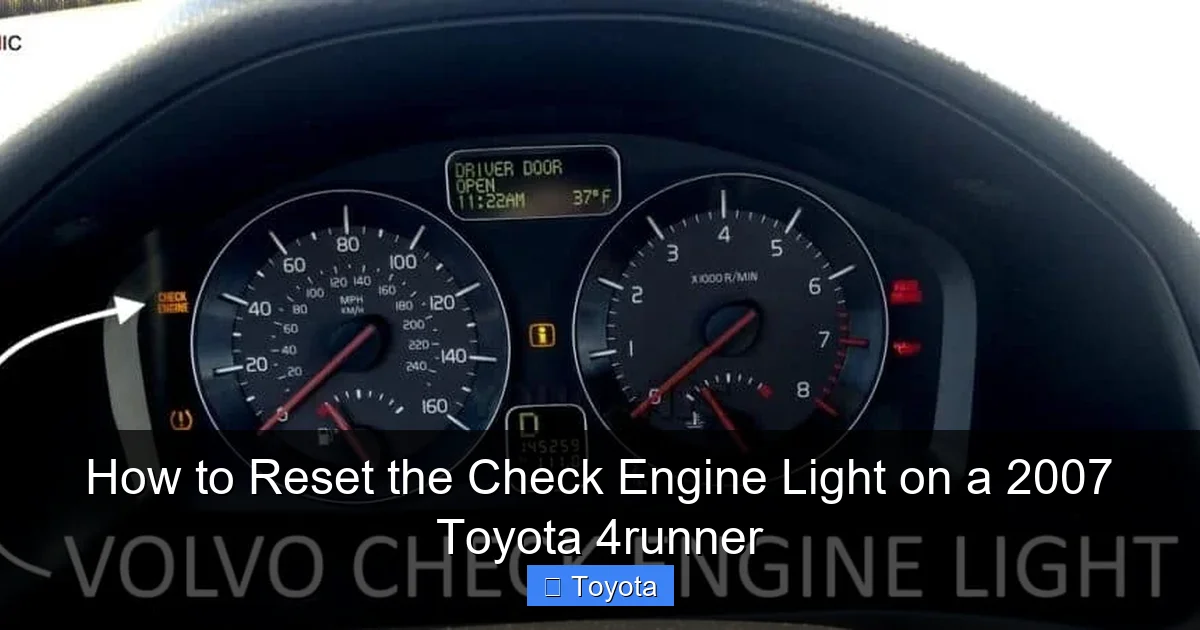
There it is. That little amber bulb on your 2007 Toyota 4Runner’s dashboard, glowing with a quiet, persistent urgency. The check engine light—or more accurately, the Malfunction Indicator Lamp (MIL)—is your vehicle’s way of saying, “Hey, something’s not quite right under the hood.” For a rugged, reliable SUV like the 4Runner, it can be especially frustrating. Your first instinct might be to find the fastest way to make it go away. But before we talk about how to reset the check engine light on a 2007 Toyota 4Runner, we need to talk about why it’s on and why simply turning it off without fixing the problem is a big mistake.
The check engine light is part of your 4Runner’s On-Board Diagnostics II (OBD2) system. This computer network constantly monitors dozens of sensors and components related to emissions and engine performance. When a sensor reading falls outside the predetermined acceptable range, the computer stores a Diagnostic Trouble Code (DTC) and turns on the light to alert you. It’s not a single “problem” light; it’s a general warning that a specific system needs attention. Resetting it erases the code from memory, but it does absolutely nothing to repair the faulty part, sensor, or wiring that triggered it. Think of it like turning off a smoke alarm without checking for a fire—dangerous and pointless.
Why You Must Diagnose, Not Just Reset: The “Why” Behind the Light
Let’s be absolutely clear: the primary goal is never just to reset the light. The goal is to identify and correct the fault. Resetting without repair is like putting a bandage on a broken arm. The light will return, often within a day or two of driving, because the problem still exists. More importantly, driving with certain active codes can cause catastrophic and expensive damage. A 2007 4Runner’s engine and emissions systems are robust, but they aren’t indestructible.

Visual guide about How to Reset the Check Engine Light on a 2007 Toyota 4runner
Image source: i.ytimg.com
Common Culprits in a 4Runner
While the 4Runner is known for longevity, some issues are more common with this generation (model years 2003-2009). The most frequent triggers for the check engine light include:
- Evaporative Emission (EVAP) System Leaks: A loose, damaged, or missing gas cap is the #1 cause of a check engine light. The EVAP system captures fuel vapors. A bad seal lets vapors escape, triggering codes like P0440, P0441, or P0455. Before you do anything else, remove the gas cap, inspect it for cracks, and ensure it clicks tightly when reinstalled. This simple fix resolves many lights.
- Oxygen (O2) Sensor Failures: The 4Runner has multiple O2 sensors monitoring exhaust gases. A failing sensor, especially the downstream (catalytic converter) sensor, will cause poor fuel economy, rough running, and codes like P0135, P0141, or P0420 (which can also indicate a failing catalytic converter).
- Mass Air Flow (MAF) Sensor Issues: This sensor measures incoming air. If it’s dirty or faulty, you’ll get codes like P0101 or P0102, along with symptoms like hesitation, poor throttle response, and decreased power. Sometimes, cleaning it carefully with MAF cleaner can help.
- Ignition System Misfires: Worn spark plugs, bad ignition coils, or faulty spark plug wires can cause misfires (codes P0300-P0304). A persistent misfire is serious. Unburned fuel entering the exhaust can overheat and destroy the catalytic converter—a repair costing thousands.
- Thermostat or Coolant Temperature Sensor: If your 4Runner runs hot or the temperature gauge behaves oddly, codes like P0115 or P0128 could be stored. An overheating engine is an immediate red flag.
Ignoring these and simply resetting the light means you’re driving blind to a problem that could strand you on a trail or lead to a very costly repair bill. Always read the code first. If you have a friend with a scanner, or you can get a free code read at many auto parts stores (like AutoZone or O’Reilly’s), do it. Knowing the code is half the battle. For example, if you get a P0420, you know to look at the catalytic converter and O2 sensors, not the fuel injectors.
Method 1: The Professional Way – Using an OBD2 Scanner
This is the correct, manufacturer-approved method for resetting the check engine light on your 2007 Toyota 4Runner. The OBD2 port is a standardized connection located under the driver’s side dashboard, usually just above the footwell. You’ll need a tool that can communicate with your 4Runner’s computer.
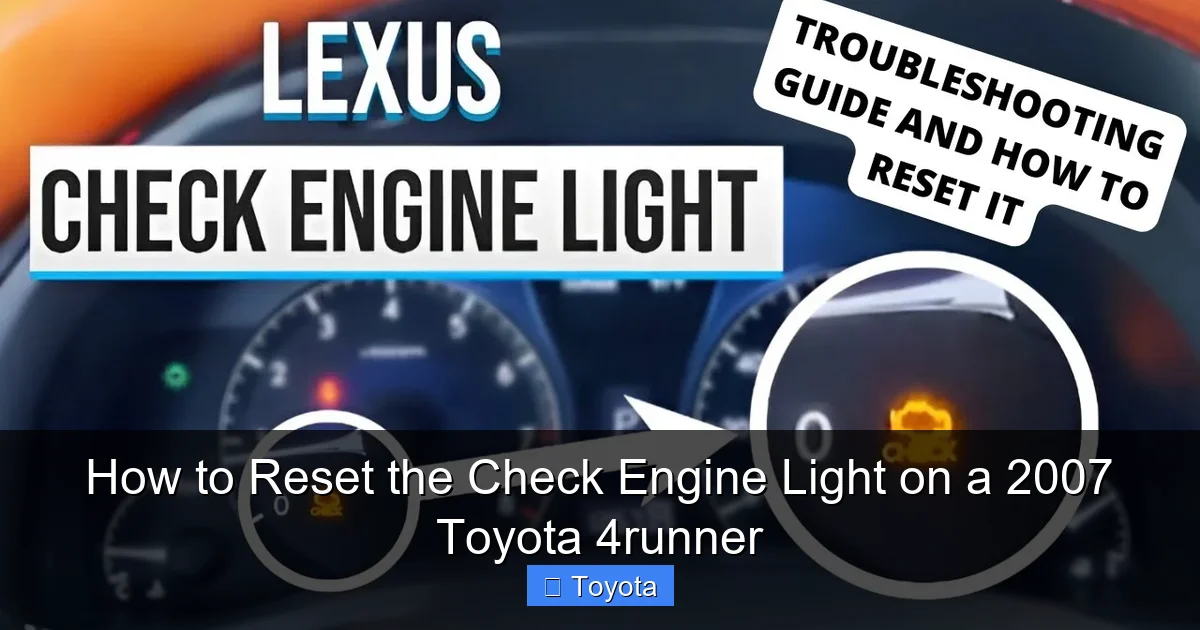
Visual guide about How to Reset the Check Engine Light on a 2007 Toyota 4runner
Image source: i.ytimg.com
Choosing Your Scanner
You have several options, ranging from free to professional-grade:
- Free Code Read & Reset: Many national auto parts stores offer to read your codes for free. Some will also clear the light for you. This is a great first step if you don’t own a tool. Just ask them to clear the code after you’ve made the repair.
- Basic OBD2 Reader ($20-$60): Devices like the Autel, BlueDriver, or Innova scanners plug in, read codes, and often have a basic “Erase Codes” function. They are perfect for DIYers. BlueDriver even connects to your phone via Bluetooth and provides repair reports.
- Advanced Scan Tool ($100+): These offer more data, live sensor readings, and access to other vehicle systems beyond just engine/emissions. They are ideal for serious enthusiasts or professionals.
- Manufacturer-Specific Tools: Dealerships use expensive proprietary tools that access all systems. You don’t need this for a simple check engine light reset.
Step-by-Step Reset with a Scanner
- Preparation: Ensure your 4Runner’s ignition is in the “ON” position (engine off). The OBD2 port is typically a 16-pin trapezoidal connector under the dash. Plug your scanner’s cable firmly into it.
- Connect and Power On: Turn your scanner on. It should automatically power up from the vehicle’s OBD2 port. Some require you to turn the key to “ON” first.
- Establish Connection: The scanner will search for your vehicle’s protocol. Select “2007 Toyota” or “4Runner” from the menu if prompted. Most modern tools auto-detect.
- Read Codes (CRITICAL STEP): Before you even think about resetting, navigate to the “Read Codes” or “Diagnose” function. Write down all the stored codes (e.g., P0441, P0302). This is your roadmap. Look these codes up online or in your scanner’s manual to understand the affected system.
- Diagnose and Repair: Use the code information to inspect, test, and replace the faulty component. This might be as simple as tightening the gas cap or replacing a $20 oxygen sensor. Do not skip this.
- Erase Codes: Once the repair is complete, return to the scanner’s main menu. Select “Erase Codes,” “Clear DTCs,” or “Reset MIL.” Confirm the action. The scanner will communicate with the Powertrain Control Module (PCM) and wipe the stored fault codes.
- Verify: The check engine light should immediately go out. Start the engine. It should remain off. If it comes back on immediately, your repair may not have been successful, or a new, different problem has occurred.
Pro Tip: Some scanners also have a “Drive Cycle” monitor. After clearing codes, you may need to complete a specific drive cycle (a set of driving conditions like acceleration, deceleration, and idling) for all monitors to set to “Ready” for emissions testing. Simply driving normally for 50-100 miles usually suffices.
Method 2: The Manual Reset – Disconnecting the Battery
This is the old-school, “hack” method. It works by cutting power to the vehicle’s computer (PCM), forcing it to reset and forget stored codes. However, it is highly discouraged as a first-line method for several reasons. It’s imprecise and can cause more headaches than it solves.
Visual guide about How to Reset the Check Engine Light on a 2007 Toyota 4runner
Image source: cimg2.ibsrv.net
The Process (If You Must)
- Safety First: Park your 4Runner on a level surface, engage the parking brake, and open the hood. Make sure the ignition is OFF.
- Locate the Battery: The 2007 4Runner typically has the battery in the engine bay, on the driver’s side. Identify the positive (+) terminal (usually red) and negative (-) terminal (usually black).
- Disconnect the Negative Cable: Using a 10mm socket or wrench, loosen the nut on the NEGATIVE (-) battery terminal clamp. Carefully lift the clamp and cable off the terminal. Tuck it away so it cannot accidentally touch the battery post.
- Wait: This is the crucial part. You need to drain all residual electrical current from the vehicle’s systems. Wait at least 10-15 minutes. Some sources recommend 15-30 minutes for a full reset. This allows the PCM’s capacitors to discharge fully.
- Reconnect: Reattach the negative cable clamp to the negative terminal and tighten the nut securely. Ensure it’s a good, clean metal-to-metal connection.
- Start the Vehicle: You will likely need to reset your clock, radio presets, and window auto-up/down functions. The transmission may shift harshly for the first few shifts as the PCM re-learns your driving habits. Start the engine. The check engine light should be off.
Major Drawbacks & Warnings
- It May Not Work: Some vehicle computers store codes in non-volatile memory that doesn’t clear with a simple battery disconnect. Your light might stay on.
- Resets Everything: You will lose all saved radio stations, clock time, and any personalized settings. The PCM will also forget its long-term fuel trim and idle adaptations, which can cause rough idle for the first 10-20 minutes of driving until it re-learns.
- Potential for Harm: On some modern vehicles, disconnecting the battery can trigger the security system or cause issues with other modules. While generally safe on a 2007 4Runner, it’s still a crude method.
- Does Not Fix Anything: This is the biggest point. If the underlying problem (like a bad O2 sensor) is still present, the light will return almost immediately—sometimes after just one drive cycle. You’ve wasted time and reset your radio for nothing.
This method should only be used if you have absolutely no access to a scanner and you are 100% certain the problem was a transient, one-time issue (like a temporary loose gas cap) that has since been corrected. Even then, using a scanner is superior.
What to Do After You’ve Reset the Light
Congratulations, the amber bulb is dark. But your job isn’t done. Now you need to confirm that the repair was successful and that the problem is truly gone.
Monitor the Light and Driving Behavior
For the next 50-100 miles of driving, pay close attention. Watch the dashboard like a hawk. Does the check engine light come back on? If so, pull the codes again. The same code returning means your fix didn’t work. A different code means you may have a secondary issue or caused a new one during the repair.
Also, listen and feel. Is the engine running smoothly? Is there any hesitation, misfiring, or unusual noises? Does the exhaust smell different (like sulfur)? Your senses are a diagnostic tool. If anything feels off, re-check your work or seek a professional opinion. The process of how to reset the check engine light on a 2007 Toyota 4Runner is incomplete until you verify the vehicle operates perfectly with the light off.
Understanding Drive Cycles and Emissions Tests
In many states, you cannot pass an emissions (smog) test if the check engine light is on, or if the OBD2 system reports that its internal “monitors” are not complete. After clearing codes, all monitors (like EVAP, Catalyst, Oxygen Sensor) will show as “Not Ready.” You must complete a full drive cycle to set them to “Ready.” This isn’t just random driving; it’s a specific sequence of speeds, engine loads, and temperatures defined by Toyota. Usually, a combination of city and highway driving over several days will complete it. Some scanners can show monitor status. If you need an emissions test soon, drive normally for a week before testing.
When to Absolutely Seek Professional Help
There are times when DIY is not the answer. Knowing your limits is a sign of a smart vehicle owner, not a failure.
- Persistent or Multiple Codes: If you clear the codes and they return immediately, or if you have several different codes (e.g., an O2 sensor code and a misfire code), the problem could be complex or interconnected. A professional has the training and advanced tools (like oscilloscopes) to trace wiring issues or complex sensor failures.
- Catalytic Converter Codes (P0420/P0430): This code often means the catalytic converter is failing. Replacing it is expensive. You need to be absolutely sure it’s the converter and not a faulty O2 sensor giving a false reading. A mechanic can perform specific tests (like monitoring exhaust backpressure) to confirm.
- Transmission-Related Codes: While the “check engine” light covers the powertrain, some codes point to transmission issues. These are complex and require specialized knowledge. Don’t mess with your 4Runner’s transmission.
- You’re Uncomfortable: If the process of reading codes, diagnosing, or even locating the OBD2 port feels daunting, that’s okay. A reputable independent mechanic or dealership can diagnose the issue for a fee (often $80-$120). This is money well spent for peace of mind and to avoid costly mistakes.
- Safety-Critical Codes: Any code related to severe misfires (P0300-P0304), engine overheating, or complete sensor failure should be addressed immediately by a professional. Do not drive the vehicle.
Your 2007 Toyota 4Runner is a valuable machine. Investing in proper diagnosis protects that value and ensures your safety on the road and trail.
Conclusion: A Light Reset is a Temporary Fix, Not a Solution
So, you now know how to reset the check engine light on a 2007 Toyota 4Runner. The method is straightforward: use an OBD2 scanner to erase the code after fixing the problem. The battery disconnect method is a crude, unreliable fallback. But the most important lesson is this: the light is your friend. It’s an early warning system that, when heeded, can save you from a breakdown and a mountain of repair bills.
Treat the check engine light with the seriousness it deserves. Read the code. Understand it. Research the common causes for your specific 4Runner. Tackle the simple fixes yourself—like tightening the gas cap or cleaning the MAF sensor. But for anything more complex, or if the light returns with a vengeance, call in the pros. A well-maintained 4Runner will reward you with hundreds of thousands of miles of reliable service. Ignoring its cries for help is the fastest way to turn that reliable SUV into a costly pile of parts. Reset the light only when you’ve earned it by solving the problem.
Frequently Asked Questions
Will disconnecting the battery always reset the check engine light on my 2007 4Runner?
Not always. While it often works, some computer modules store codes in memory that survives a power disconnect. The OBD2 scanner method is the only guaranteed way to clear all stored powertrain codes. The battery method is unreliable and resets all other vehicle settings as an unwanted side effect.
How long does it take for the check engine light to come back on after a reset if the problem isn’t fixed?
It can be almost immediate or take a few drive cycles. The 4Runner’s computer continuously monitors sensors. If a faulty sensor sends an out-of-range signal again during your next drive, the light will illuminate, sometimes within minutes. For intermittent problems, it might take a day or two of driving for the issue to reoccur and trigger the light.
Can I just use a generic OBD2 scanner from an auto parts store, or do I need a special Toyota tool?
For the sole purpose of reading and erasing generic check engine (OBD2) codes, any basic OBD2 scanner will work on your 2007 4Runner. You do not need a manufacturer-specific tool. However, for accessing other systems like ABS or airbags, a more advanced tool is needed. For just the MIL, a $20-$50 basic scanner is sufficient.
Is it illegal to drive with the check engine light on?
It’s not illegal per se, but it’s unwise and may cause you to fail mandatory emissions inspections. More importantly, if the light is flashing (indicating a severe misfire), you should stop driving immediately, as this can destroy your catalytic converter. A steady light means a non-emergency fault that should be diagnosed promptly, but you can usually drive cautiously to a repair shop.
What’s the difference between the check engine light and the maintenance required light on my 4Runner?
They are completely different. The check engine light (usually yellow/amber) indicates an emissions-related fault detected by the OBD2 system. The maintenance required light (often a wrench symbol or “MAINT REQD”) is a simple mileage-based reminder from your 4Runner’s maintenance scheduler to get an oil change or other scheduled service. You reset the maintenance light using a different procedure, usually involving the odometer button and ignition. Do not confuse the two.
My 4Runner’s check engine light is on, but the car seems to run fine. Should I still fix it?
Yes, absolutely. A “healthy” running engine with a light on is often dealing with a less severe issue, like an EVAP leak from a loose gas cap or a slow-responding O2 sensor. However, even these affect fuel economy and emissions. More critically, the problem could be a silent failure—like a worsening coolant leak or a battery in the early stages of failure—that hasn’t yet caused drivability symptoms. Ignoring it guarantees it will become a bigger, more expensive problem later. Address it now.