How to Reset the Check Engine Light on a 2005 Toyota Corolla

Contents
- 1 Key Takeaways
- 2 📑 Table of Contents
- 3 Your 2005 Toyota Corolla’s Check Engine Light: What It Really Means
- 4 Before You Even Think About Resetting: The Non-Negotiable Diagnosis Step
- 5 Method 1: The Battery Disconnect Reset (The Old-School Way)
- 6 Method 2: The OBD-II Scanner Reset (The Clean, Professional Method)
- 7 Method 3: The Drive Cycle (Letting the Car Clear Itself)
- 8 After the Reset: What to Expect and How to Proceed
- 9 The Bottom Line: Reset is a Tool, Not a Solution
- 10 Frequently Asked Questions

Car Storage Net

LED Emergency Road Flares

Torque Wrench Set

LED Indicator Light
Resetting the check engine light on your 2005 Toyota Corolla is a simple process, but it’s crucial to diagnose the underlying issue first. Never ignore the light—it’s your car’s warning system. You can reset it by disconnecting the battery or using an OBD-II scanner, but the light will return if the problem persists. Always fix the fault before clearing the code to avoid serious damage.
Key Takeaways
- Diagnosis is mandatory: Always read the diagnostic trouble code (DTC) before resetting. The code tells you what system is faulty.
- Two main reset methods: You can disconnect the battery or use an OBD-II scanner. The scanner method is more precise and preserves radio presets.
- A reset is not a repair: Clearing the light without fixing the cause is temporary. The light will return once the system re-detects the fault.
- Safety first: Disconnecting the battery can reset other systems (radio, clock, engine idle). Be prepared to reprogram them.
- Professional help is key for complex codes: If the code indicates a serious issue (e.g., misfire, catalytic converter), consult a mechanic immediately.
- Your 2005 Corolla uses OBD-II: All post-1996 vehicles, including your Corolla, have a standard diagnostic port under the dashboard.
- Drive cycles may clear minor codes: Some intermittent issues (like a loose gas cap) may reset themselves after a successful drive cycle.
📑 Table of Contents
- Your 2005 Toyota Corolla’s Check Engine Light: What It Really Means
- Before You Even Think About Resetting: The Non-Negotiable Diagnosis Step
- Method 1: The Battery Disconnect Reset (The Old-School Way)
- Method 2: The OBD-II Scanner Reset (The Clean, Professional Method)
- Method 3: The Drive Cycle (Letting the Car Clear Itself)
- After the Reset: What to Expect and How to Proceed
- The Bottom Line: Reset is a Tool, Not a Solution
Your 2005 Toyota Corolla’s Check Engine Light: What It Really Means
That little amber light on your dashboard—the one that looks like an engine—has a big job. It’s the primary warning indicator from your car’s On-Board Diagnostics (OBD-II) system. When it illuminates, it means the engine computer (ECU) has detected a problem that could increase emissions or affect performance. It’s not just a “maintenance reminder” like the service required light; it’s a genuine alert. Ignoring it is like ignoring a fever—it won’t go away on its own, and the underlying issue will likely worsen, leading to expensive repairs.
For a 2005 Toyota Corolla, common triggers range from something as simple as a loose or missing gas cap to more serious issues like a faulty oxygen sensor, spark plug misfire, or evaporative emissions (EVAP) system leak. The light’s behavior matters too. A steady glow usually indicates a non-emergency issue, while a flashing light signals a severe problem, like a catalyst-damaging misfire, requiring immediate stop-and-drive attention.
The OBD-II System: Your Car’s Self-Diagnostic Brain
Since 1996, all cars sold in the U.S. have had OBD-II. This standardized system monitors dozens of sensors and actuators—from airflow and oxygen levels to engine temperature and catalytic converter efficiency. When a sensor reading falls outside the programmed range, the ECU stores a Diagnostic Trouble Code (DTC) and turns on the check engine light. For your Corolla, these codes are alphanumeric, like P0171 (System Too Lean) or P0440 (Evaporative Emission System Malfunction).
Common Culprits in a 2005 Toyota Corolla
While any component can fail, some issues are more prevalent in this model year and engine type (likely the 1ZZ-FE 1.8L). These include:
- Loose or Faulty Gas Cap: A classic. A cap that doesn’t seal properly causes an EVAP leak, triggering code P0440/P0441.
- Oxygen (O2) Sensor Failure: The front (upstream) O2 sensor monitors exhaust gases for fuel mixture. A lazy or dead sensor (codes P0130-P0134) reduces fuel economy and performance.
- Mass Airflow (MAF) Sensor Contamination: A dirty MAF sensor (code P0102/P0103) can cause rough idle, stalling, and poor acceleration.
- Spark Plugs & Ignition Coils: Worn plugs or failing coils cause misfires (codes P0300-P0304), which can damage the catalytic converter.
- Exhaust Leaks: A leak before the front O2 sensor can introduce extra oxygen, skewing readings and setting lean codes.
Before You Even Think About Resetting: The Non-Negotiable Diagnosis Step
Here is the golden rule: You must identify and, if possible, fix the problem before resetting the light. Resetting without addressing the fault is like turning off a smoke alarm without putting out the fire. The light will return, often within 10-50 miles of driving, as the system re-checks and fails again. Worse, you lose the stored trouble code that would guide your repair.

Visual guide about How to Reset the Check Engine Light on a 2005 Toyota Corolla
Image source: i.ytimg.com
How to Read the Code Yourself
You don’t need a dealership to read the code. You have two affordable options:
- Basic Code Reader ($20-$50): Plug it into the OBD-II port (under the dash, near the steering column). It will display the alphanumeric code and a brief definition. This is enough for most common issues.
- Advanced Scanner/App ($50-$150+): Tools like the Launch CRP123 or an OBD-II adapter with a smartphone app (e.g., Torque Pro) provide live data, freeze frame data, and more detailed definitions.
Pro Tip: Write down the exact code (e.g., P0420) and its definition before doing anything else. Search online for “P0420 2005 Toyota Corolla” to find specific troubleshooting guides for your model.
When to Immediately Seek Professional Help
Some codes indicate serious, potentially dangerous problems. If your scanner shows codes related to:
- Catalyst System Efficiency (P0420/P0430): Means the catalytic converter is failing. This is an expensive repair.
- Multiple Cylinder Misfires (P0300) or a Flashing Light: Driving with this can destroy the catalytic converter in minutes.
- Transmission-related codes (P07xx, P08xx):strong> Indicate internal transmission issues.
In these cases, get to a trusted mechanic. Don’t just reset the light and drive.
Method 1: The Battery Disconnect Reset (The Old-School Way)
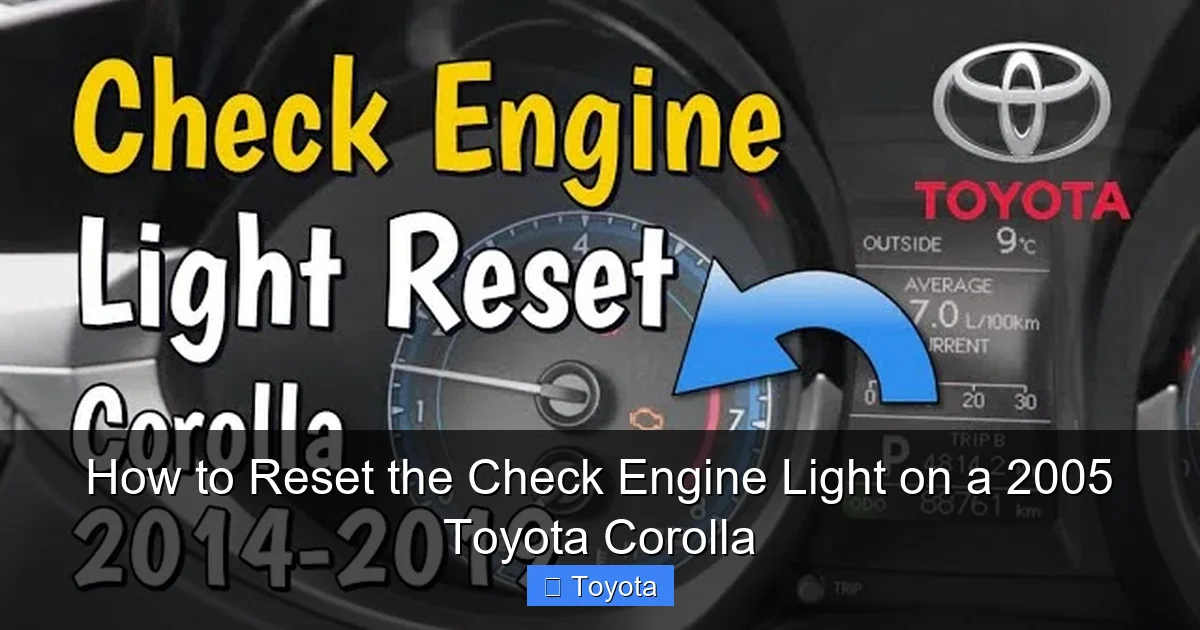
This method works by cutting power to the ECU, forcing it to clear its memory, including stored trouble codes. It’s free and requires no special tools, but it has significant downsides.
Visual guide about How to Reset the Check Engine Light on a 2005 Toyota Corolla
Image source: i.ytimg.com
Step-by-Step for Your 2005 Toyota Corolla
Tools Needed: 10mm socket or wrench, possibly a trim tool for the battery cover.
- Safety First: Ensure the car is in park (or neutral for manual), engine off, and parking brake engaged. Open the hood. If you need to access the battery in the trunk (some Corolla trims place it there), you’ll need to open the trunk and remove the cover. For most 2005 Corollas, the battery is in the engine bay.
- Locate the Negative Terminal: The negative (-) terminal is connected to the black battery cable and marked with a “-” or “NEG.”
- Disconnect the Negative Cable: Loosen the 10mm nut on the negative terminal clamp with your socket/wrench. Carefully lift the clamp and cable off the terminal post. Tuck it away so it can’t accidentally touch the post.
- Wait: Wait at least 5-10 minutes. This allows all residual power to drain from the ECU and other modules (the “capacitor drain”).
- Reconnect: Place the clamp back on the negative post and tighten the nut securely. Don’t over-tighten, but ensure it’s snug.
- Close the hood and start the car. The check engine light should be off. However, it may come back on after a few drive cycles if the problem persists.
Pros, Cons, and Crucial Cautions
- Pro: Free, universal method that always clears codes.
- Major Con: It also resets other electronic systems. Your radio will lose its presets, the clock will reset, and the engine’s idle adaptation and fuel trim values will be erased. The car may run rough for the first few drive cycles as the ECU relearns.
- Con: On some vehicles, disconnecting the battery can trigger the security system (immobilizer), requiring a special procedure to restart. This is rare on a 2005 Corolla but possible. Have your key ready.
- Caution: Never disconnect the positive terminal first. Always start with the negative to prevent short circuits. If your battery terminals are corroded, clean them with a baking soda/water solution and a wire brush before disconnecting.
For a more detailed guide on working with your Corolla’s battery, including how to safely open the hood and terminal specifics, see our article on how to open the hood on a Toyota Corolla.
Method 2: The OBD-II Scanner Reset (The Clean, Professional Method)
This is the preferred method for DIYers and professionals alike. An OBD-II scanner communicates directly with the ECU to clear stored trouble codes without disrupting other vehicle systems.
Visual guide about How to Reset the Check Engine Light on a 2005 Toyota Corolla
Image source: carfromjapan.com
Choosing the Right Scanner for Your Corolla
Any generic OBD-II scanner (not brand-specific) will work on your 2005 Corolla. For basic code clearing, a simple “code reader” suffices. If you want to see live data, research specific sensor values, or perform advanced functions, invest in a mid-range scan tool. Popular reliable brands include Autel, Launch, and Innova.
Clearing Codes the Right Way
- Locate the OBD-II Port: It’s a trapezoidal 16-pin connector, usually under the dashboard, to the left of the steering column, or near the center console. It may have a plastic cover.
- Connect the Scanner: Plug the scanner’s cable firmly into the port. Turn the ignition to the “ON” position (do not start the engine).
- Follow Scanner Prompts: Most scanners have a simple menu. Select “Read Codes” first to confirm the stored codes. Write them down. Then select “Erase Codes” or “Clear DTCs.” Confirm the action.
- Verify: After clearing, the scanner should show “No Codes Detected” or “0000.” Turn the ignition off, disconnect the scanner, and start the car. The light should be off.
Why This Method is Superior
- Preserves Settings: Your radio presets, clock, and learned idle values remain intact.
- Targeted: You can choose to clear only specific codes if you’ve fixed one issue but are still diagnosing another.
- Diagnostic Power: You get the code before clearing it, which is essential for proper repair.
If you own a Toyota and are interested in resetting other maintenance lights, such as the maintenance required light on a Toyota Tacoma, the process often involves a different procedure using the odometer button, not the OBD-II port. You can learn about that specific process in our dedicated guide.
Method 3: The Drive Cycle (Letting the Car Clear Itself)
This isn’t a manual reset method, but it’s important to understand. After you fix a problem, the ECU may clear the code itself after a successful “drive cycle.” A drive cycle is a specific set of driving conditions (engine warm-up, steady cruising, deceleration, etc.) that allows all monitors to run and pass.
How Drive Cycles Work
For your 2005 Corolla, a basic drive cycle to clear an EVAP or oxygen sensor code might involve:
- Cold start, idle for 2-3 minutes.
- Drive at 40-50 mph for 10-15 minutes.
- Include several gentle decelerations (coasting to a stop without braking).
- Let the engine idle again for a few minutes.
After this, if the fault is truly repaired, the ECU may self-extinguish the light. However, this can take several drive cycles. If the light returns, the repair was incomplete.
Is This Method Reliable?
It’s unreliable for immediate resetting. You cannot force a drive cycle; you can only provide the conditions. If a component is still faulty, the light will come back during or after the cycle. Use this method only after you are confident the repair is complete and you want to verify the fix without manually clearing the code.
After the Reset: What to Expect and How to Proceed
You’ve cleared the code. The light is off. Now what?
The Light Comes Back – Now What?
If the check engine light returns after 20-50 miles of driving, it means the ECU has detected the same fault again. Your repair was either ineffective or incomplete. Do not keep resetting it. Go back to the code. For example, if you cleared a P0440 (EVAP leak) after tightening the gas cap, but it returns, the cap may be cracked, or there’s a leak in a hose or the purge valve. Re-diagnose.
Permanent vs. Intermittent Codes
Some codes are stored as “pending” or “confirmed.” A pending code means the fault was detected once but hasn’t yet met the criteria to trigger the light. A confirmed code has been detected on multiple drive cycles and illuminates the light. Resetting clears both. An intermittent problem (e.g., a wire that shorts only when hot) may not reappear for weeks, making diagnosis tricky. In such cases, monitoring with a live data scanner while the problem occurs is key.
The Bottom Line: Reset is a Tool, Not a Solution
Resetting the check engine light on your 2005 Toyota Corolla is a useful skill, but it’s the final step in a repair process, not the first. The responsible sequence is: 1) Notice the light, 2) Read the code, 3) Research the code for your specific Corolla, 4) Diagnose and repair the faulty component, 5) Clear the code to reset the light and allow the ECU to verify the fix. By following this process, you protect your engine, maintain fuel efficiency, and ensure your Corolla remains the reliable, long-lasting companion it’s known to be. Remember, when in doubt, a professional diagnostic is a small price to pay for peace of mind and a car that runs right.
Frequently Asked Questions
Can I reset the check engine light without fixing the problem?
Yes, you can physically reset it using the battery or scanner method. However, the light will almost certainly return because the underlying fault still exists. This practice is not recommended as it masks a real problem and can lead to more severe damage and higher repair costs.
How long does it take for the check engine light to come back on after a reset if the problem isn’t fixed?
It varies. Some systems, like an EVAP leak, may trigger the light within 10-20 miles. Others, like an oxygen sensor, might take 50-100 miles as the ECU completes multiple drive cycles to confirm the fault. A flashing light will return very quickly if the misfire is constant.
Will disconnecting the battery reset other systems in my Corolla?
Yes. Disconnecting the negative battery terminal will reset the ECU, but it will also erase memory for the radio (presets), clock, power window auto-up/down, and the engine’s adaptive fuel trim and idle learn values. The car may idle slightly rough for the first 10-20 minutes of driving as the ECU relearns.
Do I need a special scanner for a 2005 Toyota Corolla?
No. Any standard OBD-II scanner (the kind with a 16-pin connector) will work. OBD-II was mandated for all cars from 1996 onward. You do not need an expensive, brand-specific Toyota scan tool just to read and clear generic engine codes.
What if the check engine light flashes and then goes off?
A flashing check engine light is a severe warning, typically for a misfire that can overheat and damage the catalytic converter. Even if it stops flashing and becomes steady, the code is still stored. You must read the code immediately (it will likely be a P0300-series misfire code) and address the ignition or fuel system issue before driving further.
My gas cap was loose, I tightened it, and the light went off. Is that normal?
Yes, this is very common. A loose gas cap is the #1 cause of EVAP system codes (P0440, P0441, P0455). After tightening it, the ECU may self-clear the code after a successful drive cycle, or you may need to manually reset it. If the light returns, inspect the cap seal or the EVAP system for cracks.