How to Reset the Bsd System on Hyundai

Contents
- 1 Key Takeaways
- 2 📑 Table of Contents
- 3 Understanding Your Hyundai’s BSD System
- 4 Common Reasons Your Hyundai BSD Light Comes On
- 5 Preparing for the Reset: Safety and Model Research
- 6 Step-by-Step Reset Procedures for Hyundai Vehicles
- 7 Troubleshooting: What to Do If the BSD Light Won’t Stay Off
- 8 Maintenance Tips to Keep Your BSD System Healthy
- 9 Conclusion: Safety, Patience, and Knowing Your Limits
- 10 Frequently Asked Questions


Resetting your Hyundai’s BSD (Blind Spot Detection) system is a straightforward process, but it requires understanding the correct procedure for your specific model and year. It’s often triggered by sensor blockage, low voltage, or after certain repairs. Always prioritize safety and consult your owner’s manual first. If the warning persists after a reset, it indicates a deeper issue needing professional diagnosis.
Key Takeaways
- BSD is a critical safety system: The Blind Spot Detection system uses radar sensors to alert you of vehicles in your blind spot, significantly reducing the risk of side-impact collisions.
- Resets are often temporary fixes: A reset clears the system’s memory but does not fix physical problems like a dirty, damaged, or misaligned sensor.
- Common triggers include: Washing the car (water in sensor), hitting a bump that jostles sensors, a weak battery, or after sensor replacement/calibration.
- Methods vary by model and year: Procedures can involve a simple button press, a specific drive cycle, or using an OBD2 scanner for calibration.
- Safety first: Never attempt a reset while driving. Ensure the vehicle is parked, engine off, and in park/neutral with the parking brake set.
- Persistent warnings mean trouble: If the BSD light or message returns immediately after a reset, there is an active fault that must be diagnosed with professional tools.
- Regular maintenance prevents issues: Keep the BSD sensor areas (usually in the rear bumper) clean of mud, snow, ice, and avoid high-pressure washers directly on them.
[FEATURED_IMAGE_PLACEHOLDER]
📑 Table of Contents
- Understanding Your Hyundai’s BSD System
- Common Reasons Your Hyundai BSD Light Comes On
- Preparing for the Reset: Safety and Model Research
- Step-by-Step Reset Procedures for Hyundai Vehicles
- Troubleshooting: What to Do If the BSD Light Won’t Stay Off
- Maintenance Tips to Keep Your BSD System Healthy
- Conclusion: Safety, Patience, and Knowing Your Limits
Understanding Your Hyundai’s BSD System
Before we talk about resetting anything, let’s get on the same page about what the BSD system actually is. BSD stands for Blind Spot Detection. It’s a sophisticated safety feature, often part of Hyundai’s SmartSense suite, designed to be your extra set of eyes. Using radar sensors, typically hidden within the rear bumper on both sides, the system constantly monitors the lanes adjacent to your vehicle. When it detects a car, motorcycle, or other object lurking in your blind spot, it provides a visual alert—usually a small icon on the corresponding side mirror or A-pillar—and often an audible chime if you activate your turn signal toward the occupied zone. It’s a fantastic tool for preventing accidental side-swipe collisions during lane changes.
These radar sensors are hardy but not indestructible. They operate in a harsh environment—exposed to road salt, grime, impacts, and extreme temperatures. The system’s computer, often called the BSD control module or part of the vehicle’s main network, is always watching for sensor data. If that data is missing, inconsistent, or outside expected parameters, it logs a fault code and illuminates a warning light on your dashboard—typically a car with squiggly lines emanating from its side, sometimes accompanied by a “Check BSD” or “Blind Spot Detection Disabled” message on your instrument cluster screen. This warning means the system is offline and not protecting you. That’s when you need to know how to reset the BSD system on Hyundai.
How the BSD System Works: A Simple Breakdown
Think of the BSD system as a two-part team: the hardware and the software. The hardware is the pair of radar sensors. They emit radio waves and measure the reflection to determine the presence, speed, and direction of nearby objects. The software is the control module that interprets this raw data. It filters out stationary objects like guardrails, focuses on moving vehicles, and decides when to alert you.
This constant communication can be interrupted. A layer of thick mud caked over a sensor can block its signal. A minor rear-end collision can jar the sensor’s mounting bracket, slightly changing its calibrated angle. A weak or dead car battery can cause a voltage drop that confuses the sensitive electronics, making them think there’s a fault. Even washing your car with a high-pressure washer directly at the bumper can force water into the sensor housing, temporarily shorting it out. Understanding these common causes is the first step to knowing whether a simple reset will suffice or if you need to address a physical problem first.
Common Reasons Your Hyundai BSD Light Comes On
You’re driving along, and suddenly that little BSD icon glows yellow or red. It’s an unwelcome guest. Before you panic or rush to the dealer, it’s helpful to understand the most frequent culprits. Many of them are easily fixable without a mechanic.
Visual guide about How to Reset the Bsd System on Hyundai
Image source: thecarhow.com
1. Sensor Obstruction: The #1 Suspect
This is, by far, the most common reason. Your rear bumper is a magnet for road debris. Mud, snow, ice, salt, and even a thick layer of pollen can coat the sensor’s “face.” The sensors are usually located behind small plastic covers in the bumper. Look for two round or oval areas, often with a textured or mesh-like surface. If they’re dirty, the system can’t “see.” A quick, gentle wash with a microfiber cloth and mild soap usually resolves this. Never use a high-pressure washer directly on these areas, as the force can damage the sensor membrane or force water inside.
2. Low or Dead Battery Voltage
Modern cars are computers on wheels. A weak battery doesn’t just make starting hard; it can cause all sorts of phantom electrical gremlins. The BSD module requires a stable voltage to operate correctly. If your battery is old, has a bad cell, or you left the lights on, the voltage can dip low enough during operation to trigger a fault. Jump-starting the car or replacing the battery often resolves this, and a system reset will then clear the lingering warning.
3. After Sensor Replacement or Repair
If you or a technician had to remove or replace a BSD sensor—perhaps due to a minor bumper repair—the new sensor must be calibrated to the vehicle’s computer. This isn’t always automatic. Sometimes, after physical work, the system needs to be told, “Hey, there’s a new sensor here, let’s learn its position.” This calibration often requires a specific reset procedure or, more commonly, a professional scan tool. If you’ve just had bumper work done and the BSD light is on, this is likely the cause.
4. Software Glitch or Temporary Communication Error
Like your smartphone, your car’s computers can occasionally have a minor hiccup. A temporary loss of communication between the BSD module and the main vehicle network might trigger a false warning. In these cases, a full system reset—often achieved by disconnecting the battery for a short period—can reboot everything and clear the error. This is a safe first step if you haven’t had any recent physical work done and the sensors are clean.
5. Actual Hardware Failure
This is the worst-case scenario. The sensor itself could be faulty, the wiring to it could be corroded or damaged (rodents love chewing wires), or the BSD control module could have failed. If you’ve cleaned the sensors, checked the battery, and performed a reset only for the light to return immediately or after a short drive, this is the probable cause. At this point, diagnostic trouble codes (DTCs) stored in the system will point a technician to the exact problem.
Preparing for the Reset: Safety and Model Research
Alright, you’ve identified a likely cause (dirty sensors, recent battery jump, etc.). You’re ready to reset. Not so fast! A little prep work ensures the process is safe and effective.
Visual guide about How to Reset the Bsd System on Hyundai
Image source: thecarhow.com
Safety First: Non-Negotiables
Your Hyundai’s BSD system is a driver-assist feature, not a fully autonomous system. You must remain alert and in control at all times. Therefore:
- Park Safely: Perform the reset only when the vehicle is parked, engine off, in Park (P) or Neutral (N), with the parking brake firmly engaged.
- Don’t Reset While Driving: Attempting to navigate menus or disconnect components while moving is dangerous and will likely fail anyway, as many systems lock out during motion.
- Know Your Model Year: Hyundai’s reset procedures have evolved. A 2015 Sonata’s method is different from a 2023 Tucson’s. Your most valuable resource is the owner’s manual. Look in the index for “Blind Spot Detection,” “BSD,” “Driver Assistance,” or “Warning Lights.”
- Battery Disconnect Warning: If your reset involves disconnecting the battery, be prepared. You may lose radio presets, seat memory settings, and clock time. You might also need your radio anti-theft code (if equipped) to reactivate the stereo afterward. Have it ready.
Gathering Your Tools and Information
For most basic resets, you don’t need any tools—just your fingers and your owner’s manual. However, for some procedures, particularly those involving a drive cycle or if the simple methods fail, you might need:
- An OBD2 scanner that can access and clear ABS/ADAS (Advanced Driver Assistance Systems) modules. Not all cheap scanners can do this; you often need a mid-to-high-level tool or a professional-grade one.
- A smartphone with an OBD2 adapter and a compatible app (like Hyundai’s own Blue Link if subscribed, or third-party apps like Torque Pro with the right adapter).
- A basic set of hand tools if you need to inspect or clean sensor areas.
Before you start, note your exact model (e.g., Hyundai Elantra Limited 2021), engine size, and trim level. This specificity is crucial when searching online forums or guides.
Step-by-Step Reset Procedures for Hyundai Vehicles
Now, to the meat of the matter. How do you actually reset the BSD system? There is no single universal method for all Hyundai models. We’ll break it down into three primary approaches, from simplest to most advanced. Always try the method specific to your model year found in your owner’s manual first.
Visual guide about How to Reset the Bsd System on Hyundai
Image source: thecarhow.com
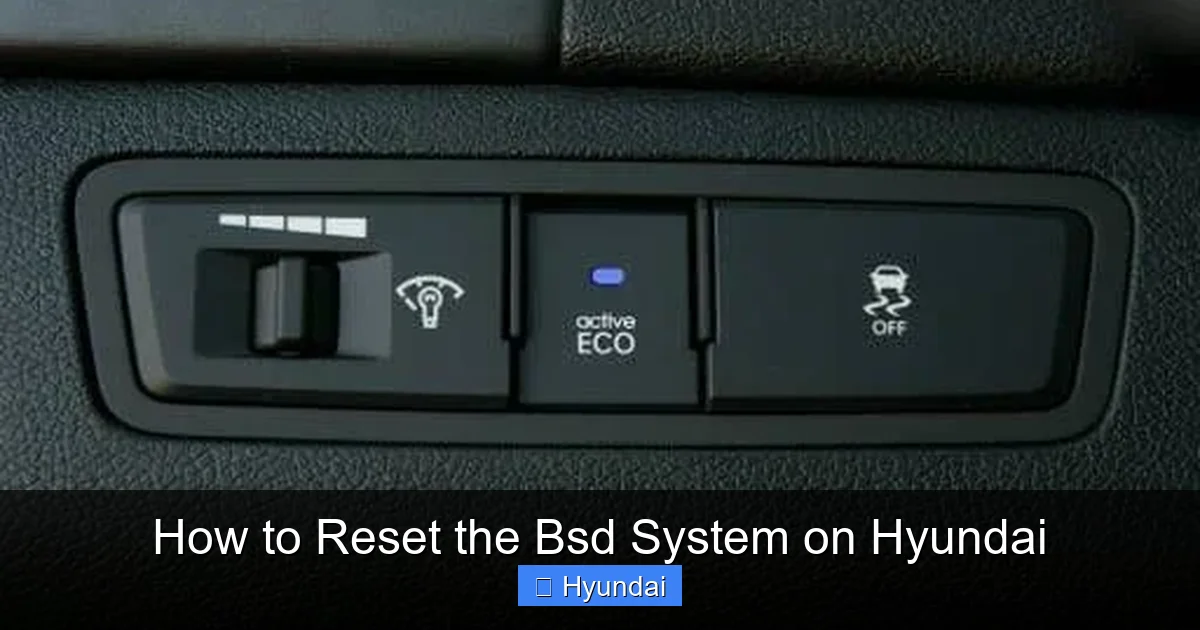
Method 1: The Dashboard Button Reset (Most Common for Newer Models)
Many Hyundai vehicles from approximately 2017 onward have a dedicated button to manually turn the BSD system on or off. This same button can often be used to reset the system after a fault is cleared. Here’s the general procedure:
- Start with the car in Park (P), engine OFF.
- Press the ENGINE START/STOP button to turn the ignition to the ON position (do not start the engine). All dashboard lights should illuminate.
- Locate the BSD button. It’s usually on the lower dashboard panel to the left of the steering wheel, on the steering wheel itself, or on the center console near the climate controls. It often features an icon of a car with radiating lines on its side.
- Press and hold this button for approximately 5-10 seconds. You should see the BSD warning light on the dashboard blink or the message on the cluster screen change.
- Release the button. Turn the ignition off, wait 10 seconds, then restart the engine normally.
- Check if the BSD warning light is still illuminated. If it’s gone, take the car for a short test drive (5-10 minutes) to see if the system reactivates and the warning stays off.
Example: On a 2020 Hyundai Santa Fe, the BSD button is on the lower dash. Holding it for 5 seconds with the ignition on typically resets the system. If the light returns during your drive, the fault is still present.
Method 2: The Drive Cycle Reset (For Intermittent Issues)
Sometimes, the system just needs to be “re-taught” its environment after a sensor has been cleaned or a battery has been jumped. A specific drive cycle can help the BSD module recalibrate itself as you drive. This method often works after you’ve physically addressed the problem (e.g., cleaned the sensors).
- Ensure the engine is warm. Start the car and let it idle for 2-3 minutes.
- Drive at a steady speed between 30-50 mph (50-80 km/h) for at least 5-10 minutes. The road should have clear lane markings and other vehicles present.
- During this drive, make several gentle lane changes (when safe!) to activate the BSD system. This gives it live data to process.
- After the drive cycle, park and turn off the engine. Restart it and check if the warning has cleared.
Pro Tip: Some Hyundai models require a more complex drive cycle involving specific speeds, turns, and idle times. This is where the owner’s manual or a dealership-level diagnostic guide is essential. If the basic cycle doesn’t work, you likely need a scan tool.
Method 3: The Full System Reboot (Battery Disconnect)
This is the nuclear option for electronic glitches. Disconnecting the battery forces a complete reset of all the vehicle’s control modules, including the BSD computer. It’s effective for clearing deep-seated software errors but will reset other systems (radio, clock, etc.).
- SAFETY FIRST: Ensure the car is off, keys removed, and parking brake set. Open the hood.
- Locate the negative (-) battery terminal. You’ll need a 10mm socket/wrench (common size).
- Loosen the nut on the negative terminal and carefully lift the cable off. Secure it away from the terminal so it can’t accidentally touch it. Do not let the positive and negative cables touch.
- Wait 15-20 minutes. This allows all residual power (capacitors) in the systems to drain completely.
- Reconnect the negative cable, tighten the nut securely, and close the hood.
- Start the car. It may run a bit rough initially as the engine control module recalibrates—this is normal.
- Check the dashboard. All warning lights, including the BSD light, should illuminate briefly as a self-check and then turn off. If the BSD light stays off, the reset was successful. Take it for a test drive.
Important: On some newer Hyundais with complex electronics, a battery disconnect can trigger additional warnings (for steering angle sensor, etc.) that also need to be cleared via a drive cycle or scan tool. Be prepared for this possibility.
When These Methods Fail: The Need for Professional Tools
If you’ve cleaned the sensors, verified a good battery charge, and attempted the appropriate reset procedure (button, drive cycle, battery disconnect) and the BSD warning returns within minutes or after the first drive, the system has detected an active fault. At this stage, consumer-level resets are no longer sufficient. You need to read the Diagnostic Trouble Codes (DTCs) stored in the BSD module. This requires an advanced OBD2 scanner that can communicate with the vehicle’s ADAS (Advanced Driver Assistance Systems) network. These tools, like the Hyundai GDS (Global Diagnostic System) or high-end aftermarket scanners, can not only read codes (e.g., C1XXX series for BSD) but also perform sensor calibration, which is often necessary after replacement. This is not typically a DIY job without specialized equipment and knowledge.
Troubleshooting: What to Do If the BSD Light Won’t Stay Off
You followed the steps. The light went out. But the next time you start the car, or after driving for a while, it’s back. Frustrating, right? Let’s diagnose the issue systematically.
Step 1: Perform a Physical Inspection
Get down on your knees and look at the rear bumper. Locate the BSD sensor covers (refer to your manual for exact location). Are they:
- Dirty or Caked with Debris? Use a gentle car wash soap, a soft microfiber cloth, and low-pressure water. Do not use abrasive scrubbers.
- Cracked, Missing, or Misaligned? The plastic cover itself might be damaged, or the sensor behind it may have been knocked loose. Any visible damage warrants a visit to a body shop or dealer.
- Covered by Aftermarket Accessories? A large spoiler, trailer hitch, or even a thick license plate frame can sometimes interfere with the radar’s field of view. Temporarily remove these to test.
Step 2: Check for Related Electrical Issues
The BSD sensors are part of the vehicle’s electrical system. A problem in one area can trigger another.
- Battery Health: Have your battery and charging system tested. A battery with low Cold Cranking Amps (CCA) or a failing alternator can cause voltage fluctuations. Many auto parts stores offer free battery tests.
- Fuse Check: Locate the fuse box (under the hood and/or inside the cabin). Find the fuse for “BSD,” “ADAS,” or “Radar” in your owner’s manual diagram. Pull it and check if the metal strip inside is intact. If it’s blown, replace it with a fuse of the exact same amperage. A blown fuse indicates a short circuit, which needs finding and fixing.
- Wiring Harness: Visually inspect the wiring that runs from the sensor into the trunk or under the car. Look for signs of rodent chewing, abrasion against metal, or water intrusion/corrosion. This is more involved but possible if you’re mechanically inclined.
Step 3: Interpret the Codes (If You Have a Scanner)
If you have access to a capable scanner, reading the BSD-specific codes is the fastest way to a diagnosis. Common codes might indicate:
- Sensor Communication Error: The module isn’t getting a signal from one side sensor. Could be wiring, connector, or the sensor itself.
- Sensor Out of Calibration: The system detects the sensor is present but its alignment is off. Requires professional recalibration.
- Internal Module Fault: The BSD control unit itself has failed. This is rare but possible.
Example: A code like “C1220 – Right Blind Spot Sensor Signal Out of Range” points directly to the right-side sensor or its wiring. You can then focus your inspection there.
Step 4: Know When to Call a Professional
If you’ve completed Steps 1-3 and the problem persists, it’s time to seek expert help. Specifically, you need a technician trained in Hyundai’s ADAS systems. They will:
- Use the official Hyundai GDS scanner to read live data from the sensors.
- Perform a precise sensor calibration on a flat, open surface using special targets. This is a delicate procedure.
- Diagnose and replace faulty sensors, wiring, or the control module if necessary.
- Clear all codes and verify the system is fully functional before returning the car.
Attempting a calibration yourself without the proper targets and training will almost certainly fail. The cost of professional calibration is worth the safety assurance.
Maintenance Tips to Keep Your BSD System Healthy
An ounce of prevention is worth a pound of cure. Keeping your Blind Spot Detection system in top shape is mostly about common-sense care.
Regular Cleaning is Key
Make sensor cleaning part of your regular car wash routine. Every time you wash the car, take an extra 30 seconds to:
- Spray the sensor area (the plastic covers in the rear bumper) with a gentle car wash soap solution.
- Agitate lightly with a soft microfiber mitt or brush dedicated to wheels/bumpers.
- Rinse with low-pressure water. Avoid directing the pressure washer jet straight at the sensor surface.
- Dry thoroughly with a clean, dry microfiber towel. Water droplets can sometimes cause temporary errors until they evaporate.
In winter, be extra vigilant about removing packed snow and ice from the bumper, especially around the sensor zones. A snow brush with a soft head is ideal.
Be Mindful of Impacts and Modifications
Your BSD sensors are precision instruments. Treat them with care.
- Parking: Try to avoid parking where your rear bumper might get rubbed or hit, like tight curbs or behind vehicles with protruding hitches.
- Aftermarket Accessories: Before installing a trailer hitch, large spoiler, or even a custom license plate frame, check your owner’s manual for clearance specifications around the rear bumper. Some hitches require a sensor relocation kit.
- Bumper Repairs: If you have any work done on the rear bumper—even just a small dent repair—insist that the technician checks the BSD sensor alignment afterward. It’s a simple check but often overlooked.
Battery and Electrical System Health
A healthy battery is the foundation of all your car’s electronics. Get your battery tested at least once a year, especially before extreme summer or winter. If your car is prone to short trips where the battery doesn’t fully charge, consider using a trickle charger periodically. A stable voltage environment prevents all sorts of false warning lights, not just BSD.
Software Updates
Occasionally, Hyundai releases Technical Service Bulletins (TSBs) or software updates for ADAS systems to improve performance or fix known bugs. When you take your car in for any service, ask the dealer if there are any pending software updates for your vehicle’s BSD or ADAS modules. It’s a free way to keep the system current.
Conclusion: Safety, Patience, and Knowing Your Limits
Resetting the BSD system on your Hyundai is a valuable skill that can save you time and money. Often, the solution is as simple as cleaning a dirty sensor or performing a button reset after a battery jump. The key is to follow a logical process: identify the likely cause, consult your owner’s manual, attempt the correct reset method safely, and then verify the fix with a test drive.
Remember, the BSD system is a critical safety feature. It is not merely an inconvenience light. If the warning persists after a proper reset, it is your car telling you that a component is malfunctioning and the system is offline. Do not ignore it. Driving without functional blind spot monitoring increases your risk. At that point, the most responsible action is to have the system professionally diagnosed. The cost of a proper repair is minor compared to the potential cost of an accident or the compromise of your safety and your passengers’.
By understanding how your Hyundai’s BSD system works, what triggers its warnings, and how to perform basic resets and maintenance, you become a more informed and proactive owner. You’ll keep your advanced safety features active and reliable for years to come, providing that extra layer of confidence and protection every time you merge onto the highway or change lanes in traffic.
Frequently Asked Questions
Is it safe to drive with the BSD warning light on?
Yes, it is safe to drive, but you must manually check your blind spots by looking over your shoulder before every lane change, as the automated system is disabled. The primary risk is forgetting this manual check and relying on a non-functional system.
Will a simple reset fix my BSD system every time?
No. A reset only clears the system’s memory. It will only fix the problem if the underlying cause was a temporary glitch, like a dirty sensor that you cleaned or a low battery that you charged. If a physical component is faulty, the warning will return.
Do I need special tools to reset the BSD system?
For basic resets (button hold, drive cycle, battery disconnect), you need no special tools. However, if the system requires calibration after a repair or to clear persistent faults, you will need a professional-grade OBD2 scanner capable of accessing the ADAS modules.
Is the BSD reset procedure the same for all Hyundai models?
No. Procedures can differ significantly between model years and trims. A 2018 Elantra may use a button reset, while a 2022 Palisade might require a specific drive cycle. Your owner’s manual is the only definitive source for your specific vehicle.
Why does my BSD light come on after I wash my car?
This is almost always due to water being forced into the sensor housing by a high-pressure washer, causing a temporary short circuit. The light should go away after the sensor dries out completely. To prevent this, use low-pressure water when washing near the rear bumper and avoid directly spraying the sensor areas.
When should I take my Hyundai to a dealer for a BSD issue?
You should visit a dealer or a specialist with ADAS calibration tools if: 1) the warning light returns immediately after a correct reset, 2) you’ve had recent rear bumper work done, 3) you suspect a sensor is damaged or misaligned, or 4) you are uncomfortable performing the reset procedures yourself. They have the necessary diagnostic software and calibration targets.