
How to Put a Toyota 4runner in 4-wheel Drive

Putting your Toyota 4Runner in 4-wheel drive is simple once you know the right steps—whether you’re tackling mud, snow, or rocky trails. This guide walks you through the process for every 4Runner generation, from lever shifts to electronic dials, so you can drive with confidence off the beaten path.
So, you’ve got a Toyota 4Runner—congrats! Whether you’re cruising down the highway or prepping for a weekend adventure in the mountains, one of the best things about this rugged SUV is its capable four-wheel-drive system. But if you’re new to the 4Runner world—or just haven’t had to use 4WD yet—you might be wondering: *How do I actually put this thing in 4-wheel drive?*
Don’t worry. You’re not alone. Even experienced drivers can get confused by the different systems across model years. Some 4Runners have a physical gear shifter near the console, while others use a sleek electronic dial on the dashboard. And then there’s the difference between 4H and 4L—what do those even mean?
The good news? Once you understand the basics, engaging 4WD is quick, safe, and totally doable. In this guide, we’ll walk you through everything you need to know—from identifying your 4Runner’s drivetrain setup to mastering the shift sequence for different driving conditions. Whether you drive a 1990s 3rd-gen with a manual transfer case or a 2024 TRD Pro with full-time 4WD, we’ve got you covered.
By the end of this article, you’ll feel confident hitting that button or pulling that lever, knowing exactly when and how to use 4-wheel drive. No more guessing. No more hesitation. Just pure, capable driving—whether you’re plowing through snowdrifts or crawling over boulders.
Key Takeaways
- Know your 4Runner’s drivetrain system: Older models use a manual transfer case lever, while newer ones feature an electronic 4WD switch or dial.
- Shift into 4H (4-High) on the go: You can typically engage 4H at speeds up to 55 mph on loose or slippery surfaces like gravel, snow, or dirt.
- Use 4L (4-Low) only when stopped or at very low speeds: This mode provides maximum torque for steep climbs, deep mud, or rock crawling—never engage while moving fast.
- Always shift back to 2H (2-wheel drive) on dry pavement: Driving in 4WD on hard surfaces can cause drivetrain binding and damage.
- Check your owner’s manual: Trim level and model year determine the exact procedure—don’t guess!
- Practice in a safe, open area: Before heading off-road, test your 4WD system in a parking lot or empty field to build confidence.
- Maintain your 4WD system: Regular service ensures smooth shifting and long-term reliability, especially if you use 4WD often.
📑 Table of Contents
Understanding Your Toyota 4Runner’s 4WD System
Before you flip any switches or yank any levers, it’s crucial to know what kind of 4WD system your 4Runner has. Toyota has used several different setups over the decades, and the method for engaging 4WD varies significantly depending on your model year and trim.
Let’s break it down by generation and technology.
Part-Time vs. Full-Time 4WD
Most 4Runners—especially those built before 2010—use a **part-time 4WD system**. This means the vehicle normally runs in rear-wheel drive (2H) and only sends power to all four wheels when you manually engage 4WD. It’s simple, robust, and ideal for off-roading or slippery conditions. However, you should **never** use part-time 4WD on dry pavement—it can cause serious damage due to drivetrain wind-up.
Newer models, particularly the 5th-generation (2010–present) TRD Off-Road and Limited trims, often come with **full-time 4WD**. This system automatically distributes power between the front and rear axles as needed, even on dry roads. It includes a center differential that allows for smooth operation on all surfaces. Many full-time systems also offer a “4H Lock” mode that mimics part-time 4WD for extra traction.
Manual Transfer Case (Older Models: 1989–2009)
If your 4Runner is from the 3rd or 4th generation (roughly 1989 to 2009), chances are it uses a **manual transfer case** with a physical gear shifter. This shifter is usually located to the right of the main transmission lever and has positions like 2H, 4H, N (neutral), and 4L.
These systems require you to **stop or slow down significantly** before shifting into 4L. However, you can often shift from 2H to 4H while driving at moderate speeds (up to 55 mph) on loose surfaces like gravel or snow.
Electronic 4WD Switch (Newer Models: 2010–Present)
Starting with the 5th-generation 4Runner (2010 and newer), Toyota introduced an **electronic 4WD control system**. Instead of a lever, you’ll find a dial or button on the center console—usually labeled with icons for 2WD, 4H, 4L, and sometimes A-TRAC (Auto Traction Control).
This system is more user-friendly and allows for smoother transitions between modes. Some trims even include additional features like crawl control and multi-terrain select, which automatically adjust throttle and braking for specific off-road conditions.
Identifying Your System
Not sure which system you have? Here’s a quick way to tell:
– **Look for a second shifter** near your main gear selector. If it has “2H,” “4H,” and “4L,” you’ve got a manual transfer case.
– **Check the dashboard or center console** for a round dial with 4WD symbols. That’s your electronic system.
– **Consult your owner’s manual**—it will specify whether your 4Runner has part-time, full-time, or automatic 4WD.
Knowing your system is the first step to using it correctly. Once you’ve identified it, you’re ready to learn how to engage 4WD safely and effectively.
How to Engage 4H (4-High) in Your 4Runner
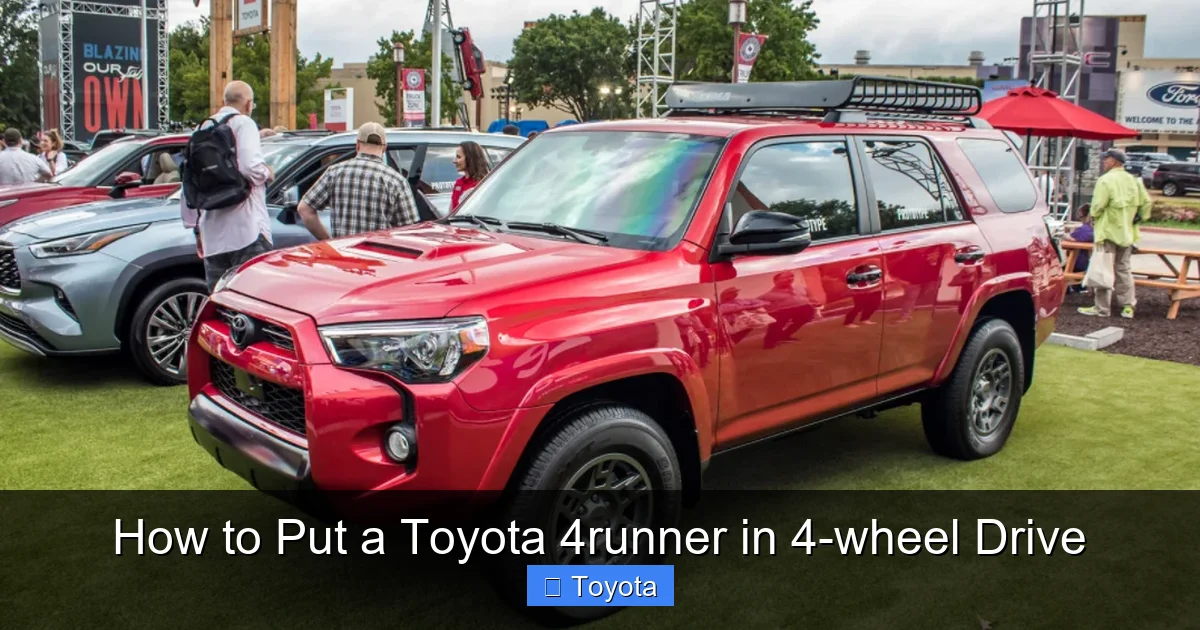
Visual guide about How to Put a Toyota 4runner in 4-wheel Drive
Image source: ihwanburhan.com
4H, or 4-High, is the most commonly used 4WD mode. It’s perfect for driving on snow-covered roads, muddy trails, gravel paths, or any surface where you need extra traction but aren’t doing serious rock crawling.
The good news? In most 4Runners, you can shift into 4H **while driving**—no need to stop completely.
For Manual Transfer Case Models (Pre-2010)
If your 4Runner has a physical transfer case lever, follow these steps:
1. **Drive at a steady speed under 55 mph** on a loose or slippery surface (like gravel, snow, or dirt). Do not attempt this on dry pavement.
2. **Press the clutch** (if manual transmission) or ease off the accelerator (if automatic).
3. **Move the transfer case lever from 2H to 4H** in one smooth motion. You should feel a slight resistance, then a firm click.
4. **Resume normal driving**. You may hear a brief clunk or feel a shift—that’s normal.
💡 *Pro Tip:* Avoid shifting into 4H during sharp turns or high-speed maneuvers. The sudden engagement can stress the drivetrain.
For Electronic 4WD Models (2010 and Newer)
If your 4Runner has the electronic dial, the process is even simpler:
1. **Drive at any speed up to 55 mph** on a non-paved or slippery surface.
2. **Turn the 4WD dial from 2WD to 4H**. You don’t need to press the brake or clutch.
3. **Wait a moment** for the system to engage. A light on the dashboard (usually labeled “4WD” or “4H”) will illuminate to confirm activation.
4. **Continue driving normally**.
Some newer models even allow you to shift from 2H to 4H at highway speeds, though Toyota still recommends doing so only on loose surfaces.
When to Use 4H
Use 4H whenever you need improved traction but aren’t facing extreme obstacles. Great scenarios include:
– Driving through snow or ice
– Navigating muddy backroads
– Towing a trailer on gravel
– Crossing wet grass or sand
Remember: **Never use 4H on dry pavement**. The lack of slippage between tires causes drivetrain binding, which can lead to expensive repairs.
Common Mistakes to Avoid
– **Shifting into 4H on dry asphalt**: This is the #1 cause of 4WD-related damage.
– **Forcing the lever**: If it won’t go into 4H, slow down or shift to neutral briefly.
– **Leaving it in 4H too long**: Once conditions improve, shift back to 2H to reduce wear and improve fuel economy.
With practice, shifting into 4H becomes second nature—and it could save you from getting stuck in a snowbank or muddy ditch.
How to Use 4L (4-Low) for Maximum Traction

Visual guide about How to Put a Toyota 4runner in 4-wheel Drive
Image source: smclassiccars.com
4L, or 4-Low, is the heavy-duty mode of your 4Runner’s 4WD system. It provides **maximum torque and low-speed control**, making it ideal for steep inclines, deep mud, rock crawling, or pulling heavy loads.
But here’s the catch: **You should never engage 4L while driving at speed**. In fact, Toyota recommends coming to a **complete stop** before shifting into 4L.
Step-by-Step: Engaging 4L on Manual Transfer Case Models
1. **Come to a full stop**. Put the transmission in neutral (for manuals) or park (for automatics).
2. **Shift the main transmission into low gear** (1st for manuals, L or 2 for automatics).
3. **Move the transfer case lever from 2H to N (neutral), then into 4L**. This two-step process prevents grinding.
4. **Shift the transmission back into drive (or 1st gear)**.
5. **Drive slowly and steadily**. In 4L, your 4Runner will feel sluggish but incredibly powerful.
💡 *Example:* Imagine you’re climbing a steep, rocky trail. In 4L, your 4Runner will crawl forward with steady torque, letting you pick your line without stalling or spinning tires.
Engaging 4L on Electronic 4WD Models
For 2010 and newer 4Runners with the electronic dial:
1. **Stop completely**. Put the vehicle in park (or neutral if manual).
2. **Press and hold the 4L button** (or turn the dial to 4L and hold).
3. **Wait for confirmation**—a dashboard light will flash, then stay solid when engaged.
4. **Shift into low range** (if your model has a separate low-range selector).
5. **Drive slowly**. Speed should not exceed 25–30 mph in 4L.
Some TRD Off-Road and TRD Pro models include **Crawl Control**, which automatically manages throttle and braking in 4L—perfect for technical off-roading.
When to Use 4L
Reserve 4L for extreme conditions:
– Rock crawling or boulder fields
– Steep mountain trails with loose gravel
– Deep mud or snow where traction is minimal
– Towing heavy loads up inclines
Safety Tips for 4L
– **Never exceed 30 mph** in 4L—doing so can destroy your transfer case.
– **Avoid sudden acceleration or braking**—smooth inputs are key.
– **Shift out of 4L before returning to pavement**. Re-engage 4H or 2H once you’re back on normal roads.
Using 4L correctly turns your 4Runner into a true off-road beast. But misuse can lead to costly repairs—so always follow the steps carefully.
Shifting Back to 2H (2-Wheel Drive)
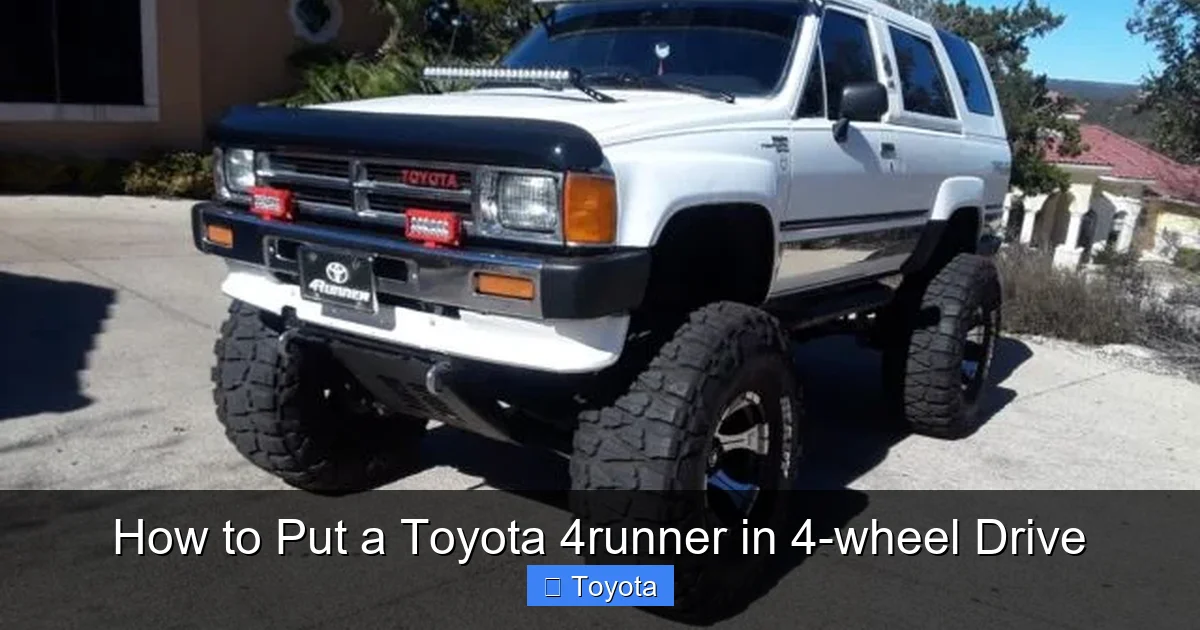
Visual guide about How to Put a Toyota 4runner in 4-wheel Drive
Image source: smclassiccars.com
Just as important as engaging 4WD is knowing when to **disengage it**. Running in 4H or 4L on dry pavement causes drivetrain stress, reduces fuel efficiency, and can damage components over time.
So, how do you safely shift back to 2H?
For Manual Transfer Case Models
1. **Drive under 55 mph** on a loose or slippery surface (never on dry pavement).
2. **Ease off the accelerator** or press the clutch.
3. **Move the transfer case lever from 4H back to 2H** in one smooth motion.
4. **Resume normal driving**.
If you’re in 4L, **stop completely** before shifting back to 4H, then follow the steps above to return to 2H.
For Electronic 4WD Models
1. **Drive at any speed up to 55 mph** on a non-paved surface.
2. **Turn the dial from 4H back to 2WD**.
3. **Wait for the 4WD light to turn off**—confirming the system has disengaged.
4. **Continue driving**.
Some drivers worry about “binding” when shifting out of 4H. If you feel resistance, **slow down slightly** or make a gentle turn to relieve tire scrub before shifting.
Best Practices
– **Shift back to 2H as soon as conditions improve**. There’s no benefit to staying in 4WD on dry roads.
– **Make it a habit**. Every time you return from off-roading or winter driving, remind yourself to disengage 4WD.
– **Listen to your vehicle**. If you hear clunking, grinding, or feel vibration on pavement, you’re likely still in 4WD.
Regularly switching between 2H and 4H keeps your drivetrain healthy and ensures your 4Runner performs at its best—no matter the terrain.
Tips for Safe and Effective 4WD Use
Now that you know how to shift into and out of 4WD, let’s talk about using it wisely. A 4Runner is built for adventure, but even the toughest SUV needs care—especially when pushing its limits.
Know When to Use 4WD
Not every slippery situation requires 4WD. Light snow, wet leaves, or damp grass might only need gentle throttle and good tires. Save 4H for when you actually need the extra grip—like when you start to slip or lose momentum.
Overusing 4WD can wear out components faster and reduce fuel economy. Use it when necessary, not as a default.
Practice in a Safe Environment
Before heading into the backcountry, **practice shifting between modes in a large, empty parking lot or field**. Try engaging 4H at 20 mph, then 4L from a stop. Get comfortable with the feel and sound of each shift.
This builds confidence and helps you avoid mistakes when it really counts.
Maintain Your 4WD System
Regular maintenance is key to long-term reliability:
– **Check transfer case and differential fluid** every 30,000–60,000 miles (or as specified in your manual).
– **Inspect driveshafts, U-joints, and CV axles** for wear or leaks.
– **Test your 4WD system seasonally**—especially before winter or off-road trips.
A well-maintained system shifts smoothly and responds instantly when you need it most.
Use the Right Tires
4WD helps, but **tires are your first point of contact with the ground**. All-terrain or mud-terrain tires dramatically improve traction in off-road conditions. Don’t rely solely on 4WD—pair it with proper rubber.
Be Mindful of Weight Distribution
When off-roading in 4L, avoid sudden shifts in weight (like slamming the brakes or jerking the wheel). Keep your movements smooth to maintain traction and control.
And remember: 4WD improves traction, but it **does not improve braking**. You’ll still need extra stopping distance on loose or slippery surfaces.
Troubleshooting Common 4WD Issues
Even with proper use, you might run into occasional hiccups. Here are some common problems and how to fix them.
4WD Won’t Engage
– **Cause**: Low speed, wrong surface, or mechanical issue.
– **Fix**: Slow down, ensure you’re on loose terrain, and try again. If it still won’t engage, check for fluid leaks or consult a mechanic.
Grinding or Resistance When Shifting
– **Cause**: Attempting to shift at high speed or on dry pavement.
– **Fix**: Come to a complete stop, shift to neutral, and try again. For manual systems, double-clutching can help.
Drivetrain Vibration on Pavement
– **Cause**: Still in 4H or 4L on dry roads.
– **Fix**: Shift back to 2H immediately. If vibration persists, have your drivetrain inspected.
4WD Light Flashing or Not Illuminating
– **Cause**: Electrical issue or incomplete engagement.
– **Fix**: Turn the vehicle off and on, then retry the shift. If the light still doesn’t come on, visit a Toyota service center.
Most issues are preventable with proper technique—but if something feels off, don’t ignore it. Early diagnosis saves money and keeps you safe.
Conclusion
Putting your Toyota 4Runner in 4-wheel drive doesn’t have to be intimidating. Whether you’re driving a classic with a manual lever or a modern beast with electronic controls, the process is straightforward once you understand your system.
Remember: **4H is for traction on loose surfaces, 4L is for extreme low-speed challenges, and 2H is for everyday driving**. Shift responsibly, maintain your vehicle, and always consult your owner’s manual for model-specific guidance.
With this knowledge, you’re ready to tackle snow, mud, rocks, and everything in between—confidently and safely. Your 4Runner isn’t just a SUV. It’s a capable adventure machine. And now, you know how to unlock its full potential.
So go ahead—hit that dial, pull that lever, and explore with confidence. The trail is waiting.
Frequently Asked Questions
Can I shift into 4H while driving?
Yes, in most Toyota 4Runners, you can shift from 2H to 4H at speeds up to 55 mph, but only on loose or slippery surfaces like gravel, snow, or dirt. Never do this on dry pavement.
Do I need to stop to shift into 4L?
Yes, you should come to a complete stop before shifting into 4L. This prevents damage to the transfer case and ensures smooth engagement.
Can I drive in 4WD on the highway?
You can drive in 4H on highways if conditions are slippery (like snow or ice), but switch back to 2H once roads are dry to avoid drivetrain damage.
Why won’t my 4Runner shift into 4WD?
Common causes include high speed, dry pavement, low transmission fluid, or mechanical wear. Slow down, check fluids, and consult your manual or a mechanic if the issue persists.
Is it bad to leave my 4Runner in 4H all the time?
Yes, running in 4H on dry pavement causes drivetrain binding and can lead to costly repairs. Only use 4H when traction is needed.
Does 4WD improve fuel economy?
No, 4WD increases mechanical resistance and reduces fuel efficiency. Use it only when necessary to save fuel and protect your drivetrain.
