How to Open a Toyota Corolla Bonnet

Contents
- 1 Key Takeaways
- 2 📑 Table of Contents
- 3 Why You Might Need to Open Your Corolla’s Bonnet
- 4 Step-by-Step Guide to Opening the Toyota Corolla Bonnet
- 5 Model-Specific Differences to Know
- 6 Common Mistakes and How to Avoid Them
- 7 Troubleshooting: What If the Bonnet Won’t Open?
- 8 Safety Tips for Working Under the Bonnet
- 9 How to Close the Bonnet Properly
- 10 Final Thoughts
- 11 Frequently Asked Questions

Jack Stands

Carburetor Cleaner

Car Ambient Light Kit

Car Seat Cover (Universal Fit)
Opening the bonnet of your Toyota Corolla is simple once you know where to look and what steps to follow. Whether you’re checking oil, topping up fluids, or performing routine maintenance, this guide walks you through the process clearly and safely—no tools required.
Opening the bonnet of your Toyota Corolla might seem like a basic task, but if you’re new to the car—or just haven’t done it in a while—it can feel a bit confusing. Unlike some vehicles that use hidden buttons or complex sequences, the Corolla keeps things refreshingly straightforward. That said, there are a few nuances depending on your model year, and skipping a step (like the secondary safety latch) could leave you frustrated or even risk damaging the bonnet.
Whether you’re checking your engine oil, topping up windshield washer fluid, inspecting belts, or simply curious about what’s under the hood, knowing how to open the bonnet correctly is essential. This guide will walk you through the entire process—from locating the release lever to safely securing the bonnet open—and include practical tips to avoid common mistakes. We’ll also cover troubleshooting for when things don’t go as planned, plus model-specific advice so you’re never left guessing.
By the end of this article, you’ll feel confident opening your Toyota Corolla bonnet like a pro—no mechanic required.
Key Takeaways
- Locate the interior bonnet release lever: Found under the dashboard on the driver’s side, usually marked with a bonnet icon.
- Pull the lever firmly: A single, strong pull releases the primary latch; you’ll hear a click when it opens.
- Find the secondary safety latch: After lifting the bonnet slightly, feel for a small lever or button near the front center of the bonnet.
- Lift and secure the bonnet: Use the bonnet prop rod or hydraulic strut (depending on model year) to keep it open safely.
- Close the bonnet properly: Lower it gently from the front, then press down firmly in the center until it clicks shut—never slam it.
- Know your model year: Bonnet mechanisms vary slightly between older (pre-2014) and newer Corolla models, so check your owner’s manual if unsure.
- Safety first: Always park on level ground, engage the parking brake, and ensure the engine is off and cool before opening the bonnet.
📑 Table of Contents
- Why You Might Need to Open Your Corolla’s Bonnet
- Step-by-Step Guide to Opening the Toyota Corolla Bonnet
- Model-Specific Differences to Know
- Common Mistakes and How to Avoid Them
- Troubleshooting: What If the Bonnet Won’t Open?
- Safety Tips for Working Under the Bonnet
- How to Close the Bonnet Properly
- Final Thoughts
Why You Might Need to Open Your Corolla’s Bonnet
There are many everyday reasons why you’d want access to your engine bay. Routine maintenance tasks like checking and changing engine oil, inspecting coolant levels, replacing air filters, or topping up brake fluid all require lifting the bonnet. Even simple things like jump-starting your car (connecting jumper cables to the battery) or cleaning debris from the radiator need bonnet access.
Beyond maintenance, opening the bonnet can help diagnose issues. If your car is overheating, making strange noises, or leaking fluids, a quick visual inspection under the hood might reveal the problem—like a loose hose, cracked belt, or low fluid reservoir. And let’s not forget seasonal checks: before winter, you might inspect antifreeze levels; in summer, you could clean leaves or dirt blocking airflow to the radiator.
The good news? The Toyota Corolla is designed with user-friendly access in mind. Unlike some performance cars with complex hood releases or luxury vehicles that hide latches behind grilles, the Corolla uses a simple two-step system that’s reliable and intuitive. Once you’ve done it a couple of times, it becomes second nature.
Step-by-Step Guide to Opening the Toyota Corolla Bonnet

Visual guide about How to Open a Toyota Corolla Bonnet
Image source: servicebox.org
Now that you know why you might need to open the bonnet, let’s get into the actual steps. The process is consistent across most Corolla generations, though minor differences exist—especially between older models (like the E150 series from 2007–2013) and newer ones (E210 series from 2014 onward). Don’t worry—we’ll highlight those differences as we go.
Step 1: Park Safely and Prepare
Before you even think about pulling any levers, make sure your car is parked on a flat, level surface. Engage the parking brake to prevent rolling, and turn off the engine completely. If the engine has been running recently, give it at least 10–15 minutes to cool down—hot components can cause burns, and steam from coolant systems can be dangerous.
Also, ensure the area around your car is clear. You’ll need enough space to lift the bonnet fully without hitting walls, curbs, or other vehicles. If you’re in a tight garage, consider opening the driver’s door fully so you have room to maneuver.
Step 2: Locate the Interior Bonnet Release Lever
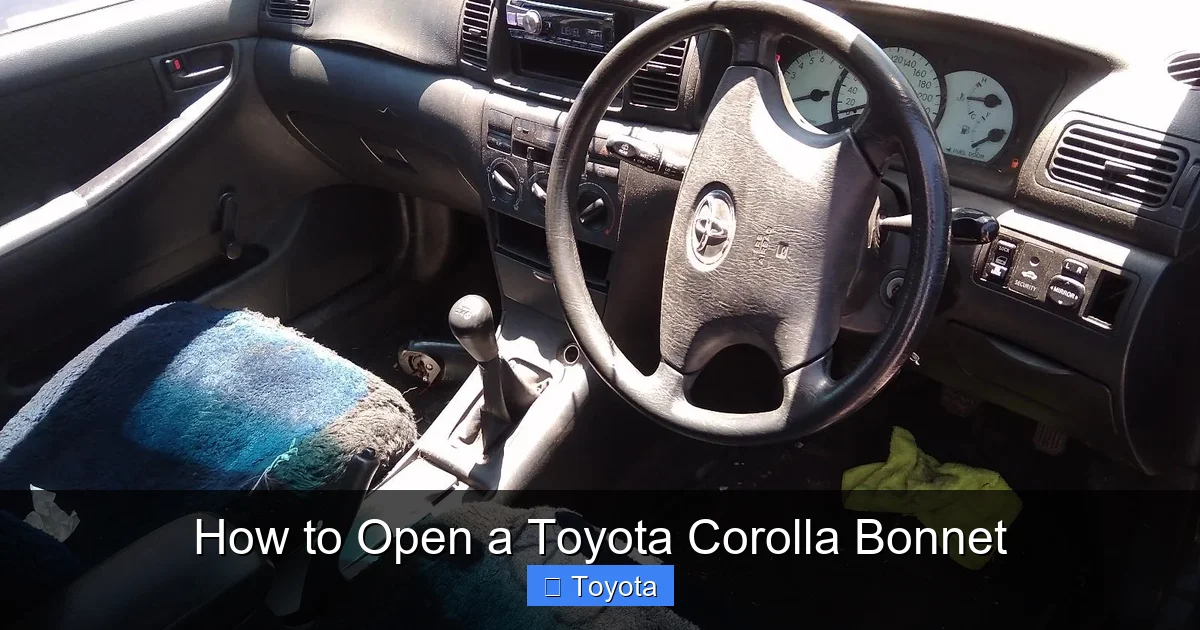
This is the most important step—and the one many people overlook. The primary bonnet release is located inside the cabin, on the lower left side of the dashboard (driver’s side), just above the footwell. Look for a small lever with a bonnet icon—it often looks like a simplified car outline with an open hood.
In older Corollas (pre-2014), this lever is usually black or gray and positioned near the door sill. In newer models (2014+), it’s often integrated into the lower dashboard panel and may be slightly recessed. If you can’t find it right away, check your owner’s manual—it will show an exact diagram. Some drivers confuse this with the fuel door release (which is typically on the same side but higher up), so double-check the symbol.
Step 3: Pull the Release Lever Firmly
Once you’ve found the lever, pull it toward you with a firm, steady motion. You don’t need to yank it—just one strong pull is enough. When the primary latch releases, you’ll hear a distinct “click” or “thunk” from the front of the car. This sound confirms the bonnet is partially unlatched.
Don’t worry if nothing seems to happen at first. Sometimes road vibration or temperature changes can make the sound subtle. The key is feeling the lever move and hearing that release. If you pull and nothing happens, try again—but avoid repeated hard pulls, which could damage the cable.
Step 4: Go to the Front of the Vehicle and Find the Safety Latch
Now walk to the front of your Corolla. You’ll notice the bonnet has lifted slightly—usually about 1–2 inches—at the center. This gap is intentional; it allows you to access the secondary safety latch, which prevents the bonnet from flying open accidentally while driving.
Reach your hand into the gap at the center front of the bonnet. Feel for a small lever, button, or sliding mechanism. In most Corollas, it’s a small metal lever that you push to the side (left or right, depending on the model) or pull upward. Newer models (2014+) often have a more ergonomic plastic tab that’s easier to grip.
Pro Tip: If you’re having trouble finding it, shine a flashlight into the gap. The safety latch is usually centered and positioned just behind the Toyota emblem or grille.
Step 5: Release the Safety Latch and Lift the Bonnet
Once you’ve located the safety latch, activate it. For lever-style latches, push it sideways until you feel it disengage. For button or tab styles, pull it up or push it in the direction indicated (often marked with an arrow). As soon as it releases, the bonnet will pop open further—you can now lift it fully.
Use both hands to lift the bonnet smoothly and steadily. Avoid jerky movements, which could strain the hinges or damage the paint. Most Corollas have hydraulic struts (gas-filled supports) that help lift the bonnet with minimal effort. However, older models (especially pre-2010) may use a traditional prop rod.
Step 6: Secure the Bonnet Open
If your Corolla has hydraulic struts (common in 2014+ models), the bonnet will stay open on its own—no extra support needed. But if you have an older model with a prop rod, you’ll need to manually secure it.
Look for a metal rod stored in a clip on the underside of the bonnet. Pull it out and insert the tip into the designated socket on the radiator support or chassis. Make sure it’s fully seated—if it slips out, the bonnet could fall and cause injury or damage.
Safety Reminder: Never rely on the prop rod being in place without checking. A loose or missing prop rod is a common cause of bonnet accidents.
Model-Specific Differences to Know

Visual guide about How to Open a Toyota Corolla Bonnet
Image source: sparesdirect.co.za
While the basic steps are consistent, Toyota has made subtle changes over the years. Knowing your Corolla’s generation can save you time and frustration.
Pre-2014 Corolla Models (E150 Series)
These models typically use a cable-operated primary release and a manual prop rod. The interior lever is often more exposed and located closer to the door. The safety latch is usually a simple metal lever that requires a sideways push. Because these cars lack hydraulic struts, you must always use the prop rod—don’t assume the bonnet will stay up on its own.
2014–2019 Corolla Models (E210 Series – First Facelift)
Toyota introduced hydraulic struts in this generation, making bonnet lifting easier. The interior release lever is more integrated into the dashboard, and the safety latch often features a plastic tab for better grip. Some trims also include a bonnet release indicator light on the dashboard (though this is rare).
2020–Present Corolla Models (E210 Series – Second Facelift)
The latest Corollas retain hydraulic struts but refine the safety latch design for smoother operation. The interior lever is now more flush with the dashboard, and some higher trims include electronic bonnet release systems (though most still use the traditional mechanical method). Always refer to your owner’s manual—Toyota sometimes updates mechanisms mid-generation.
Common Mistakes and How to Avoid Them
Visual guide about How to Open a Toyota Corolla Bonnet
Image source: narrandera-wp-photos.sgp1.cdn.digitaloceanspaces.com
Even experienced drivers make errors when opening the bonnet. Here are the most common pitfalls—and how to dodge them.
Forgetting the Safety Latch
This is the #1 mistake. Many people pull the interior lever, see the bonnet lift slightly, and assume it’s fully open. But without releasing the secondary latch, the bonnet won’t lift more than an inch or two. Always go to the front and check for the safety mechanism.
Prying the Bonnet Open
Never use a screwdriver, pry bar, or other tool to force the bonnet open. This can scratch paint, bend hinges, or damage the latch assembly. If the bonnet won’t open after pulling the lever and releasing the safety latch, there’s likely a mechanical issue—not a stubborn seal.
Not Using the Prop Rod (Older Models)
If your Corolla uses a prop rod, always deploy it. Relying on gravity or “just being quick” is risky. A falling bonnet can crack windshields, dent fenders, or injure your hands.
Slamming the Bonnet Shut
When closing, never drop the bonnet from height. Lower it gently until it’s about 6 inches from closing, then press down firmly in the center. The latch should engage with a solid “click.” Slamming can misalign the latch or damage the seal.
Opening on Uneven Ground
Parking on a slope can cause the bonnet to shift or fall unexpectedly. Always use level ground and the parking brake. If you must work on a hill, use wheel chocks for extra safety.
Troubleshooting: What If the Bonnet Won’t Open?
Sometimes, despite following all steps, the bonnet refuses to budge. Here’s how to diagnose and fix common issues.
The Lever Pulls But Nothing Happens
This usually means the release cable is broken, disconnected, or jammed. Check under the dashboard to see if the cable is intact. If it’s snapped, you’ll need a mechanic to replace it. In a pinch, you might be able to access the latch from underneath the car (not recommended unless you’re experienced).
The Bonnet Lifts Slightly But Won’t Open Fully
Almost certainly a stuck safety latch. Try jiggling the bonnet gently while pressing the safety lever. If that fails, spray a small amount of silicone lubricant (not WD-40, which attracts dirt) into the latch mechanism. Let it sit for a few minutes before trying again.
Rust or Corrosion on Older Models
In humid or salty climates, the latch mechanism can seize. Regular cleaning and light lubrication can prevent this. If corrosion is severe, consider having the latch serviced or replaced.
Hydraulic Struts Losing Pressure
If your bonnet feels heavy or won’t stay open, the gas struts may be failing. They typically last 5–7 years. Replacement is inexpensive and can be done at home with basic tools.
Safety Tips for Working Under the Bonnet
Once the bonnet is open, safety remains crucial. The engine bay contains hot surfaces, moving parts (if the engine is running), electrical components, and hazardous fluids.
– Never touch the radiator or exhaust manifold if the engine is warm—they can cause severe burns.
– Keep loose clothing, jewelry, and long hair away from belts and pulleys.
– Use a bonnet support stick or stand if working for extended periods—don’t lean on the bonnet.
– Wear safety glasses when checking fluids or inspecting components.
– Dispose of old fluids properly—never pour oil or coolant on the ground.
How to Close the Bonnet Properly
Closing the bonnet is just as important as opening it. Follow these steps for a secure seal:
1. If using a prop rod, remove it and clip it back into place.
2. Lower the bonnet slowly until it’s about 6–8 inches from the closed position.
3. Press down firmly in the center with the palm of your hand—don’t slap or stomp.
4. Listen for a solid “click” indicating the latch has engaged.
5. Gently lift the front edge to confirm it’s locked—if it moves, repeat the process.
A properly closed bonnet should sit flush with the fenders and not rattle while driving.
Final Thoughts
Opening the bonnet of your Toyota Corolla is a simple, everyday task—but one that deserves attention to detail. By following the correct steps, respecting model differences, and prioritizing safety, you’ll protect both your car and yourself. Whether you’re a new Corolla owner or a long-time driver, this skill ensures you can perform basic maintenance with confidence.
Remember: when in doubt, consult your owner’s manual. Toyota designs its vehicles for reliability and ease of use, and the bonnet release system is no exception. With practice, you’ll be able to open and close your Corolla’s bonnet in under 30 seconds—no tools, no stress, just smooth operation.
Frequently Asked Questions
Where is the bonnet release lever on a Toyota Corolla?
The bonnet release lever is located inside the car, on the lower left side of the dashboard (driver’s side), just above the footwell. Look for a lever with a bonnet icon—it’s usually black or gray and easy to reach from the driver’s seat.
Do all Toyota Corolla models use the same bonnet opening method?
Yes, the basic two-step process (interior lever + safety latch) is consistent across all Corolla generations. However, older models may use a prop rod instead of hydraulic struts, and the exact placement of the safety latch can vary slightly.
What should I do if the bonnet won’t open after pulling the lever?
First, ensure you’ve released the secondary safety latch at the front of the bonnet. If it still won’t open, the release cable may be broken or the latch may be seized. Try lubricating the latch or consult a mechanic if the issue persists.
Can I open the bonnet while the engine is running?
No—always turn off the engine and let it cool before opening the bonnet. Working on a hot engine can cause burns, and moving parts pose a safety risk.
How do I know if my Corolla has hydraulic struts or a prop rod?
Newer models (2014 and later) typically have hydraulic struts that hold the bonnet open automatically. Older models (pre-2014) usually require a manual prop rod, which is stored under the bonnet and must be inserted to keep it up.
Is it safe to drive if the bonnet doesn’t close properly?
No. A loose or improperly closed bonnet can fly open while driving, blocking your view and creating a serious hazard. Always ensure the bonnet is fully latched before driving.