
How to Get Toyota Tacoma Out of 4 Wheel Drive

Getting your Toyota Tacoma out of 4 wheel drive is simple when you follow the right steps. Whether you’re switching from 4H to 2WD or disengaging 4LO after off-roading, this guide walks you through the process for every model year. With clear instructions and safety tips, you’ll avoid damage and keep your truck running smoothly.
If you’ve ever been out on a muddy trail or snowy backroad and engaged your Toyota Tacoma’s 4 wheel drive, you know how capable this truck can be. But once the adventure is over, getting your Tacoma out of 4WD is just as important—and sometimes just as tricky—if you don’t know what you’re doing. Many drivers, especially new Tacoma owners, find themselves confused when it’s time to switch back to two-wheel drive. They worry about damaging the drivetrain, grinding gears, or simply not knowing the right steps.
The good news? It’s not complicated—once you understand how your Tacoma’s 4WD system works and follow the correct procedure. Whether you drive a newer model with an electronic switch or an older Tacoma with a manual floor shifter, the process is straightforward when done right. This guide will walk you through everything you need to know, from identifying your system type to safely disengaging 4WD without stress or damage. We’ll cover common mistakes, model-specific tips, and maintenance advice to keep your Tacoma running strong.
By the end of this article, you’ll feel confident shifting in and out of 4WD like a pro. No more guessing, no more hesitation—just smooth, safe transitions whether you’re coming back from a weekend off-roading trip or simply driving in winter conditions. Let’s dive in and make sure your Tacoma stays in top shape, mile after mile.
Key Takeaways
- Know Your Tacoma’s 4WD System: Tacomas use either a part-time or full-time 4WD system—understanding the difference is key to safe disengagement.
- Use the Correct Shift Pattern: Most Tacomas require you to shift from 4H to 2H while driving under 55 mph; 4LO requires a complete stop.
- Always Shift on Dry, Stable Surfaces: Avoid shifting in mud, snow, or loose terrain to prevent drivetrain binding or damage.
- Listen for Unusual Noises: Grinding or clunking during shifts may indicate low transfer case fluid or mechanical issues.
- Check Transfer Case Fluid Regularly: Low or degraded fluid can cause shifting problems and long-term damage.
- Use the Right Technique for Manual Shifters: Older Tacomas with floor shifters need a specific sequence—don’t force the lever.
- When in Doubt, Consult the Owner’s Manual: Your specific model year may have unique procedures—always refer to official Toyota documentation.
📑 Table of Contents
Understanding Your Toyota Tacoma’s 4WD System
Before you can safely get your Toyota Tacoma out of 4 wheel drive, it’s essential to understand what kind of 4WD system your truck has. Not all Tacomas are created equal when it comes to four-wheel drive. Depending on the model year and trim level, your Tacoma may use either a part-time 4WD system or a full-time 4WD system. Knowing the difference will help you avoid mistakes and protect your drivetrain.
Part-Time 4WD: The Most Common Setup
The majority of Toyota Tacomas, especially those from 2005 onward, come equipped with a part-time 4WD system. This system is designed for off-road use and slippery conditions like mud, snow, or gravel. In part-time 4WD, power is sent to all four wheels, but the front and rear axles are locked together. This means both axles turn at the same speed, which is great for low-traction environments but can cause problems on dry pavement.
Because of this, part-time 4WD should only be used when traction is poor. Driving in 4H or 4LO on dry roads can lead to something called “drivetrain binding,” where the wheels fight each other to turn at different speeds. This can cause stress on the transfer case, differentials, and axles—potentially leading to expensive repairs. That’s why it’s so important to know how to get your Tacoma out of 4WD when you return to normal driving conditions.
Full-Time 4WD: Less Common but Available
Some older Tacoma models, particularly those from the early 2000s, came with a full-time 4WD system. This system allows you to drive in 4WD on any surface, including dry pavement, because it uses a center differential to allow the front and rear axles to turn at different speeds. In this setup, you can leave the truck in 4H all the time if you wish—though it may reduce fuel economy slightly.
However, even full-time 4WD systems often have a “4H Lock” or “4LO” mode for maximum traction. When using these locked modes, the same rules apply: avoid dry pavement and disengage when no longer needed. Most modern Tacomas, though, use the part-time system, so unless you’re driving an older model, you’re likely dealing with part-time 4WD.
How to Identify Your System
So how do you know which system your Tacoma has? The easiest way is to check your owner’s manual—it will clearly state whether your truck uses part-time or full-time 4WD. You can also look at the transfer case shifter or dashboard controls. If you have a floor shifter with positions like 2H, 4H, and 4LO, you likely have a part-time system. If you have an electronic switch with options like “4H Auto” or “4H Lock,” it may be a full-time system or a modern part-time with auto mode.
Another clue is the owner’s manual warning label. Most part-time 4WD Tacomas have a sticker near the shifter or in the manual that says something like: “Do not drive in 4H or 4LO on dry pavement.” If you see that, you’ve got a part-time system and need to be extra careful when disengaging.
Understanding your system is the first step to safely getting your Tacoma out of 4WD. Once you know what you’re working with, you can follow the correct procedure for your model.
Step-by-Step: How to Get Your Tacoma Out of 4WD

Visual guide about How to Get Toyota Tacoma Out of 4 Wheel Drive
Image source: paultan.org
Now that you know your Tacoma’s 4WD type, let’s walk through the actual process of disengaging 4WD. The steps vary slightly depending on whether you’re coming out of 4H (high range) or 4LO (low range), and whether your truck has an electronic switch or a manual floor shifter. But the core principles remain the same: shift safely, avoid forcing the lever, and do it under the right conditions.
Disengaging from 4H (High Range)
If you’ve been driving in 4H—say, on a snowy road or gravel trail—you can usually shift back to 2H (two-wheel drive) while the vehicle is moving. This is one of the most common scenarios, and it’s designed to be convenient.
Here’s how to do it:
1. **Reduce your speed.** You should be driving under 55 mph. Ideally, slow down to around 30–40 mph or lower.
2. **Take your foot off the accelerator.** Let the truck coast for a moment to reduce drivetrain tension.
3. **Shift the transfer case lever or toggle the electronic switch.** Move it from 4H to 2H. On manual shifters, this is usually a simple push forward or pull back. On electronic systems, press the “2H” or “2WD” button.
4. **Listen for a smooth engagement.** You may hear a soft click or feel a slight shift—this is normal. If you hear grinding or resistance, stop and try again at a lower speed.
It’s important not to force the shifter. If it doesn’t move easily, slow down more or come to a complete stop. Forcing it can damage the transfer case.
Disengaging from 4LO (Low Range)
4LO is used for extreme off-road conditions—rock crawling, deep mud, steep hills. Because it provides maximum torque at very low speeds, you must come to a complete stop before shifting out of 4LO.
Here’s the correct procedure:
1. **Come to a full stop.** Put the transmission in Park (for automatic) or Neutral (for manual).
2. **Press the brake firmly.** This ensures the truck doesn’t roll while shifting.
3. **Shift the transfer case into Neutral (if applicable).** Some older Tacomas require you to shift the transfer case into N before moving to 2H or 4H.
4. **Move the lever or switch to 2H or 4H.** Choose 2H for normal driving or 4H if you’re still on slippery terrain.
5. **Shift the transmission back into Drive or Gear.** Resume driving normally.
Never attempt to shift out of 4LO while moving—even at very low speeds. The gears are under high stress, and shifting under load can cause serious damage.
Electronic vs. Manual Shifters: What’s the Difference?
Modern Tacomas (generally 2016 and newer) use electronic 4WD switches located on the dashboard or center console. These are simple to use: just press the button for the desired mode. The system handles the rest, including synchronizing the front and rear driveshafts.
Older Tacomas (pre-2016) often have a manual floor shifter for the transfer case. This requires more physical effort and timing. You may need to press a button on the shifter (called a “shift-on-the-fly” button) while moving from 2H to 4H, but for 4LO, a full stop is still required.
Regardless of the type, the key is to shift gently and at the right speed. Don’t rush it. If your Tacoma has a manual shifter and it feels stuck, don’t yank it. Slow down, ease off the gas, and try again.
Common Mistakes to Avoid
Even experienced drivers make mistakes when disengaging 4WD. Here are a few to watch out for:
– **Shifting on dry pavement in 4H or 4LO:** This causes drivetrain binding. Always return to 2H when driving on paved roads.
– **Forcing the shifter:** If it doesn’t move, something is wrong. Check your speed, gear, and whether the truck is fully stopped.
– **Not coming to a complete stop for 4LO:** This is a major no-no. Always stop fully before shifting out of low range.
– **Ignoring warning lights:** If your 4WD light stays on or flashes, there may be a problem with the system. Have it checked.
By following these steps and avoiding common errors, you’ll keep your Tacoma’s 4WD system in great shape.
Model-Specific Tips for Different Tacoma Years
Visual guide about How to Get Toyota Tacoma Out of 4 Wheel Drive
Image source: images.customwheeloffset.com
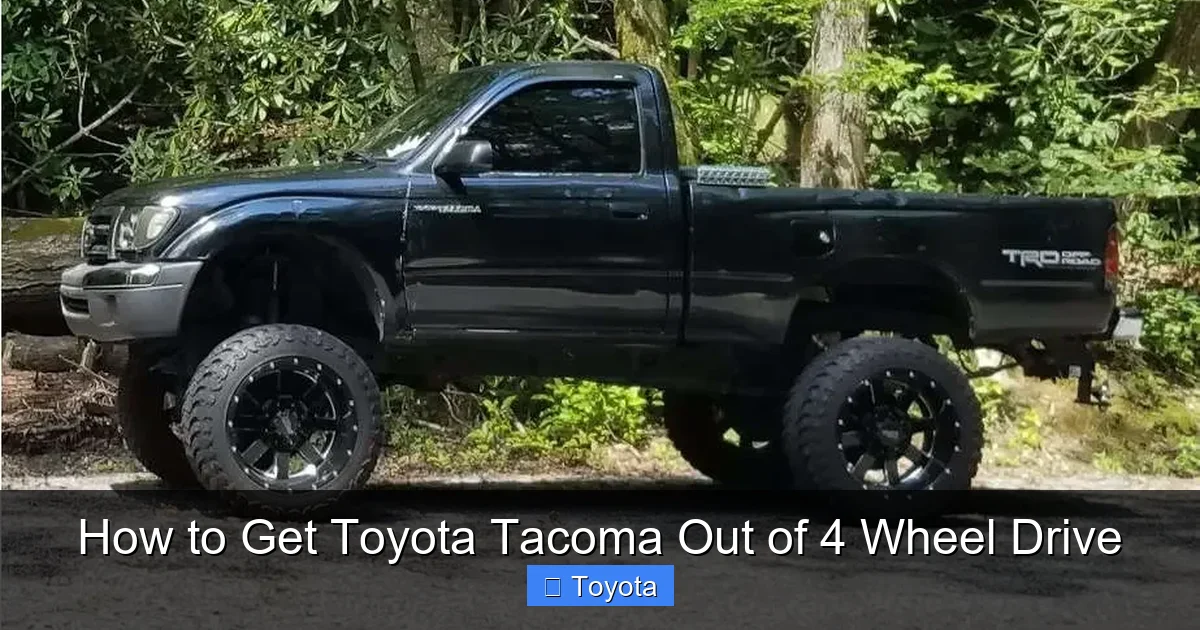
Not all Toyota Tacomas shift the same way. While the basic principles of disengaging 4WD remain consistent, the exact procedure can vary depending on your model year and trim. Let’s break it down by generation so you can find the right method for your truck.
First Generation (1995–2004)
These older Tacomas typically have a manual transfer case shifter on the floor, often located between the front seats. They use a part-time 4WD system with positions: 2H, 4H, N (neutral), and 4LO.
To get out of 4H:
– Drive under 55 mph.
– Take your foot off the gas.
– Push the shifter forward into 2H.
To get out of 4LO:
– Come to a full stop.
– Put the transmission in Neutral.
– Shift the transfer case to N, then to 2H or 4H.
– Shift the transmission back into Drive.
Note: Some 1995–2004 models require you to press a button on the shifter to move between 2H and 4H while driving. For 4LO, always stop completely.
Second Generation (2005–2015)
This generation introduced more refined 4WD systems. Most models still have a floor shifter, but some higher trims (like the TRD Off-Road) may have electronic controls.
For manual shifters:
– Shift from 4H to 2H while driving under 55 mph.
– For 4LO, stop completely, shift to N, then to 2H or 4H.
For electronic systems (if equipped):
– Use the dashboard switch to toggle between 2H, 4H, and 4LO.
– The system will prevent unsafe shifts—e.g., it won’t let you shift into 4LO while moving fast.
Always refer to your owner’s manual, as some 2005–2015 models have unique features like “4H Auto” mode, which allows limited use on dry pavement.
Third Generation (2016–Present)
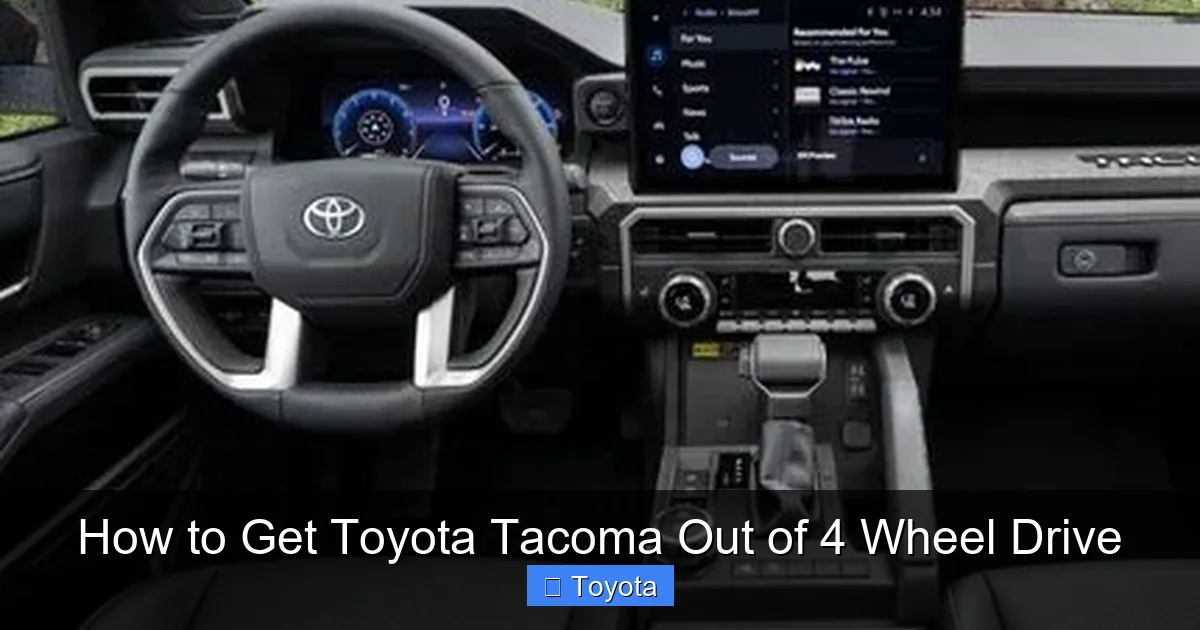
Modern Tacomas use fully electronic 4WD controls. The switch is usually on the center console, labeled with icons for 2H, 4H, and 4LO.
To disengage 4H:
– Drive under 55 mph.
– Press the “2H” button. The system will automatically disengage 4WD.
To disengage 4LO:
– Come to a full stop.
– Press the “4H” or “2H” button.
– The system will shift safely.
These systems are smart—they often prevent you from making dangerous shifts. For example, if you try to shift into 4LO while driving, the system will ignore the command or prompt you to stop first.
Special Cases: TRD Pro and Off-Road Trims
Tacomas with TRD Off-Road or TRD Pro packages may have additional features like crawl control or multi-terrain select. These don’t change the basic 4WD disengagement process, but they do add complexity.
If you’ve been using crawl control in 4LO, turn it off before shifting. The system may keep the brakes engaged, making it harder to shift. Also, some TRD models have a “4H Auto” mode that blends 2WD and 4WD for better fuel economy. In this mode, you can drive on dry pavement, but you should still switch to 2H when not needed.
No matter your model, the golden rule is the same: know your system, follow the steps, and don’t force anything.
Maintenance Tips to Keep Your 4WD System Healthy
Visual guide about How to Get Toyota Tacoma Out of 4 Wheel Drive
Image source: cdcssl.ibsrv.net
Getting your Tacoma out of 4WD is only half the battle. To ensure smooth shifting and long-term reliability, you need to maintain your 4WD system properly. Neglecting maintenance can lead to hard shifts, grinding noises, or even complete failure.
Check Transfer Case Fluid Regularly
The transfer case is the heart of your 4WD system. It contains gears and chains that need proper lubrication. Over time, the fluid can break down, become contaminated, or leak out.
Toyota recommends checking the transfer case fluid every 30,000 to 60,000 miles, depending on driving conditions. If you frequently off-road or drive in harsh environments, check it more often.
To check the fluid:
1. Locate the transfer case (usually behind the transmission).
2. Find the fill and drain plugs.
3. Remove the fill plug. The fluid should be level with the hole.
4. If low, add the recommended fluid (usually Toyota Genuine ATF or equivalent).
If the fluid looks dark, smells burnt, or has metal particles, it’s time for a full change. Consider having a mechanic do this if you’re not comfortable.
Inspect Driveshafts and U-Joints
The driveshafts transfer power from the transfer case to the axles. Over time, the universal joints (U-joints) can wear out, causing clunking noises or vibrations.
Listen for a “clunk” when shifting in or out of 4WD. This could indicate worn U-joints. Also, check for play by grabbing the driveshaft and trying to move it side to side. Any movement means it’s time for replacement.
Lubricate the Shift Linkage (Manual Shifters)
If your Tacoma has a manual floor shifter, the linkage that connects it to the transfer case can get stiff or corroded. This makes shifting difficult.
Apply a light lubricant (like WD-40 or white lithium grease) to the pivot points and cables. This will keep the shifter moving smoothly.
Test Your 4WD System Periodically
Even if you don’t off-road often, it’s smart to test your 4WD system a few times a year. Engage 4H and drive in a safe, open area (like an empty parking lot) to make sure it works. This prevents the system from seizing up due to lack of use.
If you notice any issues—grinding, hesitation, warning lights—have it inspected by a qualified technician.
Use the Right Tires
Mismatched tires can cause drivetrain stress in 4WD. All four tires should be the same size, type, and tread depth. If one tire is significantly smaller (due to wear or a spare), it can cause binding when in 4H or 4LO.
Check your tire pressures regularly and rotate them every 5,000 to 7,500 miles to ensure even wear.
By maintaining your 4WD system, you’ll ensure smooth shifts and avoid costly repairs down the road.
Troubleshooting Common 4WD Issues
Even with proper maintenance, problems can arise. Here are some common issues drivers face when trying to get their Tacoma out of 4WD—and how to fix them.
Shifter Won’t Move Out of 4H
If your shifter is stuck in 4H, it’s usually because the truck is moving too fast or the drivetrain is under load.
Solution: Slow down to under 30 mph, take your foot off the gas, and try again. If it still won’t move, come to a complete stop and shift into Neutral before trying.
Grinding Noise When Shifting
Grinding usually means the transfer case gears aren’t aligning properly. This can happen if you shift too quickly or while accelerating.
Solution: Slow down, ease off the gas, and shift gently. If grinding persists, check the transfer case fluid. Low or dirty fluid can cause hard shifts.
4WD Light Stays On
If the 4WD indicator light remains on after shifting to 2H, the system may not have fully disengaged.
Solution: Try shifting back to 4H and then to 2H again. If the light stays on, have the system scanned for error codes. It could be a sensor or electrical issue.
Truck Feels “Tight” or Hard to Steer
This is a sign of drivetrain binding—likely because you’re still in 4H on dry pavement.
Solution: Shift back to 2H immediately. Avoid making sharp turns until you’ve disengaged 4WD.
Can’t Shift Into or Out of 4LO
This almost always means the truck isn’t fully stopped.
Solution: Come to a complete stop, put the transmission in Neutral, and try again. Never force the shifter.
When in doubt, consult your owner’s manual or visit a Toyota service center. Some issues may require professional diagnosis.
Conclusion
Getting your Toyota Tacoma out of 4 wheel drive doesn’t have to be stressful. With the right knowledge and a little care, you can switch back to 2WD safely and smoothly every time. Whether you drive a classic first-gen with a manual shifter or a modern third-gen with electronic controls, the key is understanding your system and following the correct procedure.
Remember: always shift on stable, dry surfaces when possible, never force the shifter, and come to a full stop before exiting 4LO. Regular maintenance—like checking transfer case fluid and inspecting driveshafts—will keep your 4WD system in top condition for years to come.
By following the tips in this guide, you’ll protect your Tacoma’s drivetrain, avoid costly repairs, and enjoy confident driving whether you’re on the highway or the trail. So next time you’re wrapping up an off-road adventure, you’ll know exactly how to get your Tacoma out of 4WD—quickly, safely, and without a second thought.
Frequently Asked Questions
Can I shift out of 4H while driving?
Yes, you can shift from 4H to 2H while driving, but only under 55 mph. Slow down, take your foot off the gas, and shift gently to avoid grinding.
Do I need to stop completely to get out of 4LO?
Yes, you must come to a full stop before shifting out of 4LO. Put the transmission in Neutral, then shift the transfer case to 2H or 4H.
Why won’t my Tacoma shift out of 4WD?
This is usually due to high speed, drivetrain load, or low transfer case fluid. Slow down, ease off the gas, and check fluid levels.
Can I drive in 4H on dry pavement?
No, driving in 4H on dry pavement can cause drivetrain binding and damage. Only use 4H on slippery or off-road surfaces.
How often should I check my transfer case fluid?
Check it every 30,000 to 60,000 miles, or more often if you frequently off-road. Low or dirty fluid can cause shifting problems.
What’s the difference between 4H and 4LO?
4H is for high-speed off-roading or slippery roads. 4LO is for low-speed, high-traction situations like rock crawling or steep hills.