
How to Get Cheap Car Insurance

Finding cheap car insurance is easier than you think—if you know where to look and what to ask for. By comparing quotes, raising deductibles, and taking advantage of discounts, you can significantly lower your monthly premiums without cutting corners on protection.
Key Takeaways
- Shop around regularly: Insurance rates change often, so comparing quotes from multiple providers can save you hundreds per year.
- Raise your deductible wisely: Increasing your out-of-pocket cost in case of a claim can lower your premium—just make sure you can afford it.
- Maintain a clean driving record: Safe drivers typically pay less; even one speeding ticket can increase your rates.
- Ask about discounts: Many insurers offer savings for good students, low mileage, bundling policies, or installing safety devices.
- Improve your credit score: In most states, better credit correlates with lower insurance premiums.
- Choose the right car: Insurance costs vary by vehicle type; safer, less expensive-to-repair cars often cost less to insure.
- Consider usage-based programs: Some companies offer discounts based on how safely and how little you drive using telematics apps.
📑 Table of Contents
- Why Car Insurance Costs What It Does
- Shop Around: The #1 Way to Find Cheap Car Insurance
- Raise Your Deductible (But Do It Smartly)
- Take Advantage of Every Discount Available
- Improve Your Credit Score (Yes, It Matters)
- Choose the Right Car to Insure
- Consider Usage-Based or Pay-Per-Mile Insurance
- Maintain a Clean Driving Record
- Bundle Your Policies
- Review and Adjust Your Coverage Annually
- Conclusion: Smart Strategies Add Up to Big Savings
Why Car Insurance Costs What It Does
Car insurance isn’t just a legal requirement in most places—it’s also a financial safety net. But let’s be honest: it can feel like a monthly money pit, especially when you’re not sure why your premium is so high. Understanding what drives your car insurance cost is the first step toward getting a better deal.
Insurance companies use complex algorithms to calculate risk. They look at your age, driving history, location, vehicle type, credit score (in most states), and even how many miles you drive each year. The higher the perceived risk, the higher your premium. For example, a 19-year-old male driving a red sports car in downtown Chicago will pay far more than a 45-year-old woman driving a minivan in rural Vermont—even if they have identical coverage.
But here’s the good news: many of these factors are within your control. You can’t change your age overnight, but you *can* improve your credit, drive more safely, or switch to a more affordable vehicle. And while you can’t move to another state just for cheaper insurance (unless you really want to!), you *can* shop around, bundle policies, or adjust your coverage to fit your needs and budget.
Shop Around: The #1 Way to Find Cheap Car Insurance

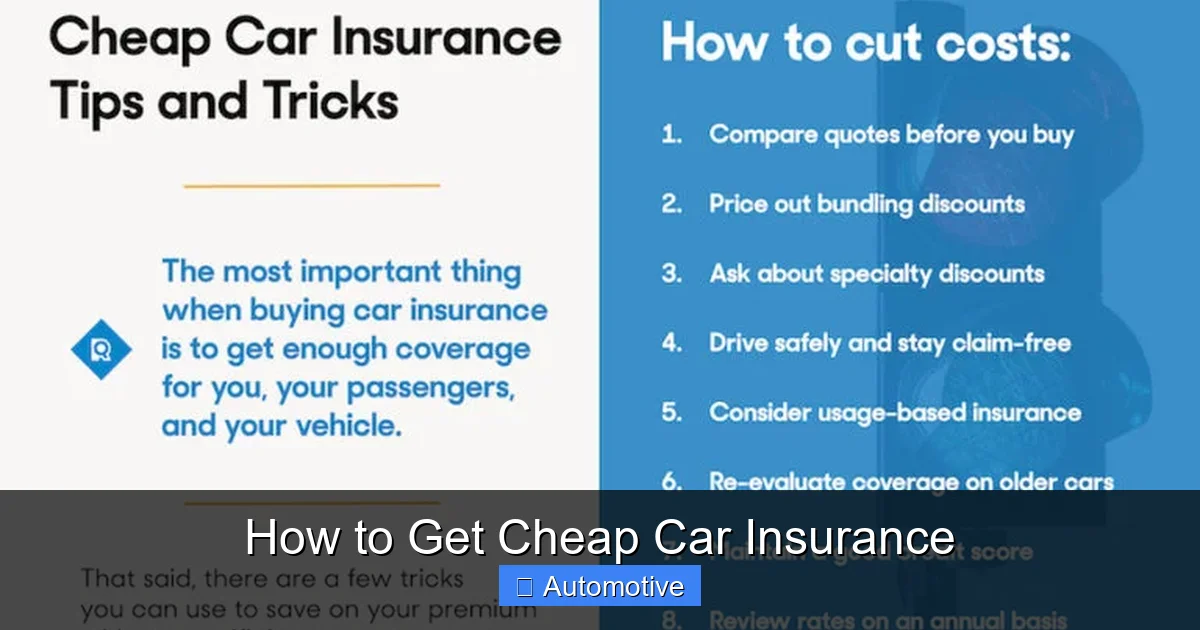
Visual guide about How to Get Cheap Car Insurance
Image source: freecarinsurancequote.ca
If there’s one golden rule for getting cheap car insurance, it’s this: never assume your current insurer is giving you the best rate. Loyalty doesn’t always pay—in fact, many insurers offer their lowest rates to new customers while quietly raising prices for long-term policyholders.
That’s why shopping around should be an annual ritual, not a one-time event. Think of it like renewing your phone plan or comparing grocery prices—small efforts can lead to big savings.
How Often Should You Compare Quotes?
Aim to get at least three to five quotes every year, especially before your policy renews. Rates fluctuate based on market conditions, claims trends, and even your personal profile changes (like moving, getting married, or adding a teen driver). A quote you got six months ago might no longer be accurate.
Pro tip: Set a calendar reminder for 60 days before your renewal date. That gives you enough time to research, compare, and switch if needed—without risking a lapse in coverage.
Where to Get Reliable Quotes
You don’t need to call every agent in town. Online comparison tools like The Zebra, NerdWallet, or Insurify let you enter your info once and see quotes from multiple insurers side by side. These platforms are free, fast, and often include customer reviews and coverage details.
But don’t stop there. Some of the best deals come directly from insurers’ websites—especially if they’re running limited-time promotions. For example, GEICO and Progressive frequently offer online-exclusive discounts that aren’t available through third-party sites.
What to Compare Beyond Price
While price is important, it’s not the only factor. Make sure you’re comparing apples to apples. Check:
– Coverage limits (liability, collision, comprehensive)
– Deductibles
– Customer service ratings (J.D. Power or AM Best)
– Claims process ease
– Available discounts
A policy that’s $20 cheaper per month might have a $2,000 deductible instead of $500—meaning you’d pay $1,500 more out of pocket if you file a claim. Always weigh total cost, not just the premium.
Raise Your Deductible (But Do It Smartly)
Visual guide about How to Get Cheap Car Insurance
Image source: assets.reviews.com
Your deductible is the amount you pay out of pocket before insurance kicks in after a claim. Choosing a higher deductible is one of the quickest ways to lower your premium—but it comes with trade-offs.
How Deductibles Affect Your Premium
Let’s say you currently have a $500 deductible and pay $120 per month for full coverage. If you raise it to $1,000, you might drop to $95 per month. That’s $25 saved each month, or $300 per year. Over five years, that’s $1,500 in savings.
But here’s the catch: if you get into an accident, you’ll need to pay that $1,000 upfront before your insurer covers the rest. So this strategy only works if you have enough savings to cover the higher deductible without stress.
When Raising Your Deductible Makes Sense
Consider increasing your deductible if:
– You have an emergency fund of at least $1,000–$2,000
– You rarely file claims
– You drive a reliable, older car where full coverage may not be worth it
– You’re trying to fit insurance into a tight budget
On the flip side, avoid high deductibles if:
– You live in an area with high accident rates
– You’re a new or inexperienced driver
– You drive a luxury or high-value vehicle
Remember: collision and comprehensive coverage both have separate deductibles. You can raise one and keep the other low if needed.
Take Advantage of Every Discount Available

Visual guide about How to Get Cheap Car Insurance
Image source: image4.slideserve.com
Insurance companies offer a surprising number of discounts—but many drivers never ask about them. In fact, some people overpay simply because they didn’t know a discount applied to them.
Common Car Insurance Discounts
Here are some of the most widely available discounts:
– **Safe driver discount**: For maintaining a clean record (usually 3–5 years without accidents or tickets)
– **Good student discount**: For full-time students with a B average or higher (often requires proof like a report card)
– **Low mileage discount**: If you drive fewer than 7,500–10,000 miles per year
– **Bundling discount**: When you combine auto and home/renters insurance with the same company (savings can be 10–25%)
– **Multi-car discount**: Insuring two or more vehicles on the same policy
– **Defensive driving course discount**: Completing an approved safety course (some states require insurers to offer this)
– **Pay-in-full discount**: Paying your annual premium upfront instead of monthly
– **Paperless billing or auto-pay discount**: Small but easy savings for going digital
Lesser-Known Discounts You Should Ask About
Some discounts aren’t advertised but are still available:
– **Occupation-based discounts**: Teachers, nurses, military personnel, and first responders often qualify
– **Membership discounts**: AAA, alumni associations, or professional groups may partner with insurers
– **Anti-theft device discount**: Installing alarms, GPS trackers, or immobilizers can reduce comprehensive premiums
– **New car discount**: Some insurers offer savings for vehicles under 2–3 years old with advanced safety features
Don’t assume you qualify—always ask your agent or check your insurer’s website. And if you’ve recently gotten married, moved, or improved your credit, mention it. These life changes can unlock new discounts.
Improve Your Credit Score (Yes, It Matters)
In 47 states (all except California, Hawaii, and Massachusetts), insurers can use your credit-based insurance score to set your rates. Studies show that people with lower credit scores tend to file more claims, so insurers charge them more.
How Credit Affects Your Premium
A driver with excellent credit (750+) might pay $900 per year for full coverage, while someone with poor credit (below 580) could pay $1,800 or more for the same policy. That’s a $900 difference—just for having a lower score.
But improving your credit doesn’t take years. Small steps can make a big impact:
– Pay bills on time (this is the biggest factor)
– Keep credit card balances below 30% of your limit
– Avoid opening too many new accounts at once
– Check your credit report for errors (you get one free report per year from AnnualCreditReport.com)
Even a 50-point increase in your score could shave $100–$200 off your annual premium.
What If You Have No Credit or Bad Credit?
If you’re rebuilding credit, focus on consistency. Use a secured credit card, pay it off in full each month, and avoid late payments. Over time, your score will improve—and so will your insurance rates.
Some insurers also offer “first-time buyer” or “no credit history” programs that don’t penalize you as harshly. Ask about these options when shopping.
Choose the Right Car to Insure
The vehicle you drive has a huge impact on your insurance cost. Insurers look at repair costs, theft rates, safety ratings, and likelihood of injury in an accident.
Cars That Cost Less to Insure
Generally, the cheapest cars to insure are:
– Midsize sedans (like Toyota Camry, Honda Accord)
– Compact SUVs with high safety ratings (like Subaru Forester, Honda CR-V)
– Minivans (like Toyota Sienna, Chrysler Pacifica)
– Older models (5+ years) with lower replacement values
These vehicles are typically cheaper to repair, less likely to be stolen, and have strong safety records—all factors that reduce risk for insurers.
Cars That Cost More to Insure
Avoid insuring:
– High-performance sports cars (like Mustang GT, BMW M3)
– Luxury vehicles (like Mercedes, Audi, or Tesla Model S)
– Full-size trucks with high horsepower
– Rare or imported cars with expensive parts
Even color can play a small role—red cars are often associated with speeding (though this is more myth than fact).
Before You Buy, Check Insurance Costs
Always get an insurance quote before purchasing a car—even if it’s used. Websites like Kelley Blue Book or Edmunds let you estimate insurance costs by make, model, and year. A $500 difference in annual premiums adds up over time.
For example, insuring a 2020 Honda Civic might cost $1,200 per year, while a 2020 Ford Mustang could run $2,100. That’s $900 more—just for the car.
Consider Usage-Based or Pay-Per-Mile Insurance
If you don’t drive much or drive safely, traditional insurance might be overcharging you. That’s where usage-based insurance (UBI) and pay-per-mile plans come in.
How Usage-Based Insurance Works
These programs use a telematics device (plugged into your car) or a smartphone app to track your driving habits. Insurers look at:
– Hard braking or rapid acceleration
– Speed (especially over the limit)
– Time of day you drive (night driving is riskier)
– Total miles driven
Safe drivers can earn discounts of 10–30%. For example, Allstate’s Drivewise and State Farm’s Drive Safe & Save programs reward good behavior with monthly savings.
Pay-Per-Mile Insurance: Ideal for Low-Mileage Drivers
Companies like Metromile and Nationwide’s SmartMiles charge a base rate plus a per-mile fee. If you only drive 5,000 miles a year (instead of the average 12,000), you could save hundreds.
For instance, Metromile might charge $30/month base + $0.05 per mile. If you drive 400 miles in a month, your total is $50. Compare that to a traditional $100/month plan—you’re saving $50 just for driving less.
Just remember: these programs require monitoring, and some people don’t like being tracked. But if privacy isn’t a concern and you’re a safe, low-mileage driver, it’s worth considering.
Maintain a Clean Driving Record
Your driving history is one of the most influential factors in your insurance rate. Even one speeding ticket or at-fault accident can increase your premium for 3–5 years.
How Violations Affect Your Rates
Here’s a rough idea of how common violations impact premiums:
– Speeding ticket: +20–30%
– At-fault accident: +30–50%
– DUI: +80–100% (or policy cancellation)
– Reckless driving: +50–100%
That means a $100/month policy could jump to $150 or more after a single ticket.
How to Keep Your Record Clean
– Obey speed limits and traffic laws
– Use hands-free devices for calls
– Avoid driving when tired or distracted
– Take a defensive driving course (some states reduce points or offer discounts)
If you do get a ticket, ask if you can attend traffic school to keep it off your record. Many states allow this for first-time offenders.
Bundle Your Policies
If you own a home or rent an apartment, bundling your auto and home/renters insurance with the same company can save you 10–25%. It’s one of the easiest ways to cut costs with minimal effort.
Why Bundling Works
Insurers love customer loyalty. When you bundle, they see you as a lower risk and reward you with discounts. Plus, managing one account is simpler for them—and for you.
For example, State Farm offers up to 15% off when you bundle auto and home. Allstate gives 10–25% off, depending on the policies. Even if one policy is slightly more expensive, the total package is usually cheaper than buying separately.
When Bundling Might Not Save You
Sometimes, the best auto insurer isn’t the best home insurer—and vice versa. If you already have great rates with two different companies, switching just to bundle might not be worth it.
Always compare the total bundled cost against your current separate policies. And don’t forget to ask about multi-policy discounts when shopping.
Review and Adjust Your Coverage Annually
Your insurance needs change over time. What made sense when you bought your first car might not fit your life now.
When to Drop Collision or Comprehensive
If your car is older and worth less than $4,000, collision and comprehensive coverage might cost more than the car is worth. For example, if your 2008 sedan is valued at $3,500 but costs $600/year to insure fully, you’re paying more in premiums than the car’s value.
In that case, consider dropping full coverage and keeping only liability (which is required by law). Just make sure you can afford to replace the car out of pocket if it’s totaled.
Adjust Coverage After Major Life Changes
Life events that should prompt a policy review:
– Buying a new car
– Moving to a new city or state
– Adding a teen driver
– Getting married or divorced
– Retiring (you may drive less)
Each of these can affect your risk profile and premium. A quick call to your agent can ensure you’re not overpaying or underinsured.
Conclusion: Smart Strategies Add Up to Big Savings
Getting cheap car insurance isn’t about cutting corners—it’s about making informed choices. By shopping around, raising your deductible wisely, taking advantage of discounts, improving your credit, choosing the right car, and adjusting your coverage, you can keep more money in your pocket without sacrificing protection.
Remember, the cheapest policy isn’t always the best. Focus on value: the right balance of cost, coverage, and customer service. And don’t wait for your renewal notice to act. Start comparing quotes today, ask about discounts, and take control of your insurance costs.
With a little effort, you can turn a monthly expense into a manageable—and even rewarding—part of your financial plan.
Frequently Asked Questions
How often should I shop for car insurance?
You should compare quotes at least once a year, ideally 60 days before your policy renews. Rates change frequently, and new discounts or promotions may be available.
Does raising my deductible always lower my premium?
Yes, but only if you can afford the higher out-of-pocket cost after a claim. Make sure you have savings to cover the deductible before increasing it.
Can I get cheap car insurance with bad credit?
Yes, but it may take more effort. Focus on improving your credit, shop with insurers that weigh credit less heavily, and ask about first-time buyer programs.
Do all insurers offer the same discounts?
No. Discounts vary by company and state. Always ask your agent or check the insurer’s website to see what’s available.
Is usage-based insurance worth it?
It can be if you’re a safe, low-mileage driver. You could save 10–30%, but it requires allowing the insurer to monitor your driving habits.
Should I drop full coverage on an older car?
Consider it if the car’s value is less than $4,000 and your annual full coverage cost exceeds 10% of the car’s worth. Make sure you can replace it if needed.
