
How to Get a Toyota Tacoma Out of 4-wheel Drive

Getting your Toyota Tacoma out of 4-wheel drive doesn’t have to be confusing. Whether you’re switching back to 2WD after off-roading or troubleshooting a stuck transfer case, this guide walks you through the process clearly and safely. Follow these proven steps to avoid damage and keep your truck running smoothly.
If you’ve ever been out on a muddy trail, snow-covered road, or rocky terrain with your Toyota Tacoma, chances are you’ve engaged 4-wheel drive to get the job done. And that’s exactly what the Tacoma’s 4WD system is built for—extra traction when you need it most. But once you’re back on dry pavement, it’s just as important to know how to get your Toyota Tacoma out of 4-wheel drive safely and correctly.
Many Tacoma owners, especially new ones, assume that once they’ve used 4WD, they can just flip a switch or turn a dial and be done with it. While that’s partly true, the process isn’t always as simple as it seems. Depending on your model year, drivetrain setup, and whether you have manual or automatic hubs, the steps can vary. And if you don’t follow the right procedure, you could end up with a damaged transfer case, binding in the drivetrain, or even a stuck 4WD system that refuses to disengage.
This guide is here to clear up the confusion. Whether you drive a first-gen Tacoma with manual locking hubs or a newer TRD Pro with electronic 4WD controls, we’ll walk you through exactly how to get your Toyota Tacoma out of 4-wheel drive—without guesswork, frustration, or costly repairs. We’ll cover the different systems, the correct shifting sequences, troubleshooting tips, and maintenance advice to keep your 4WD working like new.
By the end of this article, you’ll feel confident switching between 2WD and 4WD like a pro. So let’s get started—your Tacoma (and your wallet) will thank you.
Key Takeaways
- Know your Tacoma’s 4WD system: Different models (manual vs. automatic hubs, part-time vs. full-time 4WD) require different disengagement methods.
- Always shift to 2H when on pavement: Driving in 4WD on dry roads can cause drivetrain binding and damage.
- Use the correct sequence: Shift from 4H to 2H while moving slowly, or stop completely depending on your model year and system.
- Check for mechanical issues: If the truck won’t disengage, it could be due to vacuum leaks, stuck hubs, or low fluid levels.
- Maintain your 4WD system regularly: Flushing fluids and inspecting components prevents future problems.
- When in doubt, consult your owner’s manual: Toyota provides model-specific instructions that should always take priority.
- Practice in a safe area: If you’re new to 4WD, test shifting in an empty parking lot before hitting the trails.
📑 Table of Contents
Understanding Your Toyota Tacoma’s 4WD System
Before you can properly disengage 4-wheel drive, it’s essential to understand how your Tacoma’s system works. Not all Tacomas are created equal when it comes to 4WD. Toyota has used several different configurations over the years, and the method for getting out of 4WD depends heavily on which one you have.
The two main types of 4WD systems in Tacomas are part-time 4WD and full-time 4WD. Most Tacomas, especially the TRD Off-Road and TRD Pro trims, come with part-time 4WD. This system is designed for off-road or low-traction conditions and should not be used on dry pavement. Full-time 4WD, found in some older models or specific trims, can be used on all surfaces but still requires careful management.
Another key factor is whether your Tacoma has manual or automatic locking hubs. Older models (generally 2004 and earlier) often feature manual hubs that require you to physically turn them to engage or disengage 4WD. Newer models (2005 and later) typically use automatic hubs that engage when you shift into 4H or 4L via the transfer case lever or electronic switch.
Let’s break it down further.
Part-Time vs. Full-Time 4WD
Part-time 4WD is the most common setup in Tacomas. It sends power to all four wheels only when you manually activate it. In normal driving conditions, the truck runs in 2-wheel drive (2H), sending power to the rear wheels only. When you shift into 4H (4-high) or 4L (4-low), power is distributed to both front and rear axles.
Because part-time 4WD lacks a center differential, it can’t handle the speed differences between front and rear wheels on dry pavement. This leads to something called “drivetrain binding” or “wind-up,” which can cause clunking, shuddering, and even damage to the transfer case or axles. That’s why it’s critical to return to 2H when driving on paved roads.
Full-time 4WD, on the other hand, uses a center differential to allow for wheel speed differences. This means you can safely drive in 4WD on dry pavement. However, even with full-time systems, it’s often recommended to switch back to 2H for better fuel economy and reduced wear when you don’t need the extra traction.
Manual vs. Automatic Locking Hubs
If you drive a first-generation Tacoma (1995–2004), there’s a good chance you have manual locking hubs. These are located on the front wheels and must be physically turned to engage or disengage the front axle. To get your Tacoma out of 4WD, you’ll need to get out of the truck and turn each hub from the “LOCK” position to the “FREE” position.
Automatic hubs, found in most second-gen (2005–2015) and third-gen (2016–present) Tacomas, engage and disengage automatically when you shift the transfer case. This makes the process much easier—no getting muddy or cold outside. However, automatic hubs can sometimes fail to disengage due to dirt, corrosion, or internal wear, which is why regular maintenance is key.
Knowing which system you have is the first step to getting your Tacoma out of 4WD without issues. Check your owner’s manual or look at your front hubs to confirm. If you see a dial or switch on the hub itself, it’s manual. If the hubs are smooth with no moving parts, they’re likely automatic.
Step-by-Step: How to Get Your Tacoma Out of 4WD
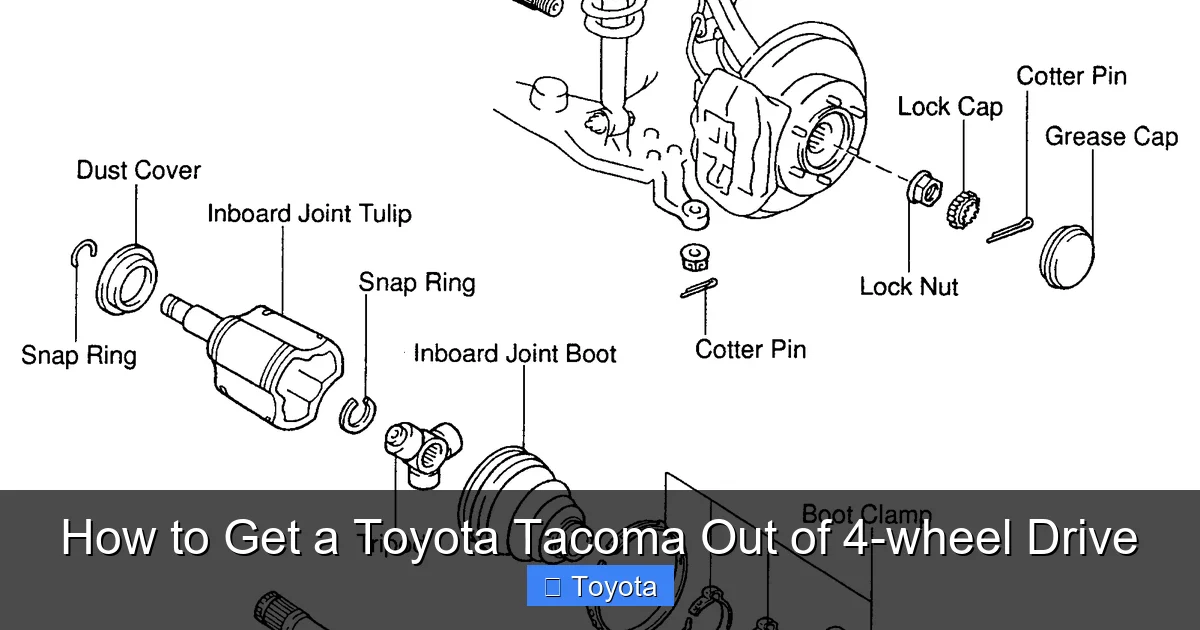
Visual guide about How to Get a Toyota Tacoma Out of 4-wheel Drive
Image source: ww2.justanswer.com
Now that you understand your system, let’s walk through the actual process of disengaging 4-wheel drive. The steps vary slightly depending on your model, but the core principles remain the same: slow down, shift correctly, and verify disengagement.
For Tacomas with Automatic Hubs (2005 and Newer)
Most modern Tacomas use electronic or lever-operated transfer cases with automatic hubs. Here’s how to safely get out of 4WD:
1. **Slow down to under 5 mph.** You should never shift out of 4H or 4L at high speeds. Ideally, come to a complete stop or drive very slowly on a flat, safe surface.
2. **Shift from 4L to 4H (if applicable).** If you were in 4-low, first shift back to 4-high. On most models, you can do this while moving slowly (under 5 mph) by moving the transfer case lever or pressing the 4H button.
3. **Shift from 4H to 2H.** Once in 4H, you can shift to 2H (2-wheel drive high). On lever-shift models, move the transfer case lever from the 4H position to the 2H position. On electronic models, press the 2H button. You may hear a slight clunk—this is normal as the front axle disengages.
4. **Drive forward slowly for 10–20 feet.** This helps ensure the front hubs fully disengage. Listen for any unusual noises or vibrations.
5. **Check the dashboard indicator.** Most Tacomas have a 4WD indicator light. When you’re in 2H, the light should turn off. If it stays on, the system may not have fully disengaged.
6. **Test drive.** Drive in a straight line and make a few gentle turns. If you feel binding, shuddering, or resistance, the 4WD may still be partially engaged.
For Tacomas with Manual Locking Hubs (1995–2004)
If you have an older Tacoma with manual hubs, the process requires a bit more effort—but it’s still straightforward.
1. **Come to a complete stop.** You must be stopped to safely disengage manual hubs.
2. **Shift the transfer case to 2H.** Move the transfer case lever from 4H or 4L to 2H. This disconnects power from the front axle at the transfer case.
3. **Exit the vehicle.** Walk to each front wheel and locate the locking hub.
4. **Turn the hub to “FREE.”** Rotate the hub dial from the “LOCK” position to the “FREE” position. You should feel it click into place. Do this for both front wheels.
5. **Get back in and drive.** Start the truck and drive forward slowly. The front wheels should now spin freely without engaging the drivetrain.
6. **Verify disengagement.** Listen for any grinding or resistance. If everything feels normal, you’re successfully in 2WD.
Electronic 4WD Systems (Some 2016+ Models)
Some newer Tacomas, especially those with the Multi-Terrain Select or Crawl Control features, use advanced electronic 4WD systems. These often have a rotary dial or touchscreen controls.
To disengage:
– Turn the dial from 4H or 4L to 2H.
– The system will automatically disengage the front axle.
– Wait for the dashboard light to turn off.
– Drive forward slowly to confirm disengagement.
Always refer to your owner’s manual for model-specific instructions, as electronic systems can vary.
Common Problems and Troubleshooting
Visual guide about How to Get a Toyota Tacoma Out of 4-wheel Drive
Image source: fourwheelcampers.com
Even with the right steps, sometimes your Tacoma won’t come out of 4WD. This can be frustrating, but it’s usually fixable with some troubleshooting.
The 4WD Light Won’t Turn Off
If the 4WD indicator remains on after shifting to 2H, the system may not have fully disengaged. Try this:
– Drive forward and backward slowly (5–10 feet each way).
– Shift back to 4H, then return to 2H.
– Check for dashboard error messages.
– If the light persists, there may be a sensor or electrical issue.
Grinding or Binding When Driving
This is a sign that the front axle is still partially engaged. It can happen if the hubs didn’t disengage fully. Solutions include:
– Stopping and shifting again.
– Driving in reverse for a short distance.
– Manually checking automatic hubs for dirt or damage.
– For manual hubs, double-check that they’re in the “FREE” position.
Automatic Hubs Won’t Disengage
Over time, automatic hubs can get clogged with mud, salt, or debris. This prevents them from unlocking properly. Try:
– Cleaning the hubs with a wire brush and brake cleaner.
– Driving in reverse for 10–20 feet to help break loose any stuck components.
– If problems persist, consider replacing the hubs or switching to manual hubs for more reliability.
Vacuum Leaks (Older Models)
Some Tacomas use vacuum-actuated front axle disconnect systems. If there’s a leak in the vacuum lines or actuator, the front axle won’t disengage. Check for cracked hoses, loose connections, or a faulty vacuum solenoid. A hissing sound under the hood can indicate a leak.
Low Transfer Case Fluid
Low or dirty fluid can cause shifting issues. Check the transfer case fluid level and condition. If it’s low, top it off with the correct specification (usually Toyota Genuine ATF or equivalent). If it’s dark or smells burnt, a full flush may be needed.
When to Use 4WD—and When to Switch Back
Visual guide about How to Get a Toyota Tacoma Out of 4-wheel Drive
Image source: tflcar.com
Knowing how to get your Tacoma out of 4WD is only half the battle. The other half is knowing when to use it in the first place.
4WD is designed for low-traction conditions: snow, mud, sand, gravel, or rocky terrain. It’s not meant for everyday driving on dry pavement. Using 4WD on high-traction surfaces can cause:
– Drivetrain binding
– Increased tire wear
– Reduced fuel economy
– Premature wear on the transfer case and axles
As soon as you return to paved roads, switch back to 2H. Even if the road looks wet or slightly slippery, 2WD is usually sufficient unless you’re losing traction.
One exception is full-time 4WD systems, which can be used on all surfaces. But even then, switching to 2H when not needed improves efficiency and reduces wear.
Practical Example: Off-Roading Trip
Let’s say you took your Tacoma on a weekend camping trip. You drove 20 miles on dirt roads, crossed a muddy stream, and climbed a steep hill—all in 4H. On the way back, you hit the highway.
As soon as you reach paved roads, slow down to under 5 mph, shift from 4H to 2H, and drive forward slowly. Within a few seconds, the 4WD light should turn off, and the truck should feel smoother. Now you’re back in 2WD, ready for efficient highway driving.
Winter Driving Tip
In snowy conditions, you might use 4H to get moving from a stop or climb a hill. But once you’re cruising on plowed roads, switch back to 2H. This prevents binding and gives you better handling.
Maintenance Tips to Prevent 4WD Issues
Prevention is always better than repair. Regular maintenance keeps your 4WD system working smoothly and reduces the chances of getting stuck in 4WD.
Inspect and Clean Hubs Regularly
For automatic hubs, inspect them every few months, especially after off-roading. Clean off mud, dirt, and salt. Apply a light coat of grease to the hub seals to prevent corrosion.
For manual hubs, check that they turn smoothly and aren’t stuck in the “LOCK” position. Lubricate the threads if needed.
Check Transfer Case and Differential Fluids
Follow your owner’s manual for fluid change intervals—typically every 30,000 to 60,000 miles. Use only the recommended fluid type. Dirty or low fluid can cause shifting problems and overheating.
Test 4WD Periodically
Even if you don’t off-road often, test your 4WD system a few times a year. Shift into 4H and drive slowly in a safe area. This keeps the components lubricated and ensures everything engages and disengages properly.
Listen for Unusual Noises
Grinding, clunking, or whining sounds when shifting or driving can indicate a problem. Don’t ignore them—have them checked by a mechanic.
Use Quality Parts and Fluids
Stick with Toyota Genuine parts or high-quality aftermarket equivalents. Cheap fluids or counterfeit parts can damage your 4WD system over time.
Conclusion
Getting your Toyota Tacoma out of 4-wheel drive doesn’t have to be a mystery. With the right knowledge and a few simple steps, you can switch back to 2WD safely and avoid costly repairs. Whether you drive a manual-hub classic or a modern electronic marvel, the key is understanding your system, following the correct sequence, and maintaining it regularly.
Remember: always shift out of 4WD when returning to pavement, drive slowly during the transition, and listen for any signs of trouble. And when in doubt, consult your owner’s manual—it’s your best resource for model-specific guidance.
Your Tacoma is built to handle tough terrain, but it also needs care and attention. By mastering the art of 4WD disengagement, you’ll keep your truck running strong for years to come. So next time you’re back from the trails, don’t just park and walk away—take a moment to shift back to 2H. Your drivetrain will thank you.
Frequently Asked Questions
Can I drive my Tacoma in 4WD on the highway?
No, you should not drive in 4WD on dry pavement or highways. Part-time 4WD systems can cause drivetrain binding and damage. Only use 4H or 4L in low-traction conditions like snow, mud, or off-road trails.
Why won’t my Tacoma come out of 4WD?
This could be due to stuck automatic hubs, a vacuum leak, low transfer case fluid, or a faulty sensor. Try driving forward and backward slowly, then re-shifting. If the problem persists, inspect the hubs and fluid levels.
Do I need to stop completely to shift out of 4WD?
It depends on your model. Most automatic systems allow shifting from 4H to 2H at speeds under 5 mph. For 4L to 4H shifts, a complete stop is usually required. Always check your owner’s manual.
How often should I service my Tacoma’s 4WD system?
Check transfer case and differential fluids every 30,000 to 60,000 miles. Inspect hubs and vacuum lines annually, especially if you off-road frequently. Regular maintenance prevents most 4WD issues.
Can I convert automatic hubs to manual hubs?
Yes, many Tacoma owners upgrade to manual locking hubs for better reliability and control. Kits are available from brands like Aisin, Mile Marker, and Warn. Installation requires some mechanical skill.
Is it bad to leave my Tacoma in 4WD all the time?
Only if you have a part-time 4WD system. Leaving it engaged on dry pavement causes binding and wear. Full-time 4WD can be used continuously, but switching to 2H when not needed improves fuel economy.
