How to Fix Driver Restraint System Malfunction in Bmw

Contents
- 1 Key Takeaways
- 2 📑 Table of Contents
- 3 Understanding Your BMW’s Driver Restraint System
- 4 Most Common Causes of a Driver Restraint System Malfunction
- 5 How to Diagnose the Problem: The Essential First Step
- 6 Practical Fixes: From Simple to Complex
- 7 When to Call a Professional BMW Specialist
- 8 Prevention and Long-Term Care
- 9 Conclusion: Safety is Non-Negotiable
- 10 Frequently Asked Questions

Phone Mount for Bike

Waterless Car Wash Spray

Dashboard Polish

Chain Lubricant Spray
A BMW driver restraint system malfunction warning means your airbags or seat belt pretensioners may not deploy in a crash. This is almost always triggered by a fault in the SRS (Supplemental Restraint System) network, like a bad sensor, wiring issue, or faulty component. While some simple fixes exist, diagnosing it properly requires an SRS-specific code scanner. Never ignore this light—address it immediately for your safety.
Key Takeaways
- It’s a Safety-Critical System: The “driver restraint system” is BMW’s term for the SRS—airbags, seat belt pretensioners, and impact sensors. A malfunction means these life-saving devices may not work.
- Common Causes are Often Simple: The #1 culprit is usually a worn or damaged seat belt buckle connector. Other frequent issues include loose wiring under seats, faulty clock springs, or bad occupant detection mats.
- DIY Diagnosis Requires Special Tools: You cannot diagnose this with a standard OBD2 scanner. You need an advanced scanner that can read SRS-specific fault codes, like BMW’s ISTA or a high-quality aftermarket tool.
- Some Fixes Are Beginner-Friendly: Checking and reseating seat belt connectors, inspecting wiring for damage, and replacing a clock spring are common DIY tasks for those comfortable with basic car electronics.
- Airbag Components Require Extreme Caution: Never attempt to service an airbag module, crash sensor, or steering wheel clock spring without first disconnecting the battery and waiting 30 minutes. Improper handling can cause accidental deployment.
- Professional Help is Often Wise: For complex codes, module replacements, or if you’re unsure, a BMW specialist is recommended. They have the proprietary software for coding and calibrating new components.
- Reset Requires Repair: You cannot simply clear the light. The underlying fault must be fixed, and then the system must be reset with a proper scanner to turn the warning off permanently.
📑 Table of Contents
- Understanding Your BMW’s Driver Restraint System
- Most Common Causes of a Driver Restraint System Malfunction
- How to Diagnose the Problem: The Essential First Step
- Practical Fixes: From Simple to Complex
- When to Call a Professional BMW Specialist
- Prevention and Long-Term Care
- Conclusion: Safety is Non-Negotiable
Understanding Your BMW’s Driver Restraint System
When that ominous “Driver Restraint System” or airbag warning light glows on your BMW’s dashboard, it’s not a suggestion—it’s a critical alert. This system, formally known as the SRS (Supplemental Restraint System), is your vehicle’s primary passive safety net. It’s a complex network of sensors, control modules, and actuators designed to work with your seat belts to protect you during a collision.
In a BMW, this isn’t just about the steering wheel airbag. It includes front side-impact airbags, curtain airbags, seat-mounted airbags, and the vital seat belt pretensioners that tighten the belts milliseconds before a crash. The system’s brain constantly monitors data from multiple impact sensors located throughout the vehicle’s structure. A single glitch in this web—a broken wire, a dirty connector, or a failed sensor—can set off the warning, indicating the entire system’s status is compromised.
Fixing this requires a methodical approach. You’ll move from the simplest, most common issues to the more complex. Think of it as detective work: the car is telling you *something* is wrong; your job is to find *what*. We’ll start with the most frequent culprits that you can often check yourself.
Most Common Causes of a Driver Restraint System Malfunction
Before you start pulling apart your dashboard, know that a staggering percentage of these warnings stem from a few predictable sources. Years of use, seat movement, and general wear take their toll on the components under the driver’s seat and around the steering wheel.

Visual guide about How to Fix Driver Restraint System Malfunction in Bmw
Image source: thedailyautomotive.com
The Usual Suspect #1: The Driver’s Seat Belt Buckle
This is, by far, the most common cause across all BMW models, especially those from the early 2000s to the late 2010s. The electrical connector for the seat belt buckle (which houses a switch telling the SRS module if the belt is fastened) is located right on the buckle itself, under the seat. Every time you get in and out, that wiring harness is flexed. Over time, the plastic connector cracks, the pins corrode, or the wires fatigue and break.
- What it looks like: The warning light may come on and off intermittently, or it may be solid. It often appears after someone has adjusted the seat or placed heavy items under it.
- DIY Check: Slide the driver’s seat all the way forward. Look under the seat for the wiring harness connected to the metal buckle mechanism. Check for any obvious cracks in the plastic connector housing, corrosion on the metal pins, or frayed wires. Unplug it and replug it firmly. Clean the contacts with electrical contact cleaner if they look dirty.
Suspect #2: The Steering Wheel Clock Spring (Spiral Cable)
This is a critical, flexible ribbon cable that lives inside the steering wheel, connecting the airbag to the SRS module while allowing the wheel to turn. As the steering wheel rotates thousands of times, this clock spring can wear out, develop hairline cracks, or its internal tracks can fail.
- What it looks like: The light is usually constant. Other symptoms can include the horn not working, steering wheel audio controls failing, or a general “airbag” warning (some cars distinguish between driver/passenger faults).
- DIY Check: This requires removing the steering wheel and airbag. DISCONNECT THE BATTERY AND WAIT 30 MINUTES BEFORE ATTEMPTING THIS. If you are not comfortable with this, skip to a professional. If you proceed, carefully remove the airbag (usually two Torx screws behind the wheel), then remove the steering wheel. The clock spring is a round, plastic-cased component behind the wheel. Look for any visible cracks or damage.
Suspect #3: Loose or Damaged Wiring Under the Seats
The wiring for both driver and passenger seat occupancy sensors, side airbags, and pretensioners runs under the seats. These wires can be pinched by seat tracks, chewed by rodents, or have their connectors jostled loose.
- What it looks like: The fault might be for the “passenger restraint” as well, or it might be specific to a side/curtain airbag circuit.
- DIY Check: With both seats moved, thoroughly inspect all wiring harnesses underneath. Look for wires rubbed against metal, pinched sections, or disconnected plugs. Pay special attention to where the harness bends as the seat moves.
Other causes include faulty side impact sensors (often in the front doors or B-pillars), a failed occupant detection mat (in the passenger seat), or, less commonly, a malfunctioning SRS control module itself.
How to Diagnose the Problem: The Essential First Step
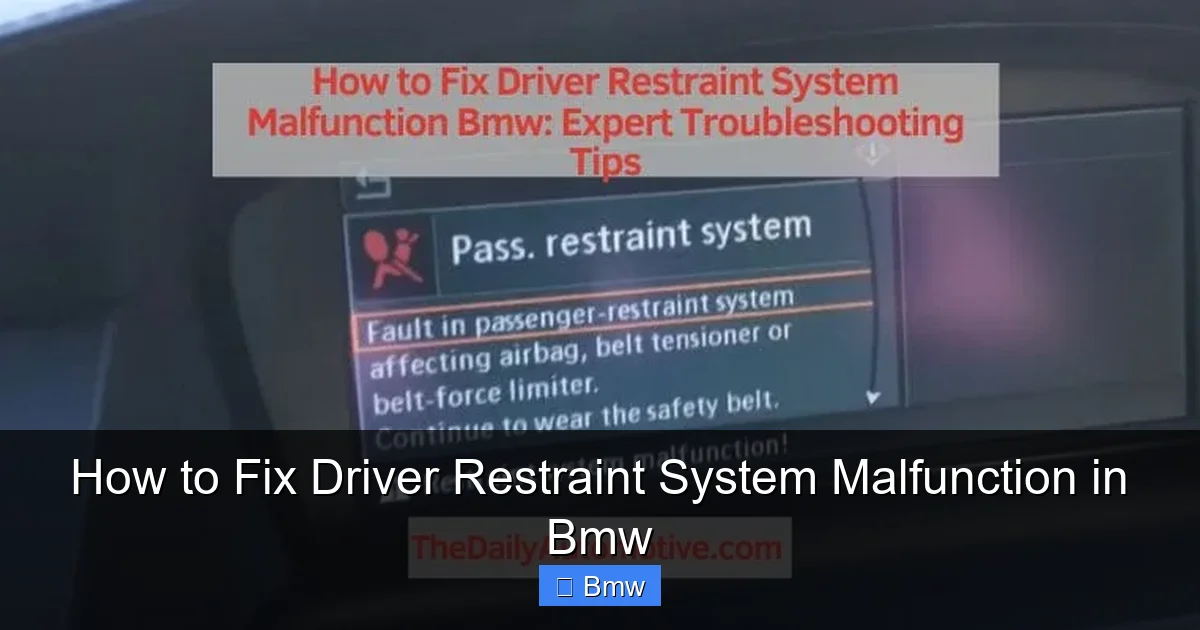
Guessing is a waste of time and money. You must retrieve the specific fault code stored in the SRS module. This code is your roadmap. A generic “airbag light on” tells you nothing. A code like “B10C3 – Driver Seat Belt Buckle Switch” tells you exactly where to look.

Visual guide about How to Fix Driver Restraint System Malfunction in Bmw
Image source: cars-care.net
The Right Tool for the Job
You cannot use a basic $20 OBD2 reader. These only read engine/transmission codes. You need a scanner that supports the BMW SRS system. Options include:
- Professional-Grade: BMW’s official ISTA software (used by dealers) running on a laptop with a ENET cable. This is the gold standard.
- High-End Aftermarket: Tools like the Foxwell NT510, iCarsoft BMW II, or Autel MaxiSys series that have specific SRS coverage for BMW.
- Specialty Tools: Some independent BMW shops use tools like the BimmerCode or BimmerLink apps with a compatible OBD2 adapter, but their SRS capabilities can be limited compared to full scanners.
Process: Connect your scanner, navigate to the SRS/Airbag control module, and read the stored fault codes. Write them down exactly. Do not clear them yet. Use the code to identify the faulty circuit or component. For example, a code “B10C3 – Open Circuit Driver Seat Belt Switch” points squarely at the driver’s buckle or its wiring.
Performing a Basic Visual and Physical Inspection
Even before you scan, do a thorough inspection. With the ignition on and the light illuminated, you can sometimes perform simple “wiggle tests.” Have a helper turn the key to “ON” (engine off) so the SRS light is on. Then, while you look under the driver’s seat, have them wriggle the seat back and forth and move it fore and aft. If the light flickers or goes out momentarily, you’ve likely found a loose connection in the seat wiring harness. Do the same around the steering column area for clock spring issues.
Practical Fixes: From Simple to Complex
Armed with a fault code and your inspection findings, you can now target the repair. Always, always disconnect the negative battery terminal and wait at least 30 minutes before touching any yellow SRS wiring or components. This ensures the backup capacitor in the SRS module is discharged and prevents accidental airbag deployment, which can cause serious injury.
Visual guide about How to Fix Driver Restraint System Malfunction in Bmw
Image source: i.ytimg.com
Fix 1: Cleaning/Reseating Seat Belt Buckle Connectors
This solves a huge percentage of problems. Once you’ve located the driver’s buckle connector (under the seat, attached to the metal buckle), unplug it. You’ll see two small plastic locking tabs. Press them and pull the connector apart. Inspect the female socket on the wiring harness side. Look for corrosion, bent pins, or debris. Spray it generously with electrical contact cleaner. Use a small plastic pick or toothpick to gently straighten any bent pins. Do the same for the male pins on the buckle side. Once clean and dry, plug it back together firmly until you hear the clicks. Secure the harness with a zip-tie away from any moving seat parts if it’s loose.
Fix 2: Repairing Damaged Wiring
If you find a frayed, pinched, or broken wire, you must repair it. Cut out the damaged section. Strip about 1/4″ of insulation from both ends. Twist the wires together clockwise and solder the connection for a permanent, reliable fix. Use heat shrink tubing (2:1 ratio) over the solder joint for insulation and strain relief. If the damage is extensive, you may need to replace the entire wiring harness segment, which can be sourced from a BMW parts dealer or a salvage yard.
Fix 3: Replacing the Clock Spring
If your diagnosis points to the clock spring (code for open circuit in driver airbag line, horn/controls not working), replacement is the fix. After safely disconnecting the battery and waiting, remove the steering wheel and airbag as mentioned. The clock spring is usually held by 3-4 Torx screws. Note its orientation (it must be installed exactly as it came out to avoid winding up and breaking). Unplug it from both the airbag and steering column stalks. Install the new one in the same orientation, reconnect plugs, and reassemble. Important: Some BMW models require the steering angle sensor to be calibrated (straight-ahead) after this procedure, which requires the diagnostic scanner.
When to Call a Professional BMW Specialist
Some issues are beyond the safe or practical scope of a DIYer. Here’s when to put down the tools and call an expert:
- Faulty SRS Control Module: If the module itself has failed, it needs to be replaced and, most importantly, coded/programmed to your vehicle’s VIN. This requires proprietary BMW software.
- Impact Sensor Replacement: Sensors mounted in the vehicle’s structure (like in the front corners or B-pillars) often require specific calibration after replacement to ensure correct deployment thresholds.
- Occupant Detection System (ODS) Issues: The mat in the passenger seat that detects weight/position is fragile and its calibration is complex. A pro is needed.
- If You’re Uncomfortable: Working with airbag systems carries inherent risk. If at any point you feel unsure, the cost of a professional diagnosis is cheap insurance against injury or a misdiagnosis that leaves your safety system compromised.
- Persistent, Unexplained Codes: Sometimes a code points to a component that tests fine, indicating a wiring间歇性 fault or a deeper module communication issue. Pros have advanced multimeters and oscilloscopes to chase these gremlins.
A reputable independent BMW shop will typically charge 1-2 hours of labor for diagnosis (often $150-$300) and then quote the repair. Dealerships will be more expensive but have full factory support. For context, a seat belt buckle connector repair might be $100-$200 at a shop, while a clock spring replacement could be $300-$600. An SRS module replacement with coding can exceed $1,000.
Prevention and Long-Term Care
You can dramatically reduce the chances of a future driver restraint malfunction with some simple habits:
- Be mindful of the driver’s seat area. Avoid storing heavy items, tools, or boxes under the driver’s seat that can crush or pinch the wiring harness.
- When adjusting the seat, do it smoothly. Jerking the seat forward/backward violently puts extra stress on the connectors.
- Keep connectors clean and dry. If you spill a drink near the center console or seat tracks, clean it up immediately. Moisture leads to corrosion in these sensitive connectors.
- Address other vehicle issues promptly. For example, a severe coolant leak, as discussed in our guide on BMW coolant leak repair costs, could potentially lead to overheating that might damage nearby wiring or sensors. Similarly, issues with the chassis control system could sometimes share sensor networks or grounding points. Keeping your BMW in overall good health prevents cascading problems.
- Perform periodic visual checks. Once a year, slide the seat forward and give the wiring under there a quick look. Ensure connectors are secure and wires are intact.
Another often-overlooked system is BMW’s chassis stabilization, which works in tandem with stability control during evasive maneuvers. If you’re experiencing handling issues alongside your SRS light, it might point to a broader electrical or sensor problem, so check our article on BMW chassis stabilization repair for related insights.
Conclusion: Safety is Non-Negotiable
A driver restraint system malfunction in your BMW is a serious warning that demands your immediate attention. It’s a testament to the car’s advanced engineering that it monitors itself so diligently, but it’s up to you to heed that call. Start with the most common, accessible fixes: inspect and clean the driver’s seat belt buckle connector and the wiring under the seats. Use a proper SRS-capable scanner to get the exact fault code—this is your most valuable piece of information.
For issues involving the steering wheel clock spring, you must proceed with extreme caution, respecting the airbag’s lethal potential. When in doubt, or when facing complex codes related to modules or sensors, investing in a professional BMW technician is an investment in your own safety. They possess the specialized tools, software, and experience to not just fix the code, but to ensure the entire system is calibrated and functional as designed.
Remember, the goal isn’t just to make a light go out. The goal is to restore your BMW’s full, factory-intended occupant protection capability. Your life and the lives of your passengers depend on it. Treat this warning with the gravity it deserves, follow a logical diagnostic path, and don’t compromise on safety.
Frequently Asked Questions
Can I drive my BMW with the driver restraint system light on?
Technically, the car will still run and drive. However, you should not drive it unless absolutely necessary. The airbags and seat belt pretensioners may not deploy in a crash, dramatically increasing your risk of injury. Have it diagnosed and repaired immediately.
Will disconnecting the battery reset the driver restraint system light?
No. Disconnecting the battery will clear some temporary codes, but a true fault will cause the light to return as soon as the system powers up and re-runs its self-test. The underlying problem must be repaired before the light can be permanently reset with a scanner.
What’s the most common fix for a driver restraint system malfunction?
By a wide margin, the most common and effective fix is cleaning, reseating, or repairing the electrical connector for the driver’s seat belt buckle. This simple, inexpensive fix resolves a large percentage of these warnings across many BMW models.
Do I need a special scanner to fix this, or will an AutoZone code reader work?
You absolutely need a scanner that specifically supports the BMW SRS (airbag) system. A standard generic OBD2 reader will only see engine and transmission codes. You need a tool that can communicate with the SRS control module to read its specific fault codes, which is essential for diagnosis.
I replaced the driver’s seat belt buckle, but the light is still on. Now what?
First, ensure the new buckle is a proper, high-quality replacement. Then, you must clear the stored fault code with your SRS scanner. If the code returns immediately, the problem is likely in the wiring *leading to* the buckle connector, not the buckle itself. Inspect the entire harness for damage.
Is it safe to replace the airbag or steering wheel clock spring myself?
Only if you are extremely confident, have followed all safety protocols (battery disconnect + 30-minute wait), and have the correct instructions for your specific BMW model. The risk of accidental airbag deployment is real and can cause severe injury or death. For most owners, this is a job for a professional.