How to Check Subaru Transmission Fluid

Contents
- 1 Key Takeaways
- 2 📑 Table of Contents
- 3 Why Checking Your Subaru Transmission Fluid Matters
- 4 Understanding Subaru Transmission Fluid Basics
- 5 Tools and Preparation: Getting Ready to Check
- 6 Step-by-Step: How to Check Subaru Transmission Fluid (With Dipstick)
- 7 Checking Fluid in Subaru CVT Models (No Dipstick)
- 8 Common Mistakes to Avoid
- 9 When to Change Your Transmission Fluid
- 10 Conclusion: Keep Your Subaru Shifting Smoothly
- 11 Frequently Asked Questions

Car Hydraulic Jack

Liquid Car Polish

Car Trash Can
Wiper Blade Refills
Checking your Subaru’s transmission fluid is a simple but essential maintenance task that helps prevent costly repairs and ensures smooth shifting. This guide walks you through the process clearly, safely, and correctly—no mechanic required.
Key Takeaways
- Check fluid when warm: Always check transmission fluid after driving for at least 10–15 minutes so the fluid is at operating temperature.
- <>Use the correct dipstick: Most Subarus have a transmission dipstick, but some newer models require a scan tool—know your model year.
- Look for proper color and smell: Healthy fluid is bright red and smells slightly sweet; dark or burnt-smelling fluid signals trouble.
- Top off carefully: Use only Subaru-approved ATF (Automatic Transmission Fluid) and add slowly to avoid overfilling.
- Inspect for leaks: While checking fluid, look under the car for signs of leaks around the transmission pan or seals.
- Follow the owner’s manual: Always refer to your specific Subaru model’s manual for exact procedures and fluid type.
- When in doubt, consult a pro: If you’re unsure about the condition or level, visit a Subaru specialist for peace of mind.
📑 Table of Contents
- Why Checking Your Subaru Transmission Fluid Matters
- Understanding Subaru Transmission Fluid Basics
- Tools and Preparation: Getting Ready to Check
- Step-by-Step: How to Check Subaru Transmission Fluid (With Dipstick)
- Checking Fluid in Subaru CVT Models (No Dipstick)
- Common Mistakes to Avoid
- When to Change Your Transmission Fluid
- Conclusion: Keep Your Subaru Shifting Smoothly
Why Checking Your Subaru Transmission Fluid Matters
Your Subaru’s transmission is one of the hardest-working components under the hood. It transfers power from the engine to the wheels, allowing your car to shift gears smoothly—whether you’re cruising down the highway or navigating city traffic. But like any complex system, it needs proper care to keep running efficiently. One of the simplest yet most overlooked aspects of transmission maintenance is checking the fluid.
Transmission fluid does more than just lubricate moving parts. It cools the transmission, helps engage clutch packs and bands, and protects internal components from wear and corrosion. Over time, this fluid can break down, become contaminated, or simply run low—leading to rough shifting, slipping gears, or even complete transmission failure. That’s why knowing how to check Subaru transmission fluid is a skill every Subaru owner should have in their DIY toolkit.
Unlike engine oil, transmission fluid isn’t something most people think about until there’s a problem. But catching issues early—like low fluid levels or degraded fluid—can save you thousands in repair bills down the road. The good news? Checking it yourself is easier than you might think. With just a few basic tools and a little know-how, you can keep your Subaru running like new for years to come.
Understanding Subaru Transmission Fluid Basics

Visual guide about How to Check Subaru Transmission Fluid
Image source: fluidadvise.com
Before diving into the actual checking process, it helps to understand what transmission fluid is and why it’s so important for your Subaru.
Transmission fluid is a specially formulated lubricant designed to handle high temperatures, extreme pressure, and constant friction inside your transmission. In automatic Subarus—which make up the vast majority of the lineup—the fluid also acts as a hydraulic medium, helping to engage gears and transfer power smoothly.
Subaru typically uses a specific type of automatic transmission fluid (ATF) called **Subaru ATF-HP** or **Subaru ATF 3309**, depending on the model and year. Using the wrong fluid can cause serious damage, so always double-check your owner’s manual or consult a Subaru dealer if you’re unsure. Never substitute with generic or universal ATF unless explicitly approved by Subaru.
It’s also worth noting that not all Subarus use the same transmission setup. Most use a conventional automatic transmission with a dipstick, especially models from the early 2000s through around 2014. However, newer models—particularly those with Lineartronic CVT (Continuously Variable Transmission)—may not have a traditional dipstick. Instead, they rely on electronic sensors and require a scan tool to check fluid levels. We’ll cover both scenarios in detail below.
Types of Subaru Transmissions
Subaru offers several types of transmissions across its vehicle lineup:
– **4EAT (4-speed Automatic):** Found in older models like the 2000–2009 Outback and Forester. These typically have a dipstick.
– **5EAT (5-speed Automatic):** Used in mid-2000s to early 2010s models. Also usually equipped with a dipstick.
– **Lineartronic CVT:** Introduced around 2010 and now standard on most new Subarus (e.g., Impreza, Crosstrek, Legacy). Many of these do *not* have a dipstick.
– **Manual Transmissions:** While less common today, some performance models (like the WRX STI) still offer manuals. These use gear oil, not ATF, and are checked differently.
Knowing which type your Subaru has is crucial. If you’re unsure, check your owner’s manual or look under the hood near the transmission for a dipstick handle—usually labeled “ATF” or “Transmission.”
Signs Your Transmission Fluid Needs Attention
Even if you haven’t checked the fluid recently, your car might be giving you clues that something’s off. Watch for these warning signs:
– **Rough or delayed shifting:** Hesitation when accelerating or jerky gear changes.
– **Slipping gears:** The engine revs but the car doesn’t speed up as expected.
– **Unusual noises:** Whining, grinding, or humming from under the car, especially in neutral.
– **Burning smell:** A strong, acrid odor could indicate overheating fluid.
– **Dashboard warning lights:** While Subarus don’t always have a dedicated transmission light, the Check Engine light may illuminate if sensors detect issues.
If you notice any of these symptoms, it’s time to check your transmission fluid—and possibly schedule a professional inspection.
Tools and Preparation: Getting Ready to Check
Visual guide about How to Check Subaru Transmission Fluid
Image source: transmissioncar.com
You don’t need a full garage setup to check your Subaru’s transmission fluid. With just a few basic items, you’ll be ready to go:
– Clean rag or paper towels
– Funnel (optional, but helpful for topping off)
– Subaru-approved ATF (if topping off is needed)
– Gloves (to keep hands clean)
– Flashlight (for better visibility under the hood)
Before you begin, make sure your car is parked on a level surface. This ensures an accurate reading—just like checking engine oil. Also, engage the parking brake for safety.
Now, here’s a critical step: **warm up the engine**. Unlike engine oil, transmission fluid should be checked when it’s at operating temperature. Drive your Subaru for at least 10–15 minutes to get the fluid warm. This allows it to expand to its normal volume and circulate fully through the system.
Once warmed up, turn off the engine and let it sit for 1–2 minutes. This gives the fluid time to settle back into the transmission pan before you check it. Never check cold fluid—it will give a falsely high reading.
Safety First
Always allow the engine to cool slightly before opening the hood. The transmission and surrounding components can get very hot, and you don’t want to risk burns. Also, avoid wearing loose clothing or jewelry that could get caught in moving parts.
If your Subaru has a CVT without a dipstick, **do not attempt to open the transmission fill plug unless you have the proper tools and knowledge**. Improper handling can lead to fluid loss, air ingress, or damage. In these cases, it’s best to visit a Subaru service center.
Step-by-Step: How to Check Subaru Transmission Fluid (With Dipstick)

Visual guide about How to Check Subaru Transmission Fluid
Image source: rparts-sites.s3.amazonaws.com
If your Subaru has a traditional automatic transmission with a dipstick (common in models up to ~2014), follow these steps:
Step 1: Locate the Transmission Dipstick
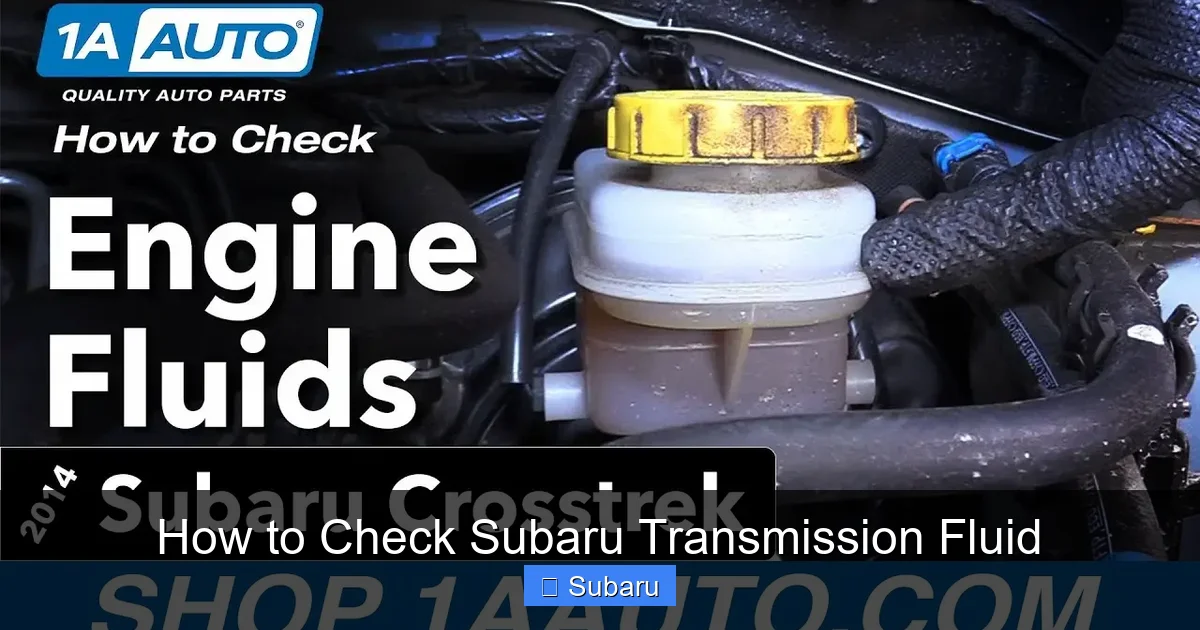
Open the hood and look toward the back of the engine bay, near the firewall. The transmission dipstick is usually on the passenger side (in left-hand-drive vehicles) and has a yellow or red handle labeled “ATF” or “Transmission.” It’s often tucked behind the engine air intake or near the brake fluid reservoir.
If you can’t find it, consult your owner’s manual—it will show a diagram of the engine bay with labeled components.
Step 2: Pull and Wipe the Dipstick
With the engine off and the car level, pull the dipstick straight out. Wipe it clean with a rag or paper towel. Make sure no debris falls into the dipstick tube.
Step 3: Reinsert and Remove Again
Push the dipstick all the way back in, then pull it out again. This time, look at the fluid level markings on the end of the dipstick. Most Subaru dipsticks have two sets of marks:
– **“COLD” range:** For checking when the fluid is cool (not recommended for accuracy).
– **“HOT” range:** The correct range to use after driving.
The fluid should be between the two lines in the “HOT” section. If it’s below the lower line, you need to add fluid.
Step 4: Inspect Fluid Condition
While checking the level, also examine the fluid’s appearance:
– **Color:** Healthy ATF is bright red or pinkish. If it’s dark brown, black, or has a milky appearance, it’s degraded or contaminated.
– **Smell:** Fresh fluid has a slightly sweet, oily scent. A burnt or acrid smell indicates overheating or internal wear.
– **Consistency:** It should be smooth and free of particles, grit, or sludge.
If the fluid looks or smells bad, it’s time for a transmission fluid change—not just a top-off.
Step 5: Add Fluid (If Needed)
If the level is low, add Subaru-approved ATF slowly using a funnel. Pour in small amounts—no more than ¼ to ½ quart at a time—then recheck the level. Overfilling can cause foaming, overheating, and transmission damage.
Replace the dipstick securely when done. Start the engine, let it idle for a minute, then shift through all gears (P-R-N-D) to circulate the new fluid before rechecking the level.
Checking Fluid in Subaru CVT Models (No Dipstick)
For newer Subarus with Lineartronic CVTs (e.g., 2015+ Crosstrek, 2017+ Impreza, most current Legacies), the process is different—and more complex.
These vehicles don’t have a traditional dipstick. Instead, the transmission has a fill plug and a level plug on the side of the transmission case. Checking the fluid requires removing the level plug with the engine running and at operating temperature.
**Important:** This procedure should only be performed by someone comfortable working under the car and following precise steps. If you’re not confident, visit a Subaru dealer or trusted mechanic.
General CVT Fluid Check Overview
1. Warm up the car by driving for 15–20 minutes.
2. Park on a level surface and set the parking brake.
3. Locate the transmission fill and level plugs (usually on the driver’s side of the transmission).
4. With the engine running and in Park, remove the level plug.
5. Fluid should trickle out slowly. If it doesn’t, the level is low.
6. Add fluid through the fill plug until it starts to drip from the level plug.
7. Reinstall both plugs securely.
Because this process involves hot components and precise timing, many owners opt for professional service. Subaru dealerships have the correct tools and training to perform this safely.
Common Mistakes to Avoid
Even simple tasks can go wrong if you’re not careful. Here are some frequent errors when checking Subaru transmission fluid:
– **Checking cold fluid:** Always warm up the engine first. Cold fluid gives inaccurate readings.
– **Using the wrong fluid:** Never substitute with generic ATF. Use only Subaru-approved fluid.
– **Overfilling:** Adding too much fluid can be as harmful as too little. Go slow and recheck often.
– **Ignoring fluid condition:** Level isn’t everything—color and smell matter just as much.
– **Skipping the owner’s manual:** Every Subaru model is slightly different. Your manual is your best guide.
– **Forcing a stuck dipstick:** If the dipstick won’t budge, don’t yank it. Check for clips or locks first.
When to Change Your Transmission Fluid
Checking fluid is one thing—knowing when to change it is another. Subaru typically recommends changing automatic transmission fluid every **30,000 to 60,000 miles**, depending on driving conditions.
If you do a lot of towing, drive in stop-and-go traffic, or live in a hot climate, consider changing it closer to 30,000 miles. For mostly highway driving in moderate conditions, 60,000 miles may be fine.
CVT fluid often has longer intervals—sometimes up to 100,000 miles—but always follow your owner’s manual. And remember: if the fluid looks dark or smells burnt, don’t wait—change it immediately.
A professional flush is usually better than a simple drain-and-fill, especially for high-mileage vehicles, because it removes more old fluid and contaminants.
Conclusion: Keep Your Subaru Shifting Smoothly
Learning how to check Subaru transmission fluid is a small investment of time that pays big dividends in reliability and longevity. Whether you drive an older Outback with a dipstick or a modern Crosstrek with a CVT, staying on top of fluid maintenance helps prevent breakdowns, improves performance, and protects your transmission from premature wear.
By following the steps in this guide—warming up your car, using the right tools, inspecting fluid condition, and topping off carefully—you’ll keep your Subaru running smoothly for years to come. And if you ever feel unsure, don’t hesitate to consult a Subaru specialist. Your transmission will thank you.
Remember: a little attention today can save you from a major repair tomorrow. So pop the hood, check that fluid, and drive with confidence.
Frequently Asked Questions
Can I check my Subaru transmission fluid when the engine is cold?
No, you should always check transmission fluid when the engine is warm. Cold fluid contracts and gives a falsely high reading, which can lead to overfilling. Drive for 10–15 minutes first to bring the fluid to operating temperature.
What color should Subaru transmission fluid be?
Healthy Subaru transmission fluid is bright red or pinkish. If it’s dark brown, black, or has a milky appearance, it’s likely degraded or contaminated and needs to be changed.
Do all Subarus have a transmission dipstick?
No. Older models (typically pre-2015) usually have a dipstick, but newer CVT-equipped Subarus often don’t. These require a specialized procedure using fill and level plugs—best handled by a professional.
Can I use generic ATF in my Subaru?
No. Always use Subaru-approved ATF (like ATF-HP or ATF 3309). Generic fluids may not meet Subaru’s specifications and can cause transmission damage.
How often should I check my Subaru’s transmission fluid?
Check it every 3,000–5,000 miles or during regular oil changes. If you notice shifting issues or a burning smell, check it immediately.
What happens if my Subaru transmission fluid is low?
Low fluid can cause poor shifting, overheating, and internal damage. Top it off with the correct fluid, but if it’s consistently low, inspect for leaks and have the system checked by a mechanic.