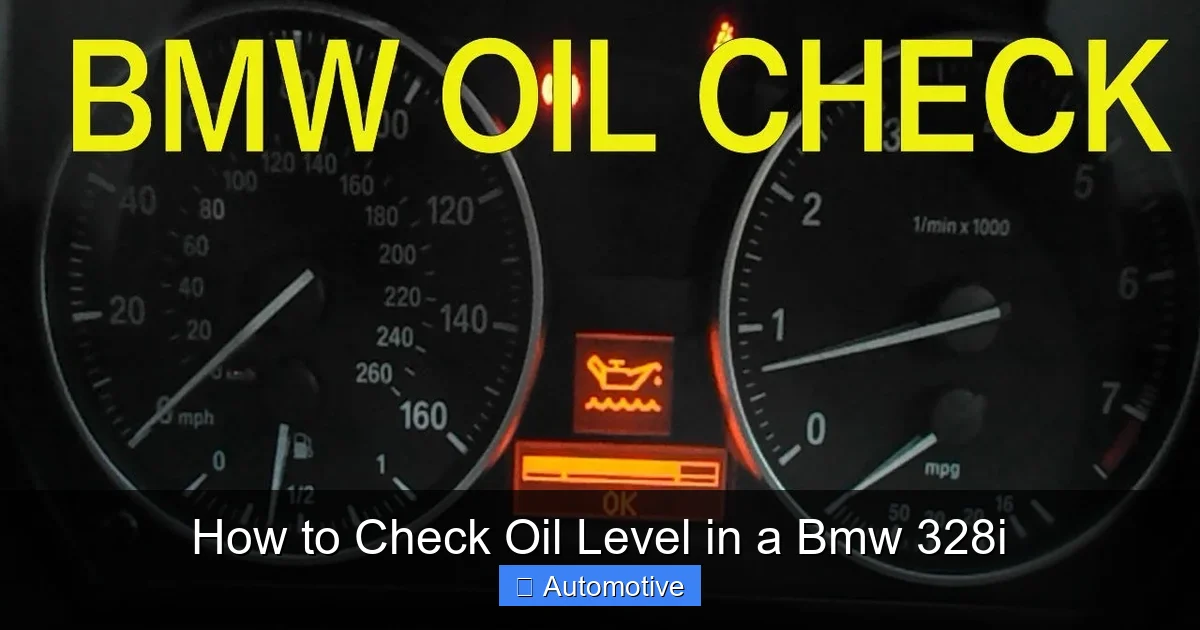
How to Check Oil Level in a Bmw 328i

Contents
- 1 Key Takeaways
- 2 📑 Table of Contents
- 3 Why Checking Oil in a BMW 328i Is Different (And Better)
- 4 Essential Preparation Before You Begin
- 5 The Step-by-Step Guide to Checking Your 328i’s Oil Level
- 6 Understanding the Display and What “Normal” Really Means
- 7 Adding Oil Correctly: Type, Quantity, and Procedure
- 8 Common Mistakes and Troubleshooting
- 9 Integrating Oil Checks into Your Routine Maintenance
- 10 Frequently Asked Questions

Parking Sensor Kit

Jack Stands

Car Window Tint Film

Multipurpose Lubricant Spray
Checking the oil in a BMW 328i is not done with a traditional dipstick. Instead, it uses an electronic sensor system accessed through the iDrive infotainment screen. The process requires the car to be on level ground and the engine to be at a specific temperature for an accurate reading. Following the correct procedure ensures you get a true measurement to prevent engine damage from low or overfilled oil.
Welcome, BMW enthusiast! Taking care of your 328i is a point of pride. The sleek lines, the driving dynamics, the legendary inline-6 engine—it’s a masterpiece of engineering. But that masterpiece needs one thing above all else to sing: clean, plentiful oil at the correct level. Unlike your grandfather’s Buick with a simple yellow-handled dipstick, your modern BMW 328i (specifically, the F30 chassis from 2012-2019) uses a sophisticated electronic system. This can be confusing at first, but once you know the steps, checking your oil is a quick, clean, and incredibly accurate process. This guide will walk you through everything, from why BMW does it this way to exactly how to get a perfect reading every single time. Let’s dive in.
Key Takeaways
- No Dipstick: Your BMW 328i uses an electronic oil level sensor, not a manual dipstick, for measurement.
- Temperature is Critical: The engine must be at operating temperature or have been off for several minutes on level ground for an accurate reading.
- iDrive is Your Tool: You will navigate the “Service” or “Vehicle Info” menu on the iDrive controller to find the oil level display.
- Understand the Display: The graphic shows a cross-hatch area; oil should be between the “MIN” and “MAX” markers within that area.
- Use BMW-Approved Oil: If adding oil, it must meet BMW’s LL-01 or LL-04 specification (typically 0W-30 or 5W-30) to avoid engine issues.
- Don’t Overfill: Adding too much oil is as dangerous as running low; add slowly and re-check frequently.
- Reset After Service: If oil is added or changed, the system may need a manual reset via the iDrive menu to track the next service interval correctly.
📑 Table of Contents
- Why Checking Oil in a BMW 328i Is Different (And Better)
- Essential Preparation Before You Begin
- The Step-by-Step Guide to Checking Your 328i’s Oil Level
- Understanding the Display and What “Normal” Really Means
- Adding Oil Correctly: Type, Quantity, and Procedure
- Common Mistakes and Troubleshooting
- Integrating Oil Checks into Your Routine Maintenance
Why Checking Oil in a BMW 328i Is Different (And Better)
The first question every new BMW owner asks is, “Where’s the dipstick?” You’ll look under the hood, search near the engine, and come up empty-handed. That’s by design. Starting in the early 2000s, BMW began phasing out traditional dipsticks in favor of an electronic oil level sensor (OLS). For the 328i, this is a sensor located in the oil pan that measures the level using a capacitive principle. It tells the car’s computer exactly how much oil is present.
The Advantages of the Electronic System
This isn’t just a cost-cutting move; it’s a genuine improvement in accuracy and convenience. A manual dipstick reading is a snapshot that depends entirely on the person pulling it—did they wipe it clean? Did they re-insert it fully? Did they read it on a completely level surface? The electronic system eliminates all human error. It provides a consistent, precise measurement. Furthermore, it’s a “dry” check. You don’t have to get your hands dirty, worry about oil drips on your manifold, or risk overfilling because you misread a cold-engine dipstick. The system also integrates with the car’s onboard computer to calculate oil life based on driving style and conditions, giving you a more holistic view of your engine’s health than just a level check.
However, this system has one major requirement: the car must be on perfectly level ground. The sensor’s calculation is based on the oil’s distribution in the pan. If your car is parked on a hill, the oil sloshes to one side, and the sensor will give a false low or false high reading. This is the single most important rule to remember.
Essential Preparation Before You Begin
Rushing this step is the #1 cause of inaccurate readings. Proper preparation takes just a few minutes but guarantees your result is meaningful. Skipping it is like trying to weigh yourself on a scale that’s on a slant—the number is useless.
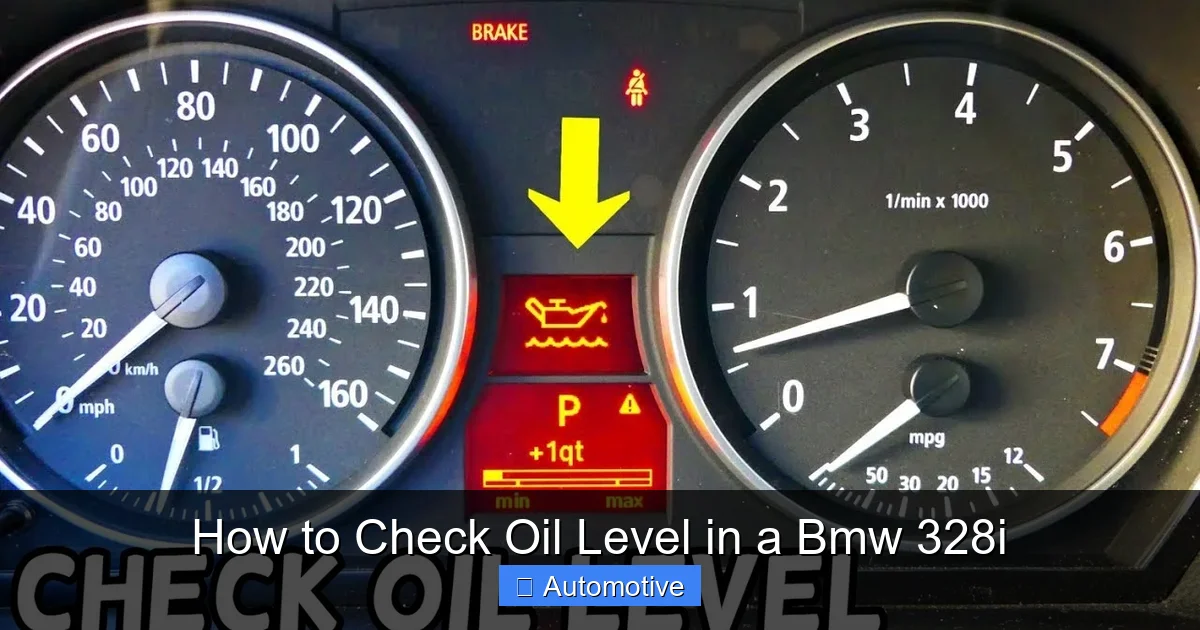
Visual guide about How to Check Oil Level in a Bmw 328i
Image source: i.ytimg.com
The Golden Rules of Position and Temperature
You have two scenarios for an accurate check, and you should choose one:
- The “Warm Engine, Short Wait” Method (Preferred): Drive your BMW normally for at least 10-15 minutes to bring the engine and oil to full operating temperature (about 220°F/104°C). Then, park it on a level surface (your garage floor is ideal), turn off the engine, and wait exactly 5 minutes. This allows the oil to drain fully back into the pan from the cylinder head and other components. Do not wait longer than 10 minutes, as some oil may start to seep back, slightly altering the level.
- The “Cold Engine, Long Wait” Method: If the car has been parked overnight or for several hours (at least 5-6 hours), it is considered cold. In this state, all oil has settled. You can check it immediately on level ground, but the reading may be slightly higher than the “warm” reading because the oil has not yet expanded from heat. The BMW system is calibrated to show the correct level when at operating temperature, so the warm method is more accurate for day-to-day checks.
Never check the oil level when the engine is cold after a short trip, or immediately after turning off a hot engine. In the first case, oil hasn’t circulated fully. In the second, it hasn’t drained back. Both give falsely low readings, causing you to add oil unnecessarily, which can lead to overfilling—a serious problem that can cause foaming, increased pressure, and seal damage.
Gather Your Tools
You don’t need many tools, but having them ready makes the process smooth:
- Your BMW’s key fob (to unlock and power the car).
- A clean, lint-free cloth (optional, for the filler cap).
- The correct oil for your 328i (more on this in a later section). A funnel with a long, narrow spout is highly recommended to avoid spills.
Open the hood and locate the oil filler cap. It’s usually on the top of the valve cover, marked with an oil can symbol. Familiarize yourself with it. You won’t be opening it during the check, but you will if you need to add oil.
The Step-by-Step Guide to Checking Your 328i’s Oil Level
Now for the main event. This process is entirely menu-driven through the iDrive system. For models with iDrive 6 (most 2016-2019 models) or iDrive 7 (some late 2019 models), the path is very similar. If you have an older model with a smaller screen, the menu names might be slightly different but the logic is the same.
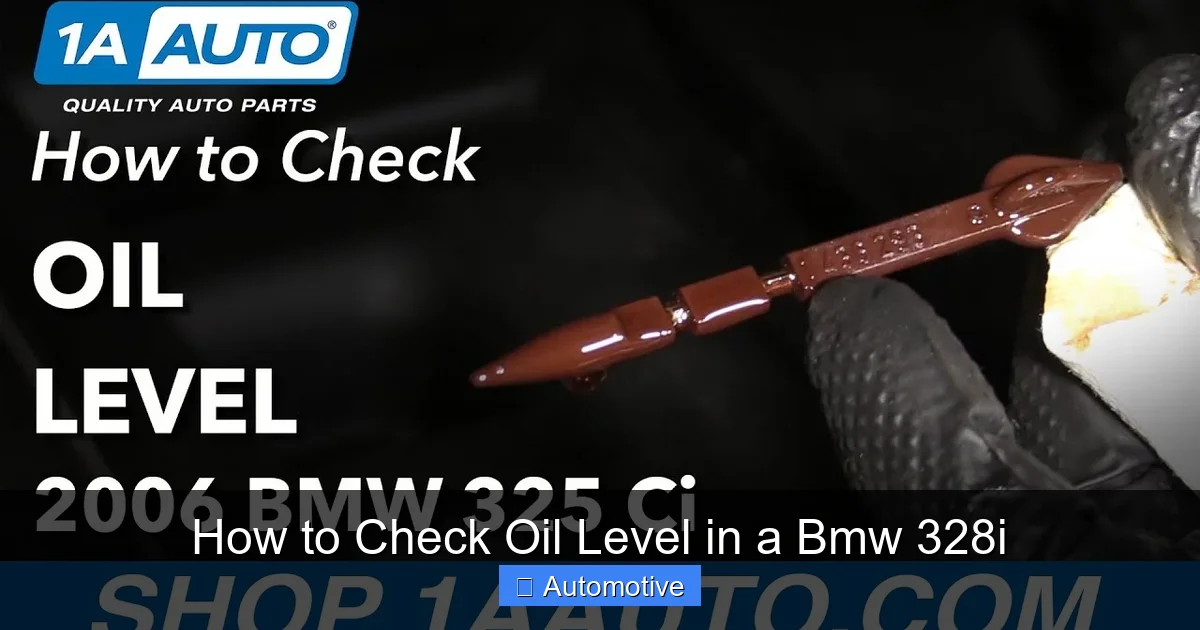
Visual guide about How to Check Oil Level in a Bmw 328i
Image source: i.ytimg.com
Step 1: Enter the Vehicle and Power On
Insert the key or press the Start/Stop button without pressing the brake pedal. This activates the car’s electrical systems (the “Ignition ON” position). You should see the iDrive screen light up. Do not start the engine.
Step 2: Navigate to the Oil Level Menu
Using the iDrive controller knob or touchpad:
- Press the “Menu” button on the controller.
- Scroll to and select “Vehicle Info” or “Service”.
- Look for an option called “Oil Level” or “Check Oil Level”. In some models, it might be under “Vehicle Status” or “Maintenance”.
- Select it. The system may prompt you to ensure the vehicle is on level ground. Acknowledge this.
Step 3: Interpret the On-Screen Display
After a moment, a graphic will appear. It typically looks like a small engine or a graduated bar with two markers: MIN and MAX. Between these markers is a cross-hatched or shaded area. This is the “safe zone.”
- Oil Level Within Cross-Hatch: This is perfect. Your oil is at the correct level. No action needed.
- Oil Level Below MIN (Red or Warning): Your oil is critically low. You must add the correct type of oil immediately. Do not drive the car in this state.
- Oil Level Above MAX (Red or Warning): Your oil is overfilled. This is also dangerous. You will need to drain some oil. Driving with overfilled oil can cause aeration (foaming), which destroys the oil’s lubricating ability and can lead to catastrophic engine failure.
- “–” or Dashes: The system cannot get a reading. This usually means the car wasn’t on level ground, the engine wasn’t at the correct temperature, or the sensor itself has a fault. Re-check after following the preparation steps precisely. If it persists, a diagnostic scan is needed.
Step 4: Exit and Secure
Once you have your reading, you can back out of the menus. Turn off the vehicle’s electrical system and close the door. If you added oil, remember that the system may now show an incorrect level until you drive the car and let it cycle, or until you manually reset the service indicator. Many models will automatically recalibrate after a short drive at temperature, but it’s good practice to check the level again after your next trip to confirm it’s stable in the safe zone.
Understanding the Display and What “Normal” Really Means
That simple graphic holds a lot of information. The cross-hatched area isn’t just a line; it represents a volume of oil. BMW designed it so that being anywhere within that zone is acceptable, but the ideal target is the center of the cross-hatch. Think of it like a fuel gauge: you want to be in the middle of the “Full” range, not hovering at the very bottom or top.

Visual guide about How to Check Oil Level in a Bmw 328i
Image source: piketransit.com
The “MIN” and “MAX” are Not Arbitrary
The distance between MIN and MAX corresponds to approximately 1 quart (1 liter) of oil. This is a crucial fact. If your level is just barely above MIN, you likely need to add about ¾ of a quart. If it’s just below MAX, you are overfilled by a small amount. This graduated scale helps you estimate how much to add or drain.
It is also normal for the level to fluctuate slightly between the “warm” check and a “cold” check the next morning. Oil expands when hot. A reading that is perfectly centered when warm might appear slightly higher (but still within the cross-hatch) when cold. This is expected and not a cause for concern unless it’s consistently at or above MAX when warm.
Pro Tip: Make a mental note of where your oil level typically sits. Does it usually run a little low? A little high? This “baseline” helps you spot a potential problem, like a slow leak (level dropping over time) or a clogged PCV system (level rising slowly over time due to fuel dilution).
Adding Oil Correctly: Type, Quantity, and Procedure
If your check revealed the level is below MIN, it’s time to top up. Doing this correctly is just as important as the check itself.
Choosing the Right Oil: Non-Negotiable
This is the most critical step. Your BMW N20 or B48 turbocharged engine (common in 328i models) requires oil that meets specific BMW performance standards. Using the wrong oil can void your warranty and damage sensitive components like turbochargers and catalytic converters. The correct specification for most 328i models is:
- BMW Longlife-01 (LL-01) or Longlife-04 (LL-04)
The viscosity is almost always 0W-30 or 5W-30 full synthetic. The best and safest choice is to use genuine BMW TwinPower Turbo Oil (which is typically a high-quality 0W-30 meeting LL-04). Excellent alternatives are major brand synthetics that explicitly state “BMW LL-01” or “BMW LL-04” approval on the bottle. Never use conventional oil or a generic synthetic that lacks these approvals. If you’re unsure, consult your owner’s manual or call your BMW dealer with your VIN.
The Topping-Up Process: Slow and Steady
- Ensure the car is still on level ground and the engine is off.
- Place a clean cloth around the oil filler cap to catch any drips.
- Unscrew the cap counter-clockwise. It will have a seal; be gentle.
- Using a funnel, pour in approximately 0.5 quarts (0.5 liters) at a time.
- Replace the filler cap loosely (do not tighten fully yet).
- Wait 2-3 minutes for the new oil to settle into the pan.
- Do NOT start the engine. Go back to the iDrive menu and re-check the oil level.
- If it’s still below MIN, repeat the process of adding 0.5 quarts and re-checking.
This iterative method prevents the #1 mistake: overfilling. It is far easier to add a little at a time than to have to drain oil because you added a whole quart too much. Once the level is centered in the cross-hatch, screw the filler cap on firmly and wipe away any spilled oil. A clean engine bay is a happy engine bay.
Common Mistakes and Troubleshooting
Even with the best instructions, pitfalls exist. Let’s cover the most frequent errors and what to do if things go wrong.
Mistake 1: Checking on a Slope
As emphasized, this invalidates the reading. The sensor thinks the oil piled in the rear of the pan is the full level, showing “MAX” when you’re actually a quart low. Always, always use a level surface. Your garage, a flat parking spot, or even a quiet, level side street. If you’re on a hill, drive to a level area first.
Mistake 2: Wrong Temperature/Timing
Checking immediately after a short trip or right after shutting off a hot engine leads to false lows. The oil is still distributed in the engine. Stick to the 5-minute warm wait or the long cold wait. If you’re unsure, let the car sit for 30-60 minutes on level ground—this is a safe “compromise” that will give a reasonably accurate reading, though it may be slightly higher than the true warm operating level.
Mistake 3: Ignoring the “MAX” Warning
People are often more worried about low oil, but overfilled oil is a silent killer. It churns in the pan, turning into a frothy, aerated mess that cannot lubricate. It increases crankcase pressure, forcing oil past seals and into combustion chambers (burning oil, fouling spark plugs). If you accidentally overfill, you must drain some. The easiest way is to use a fluid extractor pump through the dipstick tube (if your model has one for other fluids) or, more reliably, have a mechanic drain it from the drain plug. Do not just drive it to “burn off” the excess.
Mistake 4: Using the Wrong Oil
This cannot be stressed enough. The tight tolerances of a modern BMW turbo engine demand specific oil. Using a high-mileage oil, a diesel oil, or an incorrect viscosity can lead to premature wear, turbo issues, and expensive repairs. For a comprehensive guide on oil types and change procedures for your BMW, we have a detailed article on how often to change oil in a BMW 3 Series, which covers specifications in depth.
System Saying “–” or Fault?
If you’ve followed all steps (level ground, proper temperature) and still get dashes, the issue is likely with the sensor or its wiring. This is not a DIY fix. It requires a diagnostic scan with a BMW-specific tool (like ISTA) to read the sensor’s live data and check for electrical faults. A common failure point is the connector on the oil pan, which can get corroded. A trip to a qualified independent BMW shop or the dealer is necessary.
Integrating Oil Checks into Your Routine Maintenance
Checking your oil shouldn’t be a once-a-year event. It should be part of your mental monthly checklist. For a car like a 328i that is driven hard and often uses turbocharging, the oil is working overtime.
A great habit is to check the oil level once a month and before any long road trip. This simple 2-minute task gives you immense peace of mind. It also helps you track consumption. All engines burn a tiny amount of oil, but a well-sealed BMW engine should consume less than a quart every 1,000 miles. If you find yourself adding a quart every 500 miles, that’s a red flag for potential issues like worn piston rings, valve stem seals, or a leaking turbocharger shaft seal.
Remember, the electronic oil level sensor is a fantastic tool, but it’s not infallible. It’s a computer. Your senses are also a tool. If you smell oil burning, see blue smoke from the exhaust, or notice oil spots under the car, check the level immediately and investigate the source. For general, universal advice on checking oil in any vehicle, our ultimate friendly guide to checking oil in a car provides foundational principles that apply to every vehicle, even those with dipsticks.
Finally, while checking the level is your job, changing the oil and filter at the correct interval is equally vital. BMW’s official interval is often 10,000+ miles with their approved oil, but many experts recommend a more conservative 5,000-7,000 mile interval for maximum longevity, especially for spirited driving. Keeping a log of your checks and services is the best way to stay on top of your 328i’s health.
Frequently Asked Questions
Can I check the oil level when the engine is cold?
Yes, but only if the car has been parked for at least 5-6 hours. A “cold” check after a short trip will be inaccurately low. For the most accurate reading, follow the warm engine method: drive for 10+ minutes, shut off, and wait 5 minutes on level ground.
What does it mean if my oil level shows between MIN and MAX but the oil life indicator says “0%”?
These are two separate systems. The oil level sensor measures quantity. The oil life monitor calculates service interval based on time, mileage, and driving conditions. A “0%” oil life means it’s time for an oil and filter change based on the maintenance schedule, regardless of the current oil level.
My oil level is showing correctly, but I still smell burning oil. What should I do?
The level sensor only tells you quantity, not condition or location. A burning smell with a correct level indicates a leak where oil is dripping onto a hot exhaust component (like a valve cover gasket) or that oil is being burned in the combustion chamber (blue smoke). You need a visual inspection by a mechanic to find the source.
Is it normal for the oil level to drop between services?
Yes, a small amount of oil consumption is normal. A well-maintained BMW engine should not consume more than 1 quart per 1,000 miles. If you are adding oil more frequently than that, have the vehicle inspected for internal leaks or wear.
What happens if I accidentally overfill the oil?
Overfilling is dangerous. Excess oil can foam, leading to loss of lubrication, increased pressure, and seal leaks. It can also cause the crankshaft to aerate the oil. If you suspect overfilling, do not drive the car. Drain the excess oil until the level returns to the center of the cross-hatch area.
Do I need to reset the oil level sensor after adding oil?
No, the sensor reads the actual level continuously. However, if you have performed an oil change (drained and refilled), you should manually reset the oil service indicator (the “oil life” percentage) via the iDrive menu to start the new service interval countdown. The level sensor will automatically read the new full level after you drive and cycle the system.