
How to Buy a Car with a Pre-approved Loan

Buying a car with a pre-approved loan gives you financial clarity, stronger negotiating power, and a smoother purchasing experience. By securing financing before you shop, you avoid dealership pressure and can focus on finding the right vehicle at the best price.
Key Takeaways
- Pre-approval saves time: You skip the financing step at the dealership and move straight to finalizing your purchase.
- Stronger negotiating position: Sellers see you as a serious buyer with confirmed funds, giving you leverage on price and terms.
- Know your budget upfront: Pre-approval reveals exactly how much you can afford, helping you avoid overspending.
- Compare loan offers: Shop multiple lenders to find the lowest interest rate and best loan terms.
- Protect your credit score: Use rate shopping within a short window (14–45 days) to minimize credit impact.
- Flexibility at the dealership: You can still use dealer financing if it offers better terms, but you’re not locked in.
- Faster, stress-free process: With financing sorted, you can drive off the lot the same day with confidence.
📑 Table of Contents
- Introduction: Why Pre-Approval Is a Game-Changer for Car Buyers
- What Is a Pre-Approved Car Loan?
- Step-by-Step Guide to Getting Pre-Approved
- How to Use Your Pre-Approval When Buying a Car
- Benefits of Buying with a Pre-Approved Loan
- Common Mistakes to Avoid
- Tips for First-Time Buyers
- Conclusion: Drive Away Confident
Introduction: Why Pre-Approval Is a Game-Changer for Car Buyers
Buying a car is exciting—but it can also be overwhelming. Between choosing the right model, comparing features, and navigating financing, it’s easy to feel rushed or pressured. That’s where a pre-approved car loan comes in. Getting pre-approved before you step onto a dealership lot puts you in control. It’s like having a financial roadmap that shows exactly where you stand and how far you can go.
Think of it this way: walking into a dealership without financing is like showing up to a job interview without a resume. You might have the skills, but you haven’t proven your value yet. A pre-approved loan does just that—it proves you’re a serious, qualified buyer with the funds ready to go. This simple step can save you hundreds, even thousands, of dollars over the life of your loan. Plus, it turns a potentially stressful process into a smooth, confident experience.
What Is a Pre-Approved Car Loan?
Visual guide about How to Buy a Car with a Pre-approved Loan
Image source: dcdws.blob.core.windows.net
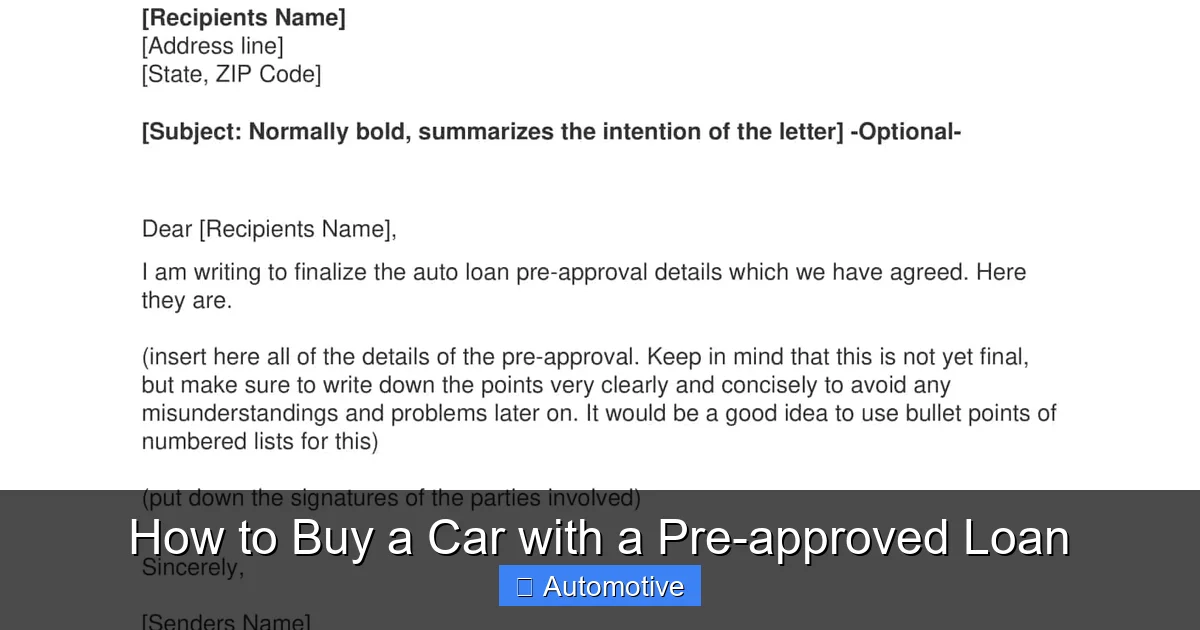
A pre-approved car loan is a conditional commitment from a lender to lend you a specific amount of money to buy a vehicle. It’s based on a review of your credit, income, and financial history. Once approved, you receive a pre-approval letter that outlines the loan amount, interest rate, and terms you qualify for. This letter is typically valid for 30 to 60 days, giving you time to shop for a car without losing your financing advantage.
It’s important to note that pre-approval is not the same as final approval. The lender will still need to verify the vehicle’s details and your final paperwork before releasing the funds. But for all practical purposes, pre-approval means you’re ready to buy. You’re not just window shopping—you’re a buyer with buying power.
How Pre-Approval Differs from Pre-Qualification
Many people confuse pre-approval with pre-qualification, but they’re not the same. Pre-qualification is a soft check that gives you an estimate of what you might qualify for. It doesn’t require a hard credit pull and isn’t a guarantee. Pre-approval, on the other hand, involves a thorough credit check and underwriting process. It’s a stronger signal to sellers that you’re ready to purchase.
For example, imagine you’re at a dealership and say, “I think I can afford around $25,000.” The salesperson might nod politely but won’t take you seriously. But if you show them a pre-approval letter for $28,000 at 5.9% APR, they’ll treat you like a VIP. That’s the power of pre-approval.
Step-by-Step Guide to Getting Pre-Approved

Visual guide about How to Buy a Car with a Pre-approved Loan
Image source: loanry.com
Getting pre-approved is simpler than most people think. It takes just a few steps and can be done online, over the phone, or in person. Here’s how to do it the right way.
1. Check Your Credit Score
Start by checking your credit score. You can get a free report from AnnualCreditReport.com or use free services like Credit Karma or Experian. Your score will determine the interest rates you qualify for. Generally, a score of 720 or higher gets you the best rates. If your score is lower, don’t panic—many lenders work with borrowers in the 600–700 range, though rates may be higher.
For example, a borrower with a 750 credit score might qualify for a 4.5% APR, while someone with a 650 score might get 7.2%. Over a 60-month loan on a $25,000 car, that’s a difference of over $2,000 in interest. Knowing your score helps you set realistic expectations.
2. Gather Required Documents
Lenders will ask for proof of identity, income, and residence. Have these ready to speed up the process:
– Government-issued ID (driver’s license or passport)
– Social Security number
– Proof of income (recent pay stubs, tax returns, or bank statements)
– Proof of residence (utility bill or lease agreement)
– Employment verification (employer contact or offer letter)
Having these documents organized saves time and shows lenders you’re prepared. It also reduces the chance of delays during final approval.
3. Shop Multiple Lenders
Don’t settle for the first offer you get. Compare rates from at least three different lenders. Consider:
– Banks (like Chase, Bank of America)
– Credit unions (often offer lower rates)
– Online lenders (such as LightStream, Capital One, or Upstart)
– Manufacturer financing (sometimes competitive, but not always the best)
For instance, a credit union might offer a 5.5% APR on a used car loan, while a big bank offers 6.8%. Over five years, that 1.3% difference adds up to nearly $1,000 in savings.
4. Submit Applications Within a Short Window
When you apply for multiple loans, do it within a 14- to 45-day window. Credit bureaus treat multiple auto loan inquiries in this timeframe as a single inquiry. This protects your credit score from taking a big hit. Spread out your applications too far, and each one counts separately—potentially lowering your score by 5–10 points per inquiry.
5. Review and Accept the Best Offer
Once you receive pre-approval letters, compare them side by side. Look at:
– Loan amount
– Interest rate (APR)
– Loan term (36, 48, 60, or 72 months)
– Monthly payment
– Fees (origination, prepayment penalties)
Choose the offer with the lowest total cost, not just the lowest monthly payment. A longer term might reduce your monthly bill, but it increases total interest paid. For example, a $25,000 loan at 6% over 60 months costs $3,996 in interest. Extend it to 72 months, and you pay $4,872—almost $900 more.
How to Use Your Pre-Approval When Buying a Car
Visual guide about How to Buy a Car with a Pre-approved Loan
Image source: typecalendar.com
Now that you’re pre-approved, it’s time to shop. Here’s how to use your financing advantage to get the best deal.
Set a Realistic Budget
Your pre-approval amount is the maximum you can borrow—not what you should spend. Factor in taxes, registration, insurance, and maintenance. A good rule of thumb is to keep your car payment under 10–15% of your monthly take-home pay.
For example, if you earn $4,000 a month after taxes, aim for a payment under $400–$600. If your pre-approval is for $30,000, you might choose a $26,000 car to stay within budget and leave room for extras.
Start Shopping Online
Use your pre-approval to shop with confidence. Browse inventory on sites like Cars.com, Autotrader, or CarGurus. Filter by price, mileage, and location. Contact dealers directly or schedule test drives. Mention your pre-approval upfront—it signals you’re ready to buy.
Say something like: “I’m pre-approved for $28,000 at 5.9% APR. I’m looking for a 2020 Honda CR-V under 40,000 miles. Do you have any in stock?” This shows you’re informed and serious.
Negotiate the Price, Not the Payment
Dealers often focus on monthly payments to hide the true cost of the car. Instead, negotiate the out-the-door price—the total amount you’ll pay including taxes and fees. Use your pre-approval as leverage.
For example, if a car is listed at $27,500, aim to get it for $26,000. Once the price is set, your lender will calculate the monthly payment based on your loan terms. This keeps the focus on value, not just affordability.
Compare Dealer Financing (But Don’t Feel Pressured)
Even with pre-approval, dealers may offer their own financing. They might advertise “0% APR” or “cash back” deals. These can be great—but only if they beat your pre-approved rate.
Ask for the full loan details: APR, term, fees, and total cost. Compare it to your pre-approved offer. If the dealer’s rate is lower, you can switch. But if not, stick with your original lender. You’re under no obligation to use dealer financing.
Finalize the Purchase
Once you’ve agreed on a price and chosen your financing, it’s time to close the deal. The dealer will send the paperwork to your lender. The lender will verify the vehicle details and your information, then send a check to the dealership.
You’ll sign the title, registration, and insurance documents. Make sure everything matches your agreement. Once funded, you can drive away—often the same day.
Benefits of Buying with a Pre-Approved Loan
There are many advantages to securing financing before you buy. Here’s why smart buyers choose this route.
1. Save Time at the Dealership
Without pre-approval, you’ll spend hours at the dealership filling out loan applications, waiting for credit checks, and negotiating terms. With pre-approval, you skip all that. You walk in, test drive, agree on a price, and drive off. The whole process can take under two hours.
2. Avoid High-Pressure Sales Tactics
Dealers know that buyers without financing are vulnerable. They may push add-ons like extended warranties, GAP insurance, or paint protection. With pre-approval, you’re in control. You can say no to extras and focus on the car itself.
3. Get Better Interest Rates
Lenders compete for your business. By shopping around, you’re more likely to find a low rate. Dealers, on the other hand, often mark up interest rates to earn commissions. A pre-approved loan helps you avoid that markup.
4. Protect Your Credit Score
Applying for financing at multiple dealerships can result in several hard credit inquiries. This can lower your score and affect future loan applications. Pre-approval consolidates your credit checks into one window, minimizing damage.
5. Flexibility and Peace of Mind
You’re not locked into any one lender. If a dealer offers a better deal, you can switch. But if not, you already have solid financing in place. This flexibility reduces stress and gives you confidence in your decision.
Common Mistakes to Avoid
Even with pre-approval, it’s easy to make errors that cost you money. Avoid these common pitfalls.
Ignoring the Total Cost of Ownership
A low monthly payment doesn’t mean a good deal. A longer loan term reduces your payment but increases total interest. Also, consider insurance, fuel, maintenance, and depreciation. A $30,000 car might cost $600/month to own—not just $450 in payments.
Skipping the Test Drive
Don’t buy a car based on photos and specs alone. Always test drive it. Check comfort, visibility, noise, and handling. Bring a friend or family member for a second opinion.
Not Reading the Fine Print
Review all documents before signing. Look for hidden fees, prepayment penalties, or clauses that allow the lender to change terms. If something seems off, ask questions or walk away.
Overextending Your Budget
Just because you’re approved for $35,000 doesn’t mean you should spend it all. Stick to your budget. Remember, a car is a depreciating asset—it loses value the moment you drive it off the lot.
Tips for First-Time Buyers
If you’re new to car buying, pre-approval is especially helpful. Here’s how to make the most of it.
Start Early
Begin the pre-approval process at least two weeks before you plan to buy. This gives you time to compare offers and fix any credit issues.
Bring a Trusted Friend
Shopping with someone who’s bought a car before can help you stay focused and avoid emotional decisions.
Ask Questions
Don’t be afraid to ask dealers or lenders to explain terms you don’t understand. A good lender or salesperson will be happy to help.
Consider a Co-Signer
If your credit is thin or damaged, a co-signer with strong credit can help you qualify for a better rate. Just remember, they’re equally responsible for the loan.
Conclusion: Drive Away Confident
Buying a car with a pre-approved loan is one of the smartest moves you can make. It puts you in the driver’s seat—literally and financially. You save time, avoid pressure, and get better deals. More importantly, you walk into the dealership knowing exactly what you can afford and what you’re worth as a buyer.
Pre-approval isn’t just about financing—it’s about empowerment. It turns a complex process into a straightforward journey. Whether you’re buying your first car or upgrading to something newer, start with pre-approval. Do your research, compare offers, and negotiate with confidence. When the keys are in your hand and the engine starts, you’ll know you made the right choice.
So don’t wait. Check your credit, gather your documents, and apply for pre-approval today. Your next car is closer than you think.
Frequently Asked Questions
What is the difference between pre-approval and final approval?
Pre-approval is a conditional offer based on your credit and income, while final approval happens after the lender verifies the vehicle and your final paperwork. Pre-approval gets you ready to buy; final approval releases the funds.
Can I still use dealer financing if I’m pre-approved?
Yes, you can. Pre-approval gives you a backup plan. If the dealer offers a better rate or terms, you can switch. But you’re not obligated to use their financing.
How long does pre-approval last?
Most pre-approval letters are valid for 30 to 60 days. After that, you may need to reapply, especially if your financial situation changes.
Will pre-approval hurt my credit score?
A single pre-approval application results in one hard inquiry, which may lower your score by a few points. But shopping with multiple lenders within a short window counts as one inquiry, minimizing the impact.
Can I get pre-approved with bad credit?
Yes, many lenders work with borrowers who have lower credit scores. You may pay a higher interest rate, but pre-approval still gives you negotiating power and a clear budget.
What if I find a car outside my pre-approved amount?
You can apply for a higher loan amount, but the lender may require additional documentation or deny the request. It’s better to stick within your approved range to avoid complications.