How to Become a Bmw Certified Mechanic

Contents
- 1 Key Takeaways
- 2 📑 Table of Contents
- 3 Your Roadmap to Becoming a BMW Certified Mechanic
- 4 Understanding the “Why”: The Value of BMW Certification
- 5 Prerequisites: Laying the Foundation (Your Education & ASE)
- 6 The Core Pathway: The BMW STEP Program
- 7 Alternative and Supplemental Training Paths
- 8 Beyond the Wrench: The Business of Being a BMW Mechanic
- 9 Your Future as a BMW Certified Mechanic: Career Trajectory
- 10 Conclusion: The Commitment to the Ultimate Driving Machine
- 11 Frequently Asked Questions

Car LED Headlight Bulb

Car Body Cover

Emergency First Aid Kit

Engine Oil Additive
Becoming a BMW certified mechanic is a prestigious career path that requires formal education, specialized BMW training, and passing rigorous certification exams. It involves completing a state-approved automotive program, gaining hands-on experience, and enrolling in BMW’s official STEP (Service Technician Education Program) or similar factory training. This certification validates your expertise on BMW vehicles, leading to higher earning potential and career advancement at authorized dealerships and independent shops.
Key Takeaways
- Formal Education is the First Step: You must graduate from an accredited automotive technology program, often a high school vocational program or a community college associate degree.
- BMW’s STEP Program is the Gold Standard: The BMW Service Technician Education Program (STEP) is the primary factory training pathway, combining classroom learning with hands-on internship experience at a BMW dealership.
- ASE Certification is a Prerequisite: Before entering BMW-specific training, you must achieve general Automotive Service Excellence (ASE) certification, proving your foundational mechanical knowledge.
- Continuous Learning is Mandatory: BMW technology evolves rapidly. Certified mechanics must complete annual recertification and ongoing training to stay current with new models and systems.
- Career Opportunities Expand Significantly: Certification opens doors to positions at BMW dealerships, high-end independent repair shops, and specialized roles with higher salary potential than general mechanics.
- It’s a Commitment to Precision: BMW’s philosophy demands meticulous attention to detail. Certification proves you meet the brand’s exacting standards for diagnosis and repair.
📑 Table of Contents
- Your Roadmap to Becoming a BMW Certified Mechanic
- Understanding the “Why”: The Value of BMW Certification
- Prerequisites: Laying the Foundation (Your Education & ASE)
- The Core Pathway: The BMW STEP Program
- Alternative and Supplemental Training Paths
- Beyond the Wrench: The Business of Being a BMW Mechanic
- Your Future as a BMW Certified Mechanic: Career Trajectory
- Conclusion: The Commitment to the Ultimate Driving Machine
Your Roadmap to Becoming a BMW Certified Mechanic
So, you’ve got a passion for precision engineering. The smooth roar of a straight-six, the satisfying click of a perfectly assembled interior, the complex ballet of electronics under the hood of a modern BMW. You don’t just want to fix cars; you want to master the Ultimate Driving Machine. Becoming a BMW certified mechanic is the formal path to turning that passion into a respected, lucrative career. It’s more than a title—it’s a badge of honor that tells every customer you’ve met the highest standard in the industry.
This journey isn’t a simple weekend course. It’s a structured, multi-stage process that blends classical mechanical theory with cutting-edge, brand-specific technology. Think of it as earning a specialized degree from one of the world’s most prestigious automotive universities. The path demands dedication, but the rewards are substantial: superior job security, significantly higher wages, and the deep professional satisfaction that comes from solving the most complex problems on some of the most engineered vehicles on the road.
This guide will walk you through every single step, from the high school shop class to the final certification exam, and beyond. We’ll break down the prerequisites, demystify the famous BMW STEP program, and show you how to build a career that lasts. Let’s pop the hood on this career path and get started.
Understanding the “Why”: The Value of BMW Certification
Before we dive into the “how,” let’s be clear on the “why.” Why go through the extra trouble? In a world of general mechanics, a BMW certified mechanic stands apart. BMW, like all premium European brands, builds vehicles with advanced materials, proprietary computer systems, and tolerances measured in fractions of a millimeter. A misdiagnosis or improper repair on a modern BMW can lead to catastrophic failure, safety issues, and immense cost for the owner.
Visual guide about How to Become a Bmw Certified Mechanic
Image source: obdforcar.com
The BMW Difference: Engineering and Electronics
Working on a BMW is fundamentally different from working on many domestic or Asian brands. You’re not just dealing with an engine; you’re managing a network of dozens of electronic control units (ECUs). From the iDrive infotainment system to the complex xDrive all-wheel-drive logic, from carbon-core body construction to efficient turbocharged powertrains, every system is deeply integrated. Factory training ensures you understand these systems as BMW designed them, not through aftermarket guesswork.
Career and Financial Impact
The financial incentive is real and significant. According to industry data, a certified technician at a dealership can earn 20-30% more than a non-certified general mechanic. Dealerships actively recruit and reward BMW certified mechanics because they reduce comebacks, increase customer satisfaction scores, and protect the brand’s reputation. This certification is often a requirement for advancement to senior technician, master technician, or service advisor roles.
Prerequisites: Laying the Foundation (Your Education & ASE)
You cannot simply walk into a BMW training center. The factory requires a solid, verifiable foundation. This is your first major checkpoint.

Visual guide about How to Become a Bmw Certified Mechanic
Image source: brisbanebmwservice.com
High School & Vocational Training
Your journey can start early. Many successful technicians begin in high school vocational programs (often called ASE Certified programs at the high school level) or through youth apprenticeships. These programs teach the absolute basics: tool identification, safety procedures, fundamental electrical theory, and simple maintenance tasks. If you’re still in high school, this is a fantastic, low-cost way to test your interest and get a head start.
Post-Secondary Automotive Program
This is the non-negotiable core requirement. You must graduate from a state-approved, accredited automotive technology program. These are typically offered at:
- Community Colleges: Often the most popular path. They offer Associate of Applied Science (AAS) degrees in Automotive Technology. Programs like those at Universal Technical Institute (UTI) or Lincoln Tech are also nationally recognized, though they are private and more expensive.
- Technical Schools: Focused, intensive programs that can be completed in 12-18 months.
These curricula are comprehensive, covering engine repair, automatic and manual transmissions, brakes, steering & suspension, heating & air conditioning, and electrical/electronic systems. They are designed to prepare you for the next critical step.
Passing the ASE Certification Tests
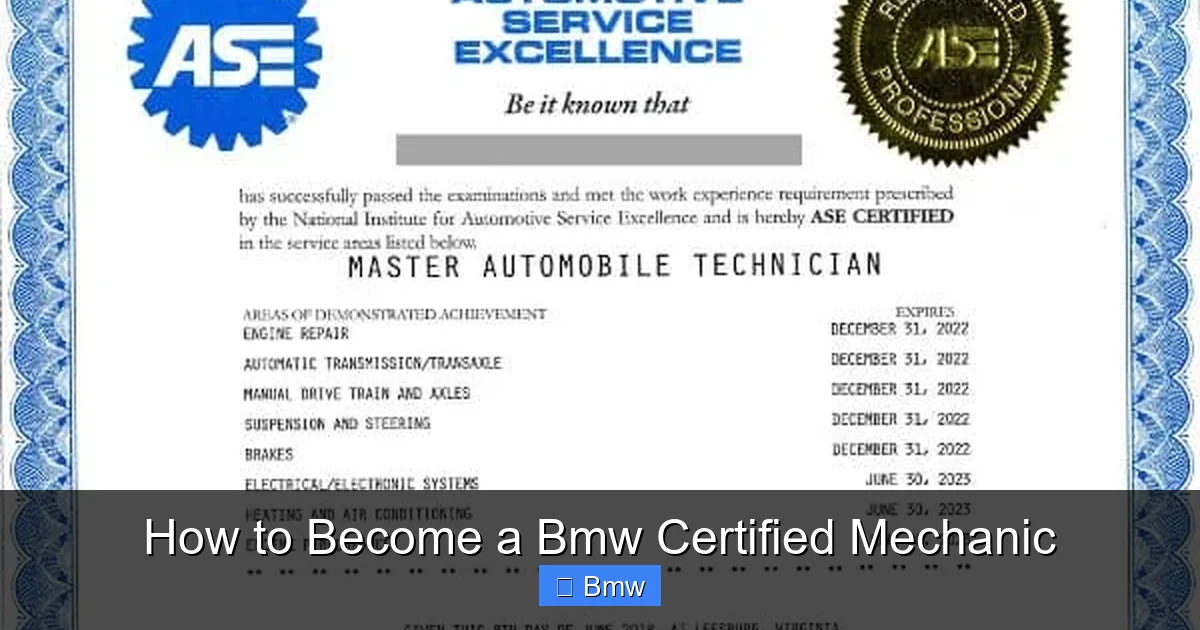
The National Institute for Automotive Service Excellence (ASE) is the industry’s gold standard for general competency. Before a manufacturer like BMW will consider you for their advanced training, you must pass at least the A1 (Engine Repair), A2 (Automatic Transmission/Transaxle), A4 (Suspension and Steering), A5 (Brakes), A6 (Electrical/Electronic Systems), and A8 (Engine Performance) tests. These are rigorous, multiple-choice exams that test your theoretical knowledge. You must have at least one year of hands-on experience (often gained during your post-secondary program’s internship) to qualify to take the tests. Achieving this ASE Master Technician status is a powerful resume item and a mandatory gateway.
The Core Pathway: The BMW STEP Program
With your education and ASE certifications in hand, you enter the primary gateway to becoming a BMW certified mechanic: the BMW Service Technician Education Program (STEP). This is not an online course. It is an immersive, factory-controlled training regimen.

Visual guide about How to Become a Bmw Certified Mechanic
Image source: jobdescriptionandresumeexamples.com
What is the STEP Program?
STEP is a two-year program that blends structured classroom and lab learning with paid, hands-on internship experience at a sponsoring BMW dealership. It’s essentially an apprenticeship model endorsed by BMW of North America. You are not just learning theory; you are applying it daily under the supervision of a master technician at a real dealership.
Structure and Curriculum
The program is divided into modules that mirror BMW’s vehicle systems:
- Engine & Drivetrain: Deep dives into BMW’s turbocharged engines (like the B48, B58), ZF and Getrag transmissions, and the specifics of their all-wheel-drive systems.
- Electrical & Electronics: This is huge. You’ll learn BMW’s proprietary CAN bus systems, circuit diagnostics using factory scanners (like the ISTA), and troubleshooting complex comfort and convenience features.
- Chassis & ADAS: Training on BMW’s multi-link suspensions, Dynamic Damper Control, and the suite of Advanced Driver Assistance Systems (ADAS) like Driving Assistant Professional, which requires precise calibration.
- Body & Special Tools: Instruction on aluminum repair techniques, proper use of BMW-specific tools (which are often expensive and specialized), and safety systems like seat belt pretensioners and airbags.
How to Get Into STEP
Admission is competitive. You must:
- Apply Directly: You apply through the BMW Group’s official career portal or through participating dealerships.
- Meet Prerequisites: Hold a high school diploma or GED, have completed an accredited automotive program, and possess your ASE certifications.
- Interview & Assessment: Selected candidates undergo interviews and may take aptitude tests to gauge mechanical reasoning and problem-solving skills.
- Secure a Sponsoring Dealership: Often, the most critical step. A BMW dealership must agree to sponsor you—hiring you as an apprentice technician and providing the on-the-job training component. Networking, applying directly to dealership service departments, and attending job fairs are key.
Once accepted, your life becomes a balance of dealership work (40+ hours per week) and periodic, intensive training blocks at BMW’s regional training centers. You are paid an apprentice wage that increases as you progress.
Alternative and Supplemental Training Paths
While STEP is the most direct route, it’s not the only one. The landscape of becoming a BMW certified mechanic has a few other valid paths.
BMW FastTrack Program
For individuals who already have significant general mechanic experience (often 2+ years) and strong ASE credentials, BMW offers the FastTrack program. This is an accelerated, full-time training program held at BMW training centers. It compresses much of the STEP curriculum into a shorter, more intense period, typically followed by a placement at a dealership. It’s designed for career-changers or experienced techs from other brands.
Independent Shop Training & Manufacturer-Sponsored Courses
Some large, reputable independent repair shops that specialize in European cars have relationships with BMW and can send their technicians to official BMW training courses on specific systems (e.g., a week-long course on iDrive retrofits or N63 engine diagnostics). If you work at such a shop and your employer pays for it, you can achieve system-specific certifications. However, this path is less comprehensive than STEP and may not carry the full “BMW Certified” dealership designation unless you complete the full suite.
The Importance of Continuous Education
Regardless of your initial path, learning never stops. BMW releases new models and technologies constantly. To maintain your certified status, you must complete annual recertification requirements and take courses on new systems as they are introduced. This is often managed through the dealership’s training department. A commitment to lifelong learning is part of the job description.
Beyond the Wrench: The Business of Being a BMW Mechanic
Earning the certification is the technical hurdle. Building a successful career requires more.
Networking and Professional Development
Join professional organizations like the Automotive Service Association (ASA) or local BMW owner club tech sessions. Attend industry trade shows (like SEMA or local dealer events). These are invaluable for learning about new tools, parts, and techniques, and for making connections that can lead to job opportunities. Sometimes, knowing the service manager at the local BMW dealership is more valuable than any certification.
Tooling and Investment
Be prepared to invest in your tools. A BMW certified mechanic is expected to have their own hand tools. Furthermore, BMW-specific diagnostic tools (like the latest ISTA+) are extremely expensive, often costing thousands of dollars. While dealerships provide the main diagnostic computers, you will need to build a high-quality personal toolset, which can be a $10,000-$20,000 investment over time. This is a significant, but expected, part of the profession.
Understanding the Dealership vs. Independent Shop Dynamic
Most BMW certified mechanics work at dealerships, where the pay and benefits are typically best, and you get the newest models and full factory support. However, top-tier independent European repair shops also value and pay for BMW expertise, sometimes offering more variety in repair work and less pressure to meet sales goals on service. Your choice depends on your preference for structure vs. variety. If you’re interested in the independent route, seeking out shops that are members of the BMW Car Club of America’s recommended list is a great start.
Your Future as a BMW Certified Mechanic: Career Trajectory
So, you’ve survived the schooling, aced the ASEs, crushed the STEP program, and are now a fully certified BMW technician. What’s next?
The Ladder: Technician to Master
Dealerships have clear career ladders. You’ll typically start as an Apprentice Technician or Associate Technician. With experience and demonstrated skill, you become a Senior Technician, then a Master Technician. At the master level, you handle the most complex diagnostics, mentor apprentices, and may have input on technical bulletins. Some master technicians eventually move into Service Advisor roles, Shop Foreman positions, or even Service Manager roles, which shift from wrenches to management.
Specialization: Becoming the Go-To Expert
Given the breadth of BMW technology, many certified mechanics develop deep specialties. You might become the shop’s expert on:
- Hybrid & Electric Powertrains: With BMW’s expanding i-series and plug-in hybrids, this is a high-demand specialty.
- Advanced Driver Assistance Systems (ADAS): Calibrating radar, camera, and sensor systems requires precision and specific training.
- Performance & M Models: Working on high-output engines, M-specific suspensions, and track-focused variants.
- Classic BMW Restoration: A niche but passionate field for vintage air-cooled and E30/E36 era models.
Specializing can dramatically increase your value and hourly rate.
Entrepreneurship: Opening Your Own Shop
The ultimate goal for some is ownership. A BMW certified mechanic with a stellar reputation and deep experience can open a highly successful independent shop. The barriers are high (startup costs, liability, marketing), but the reward is complete autonomy and the potential for significant profit. Many successful shop owners first put in 10-15 years at a dealership to learn the business inside and out. If you dream of this, also spend time learning about business management, parts inventory, and customer service.
Conclusion: The Commitment to the Ultimate Driving Machine
Becoming a BMW certified mechanic is not a shortcut. It is a deliberate, multi-year investment in your skills, your tools, and your professional reputation. It starts in the classroom, is forged in the dealership service bay, and is maintained through a lifetime of learning. The path demands a blend of theoretical knowledge, manual dexterity, electronic savvy, and a temperament for precision.
But for those who undertake it, the payoff is immense. You gain entry into an elite tier of the automotive world. You solve problems that stump other technicians. You earn the trust of BMW owners who view their cars not just as transportation, but as an extension of their passion. You become a guardian of engineering excellence. If you’re ready for that challenge, start by researching accredited automotive programs in your area and begin building your ASE portfolio. The world of BMW awaits your expertise.
Frequently Asked Questions
How long does it take to become a BMW certified mechanic?
From starting an automotive program to completing BMW STEP and becoming fully certified typically takes 3 to 4 years. This includes 1-2 years for a degree/certificate, time to pass ASE tests, and the 2-year BMW STEP apprenticeship program.
How much does BMW STEP training cost?
The BMW STEP program itself is typically free to the apprentice, as it is employer-sponsored. You are paid an apprentice wage by the dealership that sponsors you. However, you are responsible for your own living expenses and the cost of your personal hand tool set, which is a significant investment.
Can I become BMW certified without going through the STEP program?
Yes, but it’s more challenging. You can gain general experience, achieve all ASE certifications, and then apply for jobs at a BMW dealership. From there, the dealership may sponsor you for BMW-specific factory training courses on an as-needed basis. However, you will not have the comprehensive, structured credential that the full STEP program provides, which may limit your initial career progression and pay.
What is the average salary for a BMW certified mechanic?
Salaries vary widely by location, experience, and dealership. Entry-level BMW STEP graduates often start between $45,000 and $55,000 annually. With 5+ years of experience as a certified technician, especially with specialization, salaries of $70,000 to $90,000+ are common at top dealerships. Master technicians and shop foremen can exceed $100,000.
Do I need a college degree to become a BMW certified mechanic?
A formal degree from an accredited automotive program is a mandatory prerequisite for entering the BMW STEP program. While a few exceptional technicians with extensive, verifiable experience might find alternative paths, a degree or certificate from a recognized school is the standard, expected, and most reliable entry point.
Is BMW certification recognized internationally?
BMW STEP certification is primarily recognized and valid within the BMW dealership network in North America. The skills are certainly transferable, but if you move to Europe or Asia, you would need to go through BMW’s regional training programs for that market to work at an official dealer. The foundational ASE and technical skills, however, are globally respected.