How Often Should Spark Plugs Be Changed on a Toyota Corolla?

Contents
- 1 Key Takeaways
- 2 📑 Table of Contents
- 3 Understanding Spark Plugs: The Heart of Your Corolla’s Combustion
- 4 Toyota’s Official Recommendations: What Does the Manual Say?
- 5 Factors That Influence Spark Plug Lifespan
- 6 Warning Signs Your Spark Plugs Need Attention
- 7 The Replacement Process: DIY or Professional?
- 8 Beyond Replacement: Maintenance Tips for Maximizing Spark Plug Life
- 9 Conclusion: A Small Part, A Big Impact
- 10 Frequently Asked Questions


The spark plug change interval for a Toyota Corolla typically ranges from 30,000 to 100,000 miles, depending entirely on the type of plugs installed. Copper spark plugs usually need replacement around 30,000 miles, while long-life iridium or platinum plugs can last up to 100,000 miles. Always consult your owner’s manual for your specific model year and engine type, as this is the most reliable source. Ignoring worn spark plugs leads to poor fuel economy, misfires, and potential engine damage, making regular inspection and timely replacement crucial for your Corolla’s health and performance.
Key Takeaways
- The interval varies dramatically by plug material: Copper plugs (~30k miles), platinum (~60k miles), and iridium (~100k miles) have vastly different lifespans.
- Your owner’s manual is the ultimate authority: Toyota’s factory recommendation for your specific Corolla model year and engine is the first place to look.
- Symptoms often appear before the mileage limit: Rough idle, poor acceleration, decreased fuel economy, and check engine lights can signal it’s time for new plugs.
- Use OEM or equivalent quality plugs: The correct heat range and gap are critical; cheap, incorrect plugs can cause serious engine damage.
- Replace all plugs at once and as a set: Plugs wear evenly; replacing only one or two leads to uneven engine performance and is a false economy.
- DIY is feasible but requires care: With basic tools and the right procedure (know how to open the hood safely), you can save money, but torque specifications are vital.
- Neglecting plugs harms more than performance: Fouled plugs can damage ignition coils, waste fuel, increase emissions, and eventually harm the catalytic converter.
📑 Table of Contents
- Understanding Spark Plugs: The Heart of Your Corolla’s Combustion
- Toyota’s Official Recommendations: What Does the Manual Say?
- Factors That Influence Spark Plug Lifespan
- Warning Signs Your Spark Plugs Need Attention
- The Replacement Process: DIY or Professional?
- Beyond Replacement: Maintenance Tips for Maximizing Spark Plug Life
- Conclusion: A Small Part, A Big Impact
Understanding Spark Plugs: The Heart of Your Corolla’s Combustion
Imagine your Toyota Corolla’s engine as a complex dance of controlled explosions. Thousands of times every minute, a precise mixture of air and fuel must be ignited at the exact right moment to create the power that moves your car. The tiny, unassuming component responsible for creating that crucial spark is the spark plug. It’s a simple part with a monumental job, sitting in the combustion chamber of each cylinder, withstanding extreme heat and pressure. If a spark plug fails to fire correctly or fires at the wrong time, that perfect dance becomes a stumbling mess, leading directly to the problems you feel and see—rougher running, worse gas mileage, and that dreaded check engine light. Understanding what spark plugs do is the first step to knowing why their maintenance schedule is non-negotiable for a reliable Corolla.
The Anatomy of a Spark Plug
While designs vary, every spark plug has core components. The metal shell threads into the engine’s cylinder head, creating a seal. Inside, a central electrode is connected to the ignition coil’s high-voltage output. This electrode is insulated from the shell by a ceramic core, which prevents the high voltage from taking a shortcut. At the bottom tip, a ground electrode (or multiple electrodes in some designs) creates a precise gap with the central electrode. It’s across this tiny gap—measured in thousandths of an inch—that the electrical arc must jump to create the spark. The material used for these electrodes (copper, platinum, iridium) is the primary factor determining how long that gap remains correctly sized before wearing out.
Why Wear and Tear Happens
Every time your Corolla’s engine runs, each spark plug fires. That’s millions of ignition events over its life. The spark itself slowly erodes the electrode material. The extreme heat cycles—from ambient temperature to thousands of degrees Fahrenheit during combustion—cause thermal expansion and contraction, stressing the materials. Combustion byproducts and fuel additives can also cause deposits to form on the plug tip, fouling it. All these factors gradually widen the electrode gap. A wider gap requires more voltage from the ignition coil to create a spark. Eventually, the coil can’t provide enough voltage, or the plug shorts out against a deposit, leading to a mis-fire. The plug’s “service life” is simply how long it takes for this wear to exceed the manufacturer’s specifications for reliable operation.
Toyota’s Official Recommendations: What Does the Manual Say?
Forget generic internet advice for a moment. The single most important document for your Corolla’s specific maintenance needs is sitting in your glove compartment: the owner’s manual. Toyota engineers the engine and its components as a complete system. They test thousands of engines under brutal conditions to determine the realistic service life of every part, including the spark plugs. Their recommendation is based on the specific engine code in your Corolla and the type of spark plugs they installed at the factory. This is not a suggestion; it’s a critical maintenance interval designed to ensure your engine meets its performance, emissions, and longevity targets.

Visual guide about How Often Should Spark Plugs Be Changed on a Toyota Corolla?
Image source: guidemechanic.com
Decoding Your Corolla’s Manual
Open your manual to the “Scheduled Maintenance” or “Maintenance Interval” section. You’ll find a mileage-based chart. Look for the entry for “Spark Plugs” or “Ignition System.” It will list a mileage interval, such as “60,000 miles” or “100,000 miles.” Crucially, it will also often specify the type of plug required, like “Iridium” or “Platinum.” If your manual is missing, you can often find a digital version on the Toyota owner’s portal website by entering your Vehicle Identification Number (VIN). This VIN-specific information is gold. For example, a 2020 Corolla with the 2.0L Dynamic Force engine likely has a 100,000-mile interval for its iridium plugs, while a 2010 Corolla with the 1.8L engine might call for 30,000-mile intervals if it still has original copper plugs.
Model Year and Engine Variations
The Corolla has been in production for decades with numerous engines. The current generation (from around 2018 onward) primarily uses the 1.8L and 2.0L “Dynamic Force” engines, which are almost exclusively equipped with long-life iridium spark plugs from the factory, with intervals often set at 120,000 miles for severe service or 100,000 miles for normal service. Earlier models, like the popular 2009-2013 Corolla with the 1.8L 1ZR-FE engine, often came with platinum plugs with a 60,000-mile interval. Some base-model Corollas from the early 2000s might have used standard copper plugs needing a 30,000-mile change. If you don’t know your engine type, you can find it on a sticker under the hood or in your manual. To know exactly how many spark plugs you’re dealing with, you can reference a guide on how many spark plugs are in a Toyota Corolla, as most are 4-cylinder engines with four plugs, but some older V6 models existed.
Factors That Influence Spark Plug Lifespan
While the manufacturer’s interval is your baseline, real-world driving conditions can significantly shorten or, in rare cases, extend a spark plug’s life. Understanding these factors helps you decide if you should stick to the schedule or inspect/replace earlier. Think of it as your driving “environment” putting additional stress on those little ceramic and metal components.
Visual guide about How Often Should Spark Plugs Be Changed on a Toyota Corolla?
Image source: guidemechanic.com
Driving Conditions: Severe vs. Normal Service
Automakers define “normal” and “severe” service schedules. Most Corolla owners fall into the severe category, meaning more frequent service. Severe service includes: frequent short trips (where the engine never fully warms up, allowing fuel to wash oil off cylinder walls and potentially foul plugs), extensive idling (like in traffic jams or for police/taxi use), driving in extremely hot or cold climates, and operating in dusty, sandy, or high-humidity environments. If your Corolla is mostly used for commuting with a long highway cruise, it might experience “normal” service. However, for the average driver, adhering to the more conservative “severe service” interval listed in the manual is a wise precaution. If your daily drive involves lots of stop-and-go city traffic, consider checking your plugs a few thousand miles before the scheduled interval.
Fuel Quality and Additives
The quality of gasoline you put in your Corolla matters more than you might think. Lower-tier fuels with fewer detergent additives can lead to increased carbon buildup on the spark plug tip, causing fouling. This is especially true for direct-injection engines (like many modern Corollas), which are more prone to carbon deposits on intake valves. Using top-tier rated fuels can help keep combustion chambers cleaner. Similarly, using fuel additives that claim to “clean” your engine can sometimes help, but be wary of products that promise dramatic results. Consistent use of poor-quality fuel will accelerate spark plug wear and could lead to mis-fires long before the mileage limit.
Engine Health and Tune-Up History
A well-tuned engine is a happy engine for spark plugs. If your Corolla has an underlying issue—like a leaking fuel injector that delivers too much fuel (running “rich”), a faulty oxygen sensor providing incorrect air/fuel ratio data, or low compression due to worn rings—it creates a combustion environment that is hostile to spark plugs. A rich-running engine will quickly foul plugs with soot. An engine burning oil (due to worn valve guides or piston rings) will coat plugs with oily ash. If your Corolla has had a persistent check engine light for issues like these and you haven’t addressed the root cause, new spark plugs will just get ruined again quickly. Always diagnose and fix engine performance problems before installing a new set of plugs.
Warning Signs Your Spark Plugs Need Attention
While you should never wait for symptoms to appear before following your maintenance schedule, your Corolla will often give you clear hints that its spark plugs are worn out or fouled. These symptoms are your car’s way of asking for help, and ignoring them can lead to progressively worse damage and higher repair bills. Paying attention to these signs is a critical part of proactive car ownership.

Visual guide about How Often Should Spark Plugs Be Changed on a Toyota Corolla?
Image source: img.toyotask.com
The Classic Symptoms: Misfire and Roughness
The most common and noticeable sign is an engine misfire. This feels like a stumble, hesitation, or vibration, especially when accelerating from a stop or under load. You might hear a popping or coughing sound from the exhaust. A single cylinder mis-firing will cause a distinct shake at certain RPMs. On modern Corollas, the Engine Control Unit (ECU) is incredibly sensitive and will detect even a minor mis-fire. This will almost certainly trigger the check engine light to illuminate. The stored diagnostic trouble code (like P0300 for random/multiple cylinder mis-fire or P0301-P0304 for a specific cylinder) points directly to the problem area. If you see this light, a quick scan is essential. Sometimes, resetting the light after replacing the plugs solves the issue, but you can learn about the proper procedure for how to reset the check engine light on a Toyota Corolla once the repair is complete.
Performance and Efficiency Decline
Worn spark plugs don’t just cause roughness; they sabotage your Corolla’s core strengths: fuel efficiency and smooth power delivery. As the electrode gap widens, the spark becomes weaker. The ECU may try to compensate by adding more fuel, leading to a noticeable drop in miles per gallon. You might find yourself pressing the accelerator pedal further to achieve the same level of acceleration. The car feels “sluggish” or “unresponsive.” This is because incomplete combustion is wasting potential power. In extreme cases, you might experience the engine stalling when coming to a stop. While other issues like dirty fuel injectors or a clogged air filter can cause similar symptoms, worn plugs are a prime suspect, especially if the car is high-mileage and hasn’t had a plug service recently.
Visual Inspection: What to Look For
If you’re comfortable with basic maintenance, removing and inspecting one spark plug can tell you volumes. After carefully removing a plug (remembering to use the correct socket and not overtighten it upon reinstallation), examine the tip. A good plug will have a light tan or gray-colored insulator nose. Fouled with soot (black, dry carbon) indicates a rich fuel mixture or possibly weak ignition. Oily or wet fouling suggests oil is entering the combustion chamber, pointing to worn valve seals or piston rings. White, blistered, or melted appearance means the engine is running extremely hot, possibly from an incorrect heat range plug or an overheating issue. Severely eroded or gap-worn electrodes are the obvious sign of a plug at the end of its life. Even if you don’t see obvious damage, if the gap is significantly larger than the specification (found in your manual), it’s time for replacement.
The Replacement Process: DIY or Professional?
Once you’ve determined it’s time for new spark plugs, the next decision is who installs them. For the Toyota Corolla, this is one of the more accessible major maintenance items for a competent DIYer, but it’s not without its pitfalls. Weighing the cost savings of DIY against the risk of improper installation is key.
The Case for Professional Service
Taking your Corolla to a trusted mechanic or dealership offers peace of mind. Professionals have the correct tools (torque wrenches, spark plug sockets with built-in rubber seals to protect the ceramic), experience with your specific engine’s layout, and the knowledge to diagnose any underlying issues that might have caused premature plug wear. They will also perform a full inspection of related components: ignition coils, wires (if equipped), and the intake system. The labor cost is the main downside, but you’re paying for expertise and a warranty on the work. This is the safest route, especially if you’re not comfortable working under the hood or if your Corolla has a transverse-mounted engine where access is tight.
DIY: A Feasible Project for the Enthusiast
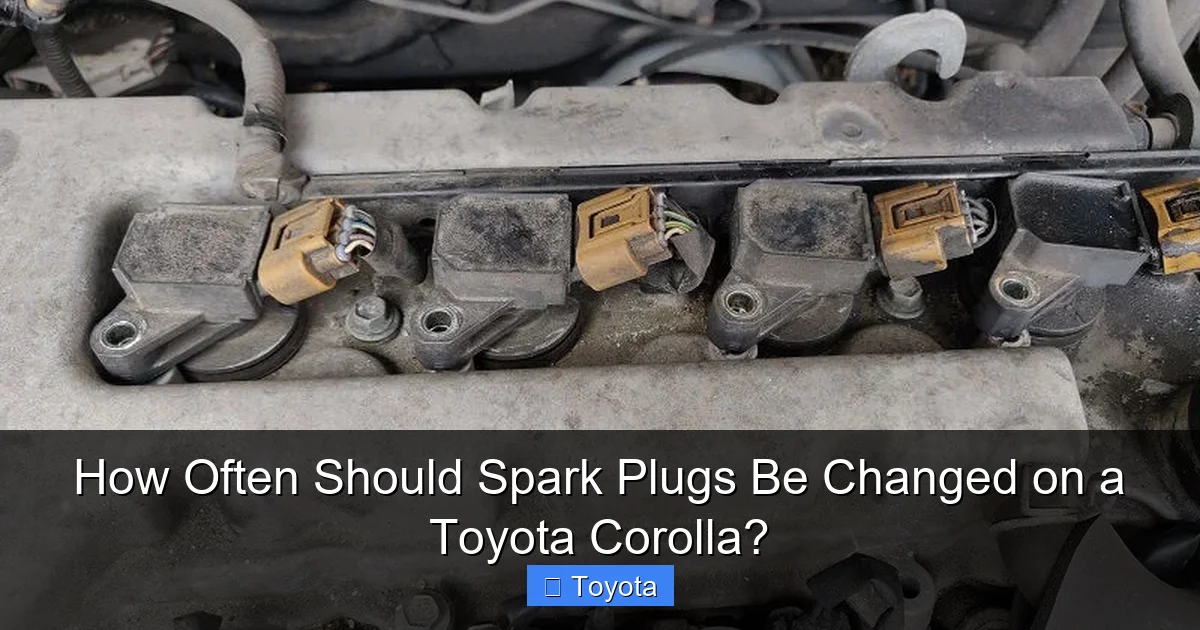
For the handy car owner, replacing spark plugs on a Corolla is a rewarding project. You’ll need a good set of spark plug sockets (often with a built-in rubber boot to hold the plug), a torque wrench (absolutely critical), a ratchet, extensions, and possibly a swivel socket for hard-to-reach rear plugs. The general process is:
- Ensure the engine is cool.
- Carefully disconnect the ignition coil electrical connectors.
- Remove the coil assembly or boot (depending on design).
- Blow out any debris from around the plug hole with compressed air to prevent dirt falling into the cylinder.
- Remove the old plug with the socket.
- Check and set the gap on the new plug to the manufacturer’s specification using a gap tool.
- Carefully install the new plug by hand to avoid cross-threading, then torque it to the exact specification (usually between 13-18 lb-ft for many Corollas, but VERIFY).
- Reinstall the coil and reconnect.
- Repeat for all cylinders.
The biggest DIY risks are over-torquing (cracking the ceramic insulator) or under-torquing (causing a leak or plug ejection). If you’re unsure at any point, seeking professional help is cheaper than a damaged cylinder head.
Parts Selection: OEM vs. Aftermarket
Do not skimp here. Use spark plugs that meet or exceed Toyota’s specifications. The “heat range” (how quickly the plug dissipates heat) is engineered specifically for your engine. A plug with a hotter heat range can cause pre-ignition; a colder one can foul. For most Corolla owners, sticking with genuine Toyota plugs or high-quality brands like Denso (which is an OEM supplier for Toyota) or NGK is the best strategy. These brands offer direct-fit replacements with the correct pre-set gap for your application. Avoid generic, no-name plugs. When in doubt, use the part number listed in your owner’s manual or from a reputable online parts catalog for your exact VIN.
Beyond Replacement: Maintenance Tips for Maximizing Spark Plug Life
Changing spark plugs at the correct interval is the core of the maintenance, but it doesn’t exist in a vacuum. How you care for your Corolla’s entire engine and fuel system directly impacts how long those new plugs will last. Think of it as creating a healthy ecosystem for your combustion chambers.
Air Filter Cleanliness is Crucial
A clogged engine air filter starves your engine of clean air. This causes the engine to run richer (more fuel, less air) to compensate. That rich mixture leads to carbon deposits on the spark plugs, causing them to foul prematurely. It’s a simple, cheap part that has an outsized impact. Check your air filter at every oil change and replace it according to the severe service schedule in your manual (often every 15,000-30,000 miles). A clean air filter ensures the correct air/fuel ratio, keeping plugs cleaner for longer.
Fuel System Health Matters
As mentioned, fuel quality and injector performance are huge. Over time, fuel injectors can get slightly clogged, causing them to spray fuel less atomized and in a less precise pattern. This can lead to pockets of richer mixture that foul the nearby spark plug. Using a quality fuel system cleaner periodically (according to product directions) can help maintain injector cleanliness. For higher-mileage Corollas, a professional fuel injector cleaning service might be beneficial. Consistent use of top-tier gasoline is your first line of defense.
Don’t Ignore Other Related Components
The ignition system is a chain: battery -> ignition coil -> spark plug wire/terminal -> plug. A failing ignition coil that produces a weak or intermittent spark will cause the plug to wear faster and may cause mis-fires. If you’re replacing plugs and one coil is failing (often indicated by a specific cylinder mis-fire code), it’s cost-effective to replace that coil at the same time to ensure the new plug gets proper voltage. Also, ensure the plug wire terminals (if your Corolla uses them; many modern models have coil-on-plug designs) are clean and making solid contact. Corrosion here can impede spark delivery.
Regular Engine Inspections
Make a habit of checking your engine oil level and condition. Very dark, sludgy oil can indicate poor combustion or infrequent oil changes, which contributes to overall engine grime. Look for any obvious leaks—oil or coolant—under the car or in the engine bay. Coolant leaks into a cylinder (from a leaking head gasket) can wash away plug insulation and cause immediate, catastrophic failure. Catching these larger issues early protects all your engine’s components, including the expensive catalytic converter, which can be destroyed by prolonged mis-firing caused by bad plugs.
Conclusion: A Small Part, A Big Impact
In the grand scheme of your Toyota Corolla’s maintenance, spark plugs represent a relatively inexpensive component with an immense responsibility. Their timely replacement is not just about avoiding a rough idle; it’s about preserving the fundamental health of your engine. By adhering to the manufacturer’s interval—whether that’s 30,000 miles for older copper plugs or 100,000+ miles for modern iridium ones—you ensure optimal combustion. This translates directly to the famous Corolla reliability, strong fuel economy, low emissions, and smooth, confident acceleration you expect. Ignoring this service is a classic case of “penny-wise, pound-foolish,” where a $50-$150 set of parts and an hour of labor can prevent thousands in damage to coils, sensors, and the catalytic converter. Make checking your spark plug interval a regular part of your maintenance checklist. When the time comes, whether you choose a professional or the DIY route, use quality parts and follow procedures precisely. Your Corolla’s engine, and your wallet, will thank you for it in the long run.
Frequently Asked Questions
What happens if I don’t change my Toyota Corolla’s spark plugs on time?
Delaying spark plug replacement leads to progressively worse engine misfires, significantly reduced fuel economy, and increased harmful emissions. Eventually, the failing plugs can overwork and damage the ignition coils, and unburned fuel can wash oil from cylinder walls or overheat and destroy the catalytic converter, leading to very costly repairs.
Can I use any brand of spark plug in my Toyota Corolla?
No, you should always use spark plugs that meet Toyota’s exact specifications for heat range and design. Using an incorrect plug can cause pre-ignition, fouling, or engine damage. Stick with genuine Toyota parts or high-quality brands like Denso or NGK that are known OEM suppliers and provide the correct pre-gapped plug for your specific engine code.
How can I tell if my spark plugs are bad without taking them out?
>Look for symptoms like a persistent check engine light (often with codes P0300-P0304), a rough or vibrating idle, noticeable hesitation or lack of power when accelerating, and a sudden drop in fuel economy. While these point to spark plug issues, they can also indicate other problems, so a proper diagnosis is recommended.
Is it difficult to change the spark plugs on a Toyota Corolla myself?
For most Corolla model years with 4-cylinder engines, it’s a moderately difficult DIY task. The main challenges are accessing the rear plugs on transverse-mounted engines and using a torque wrench correctly to avoid over- or under-tightening. If you have basic mechanical skills, the right tools, and careful patience, it’s very doable. If you’re uncomfortable, a professional service is a good investment.
Should I replace the ignition coils when I change the spark plugs?
Not necessarily as a rule, but it’s a smart preventive measure on higher-mileage Corollas (e.g., over 100,000 miles). If your coils are original and you’re at the plug service interval, replacing them proactively can prevent future mis-fires and save on labor costs since the coils are already off. If a specific coil is throwing a trouble code, replace that one immediately.
Do I need to gap my new spark plugs before installation?
Most modern spark plugs come pre-gapped from the factory for your specific application and should not need adjustment. However, it’s a critical best practice to verify the gap with a feeler gauge before installation. Manufacturing tolerances and shipping can sometimes affect the gap. Always check your owner’s manual for the exact gap specification and adjust gently if needed. Never force the gap by prying on the center electrode.