How Often Should I Change Oil in a 2015 Toyota Camry?

Contents
- 1 Key Takeaways
- 2 📑 Table of Contents
- 3 Understanding Toyota’s Official Recommendation
- 4 The Reality of “Severe” or “Special” Operating Conditions
- 5 Your Camry’s Best Friend: The Oil Maintenance Light
- 6 Synthetic vs. Conventional Oil for Your 2015 Camry
- 7 Professional Change vs. The DIY Route
- 8 The High Cost of Neglect: What Happens If You Wait Too Long?
- 9 Creating Your Personal Oil Change Schedule
- 10 Frequently Asked Questions

Brake Cleaner Spray

Car Neck Pillow

Anti-Slip Dashboard Mat

Anti Rust Spray
For a 2015 Toyota Camry, the official recommendation is an oil change every 10,000 miles or 12 months when using 0W-20 synthetic oil. However, this interval can be shorter if you frequently drive in severe conditions like stop-and-go traffic, extreme temperatures, or tow heavy loads. Always prioritize your vehicle’s specific Oil Maintenance Light, which calculates real-time engine wear. Following these guidelines is critical for maintaining your Camry’s renowned reliability and fuel efficiency.
So, you’re the proud owner of a 2015 Toyota Camry. Excellent choice. This model year solidifies the Camry’s reputation as a reliable, comfortable, and efficient family sedan. But to keep that smooth, quiet ride and that legendary Toyota durability running for another 200,000 miles, there’s one non-negotiable ritual: the oil change. The big question everyone asks is, “How often?” The answer isn’t just a simple number from a manual; it’s a conversation between you, your car, and the way you drive. Let’s break down everything you need to know about the 2015 Toyota Camry oil change schedule, from factory specs to real-world driving, so you can protect your engine with confidence.
Key Takeaways
- Toyota’s Official Guideline: For the 2015 Camry with 0W-20 synthetic oil, the factory recommendation is 10,000 miles or 12 months, whichever comes first.
- Oil Type is Critical: This long interval only applies to synthetic oil. Using conventional oil requires changes every 5,000 miles or 6 months.
- “Severe” Driving Shortens Intervals: Frequent short trips, heavy traffic, extreme heat/cold, or dusty conditions may require changes as often as every 5,000 miles, even with synthetic oil.
- Trust the Oil Maintenance Light: Your Camry’s intelligent system calculates oil life based on engine revolutions, temperature, and driving patterns. Never ignore it.
- Never Exceed the Maximum: The 10,000-mile limit is a hard maximum under ideal conditions. Driving significantly beyond it causes accelerated engine wear.
- DIY vs. Professional: You can change the oil yourself to save money, but professional service ensures proper disposal, a multi-point inspection, and resetting the maintenance light correctly.
📑 Table of Contents
- Understanding Toyota’s Official Recommendation
- The Reality of “Severe” or “Special” Operating Conditions
- Your Camry’s Best Friend: The Oil Maintenance Light
- Synthetic vs. Conventional Oil for Your 2015 Camry
- Professional Change vs. The DIY Route
- The High Cost of Neglect: What Happens If You Wait Too Long?
- Creating Your Personal Oil Change Schedule
Understanding Toyota’s Official Recommendation
First, let’s start with the source: your owner’s manual and Toyota’s corporate guidelines. For the 2015 Camry, Toyota made a significant shift towards longer oil change intervals, but it comes with a major caveat. The official recommendation states that when the vehicle is filled with 0W-20 synthetic motor oil meeting Toyota’s genuine oil specifications, the engine oil and filter should be changed every 10,000 miles or 12 months, whichever occurs first.
This is a substantial jump from the old “every 3,000 miles” rule of thumb. This extension is possible because modern synthetic oils are engineered to resist thermal breakdown, contaminants, and viscosity loss far better than conventional oils. The 2AR-FE (2.5L 4-cylinder) and 2GR-FE (3.5L V6) engines in the 2015 Camry were designed with this longer interval in mind, using tighter tolerances and advanced engine management systems.
The “IF” in the Recommendation: Oil Specification
The keyword in that official recommendation is “0W-20 synthetic.” This is not a suggestion; it’s a requirement for achieving the 10,000-mile interval. The 2015 Camry’s engine is calibrated for this specific low-viscosity oil. Using a different grade or type of oil means you must revert to a much more traditional maintenance schedule. If you use a conventional oil (like 5W-30), you should be planning for an oil change every 5,000 miles or 6 months. This older standard still applies to many vehicles and is a safe bet if you’re unsure of your oil type. You can easily confirm what oil is in your car by checking the oil cap or dipstick; it will be clearly labeled.
The Reality of “Severe” or “Special” Operating Conditions
Here’s where the owner’s manual gets very specific, and where many drivers get confused. Toyota, like every manufacturer, defines “normal” driving very narrowly. Anything outside of that falls into “severe” or “special” operating conditions, which require more frequent oil changes, often cutting the 10,000-mile interval in half, even with synthetic oil.

Visual guide about How Often Should I Change Oil in a 2015 Toyota Camry?
Image source: team-bhp.com
What qualifies as severe? It’s a much longer list than you might think. If your driving routine includes any of the following, you should seriously consider changing your oil every 5,000 to 7,500 miles:
- Extremely Short Trips: Driving less than 5-10 miles per trip, especially in cold weather. The engine rarely gets fully warmed up, allowing fuel dilution and water vapor to contaminate the oil without burning off.
- Stop-and-Go Traffic: City driving with constant idling and low speeds creates excessive heat and sludge-forming conditions.
- Extreme Temperatures: Consistent driving in very hot (above 90°F/32°C) or very cold (below 0°F/-18°C) climates stresses oil viscosity.
- Dusty or Sandy Conditions: Off-road driving or frequent travel on unpaved roads allows abrasive particles to bypass the air filter and enter the oil.
- Towing or Heavy Loads: Regularly hauling a trailer, a large boat, or carrying heavy cargo in the trunk puts extra strain on the engine.
- Extended Idling: If your job requires you to sit in the car with the engine running for long periods (e.g., police, taxi, some sales roles).
Think about your last month of driving. If your routine looks more like “severe” than “normal,” lean towards the 5,000-7,500 mile range for your 2015 Camry. It’s a small extra cost for major long-term engine protection.
Your Camry’s Best Friend: The Oil Maintenance Light
Forget memorizing miles and dates. Your 2015 Toyota Camry has a brilliant, built-in assistant: the Oil Maintenance Light (or “Oil & Filter” indicator on the multi-information display). This is not just a reminder; it’s an algorithm. The car’s computer continuously monitors engine speed, coolant temperature, ambient air temperature, and driving patterns to calculate the actual degradation of your oil’s lubricating properties.

Visual guide about How Often Should I Change Oil in a 2015 Toyota Camry?
Image source: m.media-amazon.com
This system, often called an Oil Life Monitor (OLM), is far more accurate than a fixed interval. It understands that a 100-mile highway cruise at steady speed is very different from 100 miles of gridlock traffic. The light will illuminate when the system calculates that the oil has reached approximately 15% of its remaining useful life, giving you a comfortable window to schedule a service.
How to Check and Reset the Oil Maintenance Light
You should periodically check your oil life percentage, not just wait for the light. Here’s how:
- Turn the ignition to the “ON” position (do not start the engine).
- Use the odometer/trip meter button on the dashboard to cycle through displays until you see “Oil & Filter” or a percentage.
- The display will show the remaining oil life percentage (e.g., “100%” down to “15%”).
Crucially, after any oil change, this light MUST be manually reset. If it’s not reset, the system’s calculation is thrown off. Your mechanic should do this as part of the service. To reset it yourself: with the ignition “ON,” turn the key to “OFF,” then while pressing and holding the trip meter button, turn the key back to “ON.” Continue holding until the display blinks and resets to 100%. Always consult your owner’s manual for the exact procedure for your specific trim.
Synthetic vs. Conventional Oil for Your 2015 Camry
This is the single most important factor determining your change interval. Let’s be clear: for the 2015 Camry, synthetic oil is the specified and superior choice. But what’s the real difference?
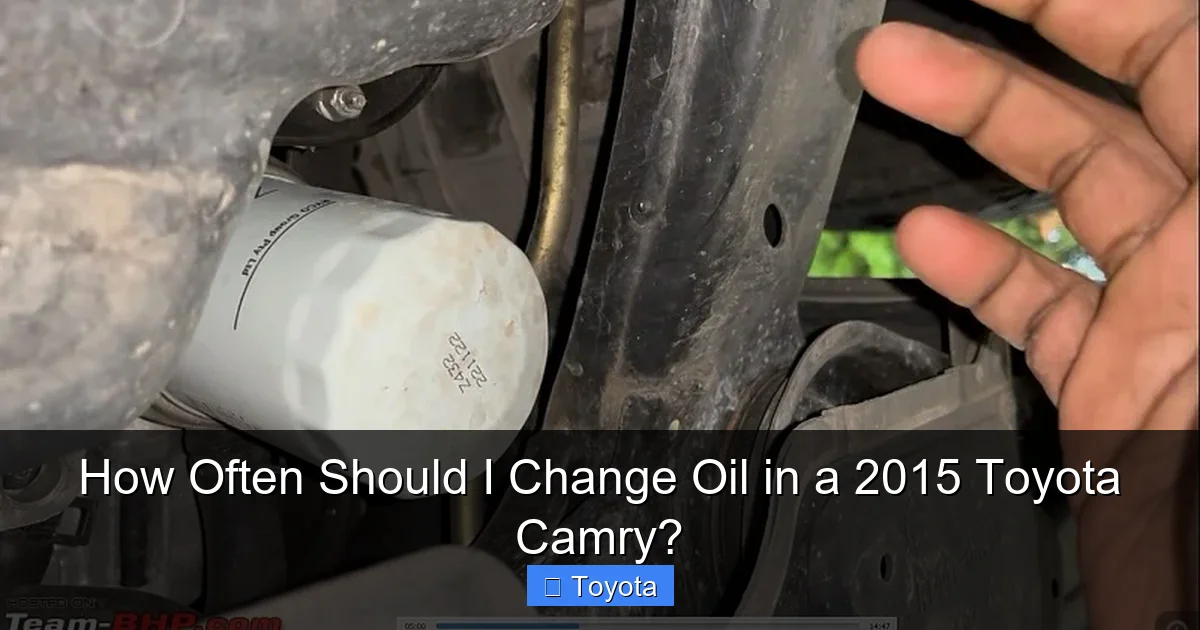
Visual guide about How Often Should I Change Oil in a 2015 Toyota Camry?
Image source: team-bhp.com
Conventional Oil: Refined from crude oil. It contains more impurities and its molecular structure is inconsistent. It breaks down faster under heat and stress. It’s less expensive per quart but requires changes every 5,000 miles/6 months. It’s acceptable for use but not optimal.
Synthetic Oil (0W-20): Man-made in a lab from a base of highly refined crude or other materials. Its molecules are uniform, pure, and designed for performance. It flows better at cold starts (the “0W” part), protects better at high temperatures, resists sludge and varnish formation, and maintains its protective properties for much longer. This is why Toyota specifies it for the 10,000-mile interval. For a deep dive into how often you should change synthetic oil in any car, the principles are very similar to what we discuss here for your Camry.
What About High-Mileage Synthetic Oil?
If your 2015 Camry has over 75,000 miles, you might see “High-Mileage” synthetic oils at the store. These are formulated with special seal conditioners and additives designed to help reduce minor oil leaks and consumption common in older engines. They are perfectly safe to use in your Camry and still meet the 0W-20 viscosity requirement. You can switch to a high-mileage formula at any time; just ensure it carries the Toyota genuine oil specification (ILSAC GF-5) and the correct viscosity. The change interval remains the same: 10,000 miles/12 months under normal conditions.
Professional Change vs. The DIY Route
Now that you know the “when,” let’s talk about the “how.” Changing the oil in a 2015 Camry is a straightforward, beginner-friendly task for those with basic mechanical skills and the right tools (socket set, oil filter wrench, drain pan, jack stands). However, before you decide, weigh the pros and cons.
DIY Pros: Significant cost savings on labor. You control the exact oil and filter brand used (use a Toyota genuine filter or a high-quality equivalent like Fram, Mobil 1, or K&N). It’s satisfying and educational.
DIY Cons: You need a safe, level workspace and to properly dispose of the used oil (most auto parts stores take it for free). There’s a risk of cross-threading the drain plug or over/under-tightening the filter, leading to leaks. You also miss out on a crucial multi-point inspection where a technician checks belts, hoses, fluid levels, tire pressure, and brakes.
Professional Service Pros: Speed and convenience (often done in under an hour). The technicians will reset your oil maintenance light correctly. They perform that vital safety inspection, catching small problems before they become big, expensive ones. They handle all waste disposal. For many, the peace of mind is worth the extra cost.
Professional Service Cons: Higher cost. You must trust the shop is using the correct oil (always verify it’s 0W-20 synthetic) and a proper filter. Some quick-lube chains may still try to upsell unnecessary services.
Our Verdict: If you’re comfortable, have the tools, and want to save money, DIY is fine. However, for most people, the professional service at a reputable independent mechanic or the Toyota dealership is the smarter, safer long-term choice for your daily driver. It’s not just about the oil; it’s about the entire health check. You can also learn how to check your oil level and percentage in a Toyota Camry yourself to monitor between changes.
The High Cost of Neglect: What Happens If You Wait Too Long?
Let’s be blunt. Ignoring the oil change schedule is like refusing to eat healthy food and exercise. The damage is slow, silent, and devastatingly expensive. Oil does three critical jobs: it lubricates, it cools, and it cleans. As it ages, it fails at all three.
Lubrication Fails: Oil thickens into sludge and loses its slippery quality. Metal-on-metal contact begins in the cylinder walls, pistons, and camshaft. This causes scoring, increased friction, and a loss of compression. The engine becomes louder, less powerful, and less fuel-efficient.
Cooling Fails: Oil carries away a significant portion of heat from the combustion chamber. Degraded oil can’t transfer heat effectively, creating localized hot spots that warp components and lead to pre-ignition (“knock”).
Cleaning Fails: The detergents in fresh oil keep microscopic metal particles and soot in suspension so they can be filtered out. Old oil stops suspending these particles. They clump together, forming abrasive sludge that clogs oil passages, starves the turbocharger (if equipped), and coats everything in a grimy layer that insulates parts from cooling oil.
The end result of severe neglect is not just a “tune-up.” It’s a catastrophic engine failure requiring a rebuild or replacement—a job that costs thousands of dollars. The $50-$100 you spend on a timely oil change is the cheapest insurance policy you can buy for your Camry’s engine. For context on the broader costs, you can research how much an oil change typically costs for various models, but for your Camry, it’s a small price to avoid a giant repair bill.
Creating Your Personal Oil Change Schedule
So, what’s the final answer for *you*? Here is a simple decision tree to create your personalized plan:
- Check Your Current Oil: Is it 0W-20 synthetic? (Check the oil cap/dipstick). If not, default to a 5,000-mile/6-month schedule.
- Assess Your Driving: Be brutally honest. Do you fall into any “severe” driving categories listed above? If yes, reduce the interval by 30-50% (e.g., aim for 5,000-7,500 miles with synthetic).
- Follow the OLM: Use your Oil Maintenance Light as your primary guide. It’s the most accurate tool you have. When it illuminates (usually at 15% life), schedule your service within the next 1-2 weeks or 500 miles.
- Set a Hard Maximum: Never, under any circumstances, exceed 10,000 miles or 12 months on a single oil change, even if the light hasn’t come on. This is your absolute ceiling.
- Document It: Keep a simple log (paper notebook or phone app) of the date, mileage, and where the service was done. This helps you track patterns and is invaluable for future owners.
For a 2015 Camry, a safe, realistic schedule for most drivers in mixed conditions is every 7,500 miles or 9 months with full synthetic 0W-20 oil. This splits the difference between Toyota’s ideal “normal” interval and the realities of “severe” driving, giving you excellent protection without being overly cautious.
Your 2015 Toyota Camry is a testament to reliable engineering. It asks for very little in return for a lifetime of service. Consistent, timely oil changes based on your actual driving habits and the car’s own intelligent feedback is the single most important thing you can do to honor that engineering. It’s the key to keeping that quiet, confident ride for years to come, ensuring your Camry remains the dependable family hauler it was meant to be. Don’t overthink it; use the oil life monitor as your guide, understand your driving style, and stick to a schedule. Your future self, and your engine, will thank you.
Frequently Asked Questions
Can I use conventional oil in my 2015 Camry instead of synthetic?
Yes, you can use conventional oil, but you must change it every 5,000 miles or 6 months. Using conventional oil voids the ability to use the extended 10,000-mile interval. Synthetic oil is strongly recommended for optimal performance and longevity.
How do I reset the oil maintenance light after an oil change?
Turn the ignition to “ON” (do not start). With the odometer display showing “Trip A,” turn the key to “OFF.” While holding the trip meter reset button, turn the key back to “ON.” Continue holding until the display blinks and resets to “100%.” Always verify the reset in your owner’s manual.
What are the first signs of engine damage from skipping oil changes?
>Early signs include increased engine noise (ticking or tapping), decreased fuel economy, a burning oil smell, blue smoke from the exhaust, and poor acceleration. These indicate significant internal wear has already occurred.
Should I use a different oil in the winter or summer?
For your 2015 Camry, always use the specified 0W-20 oil. The “0W” rating means it flows exceptionally well in cold winter starts, while the “20” provides proper protection at operating temperature. There is no need to change viscosity seasonally with this modern oil.
Do I need to change the oil filter every time I change the oil?
Absolutely yes. The oil filter’s job is to trap the metal shavings and contaminants the oil picks up. A clogged filter restricts oil flow and allows dirty oil to circulate. Always replace the filter with every oil change using a high-quality filter that meets Toyota specifications.
Is it really worth paying more for a synthetic oil change at the dealership?
The higher cost at a dealership often includes the genuine Toyota oil and filter, a rigorous multi-point inspection, and a certified technician who will correctly reset your maintenance lights. This comprehensive service can catch other minor issues early, potentially saving you money. The DIY route saves on labor but you sacrifice that expert inspection.