How Much Weight Can You Tow Without a Cdl
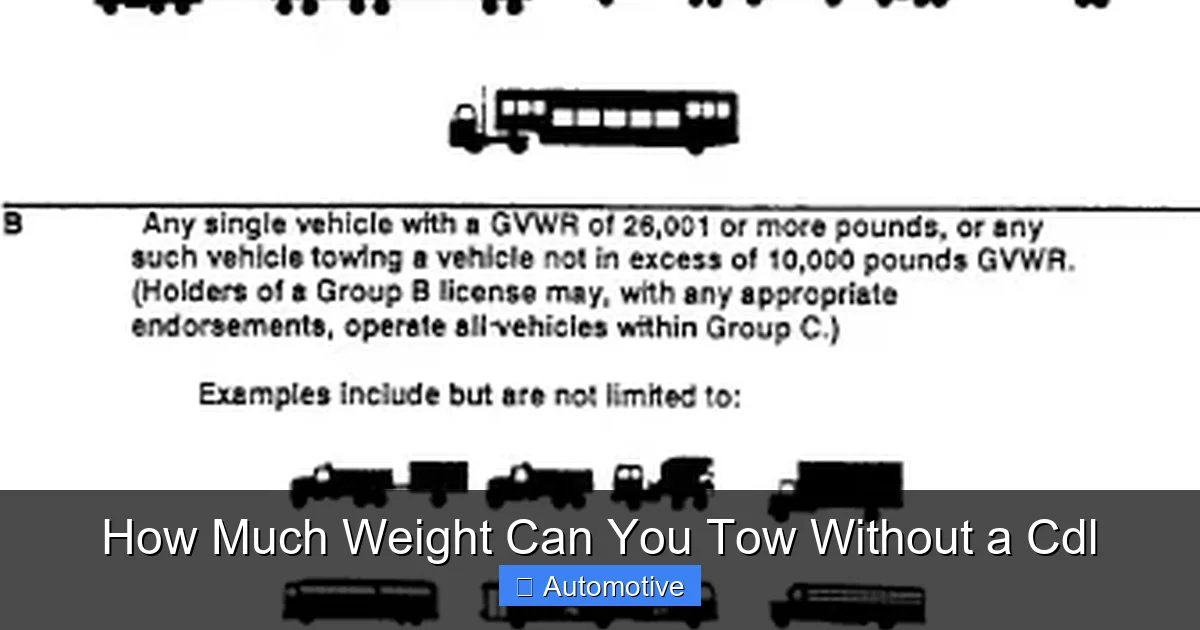
Towing without a Commercial Driver’s License (CDL) is possible—but only within strict weight and vehicle limits. Most states allow non-CDL towing up to 10,000 pounds gross vehicle weight rating (GVWR), but rules vary. Always check your state laws and vehicle specs before hitching up.
If you’ve ever dreamed of pulling a camper across the country, hauling a boat to the lake, or moving equipment for a weekend project, you’ve probably asked yourself: *How much weight can I tow without a CDL?* The good news is—you likely don’t need a Commercial Driver’s License for most everyday towing tasks. But there’s a catch: the answer isn’t one-size-fits-all. It depends on your vehicle, your trailer, where you live, and what you’re using it for.
Understanding towing limits isn’t just about convenience—it’s about safety and legality. Towing too much without the right setup can lead to loss of control, brake failure, or even legal penalties. On the flip side, staying within the rules gives you peace of mind and keeps your insurance valid. In this guide, we’ll break down everything you need to know about towing without a CDL, from federal guidelines to state-specific quirks, so you can hit the road confidently—and legally.
Whether you’re a weekend warrior, a small business owner, or just someone who likes to be prepared, knowing your towing limits empowers you to make smart decisions. We’ll cover the key terms, explain how weight ratings work, walk through real-world examples, and help you avoid common pitfalls. By the end, you’ll know exactly how much you can tow—and how to do it safely.
In This Article
- 1 Key Takeaways
- 2 📑 Table of Contents
- 3 Understanding CDL Requirements and Towing Basics
- 4 Federal vs. State Towing Laws: What You Need to Know
- 5 Weight Limits by Vehicle Type and Trailer Class
- 6 Safety Equipment and Legal Requirements for Non-CDL Towing
- 7 Common Mistakes and How to Avoid Them
- 8 When You Might Need a CDL (Even at Lower Weights)
- 9 Final Thoughts: Tow Smart, Stay Legal
- 10 Frequently Asked Questions
- 10.1 Do I need a CDL to tow a 9,000-pound trailer?
- 10.2 Can I tow a 12,000-pound trailer without a CDL?
- 10.3 What happens if I tow over the legal limit without a CDL?
- 10.4 Does my truck’s towing capacity affect CDL requirements?
- 10.5 Are there weight limits for fifth-wheel or gooseneck trailers without a CDL?
- 10.6 Can I tow for a friend’s business without a CDL?
Key Takeaways
- CDL is not required for most personal towing under 26,001 lbs GVWR: If your combined vehicle and trailer weight stays below this threshold, you typically don’t need a CDL.
- 10,000 lbs is a common safe limit for non-commercial towing: Many states allow recreational and light-duty towing up to this weight without special licensing.
- GVWR vs. actual weight matters: It’s the manufacturer-rated weight capacity (GVWR), not how much you’re actually hauling, that determines licensing needs.
- State laws differ significantly: Some states have lower thresholds or additional requirements like brake controls or safety inspections.
- Proper equipment is essential: Even without a CDL, you must use correct hitches, brakes, lights, and mirrors for safe towing.
- Commercial use changes everything: Using your vehicle to transport goods or passengers for pay often triggers CDL requirements regardless of weight.
- Always verify with your DMV: Regulations change, and local rules may apply—don’t assume federal guidelines cover everything.
📑 Table of Contents
- Understanding CDL Requirements and Towing Basics
- Federal vs. State Towing Laws: What You Need to Know
- Weight Limits by Vehicle Type and Trailer Class
- Safety Equipment and Legal Requirements for Non-CDL Towing
- Common Mistakes and How to Avoid Them
- When You Might Need a CDL (Even at Lower Weights)
- Final Thoughts: Tow Smart, Stay Legal
Understanding CDL Requirements and Towing Basics
Before diving into weight limits, it’s important to understand what a CDL actually is—and when you need one. A Commercial Driver’s License (CDL) is required in the U.S. for operating certain large or heavy vehicles, especially those used for commercial purposes. The Federal Motor Carrier Safety Administration (FMCSA) sets the baseline rules, but states can add their own layers.
So, when do you need a CDL? According to federal law, you must have a CDL if you’re driving a vehicle that meets any of these criteria:
– Has a gross vehicle weight rating (GVWR) of 26,001 pounds or more,
– Is designed to transport 16 or more passengers (including the driver), or
– Is used to haul hazardous materials in quantities requiring placarding.
Notice the key phrase: **gross vehicle weight rating (GVWR)**. This isn’t how much your truck and trailer actually weigh—it’s the maximum safe weight as determined by the manufacturer. For example, if your pickup truck has a GVWR of 8,500 lbs and you’re towing a trailer with a GVWR of 9,000 lbs, your combined GVWR is 17,500 lbs. That’s well under the 26,001 lbs threshold, so no CDL is needed.
But here’s where it gets tricky: some states consider the **actual combined weight** (GCW) instead of—or in addition to—GVWR. Others look at whether the trailer alone exceeds certain limits. And if you’re using your vehicle for business (even part-time), the rules tighten considerably.
For most personal, non-commercial towing—like pulling a travel trailer, horse trailer, or utility trailer—you won’t need a CDL as long as your total GVWR stays below 26,001 lbs. That said, many experts recommend staying under 10,000 lbs for safety and simplicity, especially if you’re new to towing.
Key Terms You Need to Know
To navigate towing regulations, you’ll need to understand a few essential terms:
– **GVWR (Gross Vehicle Weight Rating):** The maximum allowable total weight of a fully loaded vehicle, including passengers, cargo, fuel, and tongue weight. Found on the driver’s side door jamb or in the owner’s manual.
– **GCWR (Gross Combination Weight Rating):** The maximum allowable weight of a powered unit plus trailer plus load. This is set by the vehicle manufacturer and appears in your truck’s towing guide.
– **GAWR (Gross Axle Weight Rating):** The maximum weight that can be carried by a single axle. Important for ensuring even weight distribution.
– **Tongue Weight:** The downward force exerted by the trailer coupler on the hitch. Typically 10–15% of the trailer’s total weight.
– **Payload Capacity:** How much weight your truck can carry in its bed and cabin, including passengers and gear. Subtract this from GVWR to find remaining capacity.
Understanding these terms helps you calculate whether your setup is legal and safe—even without a CDL.
Federal vs. State Towing Laws: What You Need to Know
Visual guide about How Much Weight Can You Tow Without a Cdl
Image source: gocarlife.com
While federal law provides a clear threshold (26,001 lbs GVWR for CDL requirement), state laws can be more restrictive or add extra conditions. This means two drivers with identical setups might face different rules depending on whether they’re in Texas or California.
For example, in **Texas**, you can tow a trailer with a GVWR up to 10,000 lbs without a CDL—even if the combined weight exceeds 26,001 lbs—as long as it’s not for commercial use. But in **California**, any trailer over 10,000 lbs GVWR requires a non-commercial Class A license, which involves a written test and behind-the-wheel exam (though not a full CDL).
Other states, like **New York** and **Florida**, follow the federal standard closely but require additional safety equipment—such as electric brakes on trailers over 3,000 lbs or breakaway systems on heavier units. Some states also mandate periodic inspections for trailers above certain weights.
Commercial Use: The Game-Changer
One of the biggest misconceptions is that weight alone determines CDL need. In reality, **purpose matters just as much**. If you’re towing for personal use—say, hauling your ATV to a trail or pulling a camper for vacation—you’re almost always exempt from CDL requirements, even at higher weights (within reason).
But if you’re using your vehicle to transport goods or passengers for compensation—even occasionally—you may fall under commercial regulations. For instance, renting out your trailer, delivering furniture for a fee, or running a mobile food truck could trigger CDL rules, regardless of weight.
The FMCSA defines “commercial use” broadly. If your activity affects interstate commerce or generates income, it’s likely considered commercial. When in doubt, consult your state’s Department of Motor Vehicles (DMV) or a transportation attorney.
Real-World Example: Weekend Camper vs. Small Business
Imagine two scenarios:
1. **Sarah** owns a Ford F-250 (GVWR: 10,000 lbs) and tows a 7,000-lb travel trailer for weekend trips. Her combined GVWR is 17,000 lbs. She’s not paid for this—it’s purely recreational. → **No CDL needed.**
2. **Mike** uses the same truck to deliver landscaping materials to clients twice a week. His trailer GVWR is 8,000 lbs, total GVWR is 18,000 lbs. But because he’s paid for the service, his operation may be classified as commercial. → **CDL may be required**, depending on state interpretation.
This distinction highlights why understanding your use case is critical.
Weight Limits by Vehicle Type and Trailer Class
Visual guide about How Much Weight Can You Tow Without a Cdl
Image source: cdn.prod.website-files.com
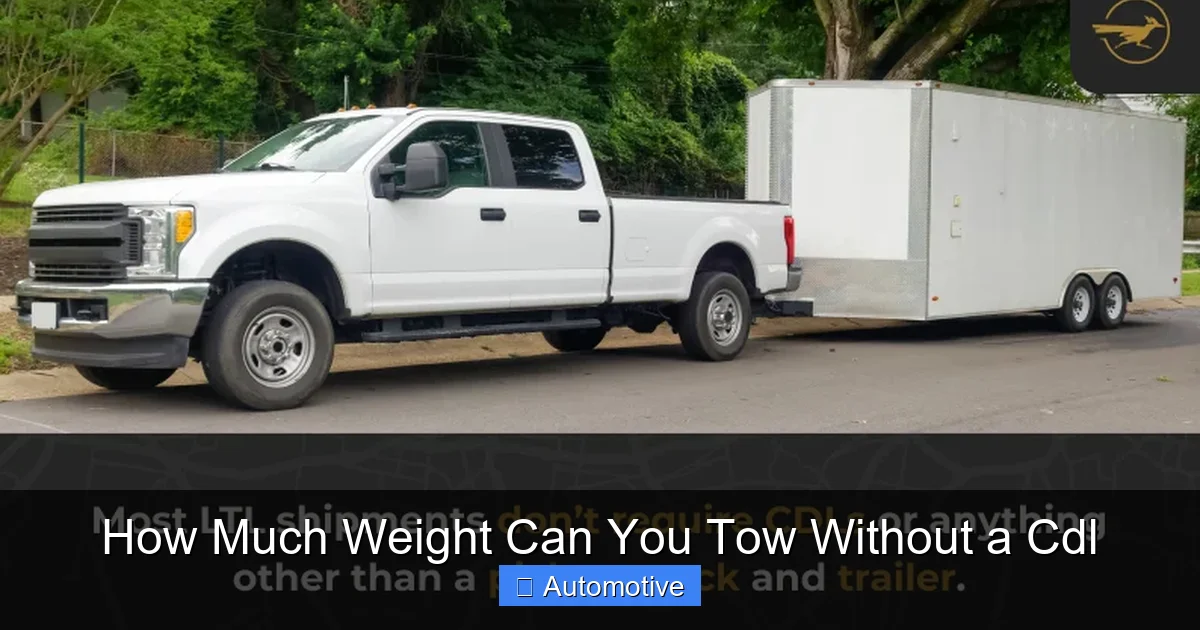
Not all trucks are created equal—and neither are trailers. Your vehicle’s towing capacity, combined with the type of trailer you’re pulling, plays a huge role in determining how much you can safely and legally tow without a CDL.
Most light-duty trucks (like half-ton pickups such as the Chevrolet Silverado 1500 or Ford F-150) have a GVWR under 8,500 lbs and can typically tow between 5,000 and 13,000 lbs, depending on configuration. Heavy-duty trucks (like the Ram 2500 or Ford F-350) often have GVWRs between 8,500 and 12,000 lbs and can tow 15,000 lbs or more.
But remember: **towing capacity ≠ legal limit**. Your truck might be able to pull 14,000 lbs, but if your trailer’s GVWR is 11,000 lbs and your state caps non-CDL towing at 10,000 lbs, you’re still out of compliance.
Trailer Classes and Their Limits
Trailers are generally categorized by weight and use:
– **Class I:** Up to 2,000 lbs – small utility trailers, jet skis.
– **Class II:** 2,001–3,500 lbs – small campers, boat trailers.
– **Class III:** 3,501–5,000 lbs – larger campers, medium boats.
– **Class IV:** 5,001–10,000 lbs – large travel trailers, horse trailers.
– **Class V:** Over 10,000 lbs – often requires special licensing or CDL depending on state.
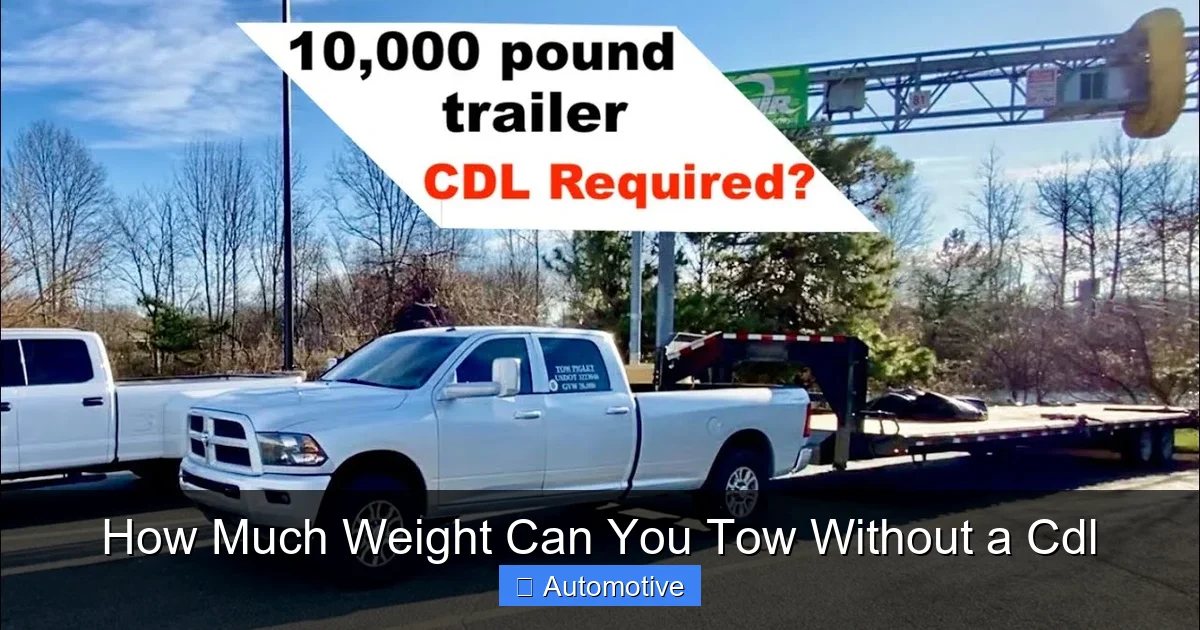
In most states, **Class IV trailers (up to 10,000 lbs GVWR)** are the highest you can tow without a CDL for personal use. Going beyond that usually means stepping into commercial territory or needing an upgraded license.
Practical Tip: Check Your Owner’s Manual
Your vehicle’s owner’s manual contains the most accurate towing information for your specific make, model, and trim. It will list:
– Maximum towing capacity
– GCWR
– Payload capacity
– Recommended hitch type
– Brake requirements
Never exceed these numbers—even if your friend’s identical truck “handles it fine.” Manufacturer specs are based on engineering limits, not anecdotal experience.
Safety Equipment and Legal Requirements for Non-CDL Towing
Visual guide about How Much Weight Can You Tow Without a Cdl
Image source: i.ytimg.com
Just because you don’t need a CDL doesn’t mean you can skip safety essentials. In fact, proper equipment is what keeps you—and others—safe on the road.
Mandatory Safety Gear
For trailers over 1,500–3,000 lbs (varies by state), you’ll typically need:
– **Electric or surge brakes:** Most states require brakes on trailers over 3,000 lbs GVWR.
– **Breakaway system:** A battery-powered brake activator that engages if the trailer detaches.
– **Safety chains:** Crossed under the coupler to catch the trailer if it unhitches.
– **Proper lighting:** functioning brake lights, turn signals, and taillights on the trailer.
– **Mirrors:** Extended mirrors if the trailer blocks your rear view.
Many states also require a **weight-distributing hitch** for trailers over 5,000 lbs or when tongue weight exceeds 500 lbs. This helps maintain steering control and prevents trailer sway.
Inspection and Registration
Even without a CDL, your trailer may need to be registered and inspected. Most states require:
– Trailer registration (with plates and renewal fees)
– Annual safety inspection (especially for trailers over 3,000–4,000 lbs)
– Proof of insurance (liability coverage for trailer damage)
Some states, like **Virginia** and **Pennsylvania**, have rigorous inspection programs that include brake tests and lighting checks. Failing an inspection can result in fines or towing restrictions.
Towing Best Practices
Beyond equipment, safe towing requires smart habits:
– **Distribute weight evenly:** 60% of cargo should be forward of the trailer axle(s).
– **Check tire pressure:** Underinflated tires overheat and blow out.
– **Practice backing up:** Use your side mirrors and go slow.
– **Allow extra stopping distance:** A loaded trailer can double your stopping distance.
– **Avoid sudden maneuvers:** Trailer sway can quickly become uncontrollable.
Taking a towing safety course (often offered by RV clubs or community colleges) is a great way to build confidence and skills—no CDL required.
Common Mistakes and How to Avoid Them
Even experienced drivers make towing errors. Here are the most common—and how to dodge them:
1. **Confusing GVWR with actual weight:** Just because your trailer weighs 8,500 lbs empty doesn’t mean it’s under the 10,000 lbs GVWR limit. Load it with gear, and you could easily exceed both.
→ *Fix:* Always check the trailer’s VIN plate for GVWR.
2. **Ignoring state-specific rules:** Assuming “federal law covers it all” can land you in hot water.
→ *Fix:* Visit your state DMV website before your first trip.
3. **Overloading the truck bed:** Adding too much payload (tools, fuel, passengers) can push your truck over its GVWR—even if the trailer is light.
→ *Fix:* Calculate total payload and stay under the limit.
4. **Skipping brake controllers:** Towing a 6,000-lb trailer without proportional braking is dangerous.
→ *Fix:* Install a brake controller and test it before hitting the road.
5. **Using the wrong hitch:** A Class II hitch won’t handle a Class IV trailer.
→ *Fix:* Match your hitch class to your trailer’s GVWR.
When You Might Need a CDL (Even at Lower Weights)
While most personal towing stays under the CDL radar, there are exceptions:
– **Transporting passengers for pay:** If you’re running a shuttle service with a large van or bus, even under 26,001 lbs, you may need a CDL with passenger endorsement.
– **Hauling hazardous materials:** Even small quantities of flammable liquids or chemicals can require a CDL with HazMat endorsement.
– **Interstate commercial operations:** If you cross state lines for business, FMCSA rules apply strictly—even for relatively light loads.
– **Employer requirements:** Some companies require CDLs for fleet drivers, regardless of vehicle size.
If any of these apply, consult the FMCSA handbook or speak with a licensing expert.
Final Thoughts: Tow Smart, Stay Legal
Towing without a CDL is not only possible—it’s common. Millions of Americans tow trailers every year for recreation, work, and daily life without ever stepping into a CDL classroom. But freedom comes with responsibility. Knowing your limits, respecting your vehicle’s capabilities, and following state laws keeps you safe and legal.
The sweet spot for most non-commercial towing? **Stay under 10,000 lbs GVWR for the trailer**, keep your combined GVWR below 26,001 lbs, and always verify local rules. Invest in the right equipment, practice safe driving, and don’t hesitate to ask for help if you’re unsure.
Remember: the goal isn’t just to tow—it’s to tow well. With the right knowledge, your next adventure can be smooth, safe, and stress-free.
Frequently Asked Questions
Do I need a CDL to tow a 9,000-pound trailer?
No, in most states you do not need a CDL to tow a 9,000-pound trailer for personal use, as long as your combined vehicle and trailer GVWR stays below 26,001 pounds. However, some states require additional licensing or safety equipment for trailers over 10,000 lbs GVWR.
Can I tow a 12,000-pound trailer without a CDL?
It depends on your state and use case. If the trailer’s GVWR is 12,000 pounds and you’re using it commercially, you likely need a CDL. For personal use, some states allow it, but many require a non-commercial Class A license or impose strict safety requirements.
What happens if I tow over the legal limit without a CDL?
You could face fines, vehicle impoundment, or invalidated insurance claims. In accidents, exceeding legal towing limits may result in liability for negligence, even if you weren’t aware of the violation.
Does my truck’s towing capacity affect CDL requirements?
Not directly. CDL rules are based on GVWR and use, not your truck’s advertised towing capacity. However, exceeding your vehicle’s GCWR or payload limit is unsafe and illegal, regardless of licensing.
Are there weight limits for fifth-wheel or gooseneck trailers without a CDL?
Yes—the same GVWR rules apply. Most fifth-wheel and gooseneck trailers under 10,000 lbs GVWR can be towed without a CDL for personal use, but always confirm with your state DMV due to variations in regulations.
Can I tow for a friend’s business without a CDL?
If you’re being compensated—even informally—your activity may be considered commercial. This could trigger CDL requirements depending on weight, distance, and state law. When in doubt, treat it as commercial and verify licensing needs.